

Global Driving Training Academy — Version 6.3.7
Learn road rules and prepare for your driving test.
Student profile
Complete the required fields, then press Next.
Visitors: 21,435
Complete accurate information to be eligible for a prize draw. Eligibility and prizes are subject to published terms; winning is not guaranteed.
Profile and progress are saved only in this browser on this device. Clearing browser data may remove them.
Practice test is about to begin
There will be the same number of test questions as training lessons, in random order.
- Read each question carefully.
- Look for key words such as STOP, GIVE WAY and speed limit.
- Choose the safest lawful action; local rules can vary by country.
- Do not rush. This is practice, not an official government examination.
Take a live photo
Camera permission is requested only when you press Open camera.

TABLE OF CONTENTS
Global Driving Training Academy
Learn Road Rules. Understand Traffic Signs. Drive Safely.
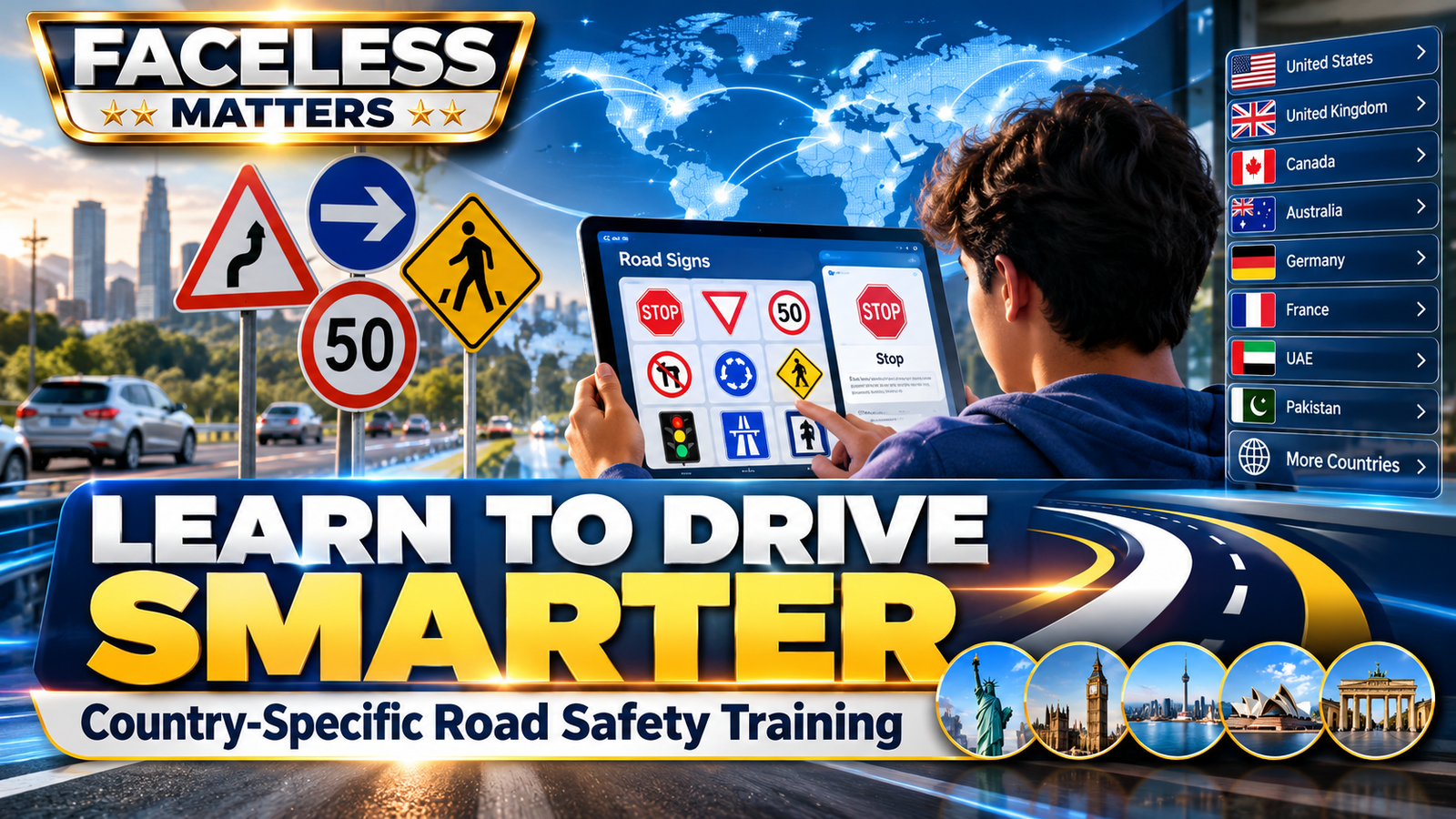
Welcome to the Global Driving Training Academy by FACELESS MATTERS — a planned multilingual learning platform designed to help people understand road signs, traffic rules, safe driving practices and country-specific driving test requirements.
Whether you are preparing to learn driving, studying for a driving licence test, planning to drive in another country, or simply improving your knowledge of road safety, this educational project aims to make essential driving information easier to understand.
Important: This page introduces a planned training platform. Interactive lessons, country-specific examinations, progress tracking and downloadable reports will become available only when those features have been implemented and tested.
Global driving training should make verified road-safety knowledge easier to access.
Choose Your Country and Learn the Rules That Apply There
Traffic rules are not identical worldwide. Countries may use different legal requirements, speed limits, road markings, driving-side rules, licence categories and examination procedures.
The planned academy will therefore organize its training by country rather than treating one country’s laws as universal.
When you select a country, the intended learning experience will focus on that country’s verified traffic regulations, recognized road signs, road-safety guidance and relevant driving-test requirements.
Global driving training must reflect the selected country’s current traffic laws.
Examples of potential country-specific learning programmes include:
- Pakistan driving rules and road-sign education.
- Saudi Arabia traffic regulations and driving-test preparation.
- India road signs and driving knowledge.
- United Arab Emirates driving rules.
- United Kingdom road signs and Highway Code guidance.
- United States traffic signs and state-specific driving requirements.
- Bangladesh, Sri Lanka and other supported countries.
The availability of a complete country course will depend on the availability and verification of reliable, current information from appropriate official sources.
Learn in Your Preferred Language
The planned Global Driving Training Academy is designed to support learners who prefer different languages.
The proposed language options include:
- English
- Urdu
- Sindhi
- Pashto
- Balochi
- Kashmiri
- Hindi
- Indian Punjabi
- Bengali
- Persian (Farsi)
- Arabic
- Dari
- Sinhala
- Tamil
- Burmese
- Dhivehi
Language selection and country selection will remain separate. For example, a learner may choose Saudi Arabia as the country and Urdu as the learning language.
Translations of traffic laws and examination questions will require careful review to preserve their original legal meaning. Language support will be introduced as reliable translations become available.
Understand Every Traffic Sign
Recognizing road signs is an essential part of responsible driving. The planned course will organize signs into individual lessons so learners can study one sign at a time.
Global driving training works best when every sign has a clear lesson.
Warning Signs
Warning signs alert drivers to potential hazards, such as sharp bends, intersections, road narrowing, slippery roads, pedestrians or other changing road conditions.
Learners will be taught to recognize the sign, understand the hazard and consider the appropriate safe response.
Regulatory and Prohibitory Signs
These signs communicate restrictions, prohibitions and other regulatory requirements. Examples may include no-entry signs, speed limits, overtaking restrictions and turning restrictions.
The meaning of each sign will be checked against the applicable country’s official rules rather than assumed to be identical everywhere.
Mandatory Signs
Mandatory signs communicate actions or directions that drivers are required to follow under the applicable traffic system.
Lessons will explain the sign’s meaning and show how it affects decisions at intersections, junctions and other road locations.
Informational and Direction Signs
Informational signs help drivers identify destinations, parking areas, hospitals, fuel stations and other facilities.
The course will explain how to read these signs and use them to navigate safely.
Road Markings and Lane Rules
Road markings can communicate lane boundaries, stopping positions, overtaking restrictions and pedestrian crossing locations.
Their meaning and legal effect will be explained according to the selected country’s verified road rules.
Learn Through Visual Lessons and Audio
The planned learning experience will combine clear graphics, straightforward explanations and practical examples.
Proposed features include:
- One traffic sign or road-safety concept per lesson.
- Enlarged graphics for easier viewing.
- Previous and next lesson controls.
- Direct lesson or page navigation.
- Browser text-to-speech where a suitable voice is available.
- Play, pause and replay controls.
- Short practice questions after lessons.
- Progress saving so learners can return to their last saved position.
Where practical, optimized vector graphics and compressed images will be used to reduce unnecessary page weight. The design will aim to work comfortably on desktop computers, tablets and mobile phones.
Driving Test Preparation
The planned academy will include a country-specific knowledge assessment designed around verified learning material.
The proposed initial examination will contain 50 questions covering road signs, traffic rules and practical driving situations.
Global driving training should help learners review mistakes and improve safely.
Questions may cover topics such as:
- Recognizing a traffic sign.
- Responding appropriately at an intersection.
- Understanding right-of-way rules.
- Identifying unsafe overtaking situations.
- Protecting pedestrians and other vulnerable road users.
- Interpreting road markings.
- Responding to hazards and changing road conditions.
The examination will be designed for learning and self-assessment. It will not be represented as an official government examination unless an appropriate authority formally establishes that status.
Review Mistakes and Improve Your Knowledge
A useful learning system should explain mistakes instead of merely displaying a score.
The proposed result report will show the initial score, percentage, correct answers, incorrect answers and the lessons associated with mistakes.
Learners will be able to revisit the relevant lessons before taking a corrective test containing only the questions they previously answered incorrectly.
For example, a learner who answers 42 out of 50 questions correctly will receive an initial score of 84%. If eight answers are incorrect, the corrective stage will focus on those eight questions after the relevant lessons have been reviewed.
If all eight corrective questions are answered correctly, the corrective-test score will be 100%. The initial score will remain separately visible so the report accurately reflects both the original performance and subsequent improvement.
A practice score cannot by itself establish the exact probability of passing an official driving test. Any readiness estimate will therefore need to be clearly distinguished from a verified pass probability.
A Professional Learning Report
The planned reporting system will provide a clear summary of the learner’s performance.
Depending on the implemented features and the information the learner chooses to provide, the report may include:
- Selected country.
- Learner name, if supplied.
- Examination date.
- Initial score and percentage.
- Incorrect questions and related lessons.
- Corrective-test results.
- Recommended topics for further practice.
PDF download, printing and optional social sharing are planned features. Learners should be able to exclude their name or photograph before sharing a report.
Any branded learning card will use FACELESS MATTERS branding and will be clearly identified as an educational report, not an official driving licence or government-issued certificate.
Road Safety Is More Than Passing a Test
Passing a knowledge test is only one part of becoming a responsible driver.
Safe driving also requires attention, patience, awareness of other road users and sound decisions in changing conditions.
Always confirm local requirements with official authorities before relying on practice materials or general guidance while preparing to drive.
Drivers should learn to:
- Follow applicable traffic signs and signals.
- Adapt speed to the road, weather and traffic conditions.
- Maintain an appropriate following distance.
- Avoid distracted driving.
- Respect pedestrians and cyclists.
- Avoid unsafe overtaking and unnecessary risks.
- Check the vehicle’s basic safety condition.
- Follow the current laws of the country where they drive.

INTERNAL READING — FACELESS MATTERS
SOURCES & EDITORIAL NOTE
Associated Press of Pakistan (APP) — Official news-agency coverage of Interior Minister Mohsin Naqvi’s November 26, 2024 statement that the government would no longer hold talks with PTI.
Geo News — Coverage of Naqvi’s remarks about PTI leadership, negotiations and security arrangements during the Islamabad protest.
Reuters — Independent international reporting on the November 26 security operation, clashes in Islamabad and competing accounts from the government and PTI.
Associated Press (AP) — Follow-up reporting on the end of Islamabad’s lockdown, the dispersal of protesters and the aftermath of the demonstrations.
Geo News — November 21, 2024 — Earlier coverage of Naqvi’s position on negotiations with PTI, providing context for the political developments before November 26.
Editorial Note: This article examines reported statements by Interior Minister Mohsin Naqvi and media coverage of the PTI protest in Islamabad on November 26, 2024. Political statements and allegations are attributed to the relevant speakers or outlets and should not automatically be treated as independently verified facts. Where accounts differ regarding the protest, security operation, casualties or responsibility, readers should consult the linked reports for context. FACELESS MATTERS aims to distinguish verified information from attributed claims and analysis, without endorsing any political party or individual.