

TABLE OF CONTENTS
Artificial Intelligence (AI) has moved from a specialized research field into one of the most important technologies shaping the global economy. Businesses are using artificial intelligence
to improve productivity, automate routine processes, analyze information and develop new products and services, while governments and institutions are increasingly focused on the opportunities and risks created by rapidly advancing AI systems.
The scale of this transformation is significant. Stanford University’s 2026 artificial intelligence
Index reports that global corporate investment in AI more than doubled in 2025, while generative AI reached approximately 53% population-level adoption within three years of its mass-market introduction. The report also found that AI adoption among surveyed organizations continued to rise, with 88% reporting AI use in at least one business function.
Readers can also explore our latest technology and digital economy coverage on FACELESS MATTERS.
What Is Artificial Intelligence?
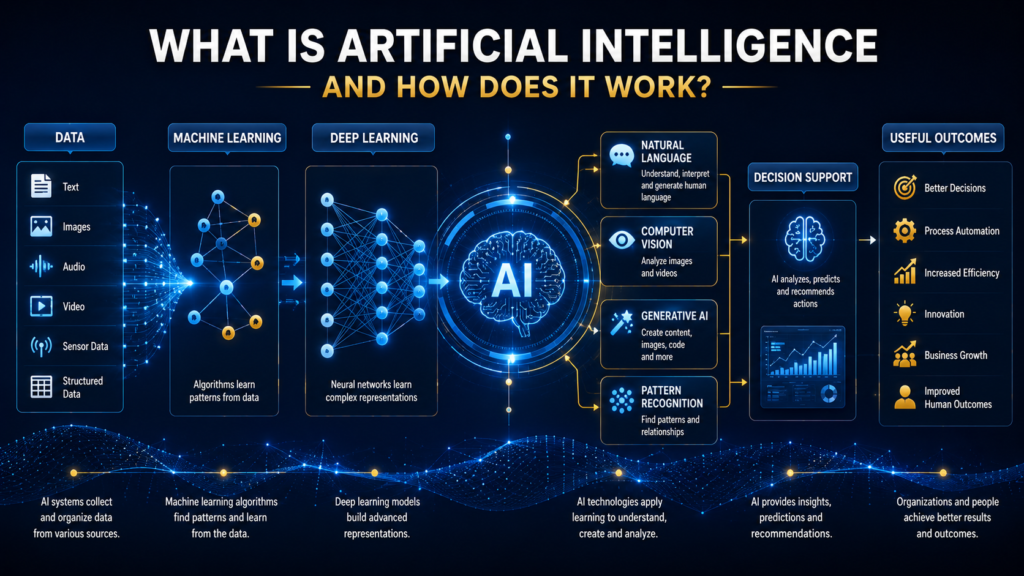
Artificial Intelligence refers broadly to computer systems designed to perform tasks that normally require aspects of human intelligence, including recognizing patterns, processing language, generating content, making predictions and supporting decisions.
Modern artificial intelligence
includes several related technologies. Machine learning enables systems to identify patterns from data and improve their performance through experience. Deep learning uses large neural networks to process increasingly complex information, while generative AI can create text, images, audio, video and computer code based on user instructions.
artificial intelligence
should not be understood as a single technology or product. It is a broad field that includes different models, applications and approaches designed for different purposes. The quality of an AI system depends not only on its underlying model, but also on the data, computing infrastructure, human expertise and processes surrounding it.
This distinction matters because artificial intelligence
performance can vary significantly between tasks. A system may perform extremely well in one structured application while requiring human verification in another. For businesses and institutions, effective AI adoption therefore involves matching the right technology to a clearly defined problem.
Why Artificial Intelligence Is Becoming Important for Businesses
Artificial Intelligence is becoming increasingly important to businesses because it can support information-intensive work, automate repetitive processes and help organizations make better use of data.
Companies are using artificial intelligence
across areas such as customer service, document processing, software development, marketing analysis, fraud detection, forecasting, research and internal operations. The objective is not necessarily to replace employees, but to improve the speed, scale or consistency of selected tasks.
Stanford’s 2026 artificial intelligence
Index reports that organizational AI adoption continued to increase in 2025, with 88% of surveyed organizations reporting AI use in at least one business function. The report also found that generative AI was being used in at least one business function by 70% of surveyed organizations.
For business leaders, the more important question is not simply whether artificial intelligence
should be adopted. It is where AI can produce measurable value.
A well-designed artificial intelligence
strategy can begin with specific business problems such as reducing repetitive administrative work, improving customer response times, analyzing large datasets or assisting employees with research and documentation.
However, organizations also need to consider data quality, cybersecurity, privacy, regulatory requirements, employee training and the cost of implementing and maintaining artificial intelligence
systems.
For a broader perspective on Pakistan’s national development and future, read our Pakistan Independence Day 2026 feature on FACELESS MATTERS.
Generative artificial intelligence
and the New Digital Economy
Generative artificial intelligence
has become one of the most visible developments in the modern artificial intelligence economy. These systems can generate new digital outputs such as written content, computer code, images, audio and video from natural-language instructions or other forms of input.
Its rapid adoption is changing how individuals and organizations interact with software. Instead of relying exclusively on traditional menus and commands, users can increasingly describe a desired outcome and ask an artificial intelligence
system to assist with the task.
Stanford’s 2026 artificial intelligence
Index reports that generative AI reached approximately 53% population-level adoption within three years, a faster adoption trajectory than the personal computer or the internet over comparable early adoption periods.
This expansion is creating economic opportunities across software, cloud computing, semiconductor manufacturing, cybersecurity, data services, consulting and professional services.
At the same time, generative artificial intelligence
introduces important challenges. AI-generated information can contain errors, incomplete explanations or fabricated details. Businesses therefore need review processes that match the risk of the task.
For low-risk activities, artificial intelligence
may function primarily as a productivity assistant. For high-impact activities involving financial, legal, medical or other consequential decisions, stronger verification and human oversight are essential.
Artificial intelligence
, Productivity and the Future of Work
One of the most important economic questions surrounding artificial intelligence
is whether the technology can produce sustainable productivity gains.
artificial intelligence
can potentially increase productivity by helping workers complete certain tasks more quickly, analyze information more efficiently and automate repetitive processes. However, the effect is not identical across occupations, industries or countries.
OECD research published in 2026 emphasizes that skills are a major factor in determining whether organizations can successfully adopt artificial intelligence
. The OECD reports that shortages of relevant skills are a significant barrier to AI adoption, while AI is also increasing demand for higher-level skills and the ability to use, analyze and interpret data.
This suggests that the future of work should not be viewed simply as a competition between humans and machines.
In many workplaces, the more realistic transformation is likely to involve humans working with increasingly capable artificial intelligence
systems. Employees may spend less time on repetitive information-processing tasks and more time on judgment, communication, problem-solving, management and activities requiring domain expertise.
The transition will still create challenges. Some roles and tasks may become less valuable, while new responsibilities and occupations may emerge. The impact will depend on how quickly businesses adopt artificial intelligence
, how workers receive training and how governments and institutions respond to changing labor-market conditions.
The Stanford Ai
Index provides data-driven analysis of artificial intelligence development, adoption, investment and impact.
artificial intelligence
Adoption in Developing Economies
The economic impact of artificial intelligence will not necessarily be distributed equally across countries.
Developing economies can potentially use Ai
to improve productivity, expand digital services and overcome certain limitations in traditional economic systems. However, successful adoption requires more than access to AI software.
OECD research identifies several barriers affecting artificial intelligence
adoption in low-income and lower-middle-income economies, including limited digital infrastructure, shortages of education and skills, restricted access to financing and less-developed regulatory frameworks.
These challenges are particularly important because advanced Ai
systems depend on computing resources, reliable connectivity, technical expertise and organizations capable of integrating new technologies into existing workflows.
At the same time, developing economies may have opportunities to benefit from artificial intelligence
through digital entrepreneurship, remote services, education, healthcare support, agricultural applications and productivity improvements.
The long-term outcome will depend partly on whether countries can build the infrastructure and human capital required to use Ai
effectively rather than simply importing AI products.
Ai in Finance, Healthcare and Professional Services
Artificial Intelligence is increasingly being explored in industries where large volumes of information must be processed accurately and efficiently.
In financial services, Ai
can assist with fraud detection, customer support, document analysis, risk management and operational processes. Because financial decisions can have significant consequences for individuals and businesses, organizations need appropriate controls and verification systems.
Healthcare represents another important area of artificial intelligence
development. AI can support research, medical imaging analysis, administrative processes and other applications. However, healthcare systems require particularly careful validation, privacy protection and professional oversight.
Professional services are also being transformed. Accountants, analysts, consultants, lawyers and other knowledge workers can use Ai
tools to assist with research, document analysis, summarization and routine information-processing tasks.
Across these industries, the most responsible approach is to treat Ai
as a capability that can support qualified professionals rather than as an automatic replacement for professional judgment.
The Stanford Ai Index provides independent, data-driven analysis of artificial intelligence development, adoption and impact.
The Importance of Responsible Ai
The rapid development of Ai has increased the importance of responsible AiAi
practices.
artificial intelligence
systems can produce inaccurate information, reflect biases contained in training data, expose sensitive information when used improperly or be misused for harmful purposes. These risks make transparency, security, privacy and human oversight important components of AI deployment.
Responsible Ai
also requires organizations to understand the limitations of the systems they use. A highly capable model can still produce an incorrect answer, particularly when the task involves incomplete information or requires specialized judgment.
Businesses should therefore establish appropriate review procedures, protect confidential information, monitor system performance and ensure that employees understand when artificial intelligence
-generated results require verification.
The goal of responsible Ai
is not to prevent innovation. It is to create conditions in which AI can be used productively while reducing avoidable risks to individuals, organizations and society.
What the Ai Economy Could Mean for Businesses
The emerging artificial intelligence
economy is creating opportunities for both established companies and new businesses.
Large technology companies are investing heavily in computing infrastructure, Ai
models and cloud platforms, while smaller businesses are adopting AI applications that can be integrated into existing workflows.
For many organizations, the most valuable Ai
opportunities may come from relatively specific improvements rather than from attempting to automate an entire business.
A company could use artificial intelligence
to reduce the time required to process documents, improve customer support, analyze market information, assist employees with research or identify patterns in operational data.
OECD research suggests that Ai
has significant potential to influence productivity, although the scale of the economic benefit depends on adoption, skills, infrastructure and other structural factors.
This means successful Ai
adoption should be measured through business outcomes rather than the number of AI tools an organization purchases.
Useful measures can include time saved, operating costs, quality improvements, customer satisfaction, employee productivity and revenue generated from new products or services.
The Future of Artificial Intelligence
The future development of artificial intelligence is likely to involve increasingly capable models, broader business adoption, more sophisticated automation and deeper integration of Ai
into everyday software.
Ai agents and systems capable of completing multiple steps of a task are receiving increasing attention. However, Stanford’s 2026 AI Index notes that deployment of AI agents remains relatively early across many business functions, showing that technical capability does not automatically translate into widespread organizational adoption.
The next stage of artificial intelligence
development will therefore depend on more than model performance.
Computing infrastructure, energy availability, cybersecurity, regulation, data governance, workforce skills and public trust will all influence the pace and direction of adoption.
For businesses, this creates a strategic challenge. Organizations that experiment responsibly and develop internal Ai capabilities may be better prepared for future changes, while organizations that ignore the technology risk falling behind competitors.
Yet responsible adoption remains essential. The long-term value ofAi
will depend on whether organizations can combine technological innovation with reliable information, skilled employees and effective governance.
Conclusion
Ai is becoming one of the most important technologies influencing the modern digital economy.
Its impact can already be seen in business operations, software development, digital services, workplace processes and investment. The rapid adoption of generativeAi
has further expanded public and commercial interest in the technology.
However, Artificial intelligence should not be treated as a guaranteed solution to every business problem. Its value depends on the quality of implementation, the skills of the people using it, the reliability of the underlying data and the safeguards surrounding its deployment.
For businesses and economies, the strongest opportunity lies in using Ai
to complement human capabilities, improve productivity and create new forms of value while maintaining appropriate standards for accuracy, privacy, security and accountability.
The Ai economy is still developing, and many of its long-term effects remain uncertain. What is increasingly clear is that understanding artificial intelligence is no longer only a technology issue. It is becoming an important business, economic and strategic priority.
Sources and Further Reading
Stanford Institute for Human-Centered Ai (Stanford HAI) — The 2026 Ai
Index Report: Economy
Organisation for Economic Co-operation and Development (OECD) — Ai and Skills: What We Know So Far (2026)
Organisation for Economic Co-operation and Development (OECD) — artificial intelligence and the Global Productivity Divide (2025)
Organisation for Economic Co-operation and Development (OECD) — The Impact of Ai on Productivity, Distribution and Growth (2024)
Google Search Central — Creating Helpful, Reliable, People-First Content
Google AdSense — AdSense Program Policies
[…] accuracy, the supplied screenshot should be treated as a news snapshot supplied to FACELESS MATTERS, while individual developing stories should be verified against their original publishers before […]
[…] 1.Artificial Intelligence: 2026’s Powerful Digital Economy ShiftAI، scientific computing اور data-driven research کے broader technological context کے لیے اہم reading۔ […]
[…] 1. [Artificial Intelligence: 2026’s Powerful Digital Economy Shift] — AI، scientific computing، data analysis اور emerging technology کے broader context کے لیے مفید reading۔ Artificial Intelligence: 2026’s Powerful Digital Economy Shift […]
[…] Artificial Intelligence: 2026’s Powerful Digital Economy ShiftAI کی business، productivity، digital economy اور future technology adoption پر اثرات […]