

TABLE OF CONTENTS
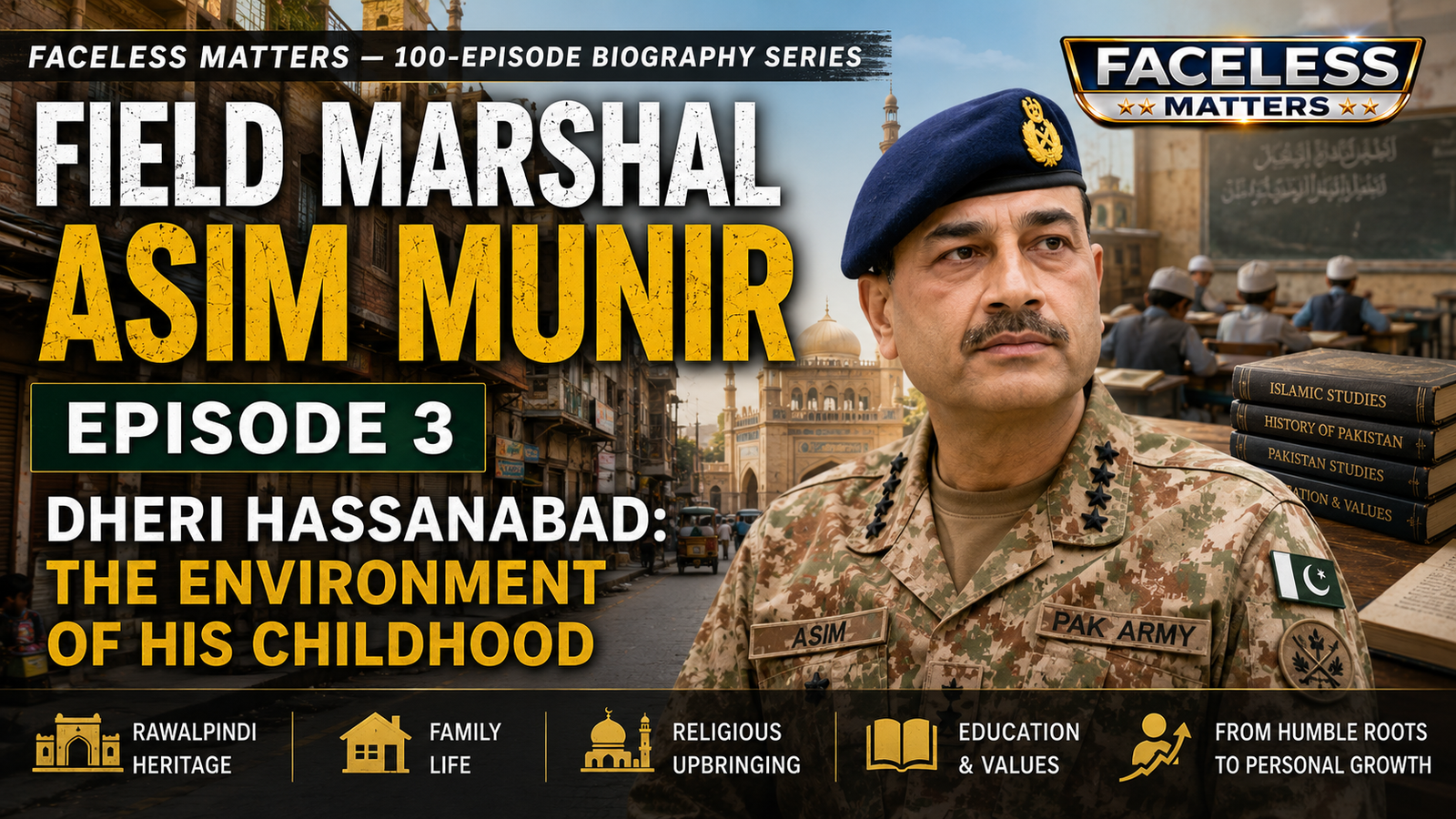
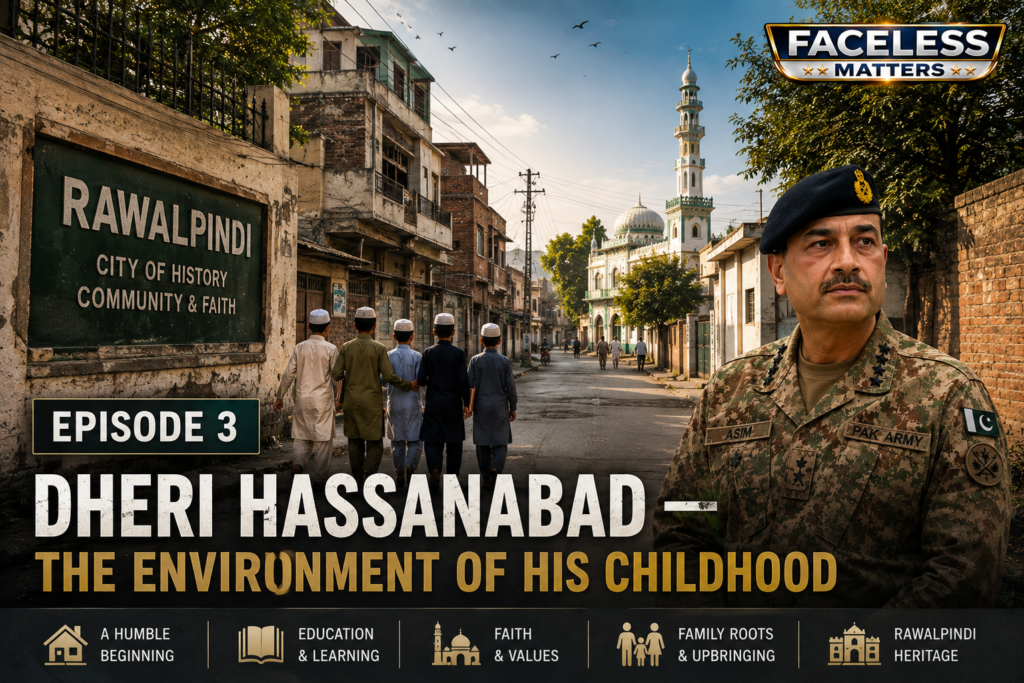
Asim Munir childhood is best understood through the family, educational and community environment that surrounded him in Rawalpindi. Before his military career, command responsibilities and eventual rise to the highest levels of Pakistan’s defence leadership, there was a young man growing up in a settled family environment associated with Dheri Hassanabad.
Episode 1 established the beginning of the biography.
Episode 2 followed the reported family journey from Jalandhar through Partition-era migration toward Pakistan and Rawalpindi.
Episode 3 now moves one generation forward.
The central question is simple:
What kind of environment surrounded the young Asim Munir after his family had established itself in Rawalpindi?
Available published accounts place his birth in Rawalpindi in 1968 and connect his family with Dheri Hassanabad. They also report that his father, Syed Sarwar Munir, worked in education and served as an imam at a local mosque. Accounts further state that Asim Munir received early education at Markazi Madrasa Dar-ul-Tajweed in Rawalpindi.
That gives us a useful historical framework.
But it does not give us permission to invent conversations, childhood memories or private family experiences.
The purpose of this episode is therefore to examine the documented environment around the young man while maintaining the same source-first discipline established in the previous two episodes.
From Migration to Settlement
Episode 2 ended with a reported sequence:
Jalandhar → Partition-era migration → Toba Tek Singh → Rawalpindi → Dheri Hassanabad → the next generation.
The importance of Episode 3 lies in that final transition.
Migration belongs primarily to the story of the previous generation.
Childhood belongs to the generation that grows up after settlement.
That distinction is important because a family that has already crossed a major historical boundary begins to experience the new country differently. The first generation may remember the place left behind. The next generation may know that history mainly through family memory, community identity and the environment in which it is raised.
For the young Asim Munir, Asim Munir childhood was therefore rooted in Rawalpindi rather than being defined only by the family’s earlier migration.
It was the city of childhood.
That is the foundation of Asim Munir childhood and the environment in which his formative years began.
Dheri Hassanabad and the Family Environment
Published reporting identifies Dheri Hassanabad in Rawalpindi as the locality associated with the Munir family’s later settlement. The Print reports that Asim Munir’s father, Syed Sarwar Munir, was a school principal and imam who delivered Friday sermons at a local mosque in Dheri Hassanabad.
India Today likewise describes Syed Sarwar Munir as a schoolteacher who also served as an imam and reports that Asim Munir studied at Markazi Madrasa Dar-ul-Tajweed in Rawalpindi.
These details establish an environment in which education and religious learning were both visible parts of family life.
However, the sources do not provide a complete private portrait of the household.
They do not tell us exactly what the family discussed at dinner.
They do not provide a verified diary of the young Asim Munir.
They do not document every teacher who influenced him.
And they do not establish that every later decision was directly caused by his childhood.
A responsible biography must preserve that boundary.
Rawalpindi: A City With a Distinct Identity
Rawalpindi provides another important layer of context.
The city has long had a close association with Pakistan’s military and administrative institutions. That later significance is especially interesting in a biography of a person who would eventually occupy the highest levels of the country’s military hierarchy.
But chronology matters.
Asim Munir childhood unfolded before anyone could know that he would eventually become Field Marshal.
His childhood environment should therefore be understood on its own terms.
Rawalpindi was first a home.
It was a place of family, education, community and ordinary development.
Only much later would the city become part of a biography extending into intelligence, military command and national defence.
This is why Asim Munir childhood should not be rewritten backward from his later achievements.
Biography becomes weaker when the future is used to manufacture certainty about the past.
Education as an Early Foundation
One of the clearest documented elements of Asim Munir childhood is the educational environment reported in Rawalpindi.
The Indian Express reports that he received his early education at Markazi Madrasah Dar-ul-Tajweed, an Islamic seminary in Rawalpindi.
This detail matters because education is one of the strongest links between childhood environment and later development.
Yet even here, caution is necessary.
Attending a religious seminary tells us something about the educational environment reported in the sources.
It does not automatically tell us everything about a person’s personality, ambitions, political opinions or future professional choices.
The educational record should therefore be presented as evidence of background rather than as a complete explanation of destiny.
This distinction will remain important throughout the 100-episode biography.
Religious Learning and Personal Development
Several published accounts emphasize the religious dimension of Asim Munir’s background.
India Today reports that his father served as an imam and that Munir studied at Markazi Madrasa Dar-ul-Tajweed. Later reporting also connects Munir with memorisation of the Quran during his military posting in Saudi Arabia.
The later achievement belongs to a different period of his life and should not be confused with the childhood timeline.
Nevertheless, the early educational environment provides useful context.
It shows that religious learning was part of the documented background surrounding the future military officer.
The biography should neither exaggerate this fact nor minimize it.
It should simply place the evidence in chronological order.
That is the purpose of this episode.
The Difference Between Background and Destiny
One of the most important principles of this 100-episode biography is the distinction between background and destiny.
A person’s childhood environment can influence opportunities, habits, relationships and education.
But influence is not the same as inevitability.
The fact that Asim Munir grew up in a religiously oriented family environment does not prove that his later military career was predetermined.
Similarly, living in Rawalpindi does not prove that military service was inevitable.
A future career develops through many stages:
education,
personal decisions,
professional opportunities,
selection,
training,
performance,
institutional circumstances
and historical events.
The childhood environment is therefore one part of the story.
It is not the entire explanation.
The Father as an Educational Influence
Syed Sarwar Munir is particularly important to this stage of the biography because available reporting connects him with both education and religious service.
The Indian Express describes him as a school principal and imam, while India Today describes him as a schoolteacher who also delivered Friday sermons at a local mosque.
The difference in wording illustrates an important research principle.
Where reputable sources vary slightly in their description of a role, the safest approach is to preserve the common factual ground rather than manufacture unnecessary precision.
The common ground is that Asim Munir’s father was involved in education and religious service in Rawalpindi.
That is significant enough without adding unsupported details.
The father’s professional environment also provides a useful bridge between the family migration story of Episode 2 and the childhood environment explored here.
The family had moved.
The family had settled.
Asim Munir childhood then became part of the family’s new chapter in Rawalpindi.
Now the next generation was being educated.
Childhood in a Post-Partition Generation
The young Asim Munir belonged to a generation born after the dramatic events of 1947.
This was different from the experience of his parents’ generation.
The older generation had lived through the creation of Pakistan and the movement of families across the new border.
The younger generation experienced Pakistan as the country in which they were born and raised.
That generational difference is one of the most important themes of this biography.
It also explains why Asim Munir childhood should be examined separately from the family’s migration history.
Episode 2 was about movement.
Episode 3 is about settlement.
The distinction allows the biography to move chronologically rather than repeatedly returning to the same historical point.
The Social Environment Around the Young Asim Munir
A neighborhood is more than buildings.
It includes schools, places of worship, streets, relatives, teachers, community relationships and everyday routines.
But the public record does not allow us to reconstruct every part of the neighborhood in precise personal detail.
That limitation should be respected.
What can be established is that the family lived in Rawalpindi, that published reporting associates the family with Dheri Hassanabad, and that education and religious service were significant elements of the father’s documented background.
These facts provide enough material to understand Asim Munir childhood without inventing a fictional childhood narrative.
FACELESS MATTERS Analysis: The Meaning of Environment
FACELESS MATTERS Analysis:
The most interesting question in Episode 3 is not whether childhood can explain a future Field Marshal.
It cannot.
The more useful question is how an environment creates a starting point.
The reported environment surrounding Asim Munir childhood combined several elements: a settled family in Rawalpindi, a father associated with education and religious service, early religious education and life inside a major Pakistani city.
Those elements do not constitute a predetermined career path.
They constitute context.
That distinction is essential for responsible biography.
A reader should finish this episode understanding more about Asim Munir childhood and the world surrounding him, not believing that every later event was already written into his childhood.
That is also why Asim Munir childhood is being treated here as a historical subject rather than a marketing device.
The goal is understanding.
Dheri Hassanabad as a Bridge Between Family and Future
Dheri Hassanabad has a special narrative role in the series.
In Episode 2, it represented the reported endpoint of a family migration and settlement journey.
In Episode 3, it becomes part of the environment surrounding the next generation.
That creates continuity between the episodes.
The family story does not suddenly disappear.
Instead, it changes form.
The movement from Jalandhar to Pakistan becomes settlement in Rawalpindi.
Settlement becomes childhood.
Childhood becomes education.
Education eventually leads toward professional life.
And professional life will later lead toward military training and service.
This structure gives the 100-episode series a clear chronological architecture.
What the Sources Establish — and What They Do Not
The strongest available reporting allows several points to be stated with reasonable confidence.
Asim Munir was born in Rawalpindi in 1968.
His father’s family had migrated from Jalandhar after Partition.
His father, Syed Sarwar Munir, was associated with education and religious service in Rawalpindi.
Published reporting identifies Dheri Hassanabad as the locality associated with the family’s settlement.
Asim Munir received early education at Markazi Madrasa Dar-ul-Tajweed in Rawalpindi.
What remains less certain is the private texture of his childhood.
We should not invent friendships, childhood conversations, private family disputes, exact daily routines or emotional experiences that the sources do not document.
That is not a limitation of the biography.
It is part of its credibility.
Why Childhood Should Be Studied Carefully
Biographies often fall into one of two extremes.
One extreme turns childhood into destiny.
The other treats childhood as irrelevant.
Both approaches are incomplete.
Childhood matters because it establishes the environment in which education, family relationships and early identity develop.
But childhood does not provide a complete explanation for adulthood.
For a future military leader, this distinction is particularly important.
Military leadership develops over decades.
It involves professional training, institutional selection, command experience and changing national circumstances.
Episode 3 therefore establishes a foundation.
It does not attempt to explain the entire future.
From Religious Education Toward Professional Life
The next chapters of the biography will gradually move away from the neighborhood and toward formal professional development.
Published reporting states that Munir later graduated from the Officers Training School in Mangla in 1986 and was commissioned into the Frontier Force Regiment.
That milestone belongs to a later stage and will receive fuller treatment in subsequent episodes.
For now, it is useful only as a destination on the timeline.
The young boy in Rawalpindi would eventually become an officer.
But the transition was not instantaneous.
Between childhood and commission came education, adolescence, preparation and professional choice.
The biography will follow those stages one by one.
FACELESS MATTERS Analysis: A Biography Built Chronologically
FACELESS MATTERS Analysis:
A 100-episode biography has one major advantage over a short profile: it has enough space to slow down.
A conventional profile may jump from birthplace to military commission in a few paragraphs.
This series does not need to do that.
Episode 1 established the earliest documented roots.
Episode 2 followed the family’s reported movement from Jalandhar to Pakistan.
Episode 3 establishes the Rawalpindi environment surrounding Asim Munir childhood.
That sequence matters because readers can see the transformation from one generation to another.
The story begins with geography.
It moves into migration.
It becomes settlement.
It becomes childhood.
And eventually it will become a military career.
That is the broader editorial purpose of the series.
The Meaning of a Childhood Environment
The strongest lesson from Episode 3 is that environments matter without determining outcomes.
A neighborhood can provide social connections.
A family can provide educational expectations.
A school or seminary can provide knowledge and discipline.
A city can expose a young person to institutions and opportunities.
But individuals still make choices.
The adult career of Field Marshal Asim Munir cannot be reduced to one neighborhood, one school or one family influence.
The value of studying Asim Munir childhood is therefore not prediction.
It is understanding.
Looking Ahead to Episode 4
Episode 3 naturally leads to a more personal family question:
Who was Syed Sarwar Munir, and what can the documented record tell us about the father whose educational and religious roles formed part of the young Asim Munir’s environment?
That will be the focus of Episode 4.
Episode 5 can then move further into the formative years, education and development of the young man himself.
The chronology remains deliberate:
Episode 1 — The beginning and roots.
Episode 2 — Family migration from Jalandhar to Pakistan.
Episode 3 — Dheri Hassanabad and the childhood environment.
Episode 4 — Syed Sarwar Munir and the father’s documented background.
Episode 5 — Growing up in Rawalpindi and the formative years.
This structure prevents the biography from jumping randomly between decades and allows each episode to add a distinct layer.
Conclusion: Before the Uniform, There Was a Home
Before the military uniform, there was a family.
Before the military academy and professional training, there was education.
Before national command, there was a neighborhood.
And before the Field Marshal became a national military figure, there was a young man growing up in Rawalpindi.
The available record gives us a careful outline of Asim Munir childhood: a family settled in Rawalpindi, a father associated with education and religious service, Dheri Hassanabad as the reported locality of family settlement, and early education at Markazi Madrasa Dar-ul-Tajweed.
That is enough to establish the foundation.
It is not enough to invent the rest.
The strength of this biography will come from maintaining that distinction throughout all 100 episodes.
Episode 3 therefore does not attempt to explain the Field Marshal through his childhood.
It does something more useful.
It shows the environment from which the next chapter of Asim Munir childhood and the wider biography emerged.
Relevant Internal Reading
1. Pakistan Digital Economy Initiative 2026: Powerful Digital Growth — A recent FACELESS MATTERS technology/economy article that gives readers a broader view of Pakistan’s changing national environment, digital infrastructure and development priorities.
3. Strait of Hormuz Crisis: Oil Above $90 in 2026 — An economy and geopolitics article examining energy security, shipping disruption and the economic consequences of regional instability, giving readers a wider understanding of Pakistan’s strategic environment.
Source Verification & Analysis
The principal historical claims in this episode were checked against published biographical reporting.
- India Today — Reports that Syed Asim Munir Ahmed Shah was born in Rawalpindi, that his father Syed Sarwar Munir’s family migrated from Jalandhar after Partition, that his father was involved in education and served as an imam, and that Asim Munir studied at Markazi Madrasa Dar-ul-Tajweed in Rawalpindi.
- The Indian Express — Reports that his father arrived in Rawalpindi from Jalandhar in 1947, worked as a school principal and imam, and that Munir received early education at Markazi Madrasah Dar-ul-Tajweed in Rawalpindi.
- ThePrint — Reports that Asim Munir was born in Rawalpindi to a family that migrated from Jalandhar after Partition and identifies Dheri Hassanabad as the locality associated with his father’s mosque and religious service.
- Dawn / Reuters reporting — Provides additional background on Munir’s entry into military service through the Officers Training School route and his 1986 commissioning, which is used here only as a chronological bridge to later episodes.
Where sources differ slightly over the exact description of Syed Sarwar Munir’s educational position, this episode uses the common factual ground rather than presenting unnecessary precision as certainty.
Suggested Future Internal Articles
1. Episode 4 — Syed Sarwar Munir: The Father Behind the Early Years
Examines the documented educational and religious background of Syed Sarwar Munir and its place within the family story.
2. Episode 5 — Growing Up in Rawalpindi: The Formative Years
Moves from the neighborhood environment toward the young Asim Munir’s education, development and formative years.
3. Episode 6 — From Religious Education Toward Military Ambition
Examines the transition from early education toward the professional choices that eventually placed Munir on the military path.
These are future-topic recommendations only. No unpublished internal URLs are being invented. This follows the established rule that future article URLs should only be added after those articles actually exist.
Previous FACELESS MATTERS Coverage
Pakistan Terrorism in 2026: President & PM Renew Resolve — This FACELESS MATTERS article examines Pakistan’s national-security environment, institutional coordination and continuing counterterrorism challenge, making it useful background for readers following the later security chapters of the 100-episode biography.
Read the FACELESS MATTERS analysis
Recommended Categories
Primary Category: Pakistan
Secondary Categories: Pakistan History, Biography, Military History, National Security, Leadership, Geopolitics, International Affairs
[…] Episode 3 examined Dheri Hassanabad and the broader environment of his childhood. […]
[…] 1. Asim Munir Childhood — Episode 3: Powerful Foundations […]
[…] Asim Munir Childhood — Episode 3: Powerful Foundations […]
[…] Asim Munir Childhood — Episode 3: Powerful Foundationshttps://facelessmatters.com/asim-munir-childhood-episode-3/ […]
[…] Asim Munir Childhood — Episode 3: Powerful Foundations […]