

TABLE OF CONTENTS
The Middle East’s strategic debate is entering another important phase as Iran publicly aligns itself with China’s call for a new regional security architecture.
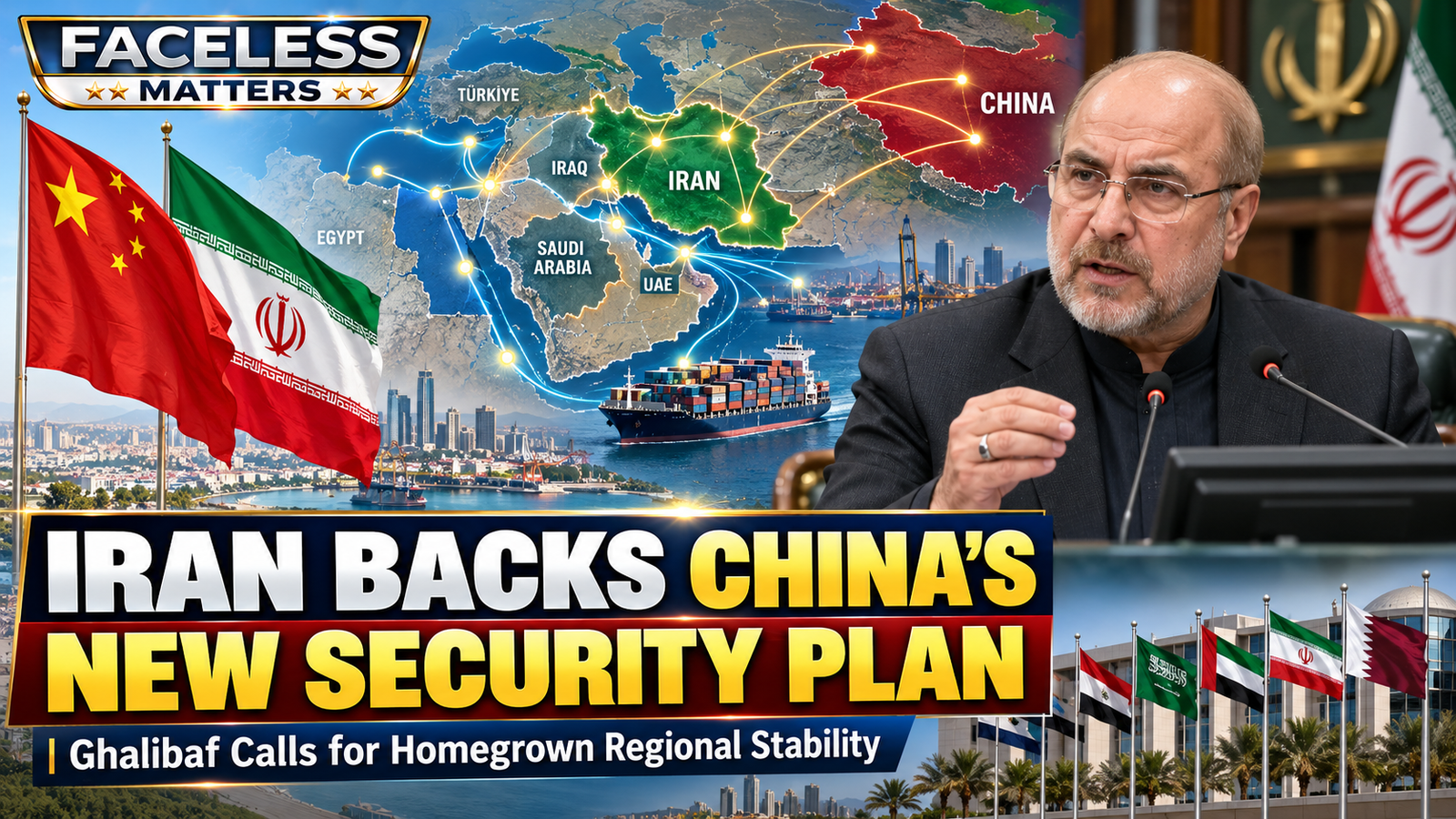
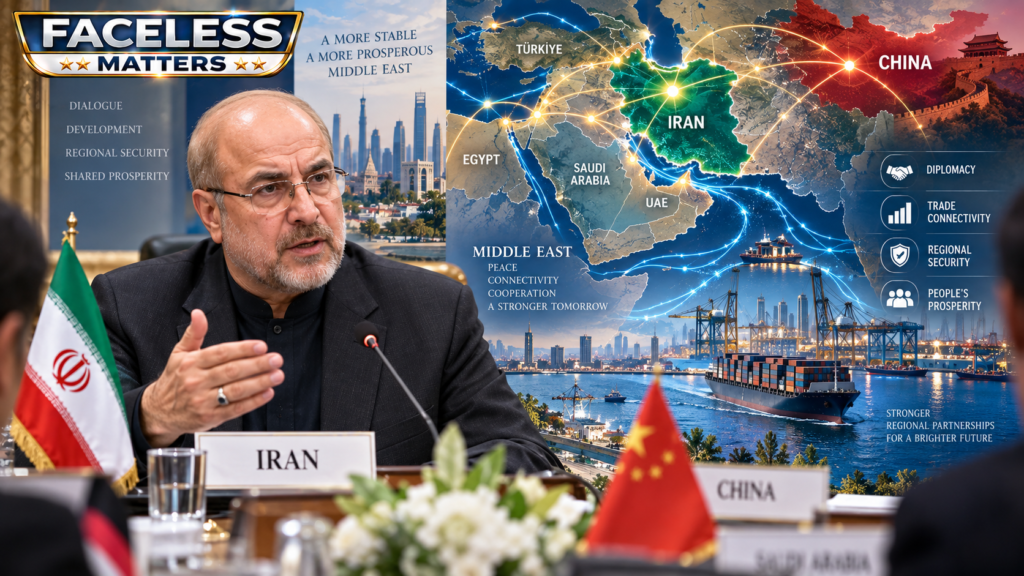
Iranian Parliament Speaker Mohammad Bagher Ghalibaf said on September 4 that China’s emphasis on fostering common security reflected a principle Iran had long championed. He argued that regional countries should take control of their own future and said genuine stability could come throIran China Security Proposalugh a new security architecture developed within the region.
The statement followed Chinese President Xi Jinping’s September 2 call during his visit to Egypt for Middle Eastern states to oppose external interference and consider a new regional security framework. China also said it was prepared to work with regional countries to protect important shipping routes.
For Tehran, this is more than a diplomatic endorsement.
It is a reaffirmation of a long-running argument: regional security should increasingly be shaped by the countries of the region rather than being determined primarily by outside military powers.
For Beijing, the message fits into a broader diplomatic strategy centered on regional dialogue, strategic autonomy, economic connectivity and common security.
For the wider Middle East, however, the crucial question is whether political statements can eventually become practical security mechanisms.
This is where the latest Iran China Security Proposal becomes strategically important.
What Did Ghalibaf Actually Say?
Regarding the Iran China Security Proposal, Ghalibaf’s statement was direct but relatively concise.
He welcomed China’s emphasis on common security and connected that principle with Iran’s own longstanding position on regional affairs.
He then argued that countries in the region should take their future into their own hands and that real stability required a new security architecture that was homegrown.
Iran, he said, was ready.
The language is significant because it places the emphasis on regional ownership rather than on a particular military alliance.
Ghalibaf did not announce the creation of a new military organization.
Nor did he present a detailed treaty, command structure or operational mechanism.
Instead, his message was political and strategic: regional states should have a greater role in determining the security environment in which they live.
That distinction is important.
The Iran China Security Proposal should therefore be understood at this stage as a strategic convergence around principles rather than as a finalized security pact.
1. The First Signal: Iran Wants Greater Regional Ownership
The strongest message from Tehran is the demand for greater regional ownership.
For decades, security in the Middle East has been heavily influenced by outside powers, particularly through military deployments, defence agreements, arms sales and diplomatic intervention.
Iran has consistently criticized dependence on external security guarantees.
Ghalibaf’s latest statement reinforces that position.
The argument is straightforward.
If countries in the region are the ones directly exposed to conflict, disruption of trade and instability, they should have a central role in designing mechanisms to manage those risks.
This does not necessarily mean that Iran wants all foreign powers to leave the Middle East immediately.
The reality is considerably more complicated.
Gulf states maintain extensive defence relationships with the United States and other international partners. European powers also maintain regional interests. China itself is an external power despite promoting greater regional ownership.
That creates an important contradiction.
A regional security architecture promoted partly by China would still involve a major global power.
The question, therefore, is not simply whether outside powers disappear.
It is whether regional states gain greater decision-making authority.
2. The Second Signal: China’s Middle East Role Is Expanding
The Iran China Security Proposal is becoming increasingly important because Beijing is moving beyond a purely economic role in the Middle East.
During his Egypt visit, Xi Jinping called for a new regional security architecture and urged Middle Eastern countries to become “masters of their own destiny,” according to reporting based on Chinese state media.
China also said it was ready to work with regional countries to safeguard shipping routes.
That is strategically significant.
China is deeply connected to the Middle East through energy imports, trade, infrastructure, investment and transport corridors.
Instability in the region therefore has direct implications for Chinese economic interests.
But Beijing has also increasingly presented diplomacy and economic cooperation as tools for reducing geopolitical tensions.
China’s 2023 mediation between Saudi Arabia and Iran demonstrated that Beijing could play a diplomatic role in bringing major regional rivals back toward formal relations.
The current debate over the Iran China Security Proposal represents another possible step.
The Iran China Security Proposal could give Beijing an additional platform from which to promote its preferred model of regional dialogue.
3. The Third Signal: Security and Trade Are Becoming Connected
Modern Middle Eastern security cannot be separated from economics.
The Strait of Hormuz remains one of the world’s most important energy and maritime chokepoints.
The wider region also contains the Red Sea, Bab al-Mandab, the Suez Canal and major Gulf ports.
Any serious security disruption can therefore affect:
- Oil prices
- LNG markets
- Shipping costs
- Insurance premiums
- Industrial supply chains
- Inflation
- Investment decisions
- Regional trade
- Global economic growth
China’s emphasis on protecting shipping routes is therefore not simply a military concern.
It is also an economic-security issue.
Reuters reported that Xi said China was prepared to work with regional countries to safeguard shipping routes at a time when conflict has disrupted important maritime traffic.
This makes the security discussion especially relevant to global markets.
A more stable regional environment could reduce some of the geopolitical risk premiums affecting energy and transportation.
However, investors should not interpret diplomatic statements as evidence that maritime risks have already disappeared.
The difference between political intention and operational security remains substantial.
4. The Fourth Signal: Tehran Sees an Opportunity for Strategic Autonomy
Iran’s endorsement of the Iran China Security Proposal also reflects a broader concept: strategic autonomy.
Tehran has long argued that regional countries should reduce dependence on external security providers.
China’s language about regional states taking control of their own future provides conceptual overlap with that position.
This does not mean Iran and China have identical strategic interests.
They do not.
China is primarily concerned with stability, energy security, trade, investment and its broader global diplomatic position.
Iran has its own security priorities, political objectives and regional relationships.
Their interests therefore overlap in some areas while remaining distinct in others.
That distinction matters for understanding the Iran China Security Proposal.
It should not automatically be interpreted as evidence that China has adopted every Iranian regional position.
Instead, it demonstrates that Tehran sees value in a Chinese framework that emphasizes collective and regionally driven security.
5. The Fifth Signal: The Middle East Could Be Moving Toward a More Multipolar Security System
Perhaps the most important implication of the Iran China Security Proposal is the possibility of a more multipolar regional order.
For decades, the United States has remained the dominant external security power in the Middle East.
That influence has not disappeared.
But regional governments have increasingly diversified their relationships.
Countries can simultaneously maintain partnerships with Washington, deepen economic relations with Beijing, strengthen ties with Türkiye, communicate with Moscow and pursue their own regional diplomatic initiatives.
This creates a more complicated strategic environment.
The emerging model is not necessarily “China replaces America.”
It may instead be:
Multiple powers + stronger regional institutions + greater strategic flexibility.
That distinction is critical.
A multipolar system can potentially create more diplomatic options.
But it can also create competing security expectations.
The real test will be whether regional countries can develop mechanisms that reduce miscalculation rather than simply adding another layer of geopolitical competition.
Why China’s Proposal Matters to Gulf States
The Gulf states are among the most important actors in any future regional security architecture.
Saudi Arabia, the United Arab Emirates, Qatar, Oman, Kuwait and Bahrain have different relationships with both Iran and major global powers.
Their security concerns are also not identical.
Some prioritize maritime security.
Others emphasize missile threats, economic stability, energy infrastructure or regional conflicts.
A successful regional architecture would therefore need to address multiple concerns simultaneously.
It would have to provide reassurance without creating a new bloc.
It would need to protect sovereignty while also supporting freedom of navigation.
It would need to reduce escalation while maintaining credible deterrence.
That is a difficult balancing act.
The Iran China Security Proposal is therefore strategically interesting, but implementation would be much harder than diplomatic messaging.
Maritime Security Could Become the First Practical Test
The most realistic area for practical cooperation may be maritime security.
The Middle East’s shipping routes connect the Gulf with the Indian Ocean, Red Sea and Mediterranean trade systems.
A security mechanism focused on maritime communication could potentially reduce risks without requiring countries to create a full military alliance.
Possible areas of cooperation could include:
- Maritime communication
- Crisis hotlines
- Incident prevention
- Search and rescue
- Commercial shipping coordination
- Information sharing
- Anti-piracy cooperation
- Port security
- Emergency navigation protocols
These measures are less politically explosive than a formal military alliance.
They could also create confidence between countries that do not fully trust one another.
If regional governments can cooperate on limited practical problems, broader security discussions could become easier.
The Economic Dimension Cannot Be Ignored
The Middle East is not only a security theater.
It is one of the world’s most important economic regions.
Energy exports, shipping routes, sovereign wealth, infrastructure investment and global trade all intersect here.
China’s economic relationship with the region is especially significant.
Beijing has invested heavily in infrastructure, industrial projects and connectivity across the Middle East.
Egypt is an important example.
During Xi’s visit, China and Egypt agreed to deepen cooperation across security and economic areas, including data centers, semiconductors, critical metals supply chains and the use of national currencies in trade and investment.
This demonstrates how China increasingly connects security, trade and development.
The Iran China Security Proposal also matters because it could test whether diplomatic language can be converted into practical regional cooperation. If participating states eventually establish communication channels, maritime safeguards, crisis-management procedures and regular consultations, the concept could move beyond political messaging. If those mechanisms fail to emerge, the proposal may remain primarily a statement of strategic preference. For investors, governments and businesses, that distinction is important because durable security arrangements can influence shipping confidence, energy planning, insurance costs and long-term investment decisions across the region. This would make cooperation measurable over time.
For businesses, the implication is straightforward:
Security architecture can influence economic architecture.
A more predictable regional environment can improve confidence in shipping, infrastructure investment and long-term commercial planning.
Can Regional Security Really Become Homegrown?
This is the biggest unanswered question.
A homegrown security architecture sounds attractive.
But regional politics remain extremely complicated.
Iran has deep disputes with some regional governments.
Gulf states have their own threat perceptions.
Israel remains central to the region’s security calculations.
The United States retains major military relationships.
Türkiye has its own strategic ambitions.
Russia remains involved in regional affairs.
China is increasing its economic and diplomatic presence.
This means there is no simple blueprint.
A genuinely regional architecture would have to include countries with competing interests.
That makes inclusiveness essential.
If the system excludes major actors, it could simply become another bloc.
If it includes too many incompatible interests without workable decision-making mechanisms, it could become ineffective.
The balance between inclusion and effectiveness will be critical.
What Iran Wants From the Emerging Framework
Iran’s immediate objective appears to be greater recognition of its argument that regional countries should have more control over their security environment.
Ghalibaf’s statement reinforces that position.
But Tehran will also need to convince neighboring countries that a regional system would provide security for everyone rather than simply strengthen Iran’s strategic position.
That is a major diplomatic challenge.
Any credible regional architecture would have to address concerns about sovereignty, territorial integrity, maritime security and escalation.
It would also need mechanisms for resolving disputes.
Without those elements, the concept could remain political rhetoric.
With them, however, the idea could become considerably more consequential.
What China Wants
China has several overlapping interests.
First, Beijing wants regional stability.
Second, it wants reliable access to energy and trade routes.
Third, China wants to expand diplomatic influence without becoming trapped in costly military commitments.
Fourth, Beijing wants to present its diplomatic model as an alternative to permanent bloc confrontation.
The Iran China Security Proposal therefore fits into a broader Chinese approach that emphasizes dialogue, sovereignty and common security.
China has previously described the need for regional countries to improve relations and explore new regional security arrangements. Chinese Foreign Ministry statements have also linked Middle Eastern stability with safe navigation through the Strait of Hormuz and regional strategic autonomy.
The challenge for Beijing is credibility.
Diplomatic influence is easier to demonstrate than security enforcement.
China can facilitate dialogue.
But whether it can help enforce a sustainable regional security framework during an actual crisis is a much more difficult question.
FACELESS MATTERS Strategic Assessment
The latest Iran China Security Proposal statement should not be interpreted as the creation of a new Iran-China military alliance.
There is no evidence in the latest remarks of a new defence treaty or joint military command.
What is emerging is something more gradual.
Iran and China appear to share a growing interest in the idea that Middle Eastern security should become more cooperative, less dependent on external intervention and more closely connected to regional dialogue.
That convergence matters.
The region is already experiencing a period of strategic adjustment.
Saudi Arabia is developing new security relationships.
Türkiye is increasing its regional diplomatic and defence role.
Pakistan is strengthening strategic cooperation with Saudi Arabia and Türkiye.
China is expanding its diplomatic and economic presence.
Iran is advocating a regional security framework that reduces reliance on outside powers.
These developments do not automatically create a new regional order.
But together they indicate that the old assumptions about Middle Eastern security are being reconsidered.
The Iran China Security Proposal is therefore best viewed as one signal within a much larger transformation.
The Pakistan Dimension
Pakistan should also watch these developments closely.
Islamabad has deep relationships with Saudi Arabia, Türkiye and China while maintaining diplomatic relations with Iran.
That gives Pakistan a potentially valuable position in any future regional dialogue.
Pakistan’s strategic geography also connects South Asia, Central Asia, China and the Middle East.
A more stable regional environment could have implications for:
- Energy security
- Trade corridors
- Investment
- Maritime commerce
- Defence cooperation
- Regional diplomacy
- Connectivity projects
Pakistan’s recent institutionalization of its defence relationship with Saudi Arabia and Türkiye also shows that regional security structures are evolving in multiple directions.
The challenge for Islamabad will be maintaining strategic balance.
Pakistan does not benefit from another polarized regional bloc system.
It benefits more from stability, connectivity and diplomatic space.
What Happens Next?
The next stage for the Iran China Security Proposal will be more important than the headlines.
Watch for five developments.
1. Will China publish more detailed proposals?
A general call for regional security is only the beginning.
The real test will be whether Beijing outlines practical mechanisms.
2. Will Iran engage Gulf states?
Tehran’s regional-security vision will require cooperation with neighboring Arab countries.
3. Will maritime security become a practical cooperation area?
This could be the easiest starting point for confidence-building.
4. Will other major regional powers support the concept?
Saudi Arabia, Türkiye, Egypt and other states would be critical to any genuinely regional framework.
5. Will the concept reduce tensions or create another geopolitical competition?
This is ultimately the most important question.
If the framework becomes another arena for competition between major powers, its value could be limited.
If it encourages regional governments to communicate, negotiate and manage crises collectively, its significance could be much greater.
FACELESS MATTERS Final Assessment
The latest statement from Ghalibaf is important because it connects two increasingly visible trends.
The first is Iran’s continuing argument for regional strategic autonomy.
The second is China’s expanding diplomatic effort to promote a new security architecture in the Middle East.
Neither trend means that the existing regional order has suddenly disappeared.
Nor does it mean China is replacing the United States as the region’s security provider.
The more realistic interpretation of the Iran China Security Proposal is that the Middle East is entering a period in which regional states have more options — and more responsibility.
The future security architecture could eventually involve several layers:
Regional diplomacy + collective security + maritime cooperation + economic connectivity + external partnerships.
That would be a very different model from a single-power security umbrella.
But it will only work if the region’s major countries believe that the system protects their interests rather than advancing one country’s agenda.
Iran has now signaled that it is ready to participate.
China has signaled that it wants a new framework.
The next question is whether the rest of the region is ready to build one.
That is where the real strategic story begins.
INTERNAL LINKS
- Makkah Defence Alliance: 5 Essential Facts for Pakistan — A recent FACELESS MATTERS analysis of Pakistan, Türkiye and Saudi Arabia’s emerging collective-defence framework, directly relevant to the changing regional security architecture. Read the Makkah Defence Alliance analysis
- Pakistan SCO Chairmanship: 5 Critical Tests Ahead — Examines Pakistan’s wider diplomatic and strategic role as regional powers reshape their partnerships and economic relationships. Read the Pakistan SCO analysis
- Pakistan Debt Repayment 2026: A Major Test of Fiscal Management — Provides economic context on Pakistan’s financial position and why regional stability, trade and strategic relationships matter for the country’s economic outlook. Read the Pakistan debt analysis
TRUSTED EXTERNAL SOURCES
- Dawn — Iran’s Ghalibaf stresses need for common security
- Reuters — China’s Xi urges new Middle East security framework
- CNN — Ghalibaf calls for homegrown regional security
- China Ministry of Foreign Affairs — China and Iran discuss regional security architecture
SOURCE VERIFICATION & FACELESS MATTERS ANALYSIS
The immediate news development is based on reporting published on September 4, 2026, including Dawn and CNN coverage of Mohammad Bagher Ghalibaf’s statement supporting the principle of common security and a homegrown regional security architecture.
The wider Chinese position was cross-checked against Reuters reporting on Xi Jinping’s September 2 visit to Egypt, where he called on Middle Eastern states to oppose external interference and consider a new regional security architecture.
China’s longer-running position on regional security, Iran relations and navigation through the Strait of Hormuz was also checked against Chinese Foreign Ministry material.
The strategic conclusions, scenario analysis and assessment of possible implications for Iran, China, Gulf states and Pakistan are FACELESS MATTERS analysis and should not be interpreted as confirmed future developments.
FACELESS MATTERS distinguishes reported facts from editorial interpretation and does not present diplomatic proposals as finalized treaties or military alliances unless officially confirmed.
For editorial questions, corrections, source concerns or legitimate inquiries: