

By Babar Rashid | Senior Correspondent, FACELESS MATTERS
Category: World News | Politics | International Affairs
Date: 1 November 2026
Introduction: A Political Deadlock Reopens an Old Electoral Debate
Israel is facing another consequential political test after its 27 October 2026 parliamentary election failed to deliver a clear governing majority. The renewed debate over direct elections has brought Israel’s method of selecting its national leadership back into public discussion. With Prime Minister Benjamin Netanyahu’s political bloc short of the numbers required to form a government and opposition parties struggling to agree on an alternative, an unusual proposal has returned to the centre of political discussion: electing the prime minister directly through a separate public vote.
The idea is significant not only because it could affect Netanyahu’s political future, but also because it raises a larger question about how a parliamentary democracy should respond when an election produces political deadlock. Should parties negotiate another coalition, should voters return to the ballot box, or should the country consider changing the way its head of government is selected?
According to Israeli media reports published on 31 October, opposition figures are considering legislation that would restore direct elections for prime minister. The proposal has been described as the “Netanyahu 2021 model” because Netanyahu himself promoted a similar idea after Israel’s inconclusive March 2021 election.
However, the proposal remains under consideration. It is not an enacted law, an officially announced election date or a confirmed agreement among opposition parties.
The debate reflects a deeper struggle over political leadership, parliamentary representation, electoral reform and public accountability. It also demonstrates how a fragmented political system can make it difficult to translate votes into a stable government.
For Israel, the immediate question is who can govern. The longer-term question is whether changing the electoral mechanism would solve the underlying political divisions or simply create a different form of uncertainty.
TABLE OF CONTENTS
1. The Election Result That Created a New Political Challenge
The October 2026 election has left Israel with a complicated parliamentary picture.
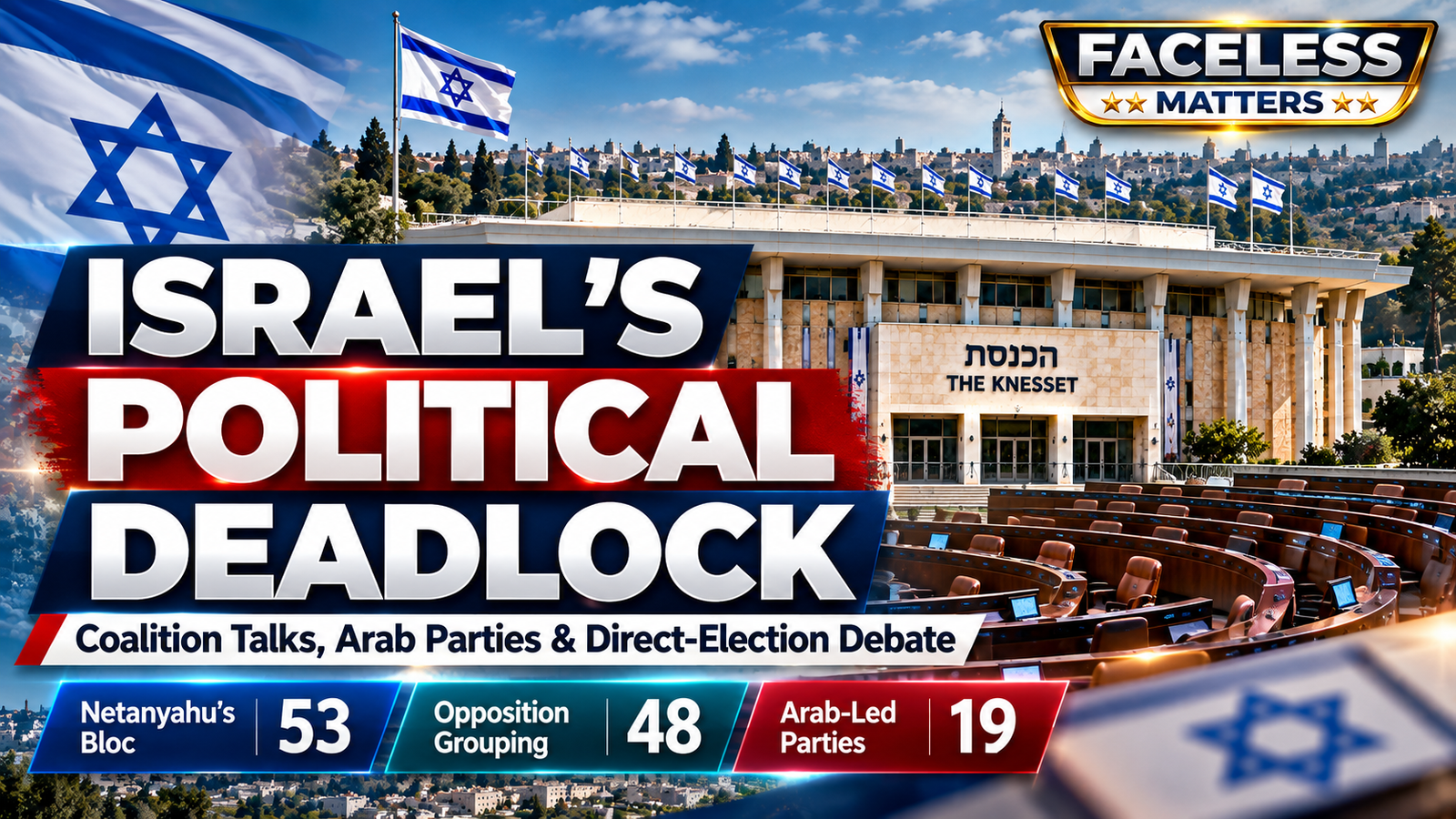
Initial results reported by international and Israeli media show Netanyahu’s Likud-led bloc with 53 seats in the 120-member Knesset. The opposition bloc led by Gadi Eisenkot has 48 seats, while Arab-led parties hold 19 seats.
Under the existing parliamentary system, a government needs the support of at least 61 members of the Knesset to secure a majority.
Neither of the two main political groupings has independently reached that threshold.
The numbers create a difficult situation for both sides. Netanyahu’s political allies have not secured a governing majority, while the opposition has struggled to agree on a workable coalition and on the role that Arab parties should play in supporting an alternative administration.
The Arab-led parties have consequently become an important parliamentary factor. Their combined representation could influence whether an alternative government can obtain sufficient support.
However, political arithmetic is not the same as political agreement. Parties that share the objective of replacing an incumbent prime minister may still disagree over national security, relations with Arab political representatives, religious policy, military service and the future direction of the country.
This distinction is central to understanding the current crisis.
A parliamentary majority must be assembled through political cooperation. Simply having more members outside the incumbent’s bloc does not automatically create a functioning government.
2. What Direct Elections Could Mean for Israel
Under the proposal being discussed, voters would choose the prime minister directly in a separate election rather than relying exclusively on the traditional parliamentary process through which parties compete for Knesset seats and subsequently negotiate a governing coalition.
The intention is to provide a possible route out of the current deadlock.
Supporters see direct elections as one possible way to give voters a separate voice in choosing the country’s prime minister.
In a conventional parliamentary arrangement, voters elect representatives and political parties. The government is then formed by the political grouping capable of obtaining parliamentary confidence.
A direct prime ministerial election would add another element: voters would separately select the individual they want to lead the government.
Supporters of the proposal may view this as a way to establish a clearer personal mandate for national leadership, particularly when several parties cannot agree on a coalition.
But direct public selection does not automatically resolve every parliamentary problem.
Israel’s Basic Law: The Government establishes the framework for forming a government and obtaining the Knesset’s confidence. Any proposal to restore direct elections would therefore need carefully drafted legislation addressing how a directly elected prime minister would operate within that constitutional and parliamentary structure.
The exact relationship between the prime minister’s electoral mandate, parliamentary confidence, ministerial appointments and the authority of the Knesset would have to be defined.
Without those details, direct elections could create a new dispute over the distribution of political power rather than ending the existing one.
3. The Political Irony: Netanyahu Previously Supported a Similar Idea
One of the most striking aspects of the current debate is its political history.
The proposal is being described in Israeli reporting as the “Netanyahu 2021 model” because Netanyahu advocated direct elections for prime minister after the inconclusive March 2021 election.
At that time, his attempts to assemble a governing coalition had encountered difficulties. A separate direct vote for prime minister was presented as a possible way to determine who should lead the country without holding another full parliamentary election.
In April 2021, Netanyahu publicly promoted the idea of a direct election for prime minister without dissolving the Knesset.
Five years later, the same general mechanism is being examined by political opponents seeking a way to end his tenure.
The renewed discussion of direct elections therefore raises questions about whether electoral reform should be guided by consistent democratic principles rather than immediate political advantage.
The political circumstances have changed, but the underlying challenge remains familiar: how can Israel establish an effective government when the parliamentary numbers do not produce an obvious governing majority?
This reversal illustrates an important feature of democratic politics. Electoral reform proposals are often judged differently depending on who expects to benefit from them.
A mechanism that appears attractive to one political leader during a deadlock may become controversial when opponents consider using it against that leader.
The essential question should therefore be whether the proposed system serves the public interest and strengthens democratic accountability, rather than whether it offers a temporary advantage to a particular political camp.
4. Israel Has Already Experimented With Direct Prime Ministerial Elections
The proposal is not entirely new to Israeli political history.
Israel’s earlier experience with direct elections offers an important historical reference for evaluating any attempt to revive the model.
Israel experimented with direct elections for prime minister between 1996 and 2001.
During that period, voters cast separate ballots: one for prime minister and another for their preferred political party in the Knesset.
The system produced three direct prime ministerial elections.
In 1996, Benjamin Netanyahu defeated Shimon Peres. In 1999, Ehud Barak defeated Netanyahu. In 2001, Ariel Sharon defeated Barak in a special election for prime minister.
The experiment was subsequently abandoned, and Israel returned to a parliamentary model in which voters elect political parties and the prime minister emerges through the process of forming a government that can command Knesset confidence.
The historical experience is particularly relevant because direct elections did not eliminate political fragmentation.
One of the concerns associated with the system was that voters could support a mainstream candidate for prime minister while separately voting for smaller or sector-specific parties in the parliamentary election.
This could weaken the larger parties and make coalition formation more difficult.
In other words, directly electing a prime minister did not necessarily create a stronger parliamentary majority.
The historical lesson is important: changing the method of selecting a national leader does not automatically resolve divisions within the legislature.
Any renewed system would need to address the weaknesses that contributed to the previous experiment being discontinued.
5. The Opposition Faces Its Own Leadership Challenge
The political challenge facing Netanyahu’s opponents is not limited to securing enough parliamentary votes.
They must also agree on who should lead an alternative government.
Several prominent opposition figures have their own political ambitions and constituencies. These include Gadi Eisenkot, Naftali Bennett, Avigdor Liberman and other leaders who have different political backgrounds and policy priorities.
The opposition is therefore not a single unified political organization.
Even under direct elections, opposition parties would need to consider whether they can agree on a candidate and a credible governing programme.
Its members may agree that Netanyahu should leave office while disagreeing about the person who should replace him and the policies a new government should pursue.
This problem becomes especially important under a direct election model.
Instead of negotiating only over the distribution of ministries and parliamentary responsibilities, opposition parties would have to agree on a prime ministerial candidate who could attract sufficient support from voters across their different constituencies.
That is not necessarily an easy task.
A candidate capable of winning support among centrist voters may not satisfy more conservative opposition parties. A candidate acceptable to right-wing opponents of Netanyahu may not attract voters who prefer a different political direction.
The selection of a common candidate could become another source of division.
Therefore, direct elections might simplify one part of the process while making another part more difficult.
6. The Arab Parties and the Question of Parliamentary Support
The 19 seats held by Arab-led parties make them an important factor in the current parliamentary calculations.
Their position highlights a wider question about political representation and the relationship between Jewish-led and Arab-led political parties in Israel.
Some opposition leaders have expressed reservations about relying on Arab parties to establish a government. Others have considered parliamentary cooperation or outside support as a possible route to replacing Netanyahu.
This disagreement creates a major obstacle to coalition formation.
A parliamentary system requires parties to negotiate with representatives who hold the votes necessary to establish a majority. Yet political leaders may face pressure from their own voters and allies when considering cooperation with parties whose positions differ significantly from theirs.
Ahmad Tibi, a prominent Arab lawmaker, has previously outlined a proposal under which Arab political representatives could support an alternative government from outside the coalition in exchange for commitments addressing issues affecting Arab communities.
Such proposals demonstrate that parliamentary cooperation can involve negotiated policy commitments without necessarily requiring every supporting party to become a formal coalition partner.
However, the direct election proposal does not make these political differences disappear.
Even if voters directly select a prime minister, the new administration would still have to operate within the parliamentary system and address the question of legislative support.
The issue is therefore not simply whether Arab parties support or oppose Netanyahu. It is also about the place of Arab citizens and their elected representatives within Israel’s political institutions.
A democratic system must consider the representation of all eligible citizens, including communities whose political influence may become decisive in a closely divided parliament.
7. Could Direct Elections Actually Remove Netanyahu?
The proposal is being discussed as a possible route to ending Netanyahu’s leadership, but its political impact remains uncertain.
A direct election could create an opportunity for opposition parties to unite behind a single candidate and ask voters to decide who should lead the country.
That could produce a more visible contest between competing leadership options.
But several questions remain unanswered.
Who would be selected as the opposition’s candidate?
Would the different opposition parties agree to support that person?
Would voters who oppose Netanyahu but disagree with one another on national policy unite behind a single alternative?
Would a directly elected prime minister be able to govern without a stable Knesset majority?
Would the proposed legal changes survive parliamentary and judicial scrutiny?
These are not minor technical details. They go to the heart of whether the proposed mechanism could work.
A direct election could produce a clear winner in the personal contest while leaving the legislature divided.
If the new prime minister cannot secure sufficient parliamentary support, the country could face another institutional confrontation.
Consequently, direct elections should not be described as a guaranteed mechanism for removing Netanyahu or as a certain solution to the political crisis.
The outcome would depend on legislation, political agreements, candidate selection and the response of Israeli voters.
8. The Alternative: Another Election or a New Coalition
Direct elections are only one of the possible routes out of the current deadlock.
Another possibility is the formation of a coalition government through negotiations among parties that did not originally campaign together.
A unity arrangement could involve political groups with different ideological positions agreeing on a limited programme of government.
Such an agreement might prioritize national security, economic stability, public administration and the management of ongoing national challenges.
However, coalition negotiations can become difficult when parties have made firm campaign commitments against working with particular political figures or groups.
Another possibility is a minority government that relies on parliamentary support from parties outside the formal coalition.
This arrangement would require a degree of political coordination and could face challenges whenever major legislation or confidence votes are presented.
A further possibility is another parliamentary election if no candidate succeeds in forming a government within the applicable legal process.
Reuters reported that the formal government-formation procedure includes consultations by President Isaac Herzog and a defined period during which a candidate is given the opportunity to assemble a government.
If the process fails, further attempts or another election may follow.
Each option carries political and economic consequences.
Repeated elections can create uncertainty for businesses, investors, public institutions and households. Coalition compromises may provide short-term stability but leave important policy disagreements unresolved. Electoral reform may offer a new route forward but also introduce legal and institutional complications.
The challenge is to find a solution that produces a government capable of governing effectively and remaining accountable to the public.
9. Netanyahu’s Political Record and the Question of Accountability
Benjamin Netanyahu has been one of the most influential and longest-serving figures in Israeli politics.
His political career has included multiple periods as prime minister, significant security decisions and a lasting influence on Israel’s domestic and international policy.
His supporters often emphasize his experience, security credentials and ability to navigate difficult regional circumstances.
His critics, meanwhile, have raised questions about government accountability, political leadership, the country’s security failures and the direction of national policy.
Netanyahu has also faced ongoing criminal proceedings involving corruption-related allegations, which he denies.
These issues form part of the wider political environment in which the October 2026 election took place.
However, political criticism, legal allegations and established judicial findings must be treated as separate categories.
A democratic election is not a substitute for a criminal trial, and criminal allegations should not be presented as convictions without a relevant court judgment.
Similarly, the political removal of an elected leader must take place through lawful constitutional and parliamentary procedures.
The principle of accountability applies to every public official, regardless of political popularity or experience.
It also applies to opposition leaders seeking to replace an incumbent. Their proposals should be judged by their legality, transparency, practicality and likely impact on democratic institutions.
10. The Security Environment Makes Political Stability More Important
Israel’s political transition is taking place amid an exceptionally difficult regional security environment.
The October 2026 election was held after years of conflict and continuing security concerns involving Gaza, Lebanon and Iran.
The October 7, 2023 attacks and the subsequent wars have deeply influenced Israeli politics, national security discussions and public expectations of government leadership.
Security policy remains a major factor in the competition between Netanyahu and his opponents.
At the same time, political instability can affect how a country makes decisions, communicates with international partners and manages economic priorities.
A caretaker administration may continue to exercise governmental authority, but it operates in a politically sensitive environment and faces questions about the scope and discretion of its decisions.
The Reuters election analysis reported that the caretaker government retains significant powers while also being expected to exercise restraint in certain circumstances.
For international observers, the issue is not simply who holds the prime minister’s office. It is whether Israel can maintain effective decision-making, institutional continuity and public confidence while political parties negotiate the next government.
A stable government does not guarantee wise decisions. Equally, a political change does not automatically produce better policy.
The quality of leadership must be assessed through decisions, results, transparency and respect for legal institutions.
11. Economic Confidence and Investor Expectations
Political uncertainty can have consequences beyond parliamentary negotiations.
Businesses and investors generally value predictable rules, functioning institutions and clear economic policy.
When a country faces repeated elections or prolonged coalition negotiations, companies may delay investment decisions while waiting for greater clarity about taxation, public spending, regulation and national priorities.
The financial implications depend on many factors, including the country’s economic fundamentals, security conditions, international trade, currency movements and investor expectations.
Israel’s technology sector, financial markets and international commercial relationships make political stability an important issue for economic planning.
However, it would be misleading to attribute every market movement to the election or to claim that a direct election would automatically improve investor confidence.
The economic impact of any political arrangement would depend on the policies adopted by the government that eventually takes office.
Investors will look for more than a winning candidate. They will want to understand the government’s fiscal direction, regulatory priorities, security outlook and ability to pass legislation.
For ordinary households, the most important questions concern employment, prices, public services, personal security and economic opportunity.
A political system should ultimately be judged by how effectively it serves the public rather than by the tactical success of individual political leaders.
12. Electoral Reform Must Strengthen Democracy, Not Merely Change Political Winners
The most important issue raised by the current proposal is whether electoral reform can strengthen democratic institutions.
Changing the method of electing a prime minister is a major institutional decision. It should not be treated merely as a temporary political tactic.
Any reform should be evaluated against several principles.
First, voters must understand what authority they are granting to a directly elected leader.
Second, the relationship between the prime minister and the Knesset must be clearly defined.
Third, the system must protect parliamentary representation and avoid creating a situation in which the executive claims a public mandate while lacking the legislative support necessary to govern.
Fourth, the rules should apply fairly to political competitors rather than being designed to target one individual.
Fifth, the reform should be based on public debate, legal clarity and a transparent legislative process.
These principles are important because electoral systems shape the distribution of power for years.
A political majority may have a legitimate interest in proposing changes, but democratic reform should be designed for the country as a whole.
The test of a successful electoral system is not whether it removes a particular prime minister. It is whether it allows citizens to choose their representatives, enables governments to function and preserves meaningful accountability.
13. What Happens Next?
The coming period will be important for Israel’s political future.
Opposition leaders must decide whether they can agree on a common strategy. They must also determine whether direct prime ministerial elections are a realistic legislative option or simply one idea among several being discussed.
Netanyahu’s political bloc will continue seeking a path to government formation, while the opposition will examine whether parliamentary cooperation can produce an alternative administration.
President Isaac Herzog’s role in the government-formation process will also be important under the existing legal framework.
At the time of writing, the direct-election proposal has not become an enacted law, and the available reporting does not establish that all opposition leaders have agreed on a common candidate or final legislative text.
The next stage will depend on political negotiations, parliamentary numbers and the legal requirements for changing the electoral system.
The public will ultimately judge whether political leaders are capable of moving beyond campaign promises and producing a workable governing arrangement.
14. FACELESS MATTERS Analysis: The Real Test Is Institutional Accountability
The debate over direct elections in Israel is about more than Benjamin Netanyahu’s political future.
It concerns the relationship between voters, political parties, parliament and executive authority.
A democratic system must allow citizens to replace leaders through lawful procedures. It must also protect the institutions that make government accountable between elections.
Directly electing a prime minister may appear attractive when parliamentary negotiations fail. Yet a system that produces a leader without a workable legislative majority could create another form of deadlock.
Israel’s previous experience with direct prime ministerial elections deserves careful consideration. The return of an old proposal should lead to a serious examination of its advantages, weaknesses and constitutional implications.
The central responsibility of political leaders is not simply to win office. It is to build a government capable of serving the public, protecting institutional integrity and making decisions through accountable processes.
For Netanyahu’s opponents, the challenge is to demonstrate that they can offer more than a shared desire to replace the incumbent. They must present a credible alternative leadership arrangement and a programme capable of securing public and parliamentary confidence.
For Netanyahu, the challenge is to demonstrate that his political leadership retains sufficient legitimacy and parliamentary support to govern.
For Israeli voters, the most important question is whether the country’s political system can deliver stability, representation and accountability at a time of significant national and regional pressure.
Conclusion: Israel Needs a Democratic Solution, Not Just a New Electoral Formula
The proposal to restore direct elections for prime minister has reopened an important debate about Israel’s political future.
The October 2026 election produced no clear parliamentary majority. Netanyahu’s bloc has 53 seats, the opposition has 48, and Arab-led parties hold 19 seats in a 120-member Knesset.
The resulting political deadlock has encouraged opposition figures to examine several possible routes forward, including a direct public vote for prime minister.
The proposal carries historical significance because Netanyahu himself promoted a similar model in 2021, while Israel previously used direct prime ministerial elections between 1996 and 2001.
But history also demonstrates that changing the voting mechanism does not necessarily solve the problem of parliamentary fragmentation.
A direct election could provide a clearer personal mandate, but it would still need to operate within a carefully defined legal and parliamentary framework.
The future of Israel’s government will depend on whether political leaders can agree on a lawful and workable arrangement that reflects the election results and preserves democratic accountability.
The ultimate measure of political reform should not be whether one leader remains in office or another replaces him.
It should be whether the system gives citizens a meaningful voice, enables effective government and ensures that public power remains answerable to the people.
FACELESS MATTERS believes that strong democratic institutions are more important than the political fortunes of any individual leader. A country needs elections that are fair, governments that are functional and public officials who remain accountable under the law.
Israel’s current political debate is therefore a test not only of Netanyahu’s leadership, but also of the resilience of its parliamentary democracy.

INTERNAL READING — FACELESS MATTERS
1. Israel’s Arab Voters and the Netanyahu Challenge: What the Election Could Change
Israel’s Arab Voters and the Netanyahu Challenge: What the Election Could Change
2. Pakistan System Reset: The Changing System and the Road to a Better Pakistan — Episode 1
Pakistan System Reset: The Changing System and the Road to a Better Pakistan — Episode 1
3. Rule of Law Pakistan: A Powerful System Reset — Episode 2
Rule of Law Pakistan: A Powerful System Reset — Episode 2
4. The Culture of Impunity in Pakistan — Pakistan System Reset Episode 4: Why Rules Lose Their Power
The Culture of Impunity in Pakistan — Pakistan System Reset Episode 4: Why Rules Lose Their Power
5. Why Systems Fail Pakistan — System Reset Episode 3
Why Systems Fail Pakistan — System Reset Episode 3
6. Pakistan IMF Review 2026: $22.6B Reserves and the Next Test
Pakistan IMF Review 2026: $22.6B Reserves and the Next Test
7. Artificial Intelligence: 2026’s Powerful Digital Economy Shift
Artificial Intelligence: 2026’s Powerful Digital Economy Shift
8. Pakistani Surgeon Sets New UK Milestone in Single-Port Robotic Gynecological Surgery
Pakistani Surgeon Sets New UK Milestone in Single-Port Robotic Gynecological Surgery
9. 95% Exemption on Electric Bike Registration Fees and 99% Concession on Annual Taxes in Punjab
95% Exemption on Electric Bike Registration Fees and 99% Concession on Annual Taxes in Punjab
SOURCES & EDITORIAL NOTE
1. The Times of Israel — Original Reporting on the Direct Election Proposal
The Times of Israel — Opposition Bloc Said Weighing Direct PM Elections to Break Political Deadlock
This report examines opposition discussions about restoring direct elections for prime minister, the political background of Netanyahu’s 2021 proposal, the parliamentary seat distribution and the legislative requirements involved.
2. The Jerusalem Post — Electoral Reform and Netanyahu’s 2021 Model
This report provides additional coverage of the proposed direct-election model, the opposition’s political disagreements, Israel’s previous experience with direct elections and the possible legal implications of changing the system.
3. Associated Press — Israel’s Election and the Main Political Issues
Associated Press — A Look at the Main Issues in Israeli Elections Seen as a Referendum on Netanyahu
This report examines the main issues shaping the 2026 Israeli election, including Netanyahu’s leadership, security concerns, political accountability and the possibility of coalition negotiations.
4. Jang — Original Pakistani News Reference
Jang — نیتن یاہو کو ہٹانے کیلئے براہ راست وزیراعظم انتخابات کرانے کی تجویز زیر غور
This is the original Pakistani news reference supplied for this FACELESS MATTERS article. It identifies the reported proposal to consider direct prime ministerial elections as a possible way to challenge Netanyahu’s continued leadership.
Editorial Note
This article is an independent political analysis prepared for FACELESS MATTERS by Babar Rashid. It distinguishes reported proposals from enacted legislation, confirmed political agreements and official decisions.
The direct-election proposal is described as an option under consideration, not as an approved law or a confirmed election schedule. Political positions, parliamentary figures and legal implications are attributed to the cited reporting. Interpretations and assessments are presented as editorial analysis rather than established facts.
The article does not endorse any political party or candidate. Its purpose is to examine electoral reform, parliamentary representation, government formation and democratic accountability in Israel.