

Key Takeaway
The United States has used nighttime maritime operations through the Strait of Hormuz during the Iran conflict, but describing this simply as “America being afraid of Iran” would go beyond the available evidence.
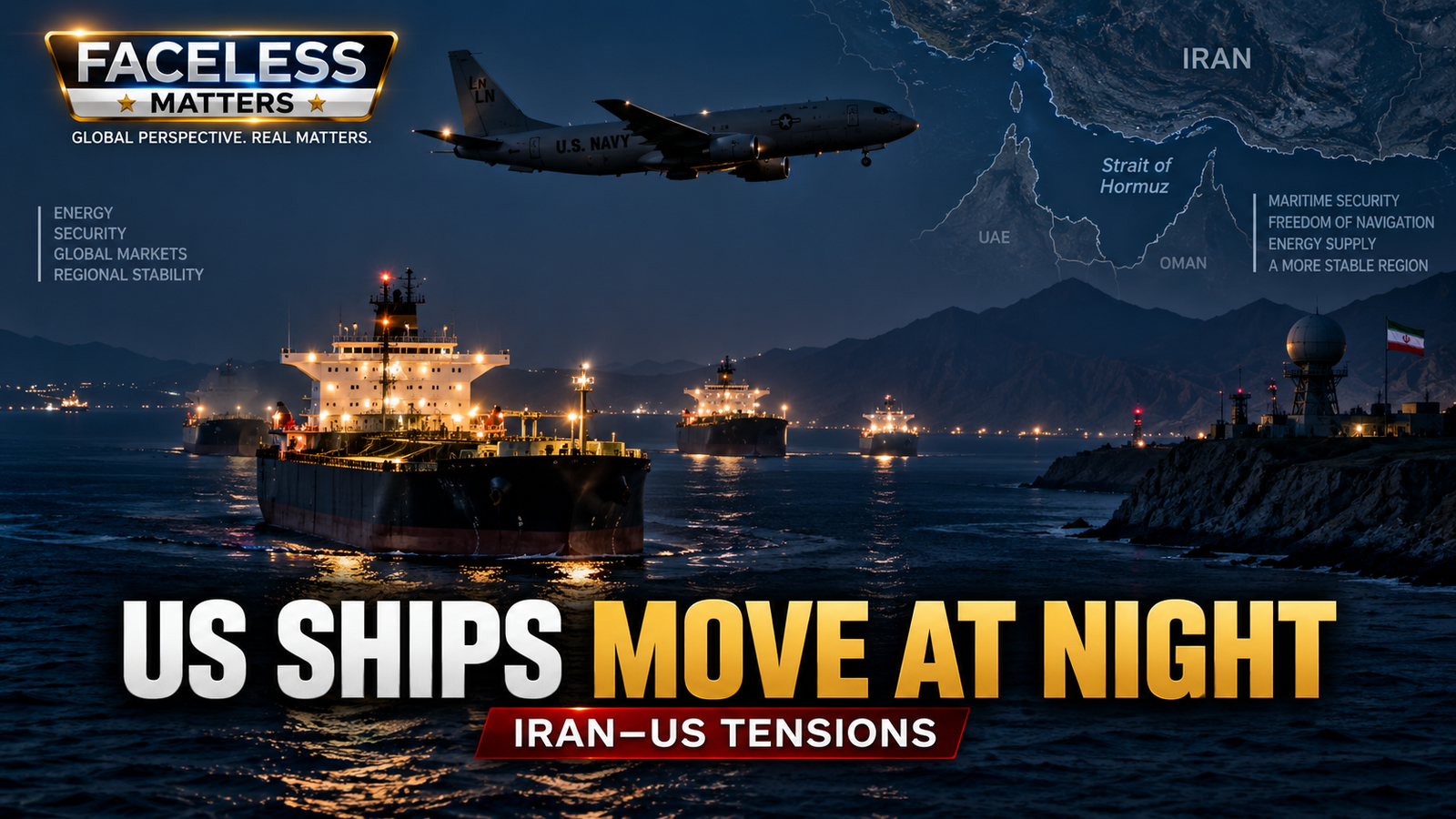
On September 18, 2026, Jang reported U.S. President Donald Trump saying that American-supported ships move through the Strait of Hormuz at night because Iran does not detect them, claiming Iranian radar capabilities have been heavily degraded.
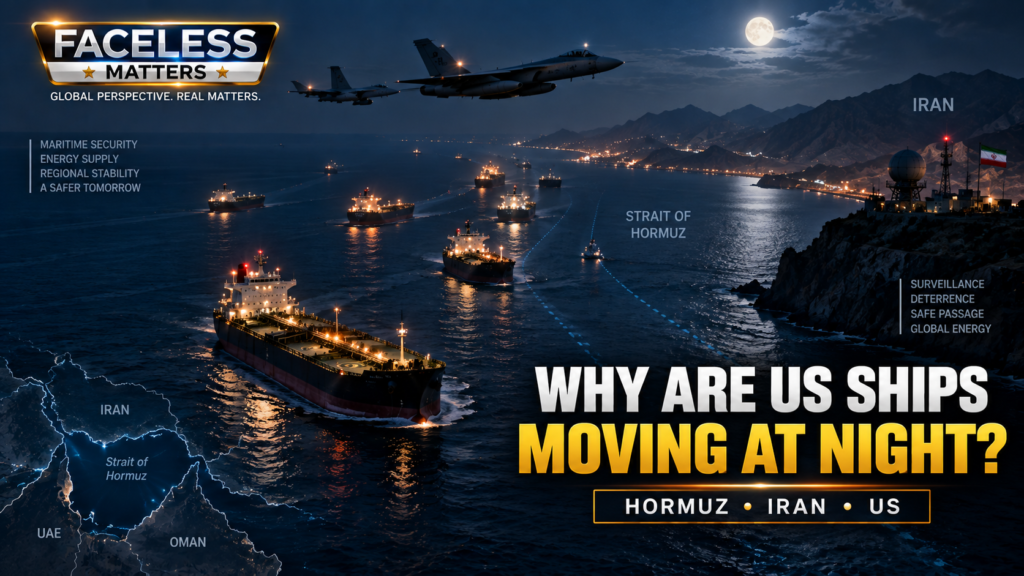
Earlier reporting by Axios described a U.S.-organized nighttime shipping corridor in which 15–20 tankers were entering or leaving the strait each night under U.S. military guidance, with fighter aircraft providing protection against possible Iranian missiles and drones.
However, subsequent reporting indicates that the United States later reduced overnight protection windows and introduced specific daytime transit periods, partly because of increased Iranian attacks and the cost of maintaining continuous aerial protection.
The bigger story is therefore not simply fear. It is risk management, surveillance, air-defense pressure and the changing military balance around one of the world’s most important energy routes.
TABLE OF CONTENTS
What Happened?
The latest discussion began with a statement attributed to President Donald Trump regarding American-supported shipping through the Strait of Hormuz.
According to Jang’s September 18 report, Trump said that the United States sends ships through the waterway at night because Iran does not know they are passing. He also claimed that Iranian radar systems had been destroyed.
That statement is significant because it provides an unusually direct description of how Washington views the surveillance environment around the strait.
But the statement should be separated into two parts:
- The reported U.S. nighttime transit operation is supported by previous reporting.
- The broader conclusion that this proves the United States is “afraid” of Iran is an interpretation, not an established fact.
That distinction matters.
What Trump Said
Trump’s reported comments suggest that Washington considers concealment and reduced Iranian surveillance important advantages for commercial shipping.
Jang reported that Trump said U.S. ships use the strait at night because Iran cannot detect them and that Iranian radar capabilities have already been substantially damaged.
Trump also reportedly said that Washington would either reach an agreement with Tehran or would not make one, while portraying the United States as having the upper hand.
Those political claims should not be treated as independent military assessments.
The operational question is different:
Why would a major military power deliberately organize shipping movements around darkness and specific transit windows?
That is where other reporting becomes important.
Why Nighttime Shipping Matters in Hormuz
The answer is partly connected to Iran’s ability to detect and attack vessels.
An Axios report published in August 2026 described a U.S.-organized shipping corridor through the southern part of the Strait of Hormuz.
According to two U.S. officials cited by Axios, approximately 15–20 tankers were entering or leaving the strait each night through a southern channel along Oman’s coast.
The ships were reportedly moving according to U.S. military guidance, while U.S. Air Force fighter aircraft provided protection against potential Iranian cruise-missile and drone attacks.
This is important because it shows that nighttime movement was not merely a political talking point.
There was a documented operational rationale behind it.
What Axios Reported
Axios reported that the U.S. operation had been designed to keep oil moving despite the wider conflict.
The report said the nighttime corridor was moving millions of barrels of oil and that U.S. officials believed Iranian surveillance of the southern route had been significantly reduced.
According to the officials cited by Axios, U.S. military operations had degraded Iranian radar and maritime-surveillance capabilities.
The report also said that Iran’s remaining surveillance relied on a smaller number of functioning radars and observers operating from fast boats.
If accurate, this would explain why darkness could provide an operational advantage.
But it does not automatically demonstrate that Washington was acting out of fear.
Military forces frequently choose operating hours based on surveillance, air-defense threats, weather, logistics, fuel consumption and the probability of detection.
Iran’s Surveillance Challenge
The surveillance issue is particularly important in the Strait of Hormuz.
The waterway is narrow, heavily trafficked and strategically important.
Iran has repeatedly claimed that it retains significant control over the strait, while Washington has claimed that U.S.-supported shipping can continue moving through it.
Independent shipping data has complicated both narratives.
An Al Jazeera analysis using maritime-tracking data reported that commercial traffic remained significantly below normal levels, while the United States and Iran offered very different descriptions of how much shipping was actually passing through the waterway.
That means public statements about control should be treated separately from independently observed shipping activity.
Why the United States Changed Transit Windows
One of the most revealing developments came later.
The Financial Times reported on September 12 that the United States had changed its protection arrangements for commercial tankers.
Instead of providing broad overnight protection windows, the U.S. military began directing ships toward specific transit periods, including daytime windows.
The report linked the change to increased Iranian attacks and the enormous cost of maintaining continuous aerial protection.
This creates an important timeline:
Earlier operation:
Nighttime shipping corridor + U.S. military protection.
Later adjustment:
More restricted transit windows + greater use of daytime movements.
That is not the pattern of a simple “night equals American fear” narrative.
It is better understood as an evolving military risk-management strategy.
Does This Mean America Is Afraid of Iran?
There is no reliable evidence allowing us to state as a fact that the United States is “afraid” of Iran.
There is, however, clear evidence that Iranian military capabilities have imposed operational costs and risks on U.S. forces and commercial shipping.
That distinction is important.
Recent reporting provides several examples.
On September 17, Anadolu reported that Iran’s Revolutionary Guard claimed it had shot down another U.S. MQ-9 drone near Qeshm Island and described it as the 53rd U.S. MQ-9 drone it had claimed to have destroyed. The claim is attributed to the IRGC and should not automatically be treated as independently verified.
The United States has also acknowledged conducting extensive military operations against Iranian targets.
U.S. Central Command has publicly reported repeated strikes against Iranian military infrastructure, including air-defense systems, missile sites and maritime capabilities.
The evidence therefore points toward a conflict in which both sides are adapting their operations to the other’s capabilities.
The Military Cost of Protecting Shipping
Protecting commercial ships is expensive.
The Financial Times reported that advanced U.S. military aircraft can cost tens of thousands of dollars per hour to operate, with an analyst cited in the report estimating roughly $25,000–$75,000 per flight hour depending on the aircraft and circumstances.
That creates a strategic problem.
If Washington protects every tanker continuously, the cost can become enormous.
If protection is limited to specific windows, resources can be concentrated where they are most useful.
This helps explain why transit schedules have become part of the military strategy.
The question is no longer simply:
Can ships pass through Hormuz?
It is also:
When can they pass with sufficient protection?
What This Means for Oil and Global Trade
The Strait of Hormuz remains one of the world’s most important energy corridors.
Before the conflict, roughly 20 million barrels of oil per day were associated with the waterway.
Current wartime flows are substantially more complicated.
The Washington Post reported that U.S. claims about the volume of oil moving through Hormuz have differed considerably from independent maritime-tracking estimates.
That discrepancy is important for markets.
If traders believe the waterway is becoming safer, oil-supply fears can ease.
If attacks increase or commercial ships avoid the route, supply risk can rise.
This is why every change in U.S. protection policy, Iranian attacks, tanker movements and shipping data can influence global energy expectations.
What Happens Next?
Several developments deserve close attention.
1. U.S. Transit Operations
Washington may continue using scheduled corridors and protected windows rather than maintaining continuous protection.
2. Iranian Surveillance
The ability of Iran to rebuild or replace damaged radar and maritime-surveillance systems could directly affect U.S. and commercial shipping decisions.
3. Drone and Missile Attacks
The continued use of drones and missiles against shipping could force further changes to transit schedules.
4. Oil Prices
Any sustained reduction in shipping capacity through Hormuz could increase the risk premium attached to global crude prices.
5. Diplomacy
Trump said on September 17 that he hoped the Iran war was approaching an end and claimed there had been direct communication with Iran, although Tehran had not publicly confirmed that negotiations had resumed.
Diplomatic developments could therefore change the military calculation as quickly as battlefield developments.
FACELESS MATTERS Analysis
The most important lesson from the nighttime shipping story is that military power is not measured only by the number of aircraft, ships or missiles a country possesses.
It is also measured by how effectively those assets can operate in a contested environment.
The United States has enormous military capabilities in the Middle East. At the same time, Iran has demonstrated an ability to impose costs through missiles, drones, maritime threats and surveillance challenges.
The nighttime shipping corridor illustrates this interaction.
Washington appears to have identified a route and timing pattern that can reduce exposure to Iranian detection and attack. That is an operational advantage.
But the subsequent reduction of overnight protection windows demonstrates another reality: maintaining that protection continuously is costly and carries its own risks.
So, does America “fear” Iran?
The available evidence does not establish that conclusion.
What it does show is something more measurable:
Iran remains capable of influencing how the United States conducts military and maritime operations in one of the world’s most strategically important waterways.
That is a significant finding without needing to exaggerate it.
Conclusion
The latest Trump statement about nighttime shipping through the Strait of Hormuz has drawn attention because it appears to reveal how U.S. forces are exploiting gaps in Iranian surveillance.
Previous reporting supports the existence of U.S.-guided nighttime shipping operations, while later reporting shows Washington adjusting transit windows because of Iranian attacks and the cost of continuous aerial protection.
The evidence therefore points to a complicated military reality.
The United States possesses substantial military power, but Iran’s capabilities still affect American operational decisions.
That does not prove that Washington is “afraid” of Tehran.
It demonstrates something more concrete:
In the Strait of Hormuz, detection, timing, air defense, drones, missiles and the cost of military protection can matter almost as much as raw military strength.
INTERNAL READING — FACELESS MATTERS
Strait of Hormuz Crisis: Oil Above $90 in 2026
Iran Strait of Hormuz: 5 Strategic Signals Behind Tehran’s Latest Warning
Pakistan Energy 2026: 5 Critical Signals From Power Costs, LNG and Global Oil Markets
Iran US Drone Display: 5 Strategic Signals Behind the Move
Pakistan Oil Crisis: 5 Proven Lessons From the Iran War
SOURCES & EDITORIAL NOTE
Jang — September 18, 2026: Trump statement regarding nighttime shipping through the Strait of Hormuz and Iranian radar capabilities.
Jang report
Axios — August 19, 2026: Reporting on the U.S.-organized nighttime shipping corridor and military protection.
Axios report
The Washington Post — September 14, 2026: Analysis of competing U.S. and maritime-tracking claims concerning Hormuz shipping.
Washington Post report
Al Jazeera — September 3, 2026: Analysis comparing U.S. claims about Hormuz traffic with independent shipping data.
Al Jazeera analysis
Anadolu — September 17, 2026: Report on Iran’s claim that another U.S. MQ-9 drone was shot down near Qeshm Island.
Anadolu report
Editorial Note: This article distinguishes between documented reporting, official statements and analysis. Claims made by political or military actors are attributed to their respective sources and are not presented as independently verified facts unless corroborating evidence is available. FACELESS MATTERS does not conclude from nighttime operations alone that the United States is “afraid” of Iran.