

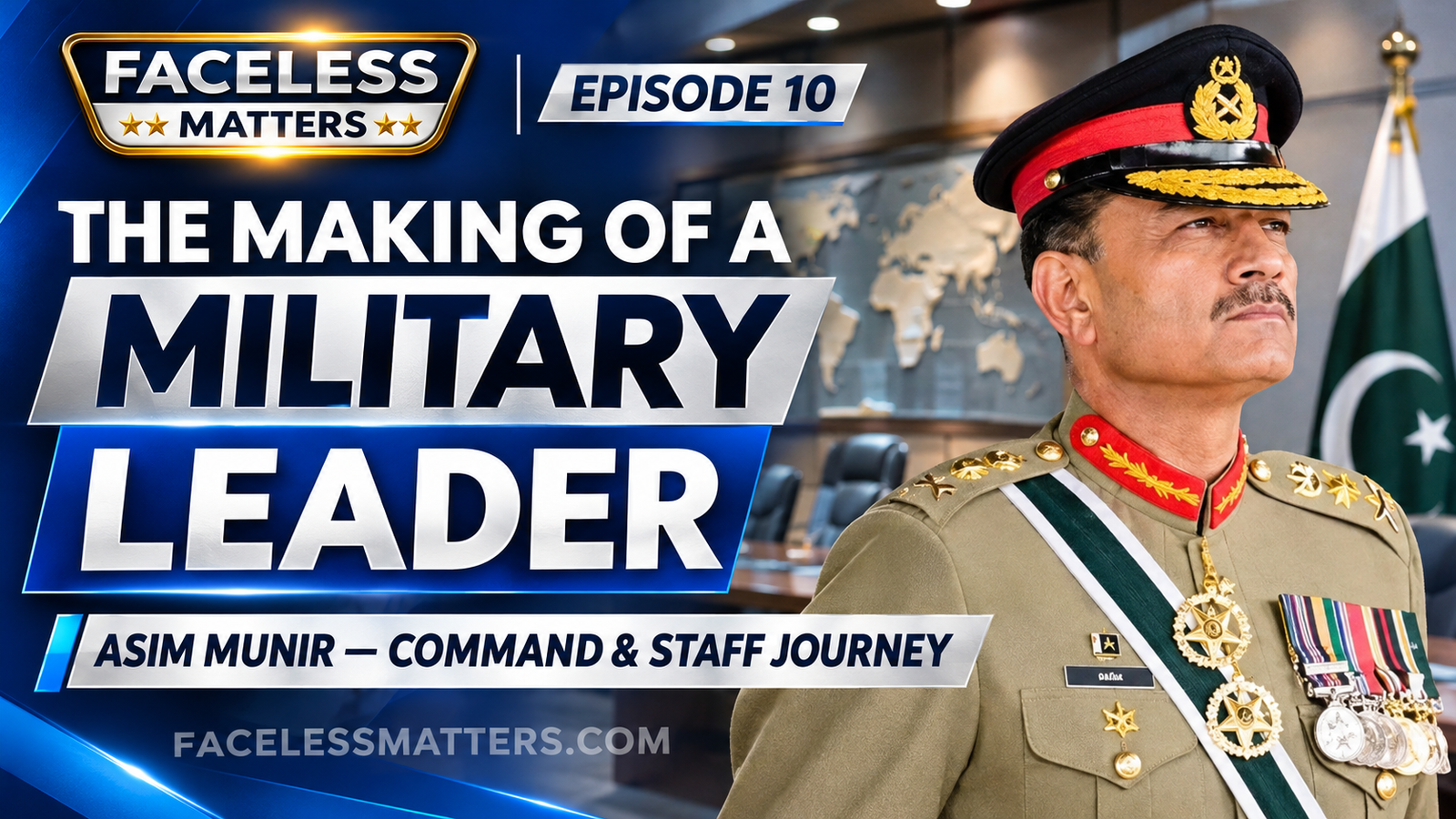
Field Marshal Asim Munir’s Early Command Career: The Staff Roles That Shaped a Military Leader
Publication: FACELESS MATTERS
Introduction: Beyond the Uniform and the Rank
The Asim Munir military career is best understood through the combination of professional education, field experience, staff responsibilities, command appointments and institutional training. A military career is not measured only by promotions, ceremonial recognition or the final rank achieved; it is also shaped by the responsibilities an officer carries and the ability to work within complex organizational structures.
For Field Marshal Syed Asim Munir Ahmed Shah, the publicly documented record identifies a career that included regimental service, infantry command, staff assignments, instructional responsibilities, overseas military training leadership and senior command appointments. These experiences form an important part of the professional background behind his later responsibilities at the highest levels of Pakistan’s military establishment.
The Asim Munir military career also provides a case study of how different military appointments contribute to an officer’s professional experience.
Episode 10 of the FACELESS MATTERS biography series examines this stage of his career: the transition from professional military training toward wider staff and command responsibilities.
The purpose is not to present an unverified timeline or to attribute particular operational achievements to appointments for which detailed public records are unavailable. Instead, this episode examines the responsibilities identified in official biographical material, explains their institutional significance and considers how staff work and field command contribute to the development of senior military leadership.
The distinction matters. A Brigade Major, a General Staff Officer, an instructor at a command college and a Chief of Staff of a Strike Corps perform different functions. Each position provides a different perspective on military organization, planning, coordination and leadership.
Understanding the Asim Munir military career requires examining these responsibilities separately rather than treating them as interchangeable positions.
The official record provides a foundation for examining these responsibilities without inventing details that have not been publicly established.
1. Asim Munir Military Career: From Training to Professional Responsibility
Military education provides the foundation for an officer’s professional life, but it does not replace practical experience. The Asim Munir military career illustrates why professional development must be examined through the different responsibilities an officer undertakes, rather than through rank and promotion alone.
Training institutions introduce officers to military doctrine, leadership principles, operational planning, administration, discipline and the responsibilities associated with command. Once an officer enters progressively demanding appointments, those principles must be applied in real institutional environments.
The official Government of Pakistan biography published through the Press Information Department records that Asim Munir was commissioned in April 1986 into the 23 Frontier Force Regiment and received the Sword of Honour during the 17th Officers Training School course.
This early foundation is an important starting point when examining the Asim Munir military career and its subsequent professional stages.
The same official record identifies several subsequent command, staff and instructional assignments. These included service as Brigade Major of a deployed infantry brigade, General Staff Officer Grade-2 in the Chief of General Staff Secretariat, Directing Staff at the Command and Staff College in Quetta and Chief of Staff of a Strike Corps.
These varied responsibilities help explain the institutional breadth of the Asim Munir military career.
These appointments demonstrate the range of professional environments in which he served.
They also show why a military career cannot be understood through a list of ranks alone. An officer may work with troops in a field formation, contribute to staff planning at headquarters, teach professional military subjects and coordinate the activities of a major formation.
Each assignment requires a different combination of technical knowledge, communication, judgment and institutional discipline.
2. Brigade Major: Coordination at the Formation Level
One of the staff appointments identified in the official record is Brigade Major of a deployed infantry brigade.
A Brigade Major is a key staff officer within a brigade headquarters. The role generally involves coordination of staff work, operational planning, communication between the brigade commander and subordinate units, monitoring of assigned tasks and the organization of information required for command decisions.
A brigade is a military formation responsible for coordinating multiple subordinate units. Its headquarters must ensure that orders, plans, logistical requirements and operational information are communicated through the appropriate command channels.
The Brigade Major therefore works within an environment where accuracy and timing are important.
The position is not simply an administrative title. It is part of the command-and-control structure through which a formation organizes its activities.
However, it is important to distinguish the general responsibilities of the appointment from the specific work performed by an individual officer. The publicly available official biography confirms that Munir held the appointment, but does not provide a complete operational diary, a dated list of brigade tasks or a record of individual decisions taken during that assignment.
A responsible biography should not manufacture such details.
What can be said is that service as Brigade Major placed him within a formation-level staff environment and exposed him to the coordination requirements associated with deployed infantry operations.
For an officer progressing through a professional military career, such experience can provide valuable understanding of how command decisions are translated into coordinated action.
This aspect of the Asim Munir military career illustrates the importance of staff coordination within a military formation.
3. General Staff Officer Grade-2: The Headquarters Environment
The official biography also identifies service as General Staff Officer Grade-2 in the Chief of General Staff Secretariat.
This appointment represents another dimension of military service: the headquarters environment.
A General Staff Officer works within an institutional structure where information, planning, coordination and staff processes support senior command decisions.
The exact responsibilities of a particular GSO appointment depend on the branch, desk, assignment and organizational requirements. The designation alone does not establish that an officer personally controlled a particular operation or made a specific strategic decision.
The Chief of General Staff Secretariat is part of the broader headquarters environment. Staff work in such settings requires an understanding of how information moves through an organization, how planning documents are prepared and how different sections contribute to institutional decision-making.
For a military officer, headquarters service can provide exposure to wider organizational priorities beyond the immediate responsibilities of a single unit or brigade.
It can also develop the ability to communicate complex information clearly, distinguish operational requirements from administrative matters and work within formal chains of command.
Headquarters experience therefore represents another important dimension of the Asim Munir military career.
The significance of this appointment should therefore be understood in institutional terms.
The public record confirms the position, while the detailed files, internal responsibilities and specific work products associated with the appointment are not publicly available in the sources used for this episode.
4. Command and Staff College, Quetta: The Instructional Dimension
Another major appointment identified in the official record is service as Directing Staff at the Command and Staff College, Quetta.
This role adds an important dimension to the professional profile: military education and instruction.
The Command and Staff College is a professional institution where selected officers undertake advanced military education. Staff education helps prepare officers for wider responsibilities by examining leadership, operational planning, military doctrine, organizational coordination and decision-making.
A Directing Staff appointment involves participation in the professional learning environment.
The instructor’s role is not simply to repeat established material. Professional military education requires the examination of problems, discussion of alternatives, evaluation of planning assumptions and the development of analytical judgment.
The value of staff education is particularly important because modern military organizations operate in complex environments. Operational problems may involve geography, logistics, intelligence, communications, weather, technology, political conditions and the coordination of different units.
Officers must learn to consider these factors together rather than treating them as isolated subjects.
The public record confirms that Munir served as Directing Staff at the Command and Staff College, Quetta. It does not provide a complete list of the courses he taught, the individual officers he instructed or the specific academic contributions he made.
Those details should therefore remain outside the factual claims of this article.
Nevertheless, the appointment demonstrates that his professional experience included an instructional role within an established military education institution.
The instructional appointment adds an educational dimension to the Asim Munir military career.
The instructional appointment adds an educational dimension to the Asim Munir military career.
5. Chief of Staff of a Strike Corps: A Wider Coordination Role
The official biography also records service as Chief of Staff of a Strike Corps.
This is one of the most significant staff appointments identified in the published record because a corps headquarters operates at a broader organizational level than a single infantry unit or brigade.
A corps is a large military formation responsible for coordinating multiple formations and units within its assigned command structure.
The Chief of Staff generally supports the corps commander by coordinating headquarters activities, integrating staff inputs and helping ensure that planning, operational information and administrative requirements are handled through the appropriate channels.
The position requires a broad understanding of how different staff branches work together.
A corps headquarters may deal with operations, intelligence, logistics, personnel, communications, training and other institutional requirements. These functions must be coordinated so that the commander receives relevant information and the formation can implement approved plans.
The Chief of Staff role is therefore a coordination and integration responsibility.
This appointment helps readers understand the wider organizational responsibilities associated with the Asim Munir military career.
It should not be confused with independently exercising every function of the corps commander. The commander retains command authority within the established chain of command, while the staff supports planning, coordination and implementation.
The official record confirms the appointment but does not identify the precise dates, the specific corps in this particular staff assignment or the operational activities undertaken during that period.
Those gaps should be acknowledged rather than filled with speculation.
6. Regimental Command: Returning to the Professional Foundation
The official biography records that Munir commanded his parent unit, the 23 Frontier Force Regiment.
This is an important part of the documented career because the regimental system is a central element of the Pakistan Army’s professional structure.
A regiment provides an institutional identity, professional tradition and organizational framework for officers and soldiers.
Command of a regiment involves leadership, discipline, training, readiness, administration and the welfare of personnel. It also requires the commander to maintain standards while ensuring that the unit remains capable of fulfilling its assigned responsibilities.
The 23 Frontier Force Regiment is the unit into which Munir was commissioned in April 1986, according to the official record.
His later command of the parent unit therefore connects the beginning of his commissioned service with a subsequent leadership responsibility within the same regimental institution.
This connection is significant as a matter of professional chronology.
However, the available official biography does not provide a detailed account of the dates of command, the unit’s specific operational deployments under his leadership or a complete evaluation of his performance during that appointment.
It would be inappropriate to invent such details.
The confirmed point is that he commanded his parent regiment, an appointment that formed part of his broader field and command experience.
Regimental command is therefore an important element in understanding the Asim Munir military career.
7. Infantry Brigade Command: Leadership Beyond Staff Work
The official record also confirms that Munir commanded an infantry brigade.
Brigade command represents a wider level of leadership responsibility than command of an individual battalion or regiment.
An infantry brigade brings together subordinate units and supporting elements under a single command structure. Its commander must consider operational readiness, training, personnel, logistics, coordination and the implementation of higher headquarters’ directions.
The brigade commander is responsible for translating broader military objectives into plans and instructions appropriate to the formation.
This involves balancing operational requirements with the welfare and professional development of personnel.
The position also requires communication across several levels of command.
A brigade commander must work with subordinate commanders, staff officers and higher headquarters while maintaining an understanding of the formation’s capabilities and limitations.
The official record confirms the command appointment but does not establish a complete dated sequence of the brigade command and the other appointments discussed in this episode.
The distinction is important for historical accuracy.
The article can explain the significance of infantry brigade command, but it should not claim particular battlefield victories, named operations or specific tactical achievements without independent supporting evidence.
The distinction between confirmed appointments and unverified operational claims is essential to an accurate account of the Asim Munir military career.
8. Force Command Northern Areas: A Distinct Geographical Responsibility
Another command appointment listed in the official biography is Force Command Northern Areas.
The Northern Areas represent a distinctive geographical and security environment within Pakistan.
Mountainous terrain, high-altitude conditions, limited infrastructure in certain locations, weather patterns and the importance of communication routes can create special requirements for military planning and administration.
A formation operating in such an environment must consider the relationship between terrain, mobility, logistics, communications and personnel readiness.
The general demands of high-altitude and mountainous military environments are well recognized in professional military studies.
However, the specific operational activities, deployment patterns and individual decisions associated with Munir’s tenure as Force Commander Northern Areas are not detailed in the official biographical summary used for this article.
It is therefore necessary to separate the general characteristics of the region from claims about his personal actions.
The confirmed fact is that Force Command Northern Areas formed part of his command experience.
That appointment is relevant because it shows that his professional career included responsibilities connected with a geographically distinct operational environment.
This geographical dimension adds further context to the Asim Munir military career.
9. Command Experience and Institutional Leadership
When these appointments are considered together, a broader professional pattern becomes visible. The Asim Munir military career includes experience across regimental service, formation-level staff coordination, headquarters work, professional instruction and field command. These different responsibilities provide important institutional context for understanding his professional development.
The official record identifies experience across several different parts of military organization:
- Regimental service and command.
- Brigade-level staff coordination.
- General Staff work at headquarters.
- Professional military instruction.
- Chief of Staff responsibilities at a Strike Corps.
- Infantry brigade command.
- Force Command Northern Areas.
- Later command of 30 Corps.
- Leadership of Pakistan’s Training Contingent in Saudi Arabia.
These roles represent different forms of professional exposure.
Regimental service develops familiarity with the unit structure and its personnel.
Brigade staff work provides experience in coordination and planning.
Headquarters assignments expose officers to wider institutional processes.
Instructional duties connect operational experience with professional education.
Corps-level staff work requires integration across a larger formation.
Field command places responsibility for people, readiness and the implementation of orders within a defined chain of command.
This range of assignments is important when examining the career of a senior military officer.
It provides a more complete picture than focusing only on intelligence appointments or the eventual appointment as Chief of Army Staff.
Taken together, these experiences provide a broader institutional perspective on the Asim Munir military career.
10. Leadership Development: What These Roles Can and Cannot Tell Us
A biography should distinguish between documented experience and conclusions about personal character.
The fact that an officer served in several staff and command appointments demonstrates professional exposure. It does not automatically prove that every appointment was successful or that every decision was correct.
Evaluating leadership requires evidence.
Useful indicators may include institutional performance, training standards, readiness, personnel welfare, professional conduct, documented decisions and the ability to work within lawful command structures.
For the appointments examined in this episode, the public record provides the positions held but does not publish comprehensive performance evaluations.
Accordingly, FACELESS MATTERS does not assign unsupported scores or claim that a particular appointment independently explains his later rise.
Instead, the article identifies the professional functions associated with the positions and explains why they matter within military organization.
This approach is especially important in high-value military biography content.
Readers deserve accurate information, not exaggerated claims designed only to create a dramatic narrative.
11. The Saudi Training Contingent: An International Dimension
The official biography also records that Munir led Pakistan’s Training Contingent in the Kingdom of Saudi Arabia.
This is a notable element of his professional record because it places part of his military experience in an international training environment.
Military training cooperation can involve the exchange of professional knowledge, institutional practices, training methods and experience between armed forces.
A national training contingent operates within the framework of the relevant bilateral arrangements and the responsibilities assigned to it.
Leadership of such a contingent requires coordination, representation and the management of personnel operating outside their home country.
The official source confirms that he led Pakistan’s Training Contingent in Saudi Arabia. It does not provide the dates, the size of the contingent, the exact training programme or a detailed description of its activities.
Those details should not be invented.
Nevertheless, the appointment demonstrates that his documented career was not limited to domestic unit and headquarters environments.
It also included an international military training responsibility.
The Saudi assignment adds an international dimension to the documented Asim Munir military career.
12. The Relationship Between Staff Experience and Senior Command
Staff work and command are sometimes presented as separate career paths. In professional military organizations, however, they are closely connected.
Command requires leadership and responsibility for a formation.
Staff work supports commanders through planning, coordination, information management and organizational integration.
Instructional work helps develop the professional knowledge of other officers.
An officer who has experienced these different environments may gain a broader understanding of how a military institution functions.
That does not guarantee superior judgment, but it can provide a wider professional perspective.
The appointments documented in Munir’s official biography show exposure to several of these dimensions.
The sequence of every appointment is not fully established by the public sources used here, so this episode does not impose an artificial chronology.
Instead, it presents the documented positions as components of a broader professional career.
This evidence-based approach keeps the examination of the Asim Munir military career grounded in documented appointments and institutional context.
13. What the Public Record Establishes
The Government of Pakistan’s Press Information Department and Radio Pakistan provide a consistent summary of several important career details.
They identify his commissioning in April 1986 into the 23 Frontier Force Regiment and his receipt of the Sword of Honour in the 17th OTS course.
They also list his major staff appointments:
- Brigade Major of a deployed infantry brigade.
- General Staff Officer Grade-2 in the Chief of General Staff Secretariat.
- Directing Staff at the Command and Staff College, Quetta.
- Chief of Staff of a Strike Corps.
The same official sources identify his command experience:
- 23 Frontier Force Regiment.
- Infantry Brigade.
- Force Command Northern Areas.
- 30 Corps.
They further record his leadership of Pakistan’s Training Contingent in Saudi Arabia and his later service as Director General Military Intelligence, Director General Inter-Services Intelligence and Quartermaster General before his appointment as Chief of Army Staff.
These are the central facts supporting this episode.
The official sources do not provide a full service file, exact dates for every appointment, detailed performance assessments or a comprehensive record of operational activities.
FACELESS MATTERS therefore treats the published information as a reliable summary of the positions held, while avoiding unsupported conclusions about specific events.
FACELESS MATTERS Analysis: A Career Built Across Different Military Functions
The central value of Episode 10 is the opportunity to examine a military career through its professional responsibilities rather than only through its highest ranks.
The documented record shows that Field Marshal Asim Munir served in staff, instructional, regimental and field command roles.
These appointments represent different institutional functions.
A Brigade Major works within formation-level coordination.
A General Staff Officer operates within a headquarters environment.
A Directing Staff member contributes to professional military education.
A Chief of Staff helps integrate the work of a major formation.
A regimental or brigade commander carries command responsibilities within the established military hierarchy.
A Force Commander operates within a geographically distinct command environment.
These roles are not interchangeable. Each has its own responsibilities and professional demands.
The broader lesson is that military leadership is an institutional process. It involves people, training, planning, communication, logistics, discipline and accountability.
The public record gives readers a basis for understanding the range of appointments in Munir’s career. It does not provide sufficient evidence to judge every individual decision made during those appointments.
That distinction is essential for responsible military history.
Conclusion: The Foundations of a Wider Command Career
Episode 10 has examined the early command and staff responsibilities documented in the Asim Munir military career. The official record identifies a range of staff, instructional, regimental and field command appointments that help explain the professional environments in which he served.
The record identifies service as Brigade Major, General Staff Officer Grade-2, Directing Staff at the Command and Staff College and Chief of Staff of a Strike Corps.
It also confirms command of the 23 Frontier Force Regiment, an infantry brigade and Force Command Northern Areas, along with leadership of Pakistan’s Training Contingent in Saudi Arabia.
Together, these appointments demonstrate the range of professional environments represented in his military career.
They provide context for understanding the later stages of his service, including intelligence leadership, corps command and senior responsibilities at General Headquarters.
The next episode will examine the further development of this career through the transition toward higher command and the wider institutional responsibilities that followed.
For readers interested in Pakistan’s military history, the value of this series lies in separating verified service records from speculation and in explaining the institutions behind the appointments.
This evidence-led approach provides readers with a clearer understanding of the Asim Munir military career and its documented professional responsibilities.
FACELESS MATTERS will continue to follow that standard.
Military history should be documented through evidence, institutional context and responsible analysis — not assumptions.
INTERNAL READING — FACELESS MATTERS
1. Related biographical details follow — Episode 9
Hafiz Sayyed Asim Munir Military Education — Episode 9: The Professional Learning Stage
2. Related Biographical Series — Episode 11
Hafiz Sayyed Asim Munir Command Appointments — Episode 11: A Significant Command Path
3. Defense — National Defense and Security
Pakistan Defense 2026: 5 Critical Security Signals After Balochistan Operations
4. Pakistan — Regional Crisis and National Security
Pakistan at a Critical Hour: What Regional War, Oil Shock and Political Protests Mean for the Nation
5. Economy — Pakistan’s Economy
Pakistan IMF Review 2026: Proven $22.6B Reserve Success
6. Technology — Digital Economy
Pakistan Digital Economy Initiative 2026: Powerful Digital Growth
7. Governance — Reforms in Pakistan’s system
Pakistan System Reset: The Changing System and the Road to a Better Pakistan — Episode 1
8. Law & Justice — Rule of Law
Rule of Law Pakistan: A Powerful System Reset — Episode 2
9. Pakistan Politics — Parliamentary Politics and National Dignity
Maulana Fazlur Rehman Parliament Remarks: What the Record Must Establish
10. World News — Global Politics
Israel’s Arab Voters and the Netanyahu Challenge: What the Election Could Change
SOURCES & EDITORIAL NOTE
1. Government of Pakistan — Press Information Department (PID)
Official biographical record confirming commissioning, Sword of Honour, professional education, staff appointments, command appointments, Saudi training-contingent leadership and later senior roles.
2. Radio Pakistan — Pakistan Broadcasting Corporation
Government broadcaster’s report on the conferment of Nishan-e-Imtiaz (Military), including the published summary of command, staff and instructional assignments.
Read the Radio Pakistan report
3. Dawn
Independent news profile published on 24 November 2022, providing career context including the Officers Training School route, Frontier Force Regiment, Force Command Northern Areas, intelligence appointments and Quartermaster General role.
Editorial Note: This article is an independent biographical and institutional analysis by FACELESS MATTERS. Official sources are used to establish the appointments listed in the public record. General explanations of military staff and command roles are contextual descriptions and should not be mistaken for a verified account of every task personally performed by the officer. Where the public record does not disclose exact dates, operational details or performance assessments, the article does not invent them. The article does not claim access to classified military records.