


TABLE OF CONTENTS
Pakistan is approaching another important stage in its economic stabilization programme as the Pakistan IMF review 2026 is expected to begin in September, putting the country’s fiscal reforms, reserve position, energy policies and financial-sector measures under renewed scrutiny.
The timing is significant.
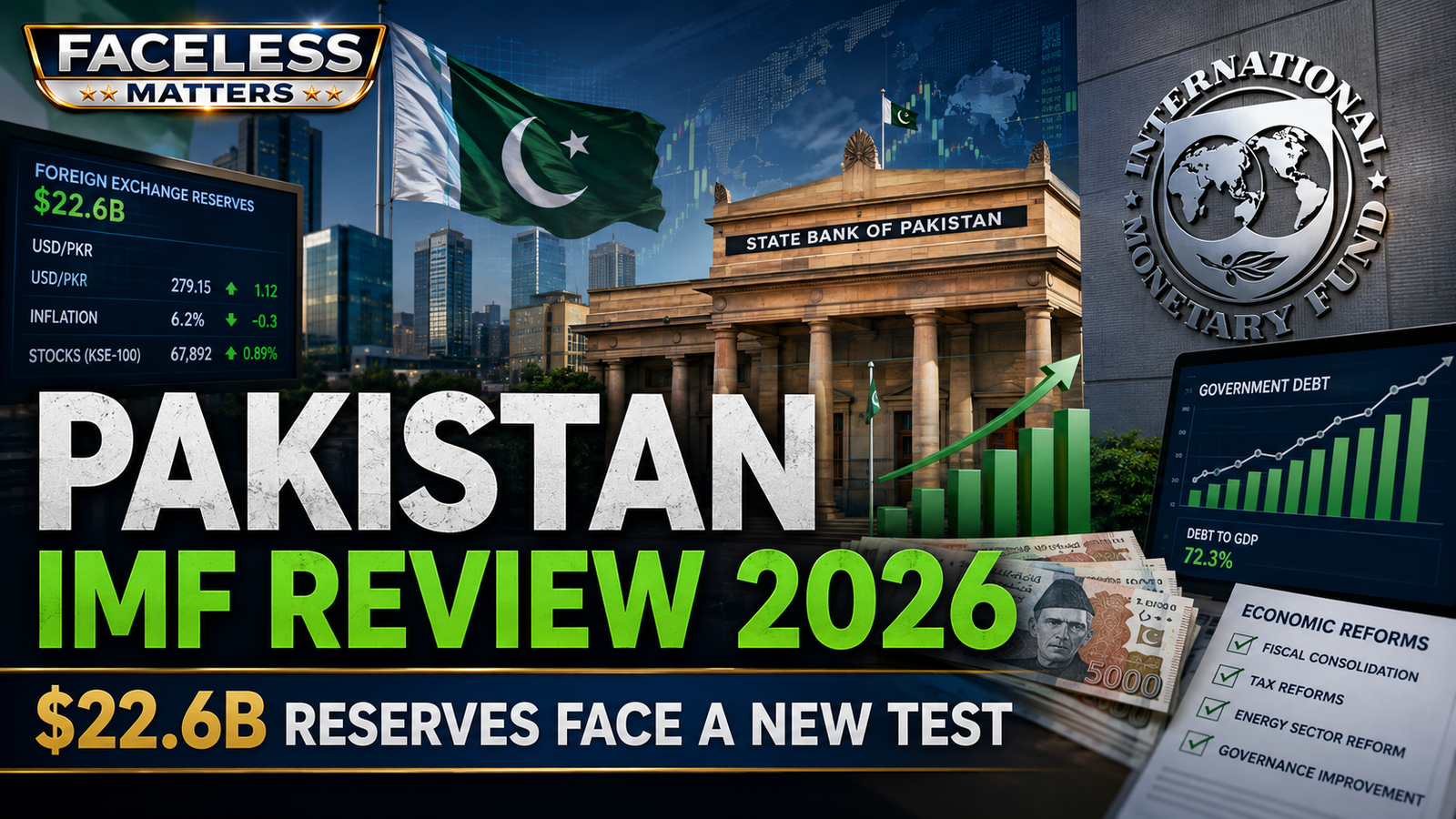
Pakistan’s foreign-exchange position has improved compared with the weaker reserve levels seen during earlier phases of its economic crisis. The State Bank of Pakistan reported total liquid foreign-exchange reserves of $22.587 billion for the week ended August 21, including $17.0985 billion held by the central bank and $5.4889 billion held by commercial banks.
At the same time, Pakistan remains exposed to external pressures.
Global oil prices, geopolitical uncertainty, borrowing costs, energy-sector reforms and the country’s ability to maintain fiscal discipline will all influence the next phase of the programme.
The latest reports indicate that the IMF mission is expected to visit Pakistan next month for the fourth review of the country’s $7 billion Extended Fund Facility, with the exact dates still to be finalized.
The central question is therefore no longer simply whether Pakistan can secure another IMF review.
It is whether the country can convert short-term stabilization into durable economic strength.
What Is Happening With the IMF Review?
The Pakistan IMF review 2026 is the next scheduled major checkpoint under the country’s Extended Fund Facility.
The IMF’s published programme schedule places the fourth review in September 2026, following the third review completed earlier this year. The IMF said in May that completion of the third review allowed Pakistan to draw about $1.1 billion under the EFF and approximately $220 million under the Resilience and Sustainability Facility, taking total disbursements under the two arrangements to about $4.8 billion.
The Pakistan IMF review 2026 is about more than simply securing another tranche of foreign currency.
Its objectives include macroeconomic stability, rebuilding reserves, broadening the tax base, strengthening public finances, reforming state-owned enterprises, improving energy-sector viability and enhancing productivity and competitiveness.
That makes the Pakistan IMF review 2026 economically important for policymakers, businesses and investors.
A successful review can reinforce confidence among lenders and investors.
A difficult review can increase uncertainty around future financing and reform credibility.
FACELESS MATTERS Analysis
The most important point is that Pakistan should not measure success only by whether another IMF tranche arrives.
The real test is whether each review leaves the economy structurally stronger than before.
If reserves rise but imports, debt servicing and energy costs continue generating recurring pressure, the underlying problem has not disappeared.
Stabilization is the beginning of economic recovery, not its final destination.
Why Pakistan’s Reserves Matter
Foreign-exchange reserves are one of the clearest indicators of a country’s external financial resilience.
Pakistan relies heavily on imports for energy, machinery, industrial inputs and other essential goods.
That means the country needs access to foreign currency to keep trade and economic activity functioning.
Higher reserves provide a larger buffer against external shocks as Pakistan approaches the Pakistan IMF review 2026.
The latest SBP figures show that total liquid foreign-exchange reserves reached $22.5874 billion as of August 21. SBP holdings stood at approximately $17.10 billion.
The improvement is significant because reserve accumulation has been one of the central objectives of Pakistan’s stabilization programme.
But reserves must be interpreted carefully when assessing Pakistan’s position ahead of the Pakistan IMF review 2026.
Not every dollar of reserves represents the same level of freely usable financial space.
Debt obligations, import requirements, external payments and future financing needs all matter.
FACELESS MATTERS Analysis
The reserve number is encouraging, but it should not create a false sense of security ahead of the Pakistan IMF review 2026.
The more important question is:
How durable is the reserve improvement?
If reserves increase because of temporary inflows but then fall rapidly when debt repayments or energy-import bills arrive, the underlying vulnerability remains.
For Pakistan, reserve quality and reserve sustainability are more important than celebrating a single weekly number.
The $22.6 Billion Reserve Position
The latest reserve data also provide a useful picture of how Pakistan’s external position is evolving.
The central bank reported:
- SBP reserves: $17.0985 billion
- Commercial-bank reserves: $5.4889 billion
- Total liquid reserves: $22.5874 billion
The figures show that the country has rebuilt a meaningful external buffer compared with the extremely difficult reserve environment of earlier years.
However, Pakistan’s economic structure means that external shocks can still quickly affect the balance.
A sustained increase in oil prices could raise the import bill.
Higher global interest rates can increase financing costs.
Geopolitical disruptions can increase freight and insurance costs.
Weak export growth can limit the pace at which foreign currency is replenished.
Remittances therefore remain important, while export diversification remains a longer-term strategic objective.
Why the Rupee Still Matters
The Pakistani rupee has also remained relatively stable.
SBP data showed a USD/PKR revaluation rate of approximately 277.51 on August 27, while the weighted average bid and offer rates were around 277.23 and 277.66 respectively.
Currency stability matters because a sudden depreciation can quickly affect:
- imported fuel;
- machinery;
- industrial raw materials;
- food imports;
- external debt servicing;
- inflation expectations;
- and business planning.
A stable exchange rate can therefore help reduce uncertainty.
But currency stability should not be achieved through unsustainable intervention.
The stronger approach is to maintain enough external liquidity and economic credibility for the exchange rate to remain broadly stable through market fundamentals.
FACELESS MATTERS Analysis
Pakistan’s currency story has changed significantly from the emergency conditions of earlier years as the Pakistan IMF review 2026 approaches.
The objective now should not be to defend an artificial exchange-rate level at any cost.
The more sustainable objective is to create an economy in which exports, remittances, investment and productivity generate enough foreign currency to support the exchange rate naturally.
That is a much harder task, but it is also the more durable one.
Fiscal Discipline Remains Central
The IMF programme continues to place major emphasis on Pakistan’s fiscal position.
The IMF’s May review said policy priorities included strengthening public finances, expanding the tax base, reforming state-owned enterprises and improving public service provision.
Fiscal discipline matters because persistent government deficits can increase borrowing requirements, making it a key issue for the Pakistan IMF review 2026.
Higher borrowing can place pressure on domestic interest rates.
Higher interest costs can then consume resources that could otherwise be used for development, infrastructure or social spending.
Pakistan therefore faces a difficult balancing act.
The government needs enough revenue to control the fiscal deficit while avoiding policies that unnecessarily weaken investment and economic activity.
Tax reform is consequently one of the most important structural components of the programme.
Energy Reforms and Financial Pressure
Energy remains another major part of Pakistan’s economic challenge.
Electricity and gas pricing affect households, businesses and government finances.
The IMF’s programme documentation includes requirements related to energy tariffs and reforms designed to improve the viability of the energy sector.
The problem is complex.
Keeping tariffs artificially low can increase fiscal pressure and create circular-debt problems.
But sharp price increases can raise household costs and increase inflationary pressure.
The policy challenge is therefore to build an energy system that is financially sustainable without creating unnecessary economic hardship.
FACELESS MATTERS Analysis
Energy reform should not be viewed simply as an IMF demand, especially as Pakistan prepares for the Pakistan IMF review 2026.
It is a structural Pakistani economic problem.
An inefficient energy system acts like a hidden tax on businesses.
It raises production costs, reduces competitiveness and makes exports harder.
A financially healthier energy sector could therefore become an economic-growth reform rather than merely a fiscal requirement.
Why Sovereign Debt Markets Matter
Another less visible but highly important area is Pakistan’s domestic debt market.
The IMF has emphasized the development of the domestic government securities market and diversification of the investor base. Its programme documents include a September 2026 structural benchmark for a comprehensive study and action plan for the local-currency bond market.
This matters because Pakistan has historically relied heavily on domestic banks to absorb government debt.
A broader investor base could potentially improve the functioning of the market and reduce concentration risks.
A deeper bond market can also provide government financing options while creating more instruments for institutional investors.
But debt management must remain disciplined.
A government that simply borrows more because financing is available can postpone rather than solve fiscal problems.
FACELESS MATTERS Analysis
Pakistan’s next financial chapter should be about quality of financing, not merely quantity.
Borrowing should support productivity-enhancing investment where possible.
The country needs a financial system that channels savings into productive activity rather than repeatedly recycling funds into government consumption.
That distinction could determine whether financial stabilization eventually produces sustainable growth.
Pakistan’s Search for New Financing
Pakistan is also exploring broader international financing options.
The Financial Times reported this week that Finance Minister Muhammad Aurangzeb described efforts to secure U.S. financing and a proposed $10 billion swap line as a potential confidence signal to private investors. The report also said Pakistan was preparing to return to international capital markets with possible Eurobond, sukuk, rupee and renminbi-denominated issuances.
This represents an important evolution as Pakistan enters the Pakistan IMF review 2026 with a stronger focus on broader financing options.
Pakistan is not simply looking for emergency liquidity.
It is attempting to improve its access to international capital markets.
That distinction matters.
Emergency financing helps a country survive.
Capital-market access can potentially help a country finance investment and manage liabilities over a longer horizon.
But international markets are demanding.
Investors evaluate creditworthiness, debt sustainability, political risk, foreign-exchange liquidity and economic reforms.
A stronger IMF programme track record can therefore potentially help Pakistan’s broader financing strategy.
Global Markets Are Adding Another Layer of Risk
Pakistan’s economic outlook cannot be separated from the global environment.
Reuters reported today that global markets are facing a difficult September as investors confront inflation concerns, high government debt, energy-price uncertainty and geopolitical risk.
Oil prices remain particularly important.
The Iran conflict and uncertainty around the Strait of Hormuz have produced significant volatility in energy markets. Reuters reported on August 28 that Brent crude was around $89.20 a barrel and heading toward a weekly decline of more than 5% amid hopes of progress concerning the strategic waterway.
For Pakistan, lower oil prices would generally reduce pressure on the import bill.
But the situation can change quickly.
A renewed energy shock could affect inflation, transportation costs, electricity generation and the current account.
FACELESS MATTERS Analysis
This is where Pakistan’s reserve position becomes particularly important.
A stronger reserve buffer gives policymakers more room to absorb temporary external shocks.
But reserves alone cannot protect the economy from a prolonged energy crisis.
The real defence is diversification:
more exports + stronger remittances + efficient energy use + fiscal discipline + productive investment.
That is the economic resilience Pakistan should be building.
What Investors Will Watch
The Pakistan IMF review 2026 will be closely watched not only by policymakers but also by banks, businesses and investors.
Several issues are likely to attract attention.
1. Fiscal performance
Investors will want evidence that fiscal targets remain credible.
2. Tax reform
The ability to increase revenue without damaging productive investment will remain important.
3. Energy-sector reforms
The financial health of the energy sector will continue to affect public finances.
4. Foreign-exchange reserves
The sustainability of reserve accumulation will remain a major indicator.
5. Exchange-rate stability
Markets will watch whether the rupee remains broadly stable without excessive intervention.
6. State-owned enterprises
SOE reform remains part of the broader structural agenda.
7. Debt-market development
The government’s strategy for expanding and improving local debt markets will matter.
8. External financing
Pakistan’s ability to attract longer-term financing and investment will be important.
9. Global oil prices
Energy prices can quickly change Pakistan’s external outlook.
10. Investor confidence
Ultimately, the most important indicator may be whether private investment begins responding positively to economic stabilization.
FACELESS MATTERS Analysis: Stability Is Not the Same as Growth
This is perhaps the most important distinction in the current Pakistani economy.
Pakistan has moved away from the emergency conditions that dominated earlier periods of the crisis.
Reserves are higher.
The exchange rate is more stable.
The IMF programme remains active.
But stabilization alone does not automatically produce strong economic growth.
A country can stabilize its balance sheet while still struggling to create enough productive jobs, exports and private investment.
That is why the next phase should focus on growth quality.
Pakistan needs:
- export diversification;
- productivity improvements;
- energy reform;
- private-sector investment;
- digital services;
- industrial competitiveness;
- infrastructure modernization;
- and stronger human capital.
The IMF programme can provide a framework for stabilization.
It cannot by itself create Pakistan’s long-term growth model.
That responsibility belongs to domestic economic policy.
What Could Strengthen Pakistan’s Position?
Pakistan’s economic position could improve significantly if several reforms begin reinforcing each other.
Export Growth
The country needs to move beyond traditional export concentration and develop higher-value products and services.
Digital Economy
Technology and IT services can provide foreign-exchange earnings without requiring the same level of physical imports as traditional manufacturing.
Energy Efficiency
Reducing energy losses can improve industrial competitiveness while lowering pressure on imports.
Tax Base Expansion
A broader and more predictable tax system can improve government finances.
Investment Climate
Investors require predictable regulations, transparent institutions and reliable infrastructure.
Financial Market Development
A deeper domestic capital market can reduce dependence on a narrow group of lenders.
Remittance Growth
Lower transaction costs and better formal channels can help maintain remittance inflows.
FACELESS MATTERS Analysis
The strongest economic strategy for Pakistan is not to choose between IMF financing, Chinese financing, U.S. financing or private capital.
The stronger strategy is to make the economy attractive enough that financing becomes a supplement rather than a permanent lifeline.
External financing should support transformation.
It should not replace transformation.
What Happens Next?
The immediate focus will be the September Pakistan IMF review 2026.
The IMF programme schedule identifies the fourth review as a September 2026 milestone, with the review linked to quantitative performance criteria and other programme conditions.
Pakistan will therefore enter the next phase with both strengths and vulnerabilities.
Strengths
- Higher foreign-exchange reserves
- More stable exchange rate
- Continued IMF programme
- Improved financial confidence
- Greater focus on structural reforms
Risks
- Energy-price shocks
- Global interest rates
- Debt-service requirements
- Weak external demand
- Fiscal pressures
- Energy-sector inefficiencies
- Geopolitical uncertainty
The outcome will depend heavily on whether Pakistan can maintain policy consistency.
The Bigger Financial Question
The Pakistan IMF review 2026 should not be treated as a pass-or-fail event that determines whether Pakistan is economically successful.
It is better understood as one checkpoint in a much longer transition.
The country is attempting to move from repeated external financing crises toward a more resilient economic model.
That requires time.
It also requires political and institutional consistency.
The biggest danger would be returning to short-term policies immediately after stabilization improves.
History shows that temporary relief can disappear quickly when structural weaknesses remain unresolved.
Pakistan therefore needs to use the current period of relative stability to address the problems that repeatedly generate external pressure.
Pakistan’s Financial Outlook
The latest data provide a mixed but cautiously more stable picture.
Foreign-exchange reserves are substantially stronger than during the most difficult phase of the recent crisis.
The rupee is relatively stable.
The IMF programme remains active.
And Pakistan is exploring broader access to international capital markets.
But the external environment remains uncertain.
Oil prices, geopolitical tensions, global interest rates and international borrowing costs could all change the outlook.
This means Pakistan cannot afford complacency.
The next stage requires converting stabilization into productivity after the Pakistan IMF review 2026.
FACELESS MATTERS Strategic Assessment
The Pakistan IMF review 2026 is important, but the deeper story is bigger than the IMF.
Pakistan has achieved an important degree of financial stabilization.
The latest reserve position of approximately $22.6 billion provides a stronger external cushion, while the relatively stable rupee reduces some immediate pressure on businesses and consumers.
But these gains must now be converted into structural economic strength.
The country needs an economic model that generates foreign exchange through exports, services, investment and productivity rather than repeatedly relying on emergency financing.
The IMF review can test whether reforms are being implemented.
The real test, however, is whether Pakistan can eventually make the IMF less central to its economic survival.
That should be the strategic destination.
9. RELATED FACELESS MATTERS ANALYSIS
1. Bond Market 2026: Rising Yields Trigger a Market Crisis — Finance | August 21, 2026
This very recent Finance analysis examines rising government borrowing costs, inflation and bond-market pressure, providing direct context for the global financing environment Pakistan is entering.
2. Pakistan Digital Economy Initiative 2026: Powerful Digital Growth — Technology | August 7, 2026
This medium-recent Technology article examines Pakistan’s digital economy, IT exports, technology investment and financial inclusion — areas that could contribute to longer-term foreign-exchange generation and economic diversification.
10. SOURCE VERIFICATION & ANALYSIS
International Monetary Fund (IMF) — Pakistan’s EFF programme, review schedule, reform priorities, reserve accumulation and financial-sector structural benchmarks.
State Bank of Pakistan (SBP) — Current foreign-exchange reserves, USD/PKR rates, money-market indicators and financial data for August 2026.
Geo News / The News — Current reporting on the expected September 2026 IMF review mission and proposed Sovereign Wealth Fund legislation.
Financial Times — Pakistan’s efforts to seek U.S. financing, attract private investment and return to international capital markets.
Reuters — Current global market risks, oil prices, geopolitical uncertainty, inflation and interest-rate concerns affecting the international financial environment.
Express Tribune — Current reporting on Pakistan’s $22.59 billion total foreign-exchange reserves and the latest rupee position.
This article independently interprets verified information and separates reported facts from FACELESS MATTERS analysis and strategic commentary.
11. FINAL FACELESS MATTERS STRATEGIC ASSESSMENT
Pakistan enters the next IMF review from a considerably stronger position than during its most acute external-financing periods.
But the objective should not be another cycle of stabilization followed by another crisis.
The real objective should be to build an economy that can generate sufficient exports, investment, productivity and foreign exchange to withstand global shocks without repeatedly requiring emergency support.
The IMF review is the checkpoint. Economic independence is the destination.