

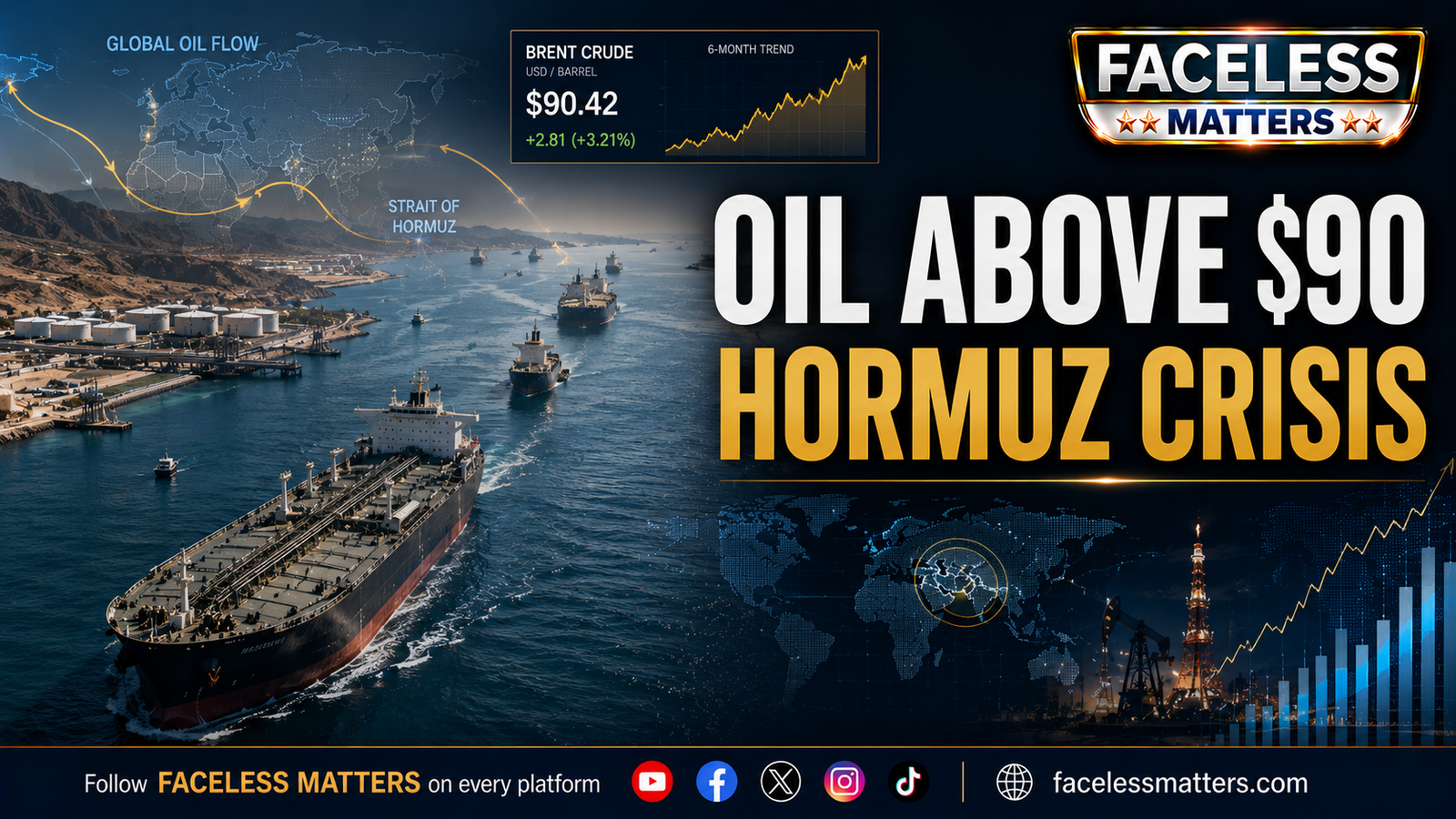
The Strait of Hormuz Crisis has also increased attention on oil supply security and maritime shipping.
TABLE OF CONTENTS
The global energy market is entering another period of heightened uncertainty as oil prices remain above $90 a barrel and shipping through the Strait of Hormuz continues to face severe disruption.
On August 19, 2026, Brent crude was trading around $91.26 per barrel, while WTI was around $84.37. Oil prices have now risen for a fourth consecutive day as uncertainty over the future of the Strait of Hormuz continues to add a geopolitical risk premium to energy markets.
The immediate issue is not simply the price of crude oil. The much larger concern is what happens when one of the world’s most important energy corridors becomes difficult or dangerous to navigate.
Reuters reported that only six commodity vessels passed through the Strait on Tuesday, compared with nine the previous day and a recent average of about 11 daily transits. The waterway previously handled around 20% of global crude oil and liquefied natural gas shipments.
That makes the current situation important for governments, energy companies, manufacturers, transport operators, investors and consumers far beyond the Gulf region.
The Strait of Hormuz Crisis is therefore becoming a major risk for global energy markets, shipping and inflation.
Why the Strait of Hormuz Crisis Matters
The Strait of Hormuz is one of the world’s most strategically important maritime energy chokepoints.
Its importance comes from geography. A relatively narrow waterway connects the Persian Gulf with the Gulf of Oman and the wider Arabian Sea, creating a critical export route for energy-producing countries in the Gulf.
Before the current conflict, roughly one-fifth of global oil and LNG shipments passed through the strait.
That means even a partial reduction in traffic can have consequences that extend well beyond the countries directly involved.
Markets respond not only to barrels that are physically missing but also to the possibility that future supplies could become harder, slower or more expensive to deliver.
That distinction is crucial.
The current market is therefore pricing a combination of:
- physical supply risk;
- higher shipping costs;
- insurance uncertainty;
- longer transportation routes;
- geopolitical risk;
- and the possibility of further disruption.
The result is a risk premium embedded in oil prices.
What Is Happening to Shipping Through Hormuz?
The latest traffic data shows that commercial movement through the strait remains unusually weak.
Reuters reported that only six commodity vessels crossed on Tuesday, including one very large crude carrier entering from the Omani side and two tankers, while three vessels exited.
That matters because energy markets depend on predictable logistics.
A producer can have crude available at the wellhead, but that crude is not economically equivalent to delivered oil if ships cannot safely transport it to refiners.
Security concerns have already caused major shipping companies to reduce or suspend operations through Hormuz and the nearby Bab al-Mandab route. Reuters reported that two major Chinese shipping companies that previously transported about half of China’s Middle Eastern oil imports stopped operating through both routes in late July.
This creates a second-order effect.
The disruption is not simply about oil production.
It is also about whether the global transportation system can move the available energy where it is needed.
Why Oil Can Rise Even Without a Full Supply Collapse
A common mistake is to assume oil prices can rise only when millions of barrels suddenly disappear.
Energy markets do not work that simply.
Traders constantly price expectations.
When a major supply route becomes uncertain, buyers and sellers begin considering the possibility of future shortages. Refiners may seek additional inventory. Shipping companies may demand higher rates. Insurers may reassess risk. Governments may begin reviewing strategic stockpiles.
All of those factors can affect prices before a physical shortage becomes obvious.
That is why Brent crude has remained elevated even while the actual situation continues to develop.
The market is effectively asking:
What happens if today’s disruption becomes tomorrow’s supply shortage?
That question can be enough to keep prices elevated.
The Energy Crisis Is Also a Shipping Crisis
The Strait of Hormuz story is increasingly becoming a story about global shipping economics.
When ships avoid a high-risk route, they may need to travel farther, use alternative ports or wait for better conditions.
Every additional day at sea can increase:
- fuel consumption;
- crew costs;
- financing costs;
- insurance premiums;
- charter rates;
- and delivery times.
The Financial Times has reported that the ongoing Middle East disruption has pushed Gulf-to-Asia oil shipping costs to exceptionally high levels, highlighting how geopolitical conflict can create a logistics shock even before a complete supply interruption occurs.
This is why energy markets cannot be analyzed only by looking at the crude-oil chart.
The real system includes ships, ports, pipelines, refineries, insurers, storage facilities, power plants and industrial consumers.
How Higher Oil Prices Could Feed Inflation
Oil is one of the most important inputs in the global economy.
When crude becomes more expensive, the impact can travel through several channels.
Higher crude prices can increase the cost of gasoline, diesel, jet fuel and other refined petroleum products.
Higher fuel costs can then affect trucking, aviation, shipping, agriculture, construction and manufacturing.
That creates a chain:
Higher oil prices → higher transport costs → higher business costs → higher consumer prices
The timing and scale can vary by country, but the basic economic mechanism is straightforward.
That is why the oil market is being watched closely by central banks as well as energy traders.
Reuters noted that recent oil-price gains have already contributed to broader inflation concerns in global markets.
The Hidden Risk: Refined Fuel Prices
Crude oil is not the only market that matters.
In some circumstances, refined products can become even more important.
Diesel, gasoline and jet fuel are what households and businesses actually consume. Even when crude prices move moderately, refining and transportation constraints can create much larger moves in fuel prices.
Reuters recently highlighted extreme pressure in the U.S. diesel market, with the diesel crack spread rising above $100 per barrel amid supply disruption.
That illustrates an important point:
Consumers do not experience the oil market directly. They experience fuel prices.
This distinction can become increasingly important if geopolitical disruption continues.
Why Asia Is Particularly Exposed
Asia is especially important because many of the world’s largest energy importers depend heavily on Gulf supplies.
China, India, Japan, South Korea and other Asian economies require huge volumes of imported energy to support manufacturing, transportation and power generation.
Reuters reported that Chinese shipping firms have already reduced their use of Hormuz and Bab al-Mandab amid heightened security concerns.
That raises several questions for Asian economies.
Can alternative supply routes deliver enough crude?
Can refiners maintain normal operations?
Will countries draw on inventories?
How much additional transportation cost can companies absorb?
And ultimately, how much of the higher energy cost will be transferred to consumers?
The answers will shape the economic impact of the crisis.
What Could Higher Oil Prices Mean for Pakistan?
Pakistan is particularly sensitive to energy-price shocks because changes in imported fuel costs can affect transportation, electricity generation, industry and the broader inflation environment.
Pakistan’s Planning Commission has already documented how the 2026 Middle East conflict affected crude prices and highlighted the importance of the Strait of Hormuz to global oil and LNG trade. The government’s Annual Plan reported that average crude prices jumped sharply during March-April 2026 as geopolitical disruption intensified, while higher insurance and freight costs also affected energy imports.
This means another sustained period of elevated oil prices could create pressure through several channels.
Higher imported fuel costs can raise the cost of moving goods.
Higher transportation costs can affect food and manufactured products.
Energy-intensive businesses can face higher operating expenses.
And if fuel-price increases become persistent, inflationary pressure can become harder to manage.
For Pakistan, therefore, the Strait of Hormuz crisis is not simply a distant geopolitical story.
It can become an economic story.
Can Alternative Routes Replace Hormuz?
Alternative transportation routes can reduce some of the pressure, but they cannot instantly replace the strategic importance of Hormuz.
Pipelines can move some energy without using shipping routes.
Oil can potentially be redirected through alternative export infrastructure.
Some vessels can use other maritime corridors.
Strategic inventories can provide temporary relief.
But none of these solutions completely eliminates the physical and logistical importance of the strait.
Reuters reported that traffic through Bab al-Mandab has increased, but Saudi oil shipments had not resumed there following a naval blockade declared by Yemen’s Houthis.
That illustrates the broader challenge.
Moving around one chokepoint can simply shift pressure onto another.
What Energy Companies Are Watching
Energy companies are likely to focus on several developments simultaneously.
First is the actual vessel traffic through Hormuz.
Second is whether additional export routes can absorb meaningful volumes.
Third is the direction of Brent and WTI prices.
Fourth is the cost of tanker insurance and freight.
Fifth is refinery demand and refined-product prices.
Sixth is whether governments release strategic petroleum reserves.
And seventh is the direction of diplomatic and military developments in the region.
These factors matter because oil prices can change quickly when expectations change.
A credible reopening of Hormuz could remove part of the geopolitical risk premium.
A renewed escalation could push that risk premium higher.
What Higher Oil Prices Could Mean for Businesses
The impact will not be evenly distributed.
Some companies may benefit from higher energy prices.
Oil and gas producers can potentially receive stronger revenues when crude prices rise.
Energy exporters may also benefit from improved government revenues and stronger trade balances.
But energy-intensive businesses face the opposite problem.
Airlines, logistics companies, shipping operators, manufacturers and heavy industrial businesses can face significantly higher costs.
For businesses, the Strait of Hormuz Crisis could mean higher energy, transport and insurance costs.
The most vulnerable companies are often those with:
- high fuel consumption;
- low pricing power;
- thin operating margins;
- large transportation requirements;
- or heavy dependence on imported energy.
That means the energy shock can produce winners and losers at the same time.
What Higher Oil Prices Could Mean for Consumers
Consumers are eventually affected when businesses pass higher input costs through the economy.
Potential effects include:
Fuel: Higher gasoline and diesel costs.
Transportation: More expensive logistics and passenger travel.
Food: Higher transportation and agricultural input costs.
Electricity: Greater pressure where fuel imports affect generation costs.
Household budgets: Less money available for discretionary spending.
This is why energy markets can become an economy-wide issue.
Even people who do not follow oil futures are exposed to changes in the cost of energy.
The Bigger Global Energy Picture
The Strait of Hormuz crisis demonstrates a broader structural weakness in the global economy.
Modern economies are deeply interconnected.
Energy supply depends on shipping.
Shipping depends on security.
Industry depends on energy.
Consumer prices depend on industry and logistics.
And financial markets respond to all of those expectations at the same time.
That means a disruption in one strategic waterway can eventually influence inflation, interest rates, corporate earnings, currencies and investment decisions.
The world is also entering a period of unusually high infrastructure demand.
Data centers, semiconductor manufacturing, electricity networks, industrial facilities and defense systems are all competing for capital at a time when long-term financing costs are already under pressure.
A sustained increase in energy prices would add another layer of cost to that investment cycle.
What Energy Markets Are Watching Next
The next phase of the story will depend heavily on whether traffic through Hormuz begins to normalize.
Markets will be watching:
1. Vessel traffic
A sustained recovery in shipping would signal improving confidence.
2. Brent crude
A continued move higher would indicate that the market is assigning greater probability to prolonged disruption.
3. Refined fuels
Diesel and jet-fuel prices may reveal stress earlier than crude prices alone.
4. Insurance and freight
Higher shipping costs could maintain pressure even if physical oil supply remains available.
5. Diplomatic developments
Any credible progress toward reopening the waterway could rapidly alter market expectations.
6. Strategic stockpiles
Government releases could temporarily reduce supply pressure.
7. Asian demand
Weakening demand could limit the upside in crude prices, while strong demand could amplify the impact of disrupted shipments.
The Bigger Economic Question
The most important question is no longer simply:
How high can oil prices go?
The more important question is:
How long can elevated energy and shipping costs remain embedded in the global economy?
A short disruption could produce a temporary price shock.
A prolonged disruption could become a broader inflation and growth problem.
That distinction matters for central banks, governments and businesses.
Central banks may have less room to respond if inflation rises at the same time economic growth weakens.
Companies may delay investments if operating costs remain uncertain.
Consumers may reduce spending if fuel and transportation prices remain elevated.
And governments may face difficult decisions between supporting households, protecting foreign-exchange reserves and maintaining fiscal stability.
The deeper risk is therefore not one expensive barrel of oil.
It is the possibility of a longer period in which energy, shipping and financing all become more expensive at the same time.
The longer the Strait of Hormuz Crisis continues, the greater the potential pressure on global oil prices and consumers.
INTERNAL READING
For more analysis from FACELESS MATTERS, explore our related coverage on Pakistan’s digital economy, economic developments and major institutional changes. These stories provide additional context for readers following the wider economic and strategic environment.
1 — Pakistan Digital Economy Initiative 2026: Powerful Digital Growth
3 — Pakistan Independence Day 2026: Courage, Sacrifice & Unity
4 — The Role of Institutions and Citizens in Ending Pakistan Terrorism
5 — The AI Infrastructure Boom: Nvidia, OpenAI and the Global Race for Data Centers, Chips and Power
Source Verification & Analysis
Reuters — Hormuz traffic slows as uncertainty over the waterway persists, August 19, 2026.
Wall Street Journal — Oil rises on persistent Hormuz uncertainty, August 19, 2026.
Reuters — Indian rupee pressured by rising crude prices and Hormuz uncertainty, August 19, 2026.
Reuters — Global markets facing inflation and bond-market pressure as oil rises, August 18, 2026.
Financial Times — Global shipping costs and disruption to strategic trade routes, August 2026.
Pakistan Planning Commission — Annual Plan 2026–27, including the impact of the Middle East conflict, crude prices, freight and Strait of Hormuz disruption.
Pakistan Ministry of Energy (Petroleum Division) — Petroleum-price notifications and energy-sector updates.
Dawn / Reuters — Recent oil-market reporting on Hormuz and global crude prices.
Associated Press — Latest regional developments involving the UAE, Iran and maritime security.
FACELESS MATTERS — Related internal coverage for broader economic and strategic context.
Educational Note
This article is intended for informational, educational and economic-awareness purposes only. It does not constitute financial, investment, commodity-trading, legal or professional advice. Energy markets can change rapidly because of geopolitical developments, supply disruptions, currency movements, policy decisions and changes in demand. Readers should independently verify important information and consider qualified professional advice before making financial or business decisions.
[…] 1. Strait of Hormuz Crisis: Oil Above $90 in 2026آبنائے ہرمز، تیل کی قیمتوں، shipping security اور پاکستان سمیت عالمی معیشت پر ممکنہ اثرات کے لیے یہ مضمون براہِ راست متعلقہ ہے۔ Strait of Hormuz Crisis: Oil Above $90 in 2026 […]
[…] 1. [Strait of Hormuz Crisis: Oil Above $90 in 2026] — Economy | Very RecentThis is the closest related FACELESS MATTERS analysis, examining oil prices, tanker traffic, shipping costs, inflation and Pakistan’s exposure to Hormuz disruption. Strait of Hormuz Crisis: Oil Above $90 in 2026 […]
[…] Strait of Hormuz Crisis: Oil Above $90 in 2026 — An Economy analysis showing how energy security, shipping disruption and economic pressures can […]
[…] Strait of Hormuz Crisis: Oil Above $90 in 2026 — An economy and geopolitics article examining energy security, shipping disruption and the […]
[…] Strait of Hormuz Crisis: Oil Above $90 in 2026 — Economy | Very RecentThis recent FACELESS MATTERS analysis explains how Iran-related […]
[…] Recent / Economy:Strait of Hormuz Crisis: Oil Above $90 in 2026 — A deeper look at the energy and shipping dimension behind current West Asian instability and […]
[…] 2. Strait of Hormuz Crisis: Oil Above $90 in 2026 […]
[…] Strait of Hormuz Crisis: Oil Above $90 in 2026تیل، shipping disruption، inflation اور پاکستان کے energy exposure کے حوالے سے پس منظر۔ […]
[…] 2. Strait of Hormuz Crisis: Oil Above $90 in 2026 — An economy-focused analysis of Hormuz, shipping disruption, oil prices, inflation and the potential impact on Pakistan and global markets.Strait of Hormuz Crisis: Oil Above $90 in 2026 […]
[…] Strait of Hormuz Crisis: Oil Above $90 in 2026عالمی oil prices، energy security اور geopolitical risk کے پاکستان کی معیشت پر ممکنہ اثرات کا متعلقہ تجزیہ۔ […]
[…] 3. Regional Security, Energy & Strategic Pressure — Our analysis of the Strait of Hormuz crisis examines how regional instability can affect energy security, shipping, economic stability and the strategic calculations of countries across Asia and the Middle East. Read: Strait of Hormuz Crisis: Oil Above $90 in 2026 […]
[…] Economy / very recent: Strait of Hormuz Crisis: Oil Above $90 in 2026 — Provides useful context on energy security and the geopolitical forces that also influence […]
[…] Economy / very recent: Strait of Hormuz Crisis: Oil Above $90 in 2026 — Provides useful context on energy security and the geopolitical forces that also influence […]
[…] Read the FACELESS MATTERS Strait of Hormuz analysis […]
[…] Strait of Hormuz Crisis: Oil Above $90 in 2026 […]
[…] Strait of Hormuz Crisis: Oil Above $90 in 2026 […]
[…] Strait of Hormuz Crisis: Oil Above $90 in 2026 […]