


TABLE OF CONTENTS
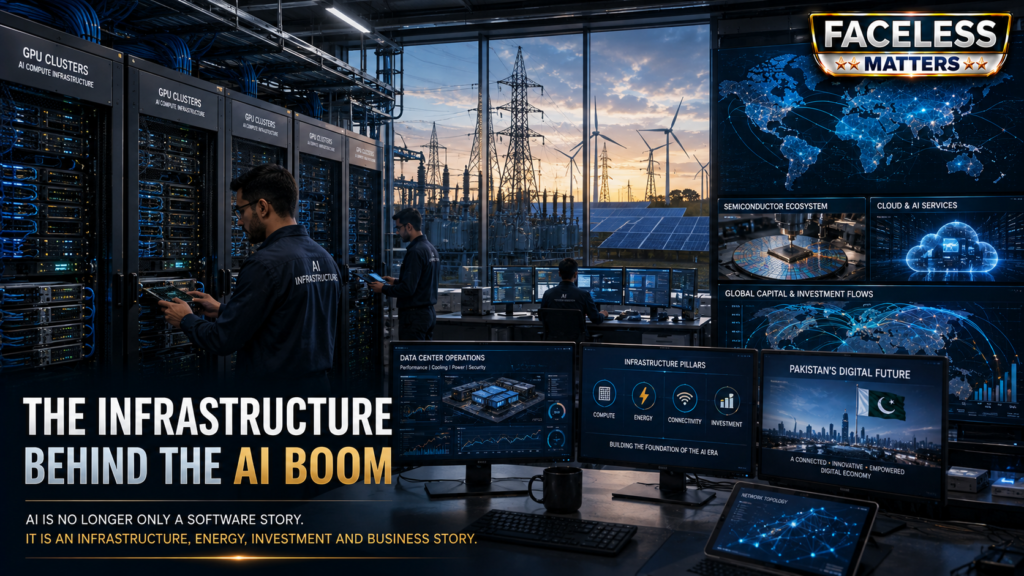
The AI infrastructure boom is entering a new phase, transforming artificial intelligence from a software story into a global business race for chips, data centers, electricity, capital and digital infrastructure.
For years, the AI story was largely about algorithms, chatbots and increasingly powerful software. Now the biggest competition is moving beneath the surface — into chips, data centers, electricity, cooling systems, networks, financing and industrial infrastructure.
That shift is creating a new global business race.
Nvidia’s latest agreement with OpenAI illustrates just how large this transformation is becoming. Nvidia has agreed to provide up to $105 billion in guarantees supporting OpenAI’s lease of a major Ohio data-center project being developed by SB Energy, while also investing $1.5 billion in SB Energy. The planned facility could eventually reach 8 gigawatts of capacity, with the first 800 megawatts expected to come online in 2028. Reuters
The numbers are enormous, but the bigger story is what they reveal.
AI is becoming an infrastructure economy.
The AI Race Is Becoming a Race for Physical Infrastructure
Modern AI systems require extraordinary amounts of computing power.
Behind every large AI model is a physical ecosystem containing specialized processors, servers, networking equipment, cooling systems, buildings and electricity.
That means companies competing in AI increasingly need access not only to talented engineers but also to:
- advanced semiconductor chips
- high-performance computing systems
- large data centers
- reliable electricity
- cooling infrastructure
- fiber-optic networks
- land and construction capacity
- long-term financing
This changes the economics of the technology industry.
The winners of the next stage of AI may not simply be companies with the best software. They may also be companies capable of building, financing and operating the infrastructure required to run that software at global scale.
Why Nvidia Is Moving Deeper Into Infrastructure
Nvidia’s position in this transformation is particularly important.
The company is best known for its GPUs, which have become foundational hardware for modern AI computing. But the latest OpenAI deal demonstrates how the company’s role can extend beyond simply selling chips.
The AI infrastructure boom is also changing how semiconductor companies participate in the technology economy.
Nvidia says its infrastructure strategy is designed to secure long-lived computing capacity where its processors can be deployed and upgraded over multiple generations. Reuters reported that Nvidia expects the Ohio facility to use Nvidia chips exclusively. Reuters
This creates a powerful business relationship.
More AI applications require more computing.
More computing requires more GPUs.
More GPUs require more data centers.
More data centers require more electricity.
And more electricity requires new infrastructure.
That creates a chain connecting the semiconductor industry with construction, utilities, finance, cloud computing and the broader economy.
OpenAI’s Data Center Strategy Shows the Scale of Future AI Demand
OpenAI’s planned Ohio facility is one example of the infrastructure scale being considered for the next generation of AI.
The project is expected to reach up to 8 gigawatts of capacity, while SoftBank and SB Energy plan additional power-generation capacity and regional grid investment to support the site. Reuters reported that the project could create around 35,000 construction jobs through 2032 and 2,500 long-term operating positions. Reuters
This is significant because it shows that AI investment can have an impact far beyond software companies.
A large AI data center can require:
construction → electricity → engineering → cooling → networking → security → maintenance → logistics → financing
In other words, the AI economy can generate demand across multiple industries simultaneously.
The Hidden Bottleneck: Electricity
One of the most important questions surrounding the AI boom is no longer simply:
How many chips can companies manufacture?
It is:
Where will the electricity come from?
Data centers operate continuously and advanced AI computing can be extremely energy intensive.
Reuters reported that land and power availability are increasingly becoming hurdles for new U.S. data-center development, with grid constraints and community concerns becoming part of the infrastructure debate. Reuters
This means electricity is becoming a strategic business resource.
As the AI infrastructure boom accelerates, electricity is becoming one of the most important constraints on future data-center growth.
As the AI infrastructure boom accelerates, electricity is becoming one of the most important constraints on future data-center growth.
Companies developing AI infrastructure increasingly need locations where they can secure:
- reliable power
- sufficient grid capacity
- affordable electricity
- cooling resources
- connectivity
- regulatory support
That could influence where future technology hubs emerge.
Why AI Infrastructure Could Become a Massive Investment Theme
The AI infrastructure boom has implications for investors and businesses far beyond Nvidia and OpenAI.
Demand can potentially flow toward:
Semiconductors
Advanced AI systems require powerful processors and supporting hardware.
Data centers
AI workloads require increasingly large computing facilities.
Energy
Data centers require dependable electricity and new generation capacity.
Construction
Large-scale infrastructure projects require buildings, engineering and specialized equipment.
Networking
AI systems depend on high-speed communication between processors and data centers.
Cooling
High-density computing produces substantial heat, creating demand for sophisticated thermal-management systems.
Finance
Large infrastructure projects require enormous amounts of capital and sophisticated financing structures.
The result is an ecosystem rather than a single industry.
The AI infrastructure boom is creating investment opportunities across semiconductors, data centers, energy, construction and finance.
For investors and businesses, the AI infrastructure boom is creating opportunities across technology, energy, construction and finance.
But There Is Also a Financial Risk
Rapid infrastructure investment does not automatically guarantee equally rapid returns.
The scale of current AI spending has already raised questions about how projects are financed and whether the economic returns will justify the capital being deployed.
Reuters noted that Nvidia’s financing role has prompted questions about circular financing because the company is helping support infrastructure that ultimately creates demand for its own chips. Nvidia has rejected the characterization of its Ohio arrangement as circular financing. Reuters
That distinction matters.
A technology boom can create enormous economic value while still producing individual projects that fail to generate expected returns.
The central question for investors will therefore become:
The AI infrastructure boom could become one of the defining business and infrastructure stories of this decade.
Can AI revenue eventually justify the infrastructure being built today?
That answer will become clearer as AI adoption moves from experimentation toward measurable productivity and commercial revenue.
Pakistan’s Digital Economy: Why Google’s Local Presence Matters
The global AI infrastructure story also has a Pakistani dimension.
Pakistan is attempting to position itself as a larger participant in the digital economy, particularly through AI skills, IT exports, digital services and technology partnerships.
The Government of Pakistan has stated that Google decided to open an office in Pakistan in July 2026. The government has also highlighted Google’s ongoing training and AI capacity-building initiatives. PID
Google’s own Pakistan information page highlights three broad areas of engagement: economic contribution and digital skills, online safety, and advancing Pakistan through AI. It also cites research suggesting significant potential economic benefits from wider AI adoption in Pakistan. About Google
This is important because a local office should not be viewed simply as another corporate address.
Pakistan can also benefit from the AI infrastructure boom by developing digital skills, technology services and AI-enabled businesses.
A stronger local presence can potentially improve coordination between technology companies, businesses, developers, educators and policymakers.
From Google Pakistan to New Digital Opportunities
Pakistan’s technology economy already has a substantial base.
The Ministry of IT and Telecommunication currently lists more than 2.3 million freelancers, more than 26,000 SECP-registered IT and ITeS companies, and IT and ITeS exports of more than $3.8 billion for the cited fiscal period. Ministry of IT & Telecommunication
The country’s challenge is therefore not simply getting more people online.
The bigger opportunity is moving from basic digital participation toward:
The AI infrastructure boom may become one of the defining business stories of this decade.
AI skills → higher-value services → software products → global clients → technology exports → investment
That transition could potentially create higher-value employment and business opportunities.
Pakistan’s government has also been expanding digital-skills initiatives. In April 2026, Google for Developers and Pakistani partners launched AI Seekho 2026, aimed at developing AI capabilities among young professionals and developers. Associated Press of Pakistan
Will Google’s Pakistan Office Create Jobs?
It is important to separate potential from guaranteed outcomes.
A technology company’s local presence can support employment directly through corporate operations, but the larger economic impact can come indirectly.
For example:
Google presence
↓
local partnerships
↓
developer ecosystem
↓
AI skills
↓
startups and digital businesses
↓
international clients
↓
higher-value employment
That is the broader opportunity.
Government sources have also linked Google’s wider Pakistan initiatives with local manufacturing, skills development and employment. Pakistan‘s first Chromebook assembly initiative, for example, was presented as a way to support local manufacturing, supply chains, technical skills and employment. PID
The important point is that a digital economy grows through an ecosystem, not through one company alone.
The Next Battle May Be Between Power Grids, Not Just AI Models
The most interesting development in the AI economy may be happening outside the traditional technology headlines.
As AI models become more capable, the limiting factor may increasingly become physical.
Who has enough electricity?
Who has enough land?
Who can build data centers quickly?
Who has access to advanced chips?
Who can finance massive infrastructure?
Who can connect it to global networks?
These questions could influence the geography of the next technology cycle.
Countries with abundant energy, strong grids, reliable connectivity, skilled workers and business-friendly technology policies could become increasingly attractive destinations for AI infrastructure.
What This Means for Businesses
For businesses, the AI infrastructure boom means that artificial intelligence should no longer be viewed purely as a software trend.
It is becoming an economic infrastructure trend.
Companies that adopt AI may benefit through productivity, automation, customer service, analytics and product development.
But businesses also need to understand the costs.
AI adoption can require:
- cloud computing
- data storage
- cybersecurity
- specialized software
- employee training
- digital infrastructure
- reliable connectivity
The companies that successfully combine AI with real business processes may ultimately gain more than companies that simply add an AI label to their products.
What Happens Next?
The next phase of the AI race will likely be defined by a combination of computing power, capital and electricity.
Nvidia and OpenAI’s Ohio project provides an unusually clear example of this transition.
The project is not simply about building a data center.
It represents a much larger economic chain connecting chips, AI models, financing, electricity, construction, cloud computing and future digital services. Reuters
Pakistan’s growing engagement with Google and other technology initiatives represents a different but related opportunity: ensuring that countries outside the traditional technology centers can participate in the value created by the AI economy.
The countries and businesses that build skills, infrastructure and reliable digital ecosystems today could be better positioned for the next decade of technology-driven growth.
The Bigger Picture
The AI revolution is entering an important transition.
The first phase was about building intelligent software.
The next phase is about building the physical world that intelligent software needs.
That means chips.
Data centers.
Electricity.
Cooling.
Networks.
Capital.
And people.
Nvidia’s growing role in AI infrastructure and OpenAI’s enormous computing requirements show how quickly the technology industry is evolving. Meanwhile, Pakistan’s efforts to deepen its relationship with Google and develop digital and AI skills demonstrate how emerging economies are seeking a place in the same global transformation. Reuters
The AI infrastructure boom may therefore become one of the defining business stories of this decade.
The future of AI will not be built only in software laboratories. It will also be built inside data centers, power plants, semiconductor facilities, universities, startups and digital economies around the world.
Sources & Further Reading
Associated Press of Pakistan — AI skills development
Reuters — Nvidia and OpenAI data-center infrastructure developments
Government of Pakistan — Google Pakistan initiatives
Google — Digital skills and AI initiatives in Pakistan
Ministry of IT & Telecommunication — Pakistan digital economy
[…] 5 — The AI Infrastructure Boom: Nvidia, OpenAI and the Global Race for Data Centers, Chips and Power […]
[…] 4 — The AI Infrastructure Boom: Nvidia, OpenAI and the Global Race for Data Centers, Chips and Power […]
[…] The AI Infrastructure Boom: Nvidia, OpenAI and the Global Race for Data Centers, Chips and PowerUse this for the connection between rising electricity demand, data centers, AI infrastructure and […]
[…] The AI Infrastructure Boom: Nvidia, OpenAI and the Global Race for Data Centers, Chips and PowerUse this for the connection between rising electricity demand, data centers, AI infrastructure and […]
[…] The AI Infrastructure Boom: Nvidia, OpenAI and the Global Race for Data Centers, Chips and PowerUse this for the broader technology/investment connection between AI infrastructure and digital […]
[…] The AI Infrastructure Boom: Nvidia, OpenAI and the Global Race for Data Centers, Chips and PowerUse this for the connection between rising electricity demand, data centers, AI infrastructure and […]
[…] The AI Infrastructure Boom: Nvidia, OpenAI and the Global Race for Data Centers, Chips and PowerUse this for the connection between rising electricity demand, data centers, AI infrastructure and […]
[…] The AI Infrastructure Boom: Nvidia, OpenAI and the Global Race for Data Centers, Chips and PowerUse this for the connection between rising electricity demand, data centers, AI infrastructure and […]
[…] The AI Infrastructure Boom: Nvidia, OpenAI and the Global Race for Data Centers, Chips and PowerUse this for the connection between rising electricity demand, data centers, AI infrastructure and […]
[…] The AI Infrastructure Boom: Nvidia, OpenAI and the Global Race for Data Centers, Chips and PowerUse this for the connection between rising electricity demand, data centers, AI infrastructure and […]
[…] The AI Infrastructure Boom: Nvidia, OpenAI and the Global Race for Data Centers, Chips and PowerUse this for the connection between rising electricity demand, data centers, AI infrastructure and […]
[…] 5 — The AI Infrastructure Boom: Nvidia, OpenAI and the Global Race for Data Centers, Chips and Power […]
[…] 3. The AI Infrastructure Boom: Nvidia, OpenAI and the Global Race for Data Centers, Chips and Powerیہ مضمون مصنوعی ذہانت، ڈیٹا سینٹرز، بجلی کی بڑھتی طلب اور توانائی کے بنیادی ڈھانچے کے درمیان تعلق کو سمجھنے میں مدد دے گا۔ […]
[…] The AI Infrastructure Boom: Nvidia, OpenAI and the Global Race for Data Centers, Chips and Powerیہ مضمون مصنوعی ذہانت، ڈیٹا سینٹرز، بجلی کی بڑھتی طلب […]
[…] 3. https://facelessmatters.com/ai-infrastructure-boom/ […]
[…] 2.The AI Infrastructure Boom: Nvidia, OpenAI and the Global Race for Data Centers, Chips and PowerAI کے پیچھے موجود computing infrastructure اور scientific data processing کی بڑھتی ہوئی اہمیت کو سمجھنے کے لیے۔ […]
[…] 2. [The AI Infrastructure Boom: Nvidia, OpenAI and the Global Race for Data Centers, Chips and Power] — technology infrastructure، computing power اور electricity کے بڑھتے ہوئے تعلق کو سمجھنے کے لیے۔ The AI Infrastructure Boom: Nvidia, OpenAI and the Global Race for Data Centers, Chips and Power […]
[…] The AI Infrastructure Boom: Nvidia, OpenAI and the Global Race for Data Centers, Chips and PowerAI infrastructure، chips، data centers، electricity اور OpenAI کی بڑھتی ہوئی […]
[…] 3. AI Infrastructure Boom: 7 Shifts in Chips & Data Centers — A Business analysis of investment, infrastructure, energy, technology and capital allocation, offering a broader perspective on how industrial investment can reshape economies.AI Infrastructure Boom: 7 Shifts in Chips & Data Centers […]
[…] The AI Infrastructure Boom: Nvidia, OpenAI and the Global Race for Data Centers, Chips and Power — Medium / Business: 19 اگست 2026 کی Business رپورٹ AI infrastructure، electricity، […]
[…] The AI Infrastructure Boom: Nvidia, OpenAI and the Global Race for Data Centers, Chips and Power — Business | August 19, […]
[…] The AI Infrastructure Boom: Nvidia, OpenAI and the Global Race for Data Centers, Chips and Power — Business | Medium-RecentThis analysis is relevant to the technology-intensive production […]
[…] The AI Infrastructure Boom: Nvidia, OpenAI and the Global Race for Data Centers, Chips and PowerAI infrastructure، chips، data centers، electricity اور OpenAI کی بڑھتی ہوئی […]
[…] The AI Infrastructure Boom: Nvidia, OpenAI and the Global Race for Data Centers, Chips and Power […]
[…] The AI Infrastructure Boom: Nvidia, OpenAI and the Global Race for Data Centers, Chips and Power […]
[…] The AI Infrastructure Boom: Nvidia, OpenAI and the Global Race for Data Centers, Chips and Power […]
[…] The AI Infrastructure Boom: Nvidia, OpenAI and the Global Race for Data Centers, Chips and PowerUse this for the connection between rising electricity demand, data centers, AI infrastructure and […]
[…] The AI Infrastructure Boom: Nvidia, OpenAI and the Global Race for Data Centers, Chips and PowerUse this for the connection between rising electricity demand, data centers, AI infrastructure and […]
[…] The AI Infrastructure Boom: Nvidia, OpenAI and the Global Race for Data Centers, Chips and PowerUse this for the broader technology/investment connection between AI infrastructure and digital […]