

TABLE OF CONTENTS
The end of August is often treated as a quiet transition period for global markets. In 2026, that assumption looks increasingly outdated.
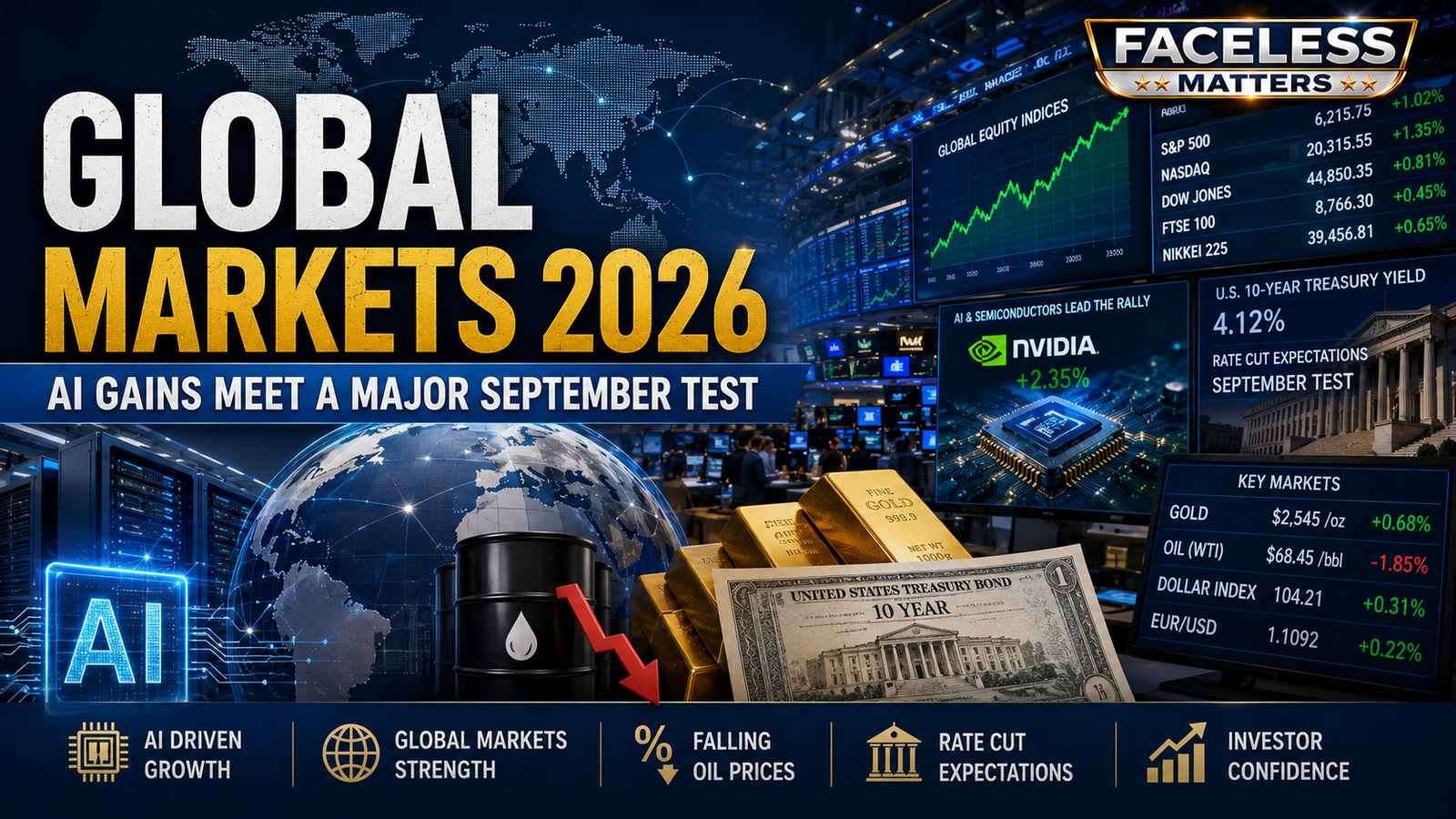
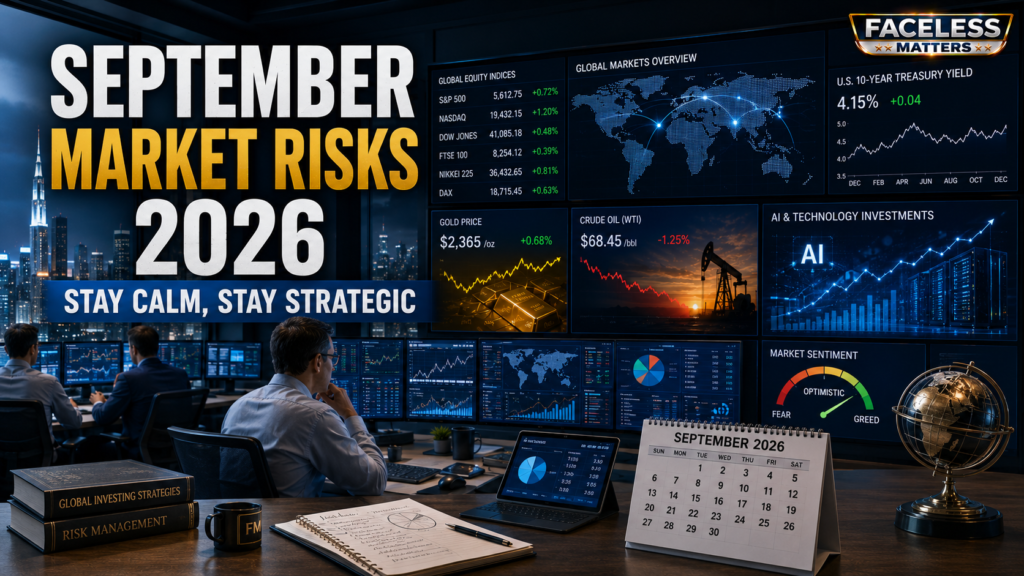
September Market Risks 2026 are emerging from several directions at the same time: inflation remains important, bond yields are demanding attention, central-bank policy is uncertain, government debt is increasingly part of the market conversation, and geopolitical developments continue to influence energy prices and investor confidence.
Yet the most important message for investors is not that September will necessarily be dangerous.
It is that September could become a test of discipline.
Recent market action supports that view. Reuters reported on August 28 that global equities rose after Federal Reserve Chair Kevin Warsh’s Jackson Hole speech, while U.S. two-year Treasury yields and the dollar also strengthened as expectations of a possible rate increase increased.
That combination tells us something important: markets can remain optimistic about economic growth while simultaneously becoming more cautious about inflation and monetary policy.
That is precisely why September Market Risks 2026 should be viewed as a strategic issue rather than a prediction game.
Why September Could Become a Turning Point
September has the potential to bring investors back from the relatively quieter summer trading environment into a much more information-heavy period.
Central banks will remain under pressure to balance inflation against economic growth. Investors will examine employment data, inflation releases, government borrowing requirements and corporate earnings.
At the same time, geopolitical developments could continue affecting oil and risk sentiment.
Reuters has highlighted a broader September risk landscape involving government debt, prolonged inflation, geopolitics, interest-rate decisions and upcoming economic data.
This does not mean that markets must fall.
In fact, one of the strongest lessons from recent market behaviour is that uncertainty and rising equity prices can coexist.
September Market Risks 2026 therefore need to be understood through scenarios rather than headlines.
1. Inflation Is Still the Market’s Quiet Pressure Point
Inflation may no longer dominate every headline, but it remains one of the most important variables in financial markets.
The reason is straightforward.
If inflation moves convincingly toward central-bank targets, policymakers have more flexibility. If inflation remains stubborn, interest rates may need to stay higher for longer — or even rise.
Warsh’s latest comments reinforced that principle. Reuters reported that he emphasized the Federal Reserve’s commitment to its 2% inflation target and suggested further action could be necessary if inflation does not convincingly return toward that objective.
That creates a difficult balance.
Technology companies may continue to benefit from strong AI investment. Consumers may continue spending. Corporate earnings may remain healthy.
But if inflation remains persistent, the cost of capital can remain restrictive.
For the September outlook, this is perhaps the most important underlying question:
Can economic growth remain strong without reigniting inflationary pressure?
That answer will influence almost every major asset class.
2. Bond Yields Deserve More Attention
Equity investors often focus on stock prices while treating bonds as a secondary story.
That can be a mistake.
Treasury yields influence borrowing costs throughout the financial system. They affect corporate financing, mortgage costs, valuation models and investor allocation decisions.
Following Warsh’s Jackson Hole remarks, the U.S. two-year Treasury yield rose sharply and the 10-year yield also moved higher, according to Reuters.
The message is clear.
Markets are not simply asking whether the economy is growing.
They are asking how expensive money will remain.
That distinction matters for high-growth companies whose valuations depend heavily on future earnings.
It also matters for governments facing large debt-service requirements.
A prolonged period of elevated yields could therefore become one of the defining September Market Risks 2026, even if equity markets initially remain resilient.
3. AI Optimism Is Powerful — But It Needs Proof
Artificial intelligence remains one of the strongest investment themes in global markets.
AI infrastructure, semiconductors, data centers and enterprise software continue to attract enormous investor attention.
But successful investing requires a distinction between technological potential and financial performance.
A company can have an extraordinary technology story and still face valuation pressure if earnings fail to justify expectations.
That does not make the AI investment story negative.
Quite the opposite.
The more mature the AI investment cycle becomes, the more important measurable productivity, revenue growth and sustainable profitability will become.
For September Market Risks 2026, AI should therefore be viewed as an opportunity that needs discipline rather than a bubble that must automatically burst.
FACELESS MATTERS’ view is constructive: companies that can demonstrate real productivity improvements and durable earnings growth may remain attractive even if speculative enthusiasm cools.
4. Oil Remains a Geopolitical Variable
Energy prices are another major piece of the September picture.
Reuters reported on August 28 that U.S. crude and Brent prices declined during the session, while the broader market continued watching geopolitical developments and potential diplomatic progress.
Lower oil prices can support consumers and businesses by reducing some input costs.
But the geopolitical environment remains complicated.
The continuing U.S.-Iran confrontation and sanctions pressure are keeping energy security on the international agenda. AP reported that the conflict has reached its six-month mark and continues to affect regional stability and global energy concerns.
This means investors cannot examine oil purely through supply-and-demand charts.
Politics matters.
Diplomacy matters.
Shipping routes matter.
And the potential economic consequences of disruption matter.
That is why oil should remain high on the list of September Market Risks 2026.
5. Gold Is Sending a Different Message
Gold often attracts attention when investors become concerned about inflation, currencies, geopolitical instability or fiscal sustainability.
It is therefore worth watching even when equities remain strong.
A rising stock market does not necessarily mean investors are universally confident.
Capital can move simultaneously into equities, gold and other defensive or alternative assets for different reasons.
That is not automatically contradictory.
It can indicate that investors are optimistic about economic opportunities while remaining concerned about policy and geopolitical uncertainty.
FACELESS MATTERS sees this as an important distinction.
The question is not whether gold is “right” and stocks are “wrong.”
The question is what each asset is telling us about different parts of the global economic picture.
6. Government Debt Is Becoming a Bigger Market Story
One of the less dramatic but potentially more consequential developments is the growing focus on government debt.
High debt levels do not automatically trigger a crisis.
Countries with deep capital markets, strong institutions and credible monetary systems can carry substantial debt.
But the cost of servicing that debt becomes increasingly important when interest rates remain elevated.
This creates a feedback mechanism:
Higher borrowing costs can increase fiscal pressure.
Greater fiscal pressure can increase bond-market sensitivity.
Higher yields can then increase borrowing costs again.
This does not guarantee a market crisis.
But it means investors need to watch fiscal policy more carefully.
For the September outlook, government debt is therefore not simply a political issue. It is increasingly a financial-market variable.
7. Pakistan Cannot Ignore the Global Picture
For Pakistani investors, these developments are not distant Wall Street stories.
Global interest rates influence capital flows.
Oil prices influence the country’s import bill.
The dollar affects external financing and currency pressure.
Geopolitical uncertainty can influence trade, investment and energy security.
Pakistan is therefore connected to the same global financial system even when domestic market drivers appear more important.
That makes international market awareness increasingly valuable for Pakistani investors.
Recent Pakistani market coverage has also highlighted the influence of falling oil prices and renewed hopes around geopolitical developments on local investor sentiment. Dawn reported that Pakistan’s equities opened strongly amid lower oil prices and hopes for a potential U.S.-Iran peace development.
The lesson is simple:
Pakistan’s market cannot be evaluated in isolation.
8. The Positive Case Is Still Strong
A risk-focused article should not automatically become a bearish article.
There are several reasons for constructive optimism.
The global economy continues to show areas of resilience.
AI investment remains powerful.
Technology productivity has substantial potential.
Energy prices can provide relief when they move lower.
Corporate balance sheets in many major economies remain capable of supporting investment.
And central banks still possess policy tools to respond when economic conditions change.
The important point is that September Market Risks 2026 do not eliminate opportunities.
They change the requirements for finding them.
Investors should increasingly reward:
- sustainable earnings;
- strong balance sheets;
- genuine productivity growth;
- reasonable valuations;
- diversified exposure;
- and companies capable of adapting to changing financing conditions.
9. What Investors Should Watch in September
Instead of attempting to predict every market move, investors can concentrate on a manageable list of indicators.
Inflation
Is inflation moving convincingly toward target?
Employment
Is the labour market weakening materially or remaining resilient?
Treasury Yields
Are long-term yields rising because of stronger growth, inflation fears or fiscal concerns?
Oil
Are energy prices responding primarily to supply-demand conditions or geopolitical developments?
AI Earnings
Are AI-related companies converting investment enthusiasm into measurable revenue and productivity?
The Dollar
Is the dollar strengthening because of higher U.S. rates, global risk aversion or other capital-flow dynamics?
Geopolitics
Are diplomatic developments reducing risk or creating new economic uncertainty?
These indicators together provide a more useful framework for understanding September Market Risks 2026 than any single market headline.
10. FACELESS MATTERS ANALYSIS
Our Positive View: Discipline Can Create Opportunity
FACELESS MATTERS believes the most constructive interpretation of the current environment is not that markets are heading toward an inevitable crash.
The more reasonable interpretation is that the easy part of the rally may be giving way to a more selective phase.
That is not necessarily bad.
Healthy markets eventually demand evidence.
Companies need to prove their earnings.
Technology needs to produce measurable productivity.
Governments need credible fiscal strategies.
Central banks need policy credibility.
And investors need to distinguish genuine opportunity from temporary excitement.
This transition can actually strengthen markets over the long term.
If capital increasingly moves toward businesses with durable earnings and productive investment, the quality of the market can improve even when volatility rises.
Our view is therefore constructively cautious.
We do not believe investors should react emotionally to every movement in stocks, oil, gold or bonds.
Instead, September Market Risks 2026 should encourage better analysis, stronger diversification and greater attention to fundamentals.
11. The Biggest Mistake Would Be Emotional Investing
Markets frequently punish extreme certainty.
When prices rise rapidly, investors may assume they can only go higher.
When prices fall, investors may assume the decline must continue.
Both assumptions can be dangerous.
The better approach is to ask:
What changed?
If the answer is inflation, examine inflation.
If the answer is monetary policy, examine rates.
If the answer is earnings, examine corporate fundamentals.
If the answer is geopolitics, examine the economic transmission mechanism.
This is where disciplined analysis becomes more valuable than prediction.
12. Our Outlook for the Coming Weeks
The most likely environment is not necessarily a simple bull-versus-bear battle.
Instead, markets may move through alternating periods of optimism and caution.
Strong economic data could support equities while simultaneously reducing expectations for rate cuts.
Weak economic data could increase rate-cut hopes while raising concerns about corporate earnings.
Lower oil could support consumers while reflecting weaker global demand.
Higher gold could signal inflation or geopolitical concerns even while equities perform well.
In other words, the same data can have different consequences for different assets.
That is why September Market Risks 2026 should be approached as a multi-variable investment environment.
Conclusion: Stay Calm, Stay Strategic
September does not need to become a month of fear.
It can become a month of clarification.
Investors may gain a clearer understanding of where inflation is heading, how central banks intend to respond, whether AI investment can continue producing strong financial returns, and how geopolitical developments are affecting energy markets.
The important lesson is that uncertainty does not automatically mean danger.
Sometimes uncertainty simply means the market is asking better questions.
FACELESS MATTERS’ positive assessment is that investors who remain patient, diversified and focused on fundamentals may find opportunities even in a more complicated environment.
The strongest strategy is not to predict every market move.
It is to build a framework capable of surviving several possible outcomes.
September Market Risks 2026 are real, but so are the opportunities created by disciplined decision-making.
The market does not reward fear.
It rewards preparation.
INTERNAL READING
For more analysis from FACELESS MATTERS, explore our related coverage on Pakistan’s digital economy, economic developments and major institutional changes. These stories provide additional context for readers following the wider economic and strategic environment.
1 — Pakistan Digital Economy Initiative 2026: Powerful Digital Growth
3 — Pakistan Independence Day 2026: Courage, Sacrifice & Unity
4 — The Role of Institutions and Citizens in Ending Pakistan Terrorism
5 — The AI Infrastructure Boom: Nvidia, OpenAI and the Global Race for Data Centers, Chips and Power
Editorial & AdSense Note
This article is an editorial analysis and opinion, not personalized financial advice. Market conditions can change rapidly, and investors should independently verify information and consider their own financial circumstances before making investment decisions.
Reported market facts in this article are based on current reporting from Reuters, AP and Pakistani news coverage; the FACELESS MATTERS Analysis sections represent editorial interpretation and should be understood as opinion rather than a guarantee of future market performance.