

TABLE OF CONTENTS
The story of a senior military commander is usually told from the moment he reaches the highest rank. That approach, however, can miss the more important question: where did the foundations of that leadership begin?
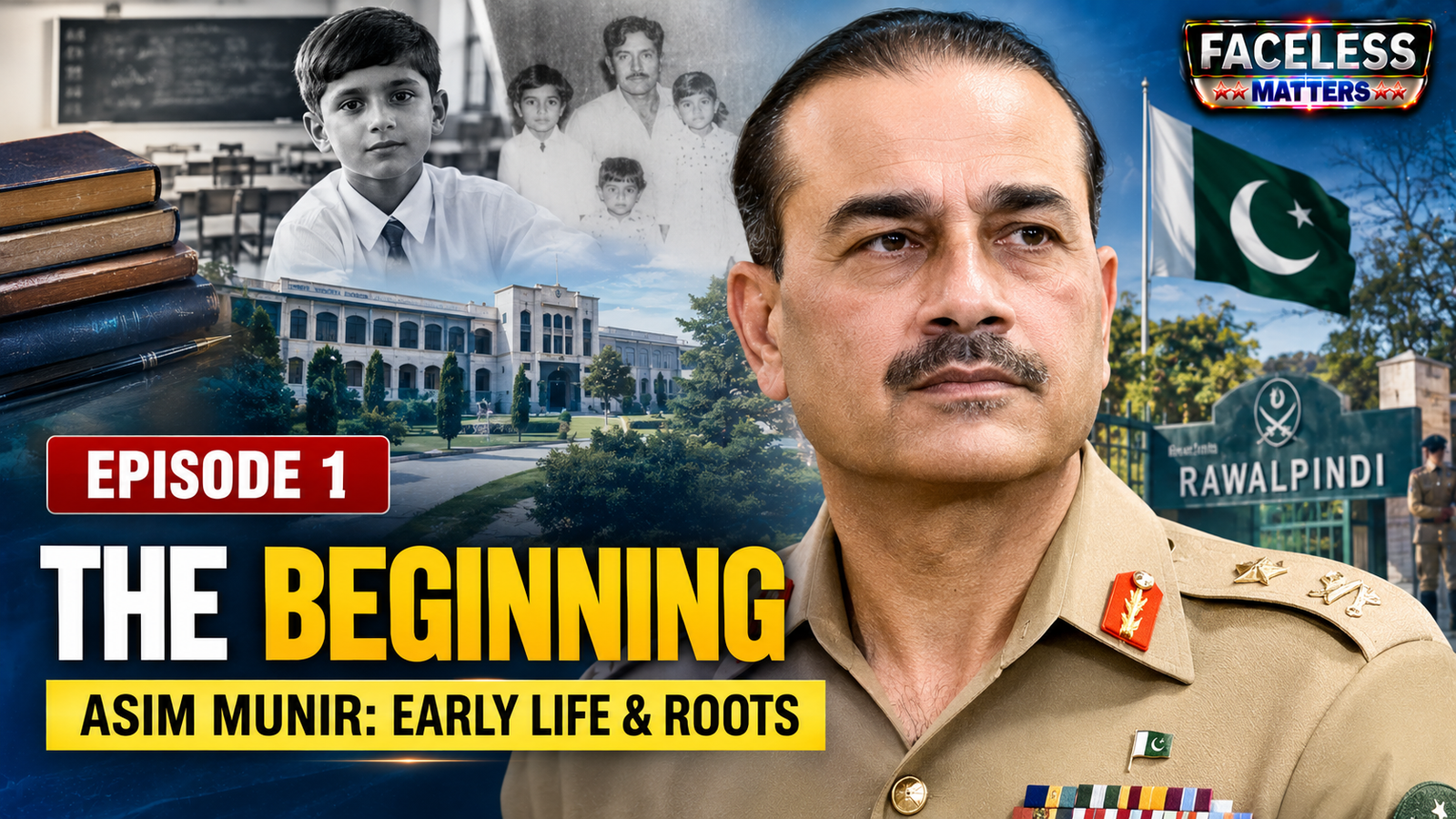
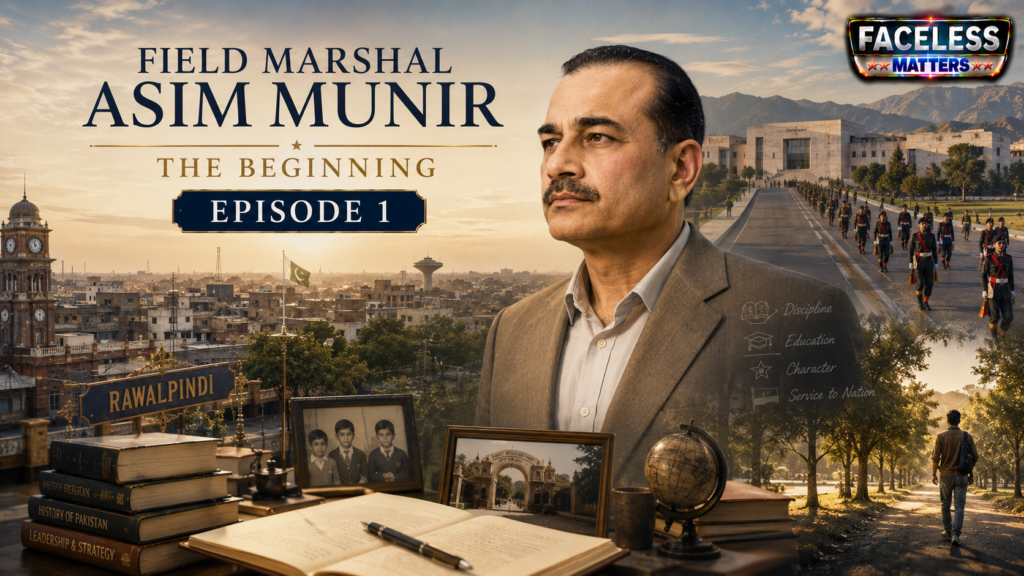
The first episode of the FACELESS MATTERS 100-part biography series examines Asim Munir early life from the beginning, focusing on the family, city, education and formative environment that preceded his military career.. Before the uniforms, commands, intelligence appointments and national-security responsibilities, there was a family, a city, an educational environment and a young man growing up in Rawalpindi.
Field Marshal Syed Asim Munir Ahmed Shah was born in Rawalpindi in 1968, according to biographical accounts published by multiple sources. His family roots have been traced to Jalandhar in pre-partition India, with the family moving to Pakistan following the 1947 Partition and subsequently settling in Rawalpindi. His father, Syed Sarwar Munir, is widely described as a school educator who also served as an imam at a local mosque.
These details matter because a biography should not reduce a person’s development to later achievements. Early surroundings can provide context for understanding the values, educational influences and disciplines that appear later in a public career. At the same time, it is important not to turn background information into unsupported psychological conclusions.
The Beginning: Rawalpindi and Family Roots
Asim Munir early life is closely connected with Rawalpindi, which provides an important setting for the opening chapter of this biography.. The city has long had a close relationship with Pakistan’s military institutions, but it is also a major urban center with its own educational, religious and social traditions.
According to published biographical accounts, the family of Asim Munir had roots in Jalandhar and migrated to Pakistan around the time of Partition. Accounts describe an initial period in Toba Tek Singh before the family eventually settled in Dheri Hassanabad, Rawalpindi.
The migration story places his family within one of the defining historical experiences of Pakistan’s founding generation. Millions of families were displaced during Partition, and many rebuilt their lives in new cities across Pakistan. In this case, the family’s eventual settlement in Rawalpindi became the environment in which the future military leader was born and raised.
The available public record does not justify romanticizing every detail of this family history, nor does it provide a complete private account of his childhood. A responsible biography therefore distinguishes between what is documented and what remains personal or uncertain.
That distinction will remain central throughout this 100-episode series.
A Father Who Combined Education and Religious Service
One of the most consistently reported details about Asim Munir’s family background concerns his father, Syed Sarwar Munir.
Published accounts describe him as an educator and school principal who also served as an imam at a local mosque in Dheri Hassanabad. India Today reported that he was a schoolteacher and imam, while other accounts identify him as principal of FG Technical High School in Lalkurti, Rawalpindi.
This combination of education and religious service is significant as biographical context. It indicates that the household was associated with both formal education and religious learning.
It would nevertheless be inappropriate to claim that every later characteristic of Asim Munir was directly caused by his father’s profession. Human development is more complicated than that. Family, education, friendships, social environment, personal decisions and professional experiences all interact over time.
What can reasonably be said is that his early environment appears to have exposed him to education, religious study and disciplined community life from an early age.
Asim Munir Early Life and the Importance of Education
The available record on Asim Munir early life repeatedly identifies education as an important part of his formative years.
Reports state that he received early religious education at Markazi Madrasah Dar-ul-Tajweed in Rawalpindi. His later public profile also identifies him as someone who memorized the Quran and became known as a Hafiz.
The exact chronology of his religious education and Quran memorization is not equally documented across every source. Some accounts place his memorization during a later period of military service in Saudi Arabia, while other profiles summarize the achievement more generally as part of his religious background.
For that reason, this series will avoid assigning an unsupported exact age or date to the achievement in Episode 1.
What is well established is that religious education formed part of his background and remained a notable feature of his public identity.
A Formative Environment of Discipline
The story of Asim Munir early life is also connected in published accounts with a strong culture of discipline.
A school principal father, religious instruction and life in Rawalpindi created an environment in which education and responsibility were visible parts of everyday life. But again, biography requires restraint: these circumstances can provide context, but they cannot automatically prove the psychological qualities of a future commander.
The later record shows that discipline became an important part of his professional career. His military education, training and subsequent assignments repeatedly placed him in institutions where performance, leadership and responsibility were central requirements.
The first episode therefore does not need to claim that the future Field Marshal was destined for greatness from childhood. A stronger historical argument is more measured: the foundations of his later career developed through a combination of family circumstances, education, personal choices and professional opportunities.
That distinction makes the biography more credible.
The Young Man Behind the Future Uniform
Published accounts of Asim Munir early life also describe Munir as a local cricket player during his younger years, with some sources identifying him as a fast bowler.
This seemingly ordinary detail is useful because it reminds readers that major public figures also pass through ordinary stages of life.
Before becoming a military officer, Munir was a young man living in Rawalpindi, studying, participating in community life and developing interests outside formal professional service.
Sports can teach teamwork, competition, patience and performance under pressure, but it would be speculative to claim that cricket directly produced his later command style. The more defensible point is simply that cricket formed part of the publicly reported picture of his youth.
Asim Munir Early Life: Faith, Study and Personal Formation
The recurring theme in accounts of Asim Munir early life is the coexistence of religious education and conventional academic development.
His background is particularly notable because his later military career combined conventional professional military education with a continuing public association with Islamic scholarship and Quranic knowledge.
This combination became a distinctive part of his public identity.
The FACELESS MATTERS approach, however, is to separate biography from mythology. A person’s religious background should be presented as documented context rather than used as proof of political, strategic or moral conclusions.
That approach is especially important for a figure who later became central to Pakistan’s national-security establishment.
From Rawalpindi Toward a Military Future
The decisive transition would come later.
The official Government of Pakistan record states that Asim Munir was commissioned in April 1986 into the 23 Frontier Force Regiment and received the Sword of Honour of the 17th Officers Training School course. The same official profile records later education at the Fuji School in Japan, Command and Staff College in Quetta, Malaysian Armed Forces Command and Staff College, and National Defence University Islamabad.
But those achievements belong to later episodes.
Episode 1 deliberately stops before turning the story into a complete military résumé.
The purpose of this opening chapter is to establish the starting point: a family with roots connected to the upheavals of Partition, a childhood in Rawalpindi, a father associated with education and religious service, early religious learning, and the ordinary experiences of youth.
The military transformation comes next.
FACELESS MATTERS Analysis: Why the Beginning Matters
FACELESS MATTERS Analysis:
A serious biography should resist the temptation to begin with the most dramatic achievement.
Field Marshal is a powerful title, but the title itself does not explain the journey. Understanding a national military leader requires a timeline that begins before the person becomes nationally visible.
In Asim Munir’s case, the documented early background provides several important themes for the remaining 99 episodes.
The first is education. His early religious studies were followed by extensive professional military education. That combination later became one of the recognizable features of his public profile.
The second is discipline. His family and educational environment are repeatedly described through institutions connected with teaching, religious learning and structured responsibility. Later, military training would place those qualities inside a formal professional system.
The third is migration and national identity. His family’s movement from Jalandhar to Pakistan after Partition connects his personal history to one of the defining transformations of South Asian history.
The fourth is Rawalpindi. The city is not merely a birthplace in this story. It became the environment in which his family settled and where his early education and religious formation took place.
The fifth is personal choice. No family background automatically produces a Field Marshal. The decisive steps came later, when he entered military training, earned recognition as a cadet and accepted progressively greater responsibilities.
That is why the opening episode should be viewed as a foundation rather than a conclusion.
What the Public Record Establishes
The strongest available evidence supports several basic points.
Asim Munir was born in Rawalpindi in 1968. His family had roots in Jalandhar and migrated to Pakistan around Partition. His father, Syed Sarwar Munir, was an educator and imam. Asim Munir received early religious education at Markazi Madrasah Dar-ul-Tajweed in Rawalpindi. Later accounts identify him as a Hafiz of the Quran.
The official Government of Pakistan biography later confirms his commissioning in April 1986 through the 17th Officers Training School course, his Sword of Honour and his commissioning into the 23 Frontier Force Regiment.
Those facts give us the basic framework for the next episode.
They also show why a 100-part biography can offer something more valuable than a conventional short profile. Instead of compressing decades into a few paragraphs, the series can examine each stage separately and distinguish documented facts from later interpretation.
Asim Munir Early Life and the Road Ahead
The deeper significance of Asim Munir early life is not that it provides a simple explanation for everything that happened afterward.
Rather, it gives us the first pieces of a much larger story.
A young man grew up in Rawalpindi within a family associated with education and religious service. He received religious instruction. He participated in ordinary youth activities such as cricket. Then he made a professional decision that changed the direction of his life: he entered military training.
From that point onward, his career would pass through command assignments, staff responsibilities, intelligence leadership, advanced military education and eventually the highest levels of Pakistan’s military establishment.
The distance between those two points is the subject of the next 99 episodes.
The first chapter therefore ends not with the Field Marshal at the height of his career, but with the young man standing at the threshold of it.
That is where every long journey begins.
The Historical Perspective
There is another reason to begin with the early years.
Public figures are often reduced to the controversies, decisions or achievements associated with their highest office. Such an approach can make biography reactive rather than historical.
A 100-episode series allows a different method.
Each stage can be examined in sequence: the family background, education, military training, early command, overseas service, intelligence appointments, corps command, General Headquarters responsibilities, appointment as Chief of Army Staff, promotion to Field Marshal and the evolving responsibilities associated with the Chief of Defence Forces role.
The official record confirms that Munir’s career eventually included both major intelligence appointments and senior command responsibilities before his appointment as Chief of Army Staff in November 2022.
In December 2025, the President of Pakistan approved his appointment as Chief of Defence Forces concurrently with his existing role as Chief of Army Staff for a five-year period.
Those later developments demonstrate the extraordinary distance covered by the career that began decades earlier.
But history is best understood one step at a time.
A Beginning, Not a Verdict
Episode 1 is therefore intentionally focused on Asim Munir early life, documented family circumstances and the formative environment from which his later military journey emerged.
It does not attempt to prove that every later decision was predetermined by childhood.
It does not turn family history into mythology.
It does not manufacture private stories that are absent from the reliable public record.
Instead, it establishes the documented foundation on which the rest of the biography can be built.
The early years of Field Marshal Syed Asim Munir were shaped by a family with roots connected to Partition, settlement in Rawalpindi, education, religious learning and ordinary youth experiences. These elements provide context for the person who would later enter Pakistan’s military profession.
The next chapter will move from the foundations of Asim Munir early life toward the decisive transition into military life.
And that transition begins in 1986.
FACELESS MATTERS Analysis: The First Lesson of the Journey
FACELESS MATTERS Analysis:
The most valuable lesson from Episode 1 is that national leadership is rarely created in a single moment.
It develops through accumulated experiences.
Family creates an initial environment. Education expands horizons. Faith can shape personal identity. Sports can provide experience in competition and teamwork. Professional institutions then test individuals under increasingly demanding circumstances.
For Asim Munir, the documented record shows that this process eventually led from Rawalpindi to the Officers Training School at Mangla and into the Frontier Force Regiment.
The Sword of Honour would become the first major publicly recorded distinction in that military journey.
But that belongs to the next chapter.
Episode 1 has reached its proper ending: the beginning has been established, the foundations have been identified, and the door to the military career is now open.
Source Verification & Analysis
The principal biographical claims in this episode were cross-checked against published biographical reporting and official Government of Pakistan material.
- Government of Pakistan, Press Information Department — Official biographical information confirming April 1986 commissioning, 17th OTS course, Sword of Honour, 23 Frontier Force Regiment, later education and major military appointments.
- India Today — Biographical reporting on birth in Rawalpindi, family background, Syed Sarwar Munir’s role as educator and imam, early education at Markazi Madrasah Dar-ul-Tajweed and later Quran memorization.
- The Indian Express — Independent reporting on family migration, the father’s educational and religious roles, early education and the 1986 Officers Training School pathway.
- The Economic Times — Reporting on the significance of Munir’s seminary education and his identity as a Hafiz.
- The Print — Biographical reporting concerning family roots, religious education and later military development.
Where public sources differ on the exact chronology of Quran memorization or other personal details, this episode deliberately avoids presenting an uncertain chronology as established fact.
Suggested Future Internal ArticleSuggested Future Internal Article
1. Global Energy Supply Crisis 2026: What Happens Next?
This future article will examine the Strait of Hormuz, oil, natural gas, shipping and the wider implications for global energy security.
Global Energy Supply Crisis 2026: What Happens Next?
2. Global Bond Market Selloff: Why Borrowing Costs Are Rising in 2026
This future article will explain the relationship between geopolitical tension, inflation, interest rates, bond markets and global financial conditions.
Global Bond Market Selloff: Why Borrowing Costs Are Rising in 2026
3. The AI Infrastructure Boom: Nvidia, OpenAI and the Global Race for Data Centers, Chips and Power
This future article will explain the connection between artificial intelligence, data centers, electricity demand and global energy infrastructure.
The AI Infrastructure Boom: Nvidia, OpenAI and the Global Race for Data Centers, Chips and Power
Fresh News Link
Source: Reuters
Article/Report Title: Pakistan’s Munir spoke to Trump ahead of Tehran visit, sources say
Why it matters: The report, published August 24, 2026, demonstrates how far the career examined in this 100-part biography has progressed from its early Rawalpindi beginnings. Reuters reported that Munir was involved in Pakistan’s current diplomatic efforts concerning Iran and regional peace.
Read the latest Reuters report
Previous FACELESS MATTERS Coverage
Article Title: Pakistan Terrorism in 2026: President & PM Renew Resolve
Short explanation of relevance: This FACELESS MATTERS article provides broader context on Pakistan’s national-security environment, institutional responsibility and the continuing challenge of terrorism—issues that become increasingly relevant as the biography progresses toward Munir’s senior military career.
Read the FACELESS MATTERS analysis
Recommended Categories
Primary Category: Pakistan
Secondary Categories: Geopolitics, National Security, Military Affairs, Leadership, Politics, World News, True History
[…] 1 — THE BEGINNING, FAMILY ROOTS AND EARLY FORMATIONFIELD MARSHAL ASIM MUNIR — EPISODE 1: THE BEGINNING, FAMILY ROOTS AND EARLY […]
[…] Recent — Pakistan / History: Field Marshal Asim Munir — Episode 1: The Beginning, Family Roots and Early Formation — useful for understanding the wider Pakistani public and historical context surrounding national […]
[…] 3. Asim Munir Early Life — Episode 1: Family Roots […]
[…] Episode 1 examined the beginning of his story and the family roots associated with Jalandhar. […]
[…] Asim Munir Early Life — Episode 1: Family Roots […]