

TABLE OF CONTENTS
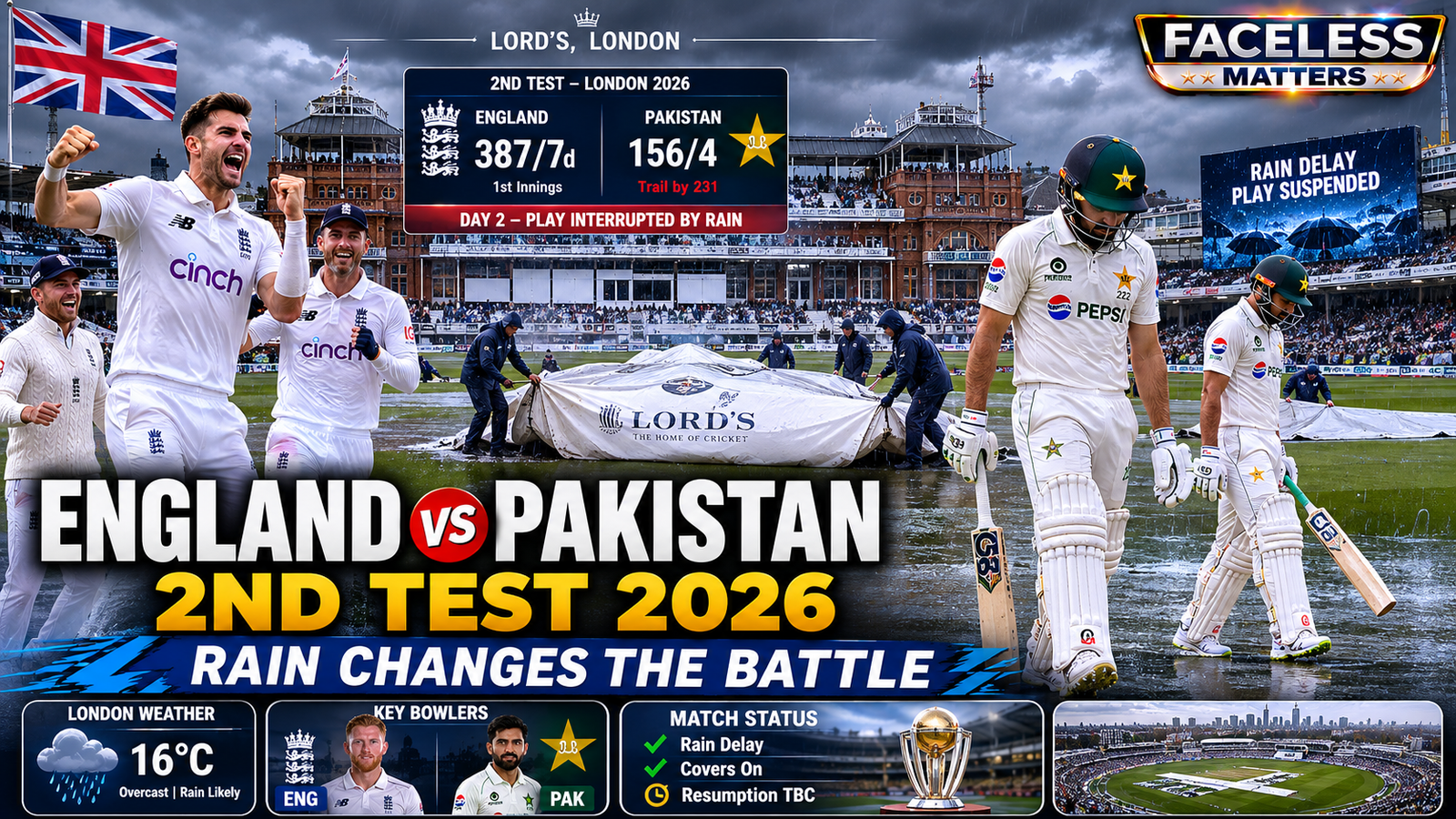
The England vs Pakistan 2nd Test 2026 has become one of the biggest cricket stories of the weekend, with England holding a commanding position while persistent rain repeatedly interrupts play.
The England vs Pakistan 2nd Test 2026 is being played from August 27 to 31 as part of the ICC World Test Championship series. England entered Lord’s with a 1–0 series lead after winning the opening Test at Headingley by an innings and 103 runs.
By the third day, England had already established a substantial lead, while Pakistan’s bowlers were still fighting to keep the match from becoming completely one-sided.
In the England vs Pakistan 2nd Test 2026, the biggest question is now simple:
Can Pakistan create enough pressure before rain and the match clock remove England’s opportunity to finish the job?
Why This Test Has Become So Important
The England vs Pakistan 2nd Test 2026 carries significance beyond one match.
England are attempting to close out the series at Lord’s, while Pakistan are trying to recover from a heavy defeat in the first Test.
The ICC confirmed before the second Test that England had won the opening match by an innings and 103 runs. England were also looking to improve their position in the World Test Championship standings, while Pakistan needed a major response.
That created two very different objectives.
For England, the priority was control.
For Pakistan, the priority was survival, resistance and a chance to change the direction of the series.
Rain Has Become a Major Character in the Match
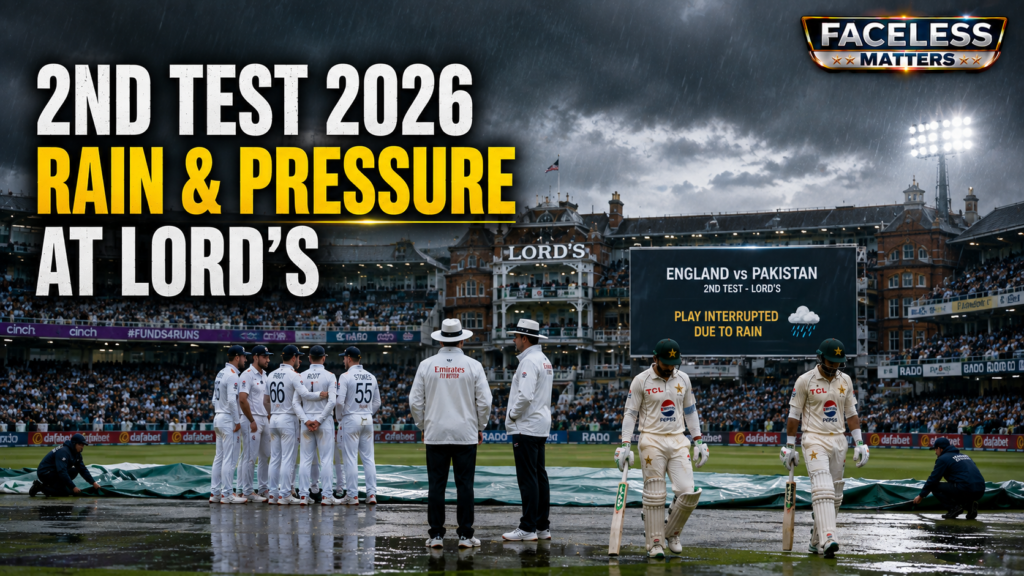
In the England vs Pakistan 2nd Test 2026, the weather has played an unusually important role.
Day one was already affected by rain, with only 56 overs possible as Pakistan’s bowlers made early inroads into England’s batting. Pakistan finished the opening day with England at 248/9.
Day three has brought further disruption.
The Guardian’s live coverage reported repeated rain interruptions, with England reaching 177/7 and Dan Lawrence completing a half-century from 64 balls before another interruption. England’s lead had moved beyond 350 runs.
The Times similarly reported that persistent rain restricted play while England remained firmly in control.
This changes the strategic calculation.
England need enough time to take ten Pakistan wickets.
Pakistan need enough time to survive.
The weather therefore benefits neither side in a simple way.
England’s Bowling Attack Has Made the Difference
England’s biggest advantage has been the effectiveness of their bowling attack.
In the first innings, Pakistan were dismissed for only 110.
Ollie Robinson produced a devastating spell, taking four wickets for 11 runs, while Jofra Archer claimed three wickets for 26. Josh Tongue also contributed two wickets. Pakistan’s collapse gave England a first-innings lead of 180 runs.
That bowling performance created the foundation for England’s current position.
The important point is not simply the number of wickets.
It is the way England have attacked Pakistan’s batting.
The combination of pace, movement, disciplined lengths and pressure has repeatedly forced Pakistan’s batsmen to play difficult deliveries.
At Lord’s, where conditions can reward seam bowling, that becomes particularly dangerous.
Mohammad Abbas Has Given Pakistan Something to Fight With
Pakistan’s situation has not been completely negative.
Mohammad Abbas has been one of the most impressive players for Pakistan during the match.
The ICC reported that Abbas finished England’s first innings with 4/73, while Mohammad Ali claimed 3/86.
Abbas has also continued to trouble England during the second innings.
His control and ability to exploit movement have provided Pakistan with an important source of pressure.
That matters because Pakistan cannot afford to depend only on batting improvement.
If they are going to force England into a difficult position, their bowlers must continue taking wickets.
Dan Lawrence Provides England With Stability
Dan Lawrence has also emerged as an important figure.
He scored a half-century on day three, reaching 50 from 64 balls before rain interrupted play.
His innings represents the type of contribution England need at this stage.
They do not necessarily need every batter to score a century.
They need enough runs to create a target that gives their bowling attack sufficient time and pressure.
That is why lower-order resistance and middle-order acceleration can become extremely valuable in a rain-affected Test.
Pakistan’s Biggest Problem Is the First-Innings Collapse
In the England vs Pakistan 2nd Test 2026, the central problem for Pakistan remains their first-innings batting performance.
Pakistan were bowled out for 110 after England had posted 290.
That created a deficit of 180 runs before England even began their second innings.
A Test team can survive one poor session.
Surviving an entire innings collapse is much harder.
The challenge becomes even greater when the opposition has a strong pace attack and the weather reduces the available playing time.
Pakistan therefore needed much greater resistance from their top and middle order.
Babar Azam’s Return Was Important — But Batting Still Had to Deliver
Babar Azam returned for the Lord’s Test after missing the first Test with a finger injury.
Before the match, the ICC reported that Babar had declared himself 90 percent fit and was expected to return to the Pakistan XI.
His return added experience and leadership to the batting order.
But Test cricket does not reward reputation alone.
The batting unit still has to convert opportunities into runs.
That has been the biggest challenge for Pakistan throughout the opening stages of the series.
The Weather Creates a Completely Different Tactical Game
A normal Test match allows both teams to work with time.
Rain removes that certainty.
If England declare too late, they may not have enough overs to bowl Pakistan out.
If England declare too early, Pakistan could potentially chase a manageable target.
Pakistan therefore has an unusual strategic opportunity.
They do not necessarily need to dominate England.
They need to keep England’s lead within a range that makes the remaining time uncomfortable for the home side.
That is a much smaller objective.
What England Need From Here
England’s strategy is relatively straightforward.
They need to maximize their lead while preserving enough time to bowl Pakistan out.
The ideal scenario would be:
- Add enough runs to create a very large target.
- Declare at an appropriate moment.
- Use the remaining overs aggressively.
- Attack Pakistan’s top order.
- Take early wickets before the weather eliminates valuable playing time.
England’s bowling resources give them confidence.
But confidence cannot stop rain.
That is the unusual element of this Test.
What Pakistan Need From Here
Pakistan’s requirements are more difficult.
They need their bowlers to finish England’s innings quickly.
Then the batting unit must produce a significantly stronger performance.
Most importantly, Pakistan cannot afford another collapse.
If they lose early wickets again, England’s position could become overwhelming.
If Pakistan’s top order survives, however, the match could become more complicated.
A long partnership would consume valuable time and potentially frustrate England’s attack.
The Bigger Question: Can Pakistan Save the Test?
The England vs Pakistan 2nd Test 2026 has reached a point where Pakistan’s objective may no longer be winning the match in the conventional sense.
The first priority is survival.
A draw would not completely repair Pakistan’s position in the series, but it would stop England from taking a 2–0 lead.
That makes every defensive partnership extremely valuable.
In a rain-affected Test, survival can become an attacking strategy in itself.
Every over survived reduces the time available to England.
Every wicket lost increases England’s chances of victory.
That mathematical pressure will shape the remaining match.
England’s Wider World Test Championship Position
The contest also matters in the World Test Championship.
The ICC confirmed that the series forms part of the 2025–27 World Test Championship cycle. England and Pakistan entered the series in the lower portion of the standings, increasing the importance of every result.
For England, a series victory would provide valuable momentum.
For Pakistan, avoiding a clean sweep becomes increasingly important.
The third Test is scheduled for September 9–13 at Edgbaston.
That means the Lord’s result could significantly influence the psychological environment heading into the final match.
The Pakistan Batting Question
Pakistan’s biggest long-term issue is not one player.
It is collective consistency.
Test cricket requires batsmen to absorb pressure, leave difficult deliveries, build partnerships and remain mentally disciplined for long periods.
The conditions at Lord’s make those requirements even more important.
Pakistan’s batsmen cannot simply attack every ball.
Nor can they remain excessively defensive.
They need a balance between survival and scoring.
That balance was missing during the first innings.
The England Advantage Is More Than Runs
England’s advantage is not only the scoreboard.
It is also confidence.
They won the first Test heavily.
They bowled Pakistan out for 110 in the second.
Their pace attack is producing wickets.
Their middle order is contributing.
And Pakistan are under pressure to recover.
That combination creates a powerful psychological advantage.
However, Test cricket can change quickly.
One major partnership can change the tone.
One spell of hostile bowling can change the scoreboard.
And one full day of rain can change the entire result.
FACELESS MATTERS Positive Analysis
FACELESS MATTERS sees the England vs Pakistan 2nd Test 2026 as a useful example of why Test cricket remains fundamentally different from short-format cricket.
The match is not decided simply by momentum.
It is decided through time management, weather, pitch conditions, bowling changes, batting discipline and strategic patience.
England currently have the stronger position.
But Pakistan still have one important resource:
time.
If the weather continues to reduce playing opportunities, Pakistan’s chances of surviving increase.
That does not mean Pakistan are favourites.
It means the match remains strategically alive.
What Pakistan Should Learn From This Test
Pakistan’s immediate lesson is obvious.
The team needs greater batting resilience against high-quality seam bowling.
A strong first innings would have changed the match completely.
Instead of trailing by 180, Pakistan could have forced England to fight for a smaller advantage.
That is why Test preparation must focus on more than individual technique.
It must include:
- partnership building;
- defensive discipline;
- decision-making outside off stump;
- handling short bowling;
- fitness;
- mental endurance;
- and adaptability to weather conditions.
These are not glamorous areas.
But they win Test matches.
What England Should Be Careful About
England also have risks.
A huge lead can sometimes create complacency.
If they continue batting for too long, the weather may remove their opportunity to take wickets.
If they declare too early, Pakistan could find enough time to escape.
Therefore, England’s captaincy decisions will become increasingly important.
The England vs Pakistan 2nd Test 2026 may ultimately be decided not by the best individual performance, but by the timing of England’s declaration and the number of overs remaining afterward.
The Road Ahead
The England vs Pakistan 2nd Test 2026 is now moving toward a decisive final phase.
England have the stronger position.
Pakistan need resistance.
Rain remains an unpredictable factor.
And the clock is becoming almost as important as the scoreboard.
The next major developments will revolve around three questions:
How large will England’s final lead become?
When will England declare?
Can Pakistan survive the remaining overs?
Those questions will determine whether Lord’s produces another England victory, a dramatic Pakistan resistance, or a weather-influenced draw.
Conclusion: Pressure, Patience and the Lord’s Clock
The England vs Pakistan 2nd Test 2026 has produced a fascinating mixture of high-quality bowling, batting pressure and unpredictable English weather.
England have earned their commanding position through disciplined cricket.
Pakistan have shown flashes of resistance, particularly through Mohammad Abbas and periods of effective bowling.
But the visitors now need their batting to produce something much stronger.
The weather may give Pakistan a chance.
Yet weather alone cannot rescue a team that continues losing wickets.
The final phase of the England vs Pakistan 2nd Test 2026 will therefore test Pakistan’s most important quality:
resilience.
For England, the objective is clear — convert dominance into a series-winning result.
For Pakistan, the challenge is equally clear — survive long enough to deny England the time they need.
That is what makes Lord’s so compelling.
The scoreboard tells one story.
The clouds tell another.
And the clock may ultimately decide which story wins.
Source Verification & Analysis
Current match information was cross-checked against ICC World Test Championship reporting, England and Wales Cricket Board match coverage, and live reporting from established international sports media.
Primary sources: ICC World Test Championship | England and Wales Cricket Board | Guardian Sport | The Times Sport
Internal Reading
For readers interested in the wider FACELESS MATTERS coverage, these three website references were selected from different categories and publication periods:
1. Recent — Pakistan / History: Field Marshal Asim Munir — Episode 1: The Beginning, Family Roots and Early Formation — useful for understanding the wider Pakistani public and historical context surrounding national figures.
2. Technology / recent: Pakistan Digital Economy Initiative 2026: Powerful Digital Growth — Relevant to the technology, connectivity and digital infrastructure side of the modern space economy.
3. Economy / very recent: Strait of Hormuz Crisis: Oil Above $90 in 2026 — Provides useful context on energy security and the geopolitical forces that also influence strategic infrastructure and technology.
Editorial & AdSense Note
This article is an editorial sports analysis based on reported match developments. It is intended for news, educational and informational purposes only and does not constitute betting advice, gambling advice or a guarantee of any sporting outcome.