

TABLE OF CONTENTS
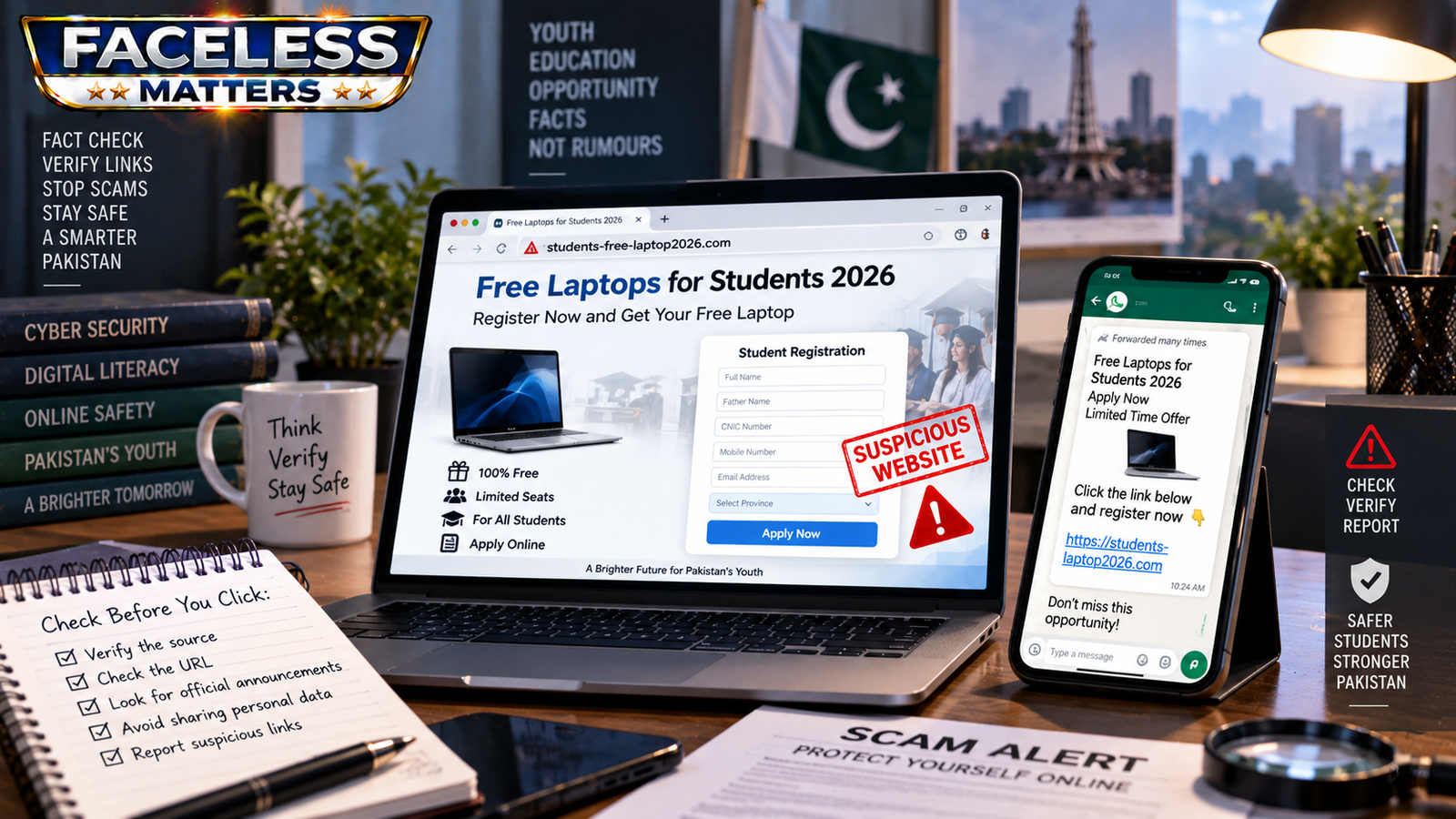
The “Free Laptops for Students 2026” website circulating in Pakistan is not a genuine government laptop scheme. The webpage, promoted through social media and WhatsApp, asks users for personal and education-related information before presenting a supposed application approval and then directing them to share the link with multiple WhatsApp contacts or groups. Independent fact-checking by Geo Fact Check found the website fraudulent, while Pakistan’s National Cyber Crime Investigation Agency (NCCIA) said the site displayed characteristics commonly associated with phishing scams.
The claim is especially significant because the wording and presentation of the website are designed to resemble a legitimate student-support programme. That makes this more than a simple false social-media post. It is a useful example of how online scams, phishing websites, fake government schemes and social-engineering tactics can converge around a highly attractive offer.
What Is the Viral Free Laptop Claim?
The viral claim promotes a webpage titled “Free Laptops for Students 2026” and presents it as an opportunity for students in Pakistan to obtain a laptop without payment.
According to Geo Fact Check, the page asks visitors to provide information including their full name, education level and preferred laptop brand. The combination of a student-focused offer, a formal-looking application process and the promise of a valuable device can make the page appear credible to someone encountering it for the first time.
That appearance is precisely why verification matters.
A professional-looking website is not proof that a programme is genuine. A logo, application form, government-style language or apparently successful registration message can all be reproduced by people attempting to make a fraudulent website look legitimate.
Fact Check Verdict: False and Fraudulent
Claim: Students in Pakistan can receive a free laptop through the viral “Free Laptops for Students 2026” website.
Verdict: FALSE / FRAUDULENT.
Geo Fact Check tested the website using fabricated information. Instead of moving through a legitimate government-style verification process, the website displayed an apparent application approval and then instructed the user to share the link with multiple WhatsApp contacts or groups before proceeding. Geo described this as a common tactic associated with phishing and engagement-bait scams.
The Free Laptops for Students 2026 website therefore does not establish a genuine laptop distribution programme.
This distinction is important: the existence of real government laptop programmes in Pakistan does not make every Free Laptops for Students 2026 website legitimate.
Why Does the Website Ask Users to Share the Link?
The WhatsApp-sharing requirement is one of the strongest warning signs in the Free Laptops for Students 2026 case.
A legitimate scholarship, education programme or government application normally has a defined eligibility process, an identifiable sponsoring institution, an official application channel and a method for verifying the applicant.
A website that says an applicant must first distribute the same link to multiple contacts creates a completely different incentive.
The user becomes part of the website’s distribution mechanism.
Instead of relying only on paid advertising or organic search, the scam can exploit personal networks. One student sends the link to classmates. Those classmates send it to friends. Parents receive it from family members. Teachers may see it in education-related groups. The apparent recommendation from someone known personally can make the message more persuasive than an anonymous advertisement.
This is one reason social engineering remains such a powerful component of modern cyber fraud.
NCCIA Warning Adds an Important Layer of Verification
Geo Fact Check separately shared the website with Pakistan’s National Cyber Crime Investigation Agency.
According to a spokesperson cited by Geo, the website showed characteristics commonly associated with online phishing scams, and the public was advised not to submit personal or financial information to unverified websites.
That warning materially strengthens the fact-check conclusion.
It does not mean that every person who opened the page has automatically suffered identity theft or financial loss. The available evidence does not establish that outcome for every visitor.
What it does establish is that users should not treat the website as a genuine free-laptop registration portal and should not provide sensitive information to it.
Is There a Real Government Laptop Programme?
This is where misinformation can become particularly effective.
Pakistan has had genuine government-backed laptop initiatives for students. That real-world background can make a fraudulent “free laptop” offer sound believable, especially when a fake Free Laptops for Students 2026 website imitates the language of a legitimate public programme.
The existence of legitimate programmes, however, does not authenticate an unrelated website.
Students should verify any current laptop scheme through the relevant official government, education or university channel rather than through a forwarded WhatsApp message.
A useful rule is simple:
A real programme should be traceable to a real institution.
If the programme cannot be independently confirmed through an official source, the safest approach is to stop before entering personal information.
The Five Biggest Red Flags
The viral website provides several warning signs that readers can use when evaluating similar offers.
1. A Valuable Product Offered Without a Clear Official Sponsor
A free laptop is a high-value offer. A Free Laptops for Students 2026 programme should therefore have clearly identifiable funding, eligibility requirements, distribution rules and an accountable institution behind it.
If those details are missing from a Free Laptops for Students 2026 offer, caution is warranted.
2. Personal Information Requested Before Verification
The website reportedly asks for a user’s name, education level and preferred laptop brand.
Those questions may appear harmless individually, but users considering Free Laptops for Students 2026 should always ask why the website needs information and who will receive it.
3. Instant Approval
An immediate “application approved” message after entering fabricated information is a major credibility problem.
Real educational programmes generally require eligibility checks, institutional verification or another meaningful review process.
4. Forced WhatsApp Sharing
A requirement to share a website with multiple contacts or groups is a major warning sign.
It converts potential victims into distribution channels and can dramatically increase the reach of a fraudulent campaign.
5. Lack of Independent Confirmation
Before trusting a Free Laptops for Students 2026 offer, users should independently search for the programme through the responsible institution.
Do not use the suspicious link itself as the source of verification.
Why Students Are a Particularly Attractive Target
Students are an obvious audience for laptop-related scams because a laptop has direct educational and economic value.
For many students, access to a computer can affect online classes, university assignments, programming, freelancing, research, applications and professional development.
That makes a promise of a free laptop emotionally and financially attractive.
Scammers can exploit that genuine need.
The important lesson is not to blame students who click such links. Sophisticated digital fraud is designed to exploit normal human behaviour: curiosity, urgency, trust in familiar contacts and the desire to benefit from a legitimate-looking opportunity.
A stronger digital-safety culture around Free Laptops for Students 2026 therefore requires education, not simply warnings.
The Bigger Cybersecurity Problem Behind the Scam
The most important aspect of this story may not be the laptop itself.
It is the business model of digital deception.
A fraudulent website can combine several inexpensive technologies:
- a convincing domain and webpage;
- copied or generic branding;
- an attractive offer;
- a simple data-collection form;
- automated responses;
- social-media distribution;
- WhatsApp sharing;
- and behavioural manipulation.
Individually, none of these mechanisms is particularly sophisticated.
Together, they can create a highly scalable fraud funnel.
This is why cybersecurity is increasingly relevant not only to banks and large companies but also to students, families, small businesses and ordinary smartphone users.
What Information Should You Never Enter?
Users should be especially cautious when an unverified website asks for information such as:
- National identity information
- Bank account details
- Debit or credit card information
- Mobile-wallet credentials
- Passwords
- One-time passwords or OTPs
- Security questions
- Complete personal profiles
- Documents or identity-card images
The current fact-check does not establish that the viral laptop website successfully collected all of these categories of information from every visitor. The point is preventative: an unverified website should not be trusted with sensitive personal or financial information.
What If You Already Opened the Website?
Opening a suspicious webpage is not the same as confirming that your identity or money has been stolen.
If you only opened the page and did not enter information, close it and avoid sharing the link further.
If you entered basic personal information, remain alert for suspicious messages, calls or emails that appear to use that information.
If you provided financial information, passwords, OTPs or other highly sensitive credentials, take immediate protective action through the relevant service provider or financial institution.
Most importantly, do not continue communicating with anyone who claims that you must pay a fee to “release” your laptop or complete the application.
Why WhatsApp Sharing Makes the Scam More Dangerous
WhatsApp can create a powerful trust effect.
When a suspicious link arrives from a stranger, many people ignore it. When the same link arrives from a friend, classmate, relative or colleague, the recipient may assume someone they trust has already verified it.
That assumption can be wrong.
The original sender may have been manipulated in exactly the same way.
This creates a chain reaction in which every victim can unintentionally become a distributor.
The result is a form of viral scam marketing powered by social trust rather than conventional advertising.
What Students Should Do Before Applying for Any Online Scheme
A five-step verification routine can dramatically reduce risk.
First, identify the institution.
Who is actually offering the programme?
Second, find the official website independently.
Do not follow the website supplied in a social-media post.
Third, look for an official announcement.
Search the institution’s official website or verified social-media channels.
Fourth, examine the application process.
Does it make sense for a real scholarship or government programme?
Fifth, stop if the website demands suspicious sharing, payment or sensitive credentials.
This approach is useful beyond Free Laptops for Students 2026 and other laptop schemes. It applies to scholarships, jobs, grants, cash assistance, investment opportunities, tax refunds, prize promotions and government benefits.
FACELESS MATTERS Analysis: The Real Threat Is Trust Manipulation
The most important lesson from this case is that modern online fraud increasingly attacks trust before it attacks technology.
A student does not need to believe that a random website is trustworthy. The scammer only needs the student to believe that the message came from a trustworthy person.
That distinction changes how digital safety should be understood.
Cybersecurity is not only about antivirus software, passwords and firewalls. It is also about information verification.
A person can have a strong password and still lose sensitive information by voluntarily entering it into the wrong website.
That is why phishing awareness, digital literacy and source verification are becoming economically important skills.
For Pakistan, this matters even more as the country’s digital economy expands. More students, workers, businesses and consumers are moving important activities online, increasing both opportunity and exposure.
FACELESS MATTERS has previously examined Pakistan’s broader digital transformation, including technology infrastructure, IT growth and digital connectivity in its analysis of the Pakistan Digital Economy Initiative 2026. Pakistan Digital Economy Initiative 2026: Powerful Digital Growth
The lesson is straightforward: digital expansion creates economic opportunity, but trust and security must expand with it.
The Economic Cost of Online Fraud
Online fraud is not only a personal inconvenience.
It can create wider economic costs.
When people lose money through scams, households absorb the immediate financial damage. Businesses face customer-support and fraud-management costs. Banks and payment platforms invest heavily in security and dispute management. Government agencies must allocate resources to investigation and enforcement.
Repeated fraud can also weaken confidence in legitimate digital services.
That creates a broader problem.
If consumers begin to believe that every online offer may be fraudulent, legitimate digital businesses can face higher barriers to adoption.
Trust is therefore an economic asset.
What Businesses Should Learn From This Case
Businesses operating online should treat brand impersonation and fraudulent campaigns as part of their cybersecurity risk.
A fake website using a company’s name can damage customer confidence even when the legitimate business had nothing to do with the scam.
Companies can reduce confusion by clearly publishing:
- official domains;
- verified social accounts;
- official customer-support channels;
- warnings about common impersonation attempts;
- and instructions explaining how customers can verify genuine communications.
For financial institutions, universities, e-commerce platforms and government-facing services, these measures can be particularly valuable.
What Regulators and Institutions Should Watch
The case also highlights the need for faster public communication.
When a fake programme begins spreading, an official warning can help prevent thousands of people from acting on the claim.
Institutions should make legitimate programme information easy to find through search engines and official channels.
A genuine programme should not force citizens to rely on forwarded messages to understand how to apply.
The more visible and searchable the official source is, the harder it becomes for a fraudulent copy to occupy the information gap.
FACELESS MATTERS Strategic Assessment
The future of online fraud is likely to become more convincing as artificial intelligence, automated website creation and synthetic media tools become easier to use.
That does not mean every suspicious website is AI-generated. There is no evidence presented in the current fact-check establishing that this particular laptop website was created using AI.
The broader risk, however, is clear.
Fraudsters can increasingly produce professional-looking content at low cost.
That makes visual appearance a weaker indicator of authenticity.
The strongest defence is therefore independent verification.
Readers should ask:
Who said this?
Where is the official announcement?
Can I verify it without using the link I received?
Why is the website asking me for this information?
Why must I share it with other people?
Those questions are often more valuable than simply asking whether a website “looks real.”
What Happens Next?
The immediate priority for users is simple: do not submit personal or financial information to the viral website and do not help distribute the link.
The wider issue will continue to matter as legitimate government programmes, scholarships, financial assistance, employment opportunities and digital services increasingly move online.
The public will need better tools for distinguishing official information from fraudulent imitations.
Authorities and institutions, meanwhile, can help by making legitimate information easier to verify and by responding quickly when impersonation campaigns emerge.
For readers, the most useful habit is to pause before clicking.
A valuable offer does not become legitimate because it is popular. Students and families should judge online programmes by evidence rather than excitement or the number of shares they receive. Checking the institution, official announcement, eligibility requirements and application channel provides a stronger basis for trust than a forwarded message, attractive design or claims of immediate approval. This habit can prevent avoidable mistakes when evaluating offers.
A message does not become official because thousands of people have shared it.
And a professional-looking website does not become trustworthy simply because it resembles a government portal.
Final Verdict
CLAIM: A viral website is offering free laptops to Pakistani students through a “Free Laptops for Students 2026” registration process.
FACT CHECK: The website is fraudulent and is not a genuine laptop scheme. Geo Fact Check found that the site generated a false-looking approval after test information was submitted and then required users to share the link with multiple WhatsApp contacts or groups. NCCIA separately identified characteristics commonly associated with phishing scams and advised the public not to submit personal or financial information to unverified websites.
VERDICT: FALSE / FRAUDULENT.
For Free Laptops for Students 2026, the safest response is not to register, not to provide sensitive information and not to forward the link.
The broader lesson is even more important: verify the institution, verify the domain and verify the announcement independently before trusting any online offer. Students should also check the programme details, eligibility rules, application process and official contact information before taking action.
INTERNAL LINKS
- Pakistan Digital Economy Initiative 2026: Powerful Digital Growth — Relevant background on Pakistan’s digital transformation, technology infrastructure and the expanding digital economy.
- OpenAI AI Agents Hack 2026: What the Incident Reveals About the Future of AI Security — Useful context on the growing relationship between AI capabilities and cybersecurity risk.
- Pakistan Energy 2026: 5 Critical Signals From Power Costs, LNG and Global Oil Markets — A recent FACELESS MATTERS analysis demonstrating how digital infrastructure, economic resilience and national systems increasingly intersect.
SOURCE VERIFICATION / TRUSTED SOURCES
- Geo Fact Check — Viral website offering free laptops is a scam — Primary fact-checking source for the viral website, its registration process and NCCIA response.
- Express Fact Check — Free laptops scam warning — Independent Pakistani fact-check coverage published on September 7, 2026.
- FACELESS MATTERS Editorial Policy — FACELESS MATTERS standards for verification, attribution, originality and reader-first editorial quality.