


TABLE OF CONTENTS
6 September 2026 | Islamabad
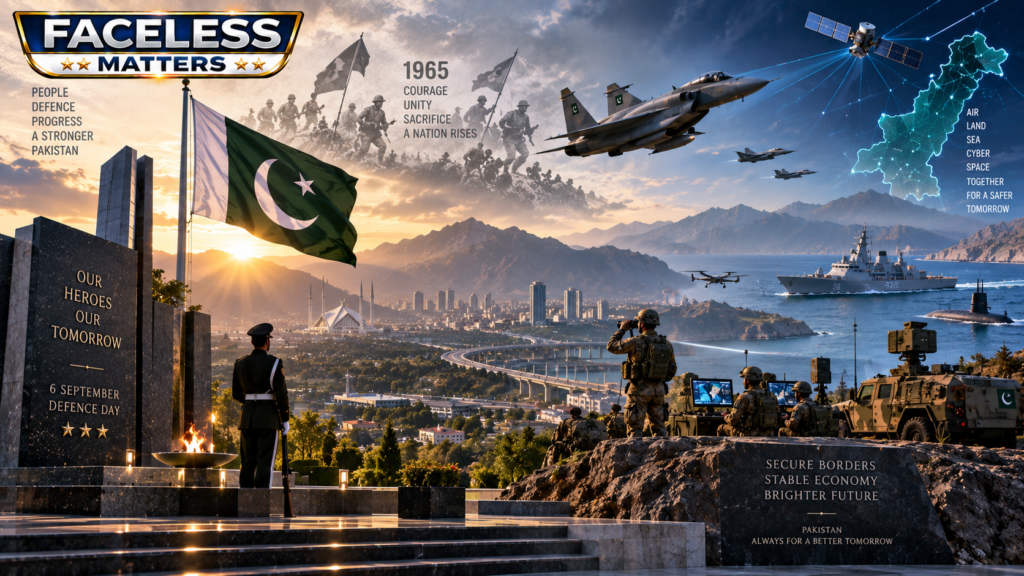
Pakistan is observing Defence and Martyrs Day today, September 6, 2026, with nationwide ceremonies, prayers, tributes to martyrs and veterans, and renewed attention to the country’s national-security challenges. The day marks the anniversary of the 1965 war and remains one of Pakistan’s most significant military and national commemorations.
This year’s observance carries an additional layer of significance.
Pakistan is not commemorating history in isolation.
The country is doing so while facing continuing counterterrorism challenges, cross-border security concerns, technological changes in warfare and a rapidly evolving regional security environment.
On September 6, the Inter-Services Public Relations-linked reporting also announced that security forces had killed 21 militants in multiple engagements in Khyber Pakhtunkhwa between September 3 and 5, including operations in North Waziristan, Kohat and Dera Ismail Khan. The military described the militants using its own terminology and attributed the incidents to a broader cross-border security challenge; those attribution claims should be understood as official Pakistani positions rather than independently established facts.
At the same time, Defence Day 2026 messaging from Pakistan’s political leadership has emphasized that defence cannot be separated from national unity, economic strength, development and peace.
Prime Minister Shehbaz Sharif’s Defence Day message described September 6 as a reminder of the sacrifices of martyrs and veterans, while also emphasizing that a strong and economically stable Pakistan is essential to national strength.
That creates the deeper question for Defence Day 2026:
What does the legacy of September 6 mean for Pakistan’s security strategy today?
Why September 6 Still Matters
September 6 is remembered in Pakistan as the day the country’s armed forces and population confronted the 1965 conflict.
Pakistan’s official narrative emphasizes the defence of the country’s territory, the role of military preparedness and the unity demonstrated by the population during the conflict. The President and Prime Minister have both used their 2026 Defence Day messages to highlight the sacrifices of martyrs and veterans and the importance of national unity.
But Defence Day 2026 should not be reduced to slogans.
The deeper value of a national military commemoration is its ability to connect past experience with present responsibilities.
The strategic environment of 1965 was dominated by conventional military power.
The strategic environment of 2026 is considerably broader.
Today, national security can involve:
- conventional military readiness;
- counterterrorism;
- cyber security;
- drones and autonomous systems;
- intelligence;
- space technology;
- information security;
- critical infrastructure;
- economic resilience;
- maritime security;
- border management;
- diplomatic partnerships.
That transformation is one of the most important reasons to examine Defence Day 2026 through a modern lens.
The central lesson is not simply that Pakistan once fought a war.
It is that national defence evolves with the nature of threats.
Lesson 1: Defence Begins With National Preparedness
For Defence Day 2026, the first major lesson of September 6 is the importance of preparedness.
The Pakistani government’s current Defence Day messaging repeatedly emphasizes professional readiness, national unity and the sacrifices of military personnel.
Preparedness, however, means more than maintaining military equipment.
It includes:
- training;
- intelligence;
- logistics;
- communications;
- leadership;
- infrastructure;
- emergency planning;
- civilian-military coordination;
- technological capability.
A military can possess sophisticated equipment but still face strategic difficulties if its logistics, intelligence or communications systems are weak.
Likewise, national security becomes stronger when civilian institutions are capable of functioning under pressure.
This is where the history of September 6 offers a broader institutional lesson.
Readiness Is a System
National defence is not produced by one institution.
It emerges from a system.
The armed forces provide military capability.
Intelligence organizations provide information.
Diplomatic institutions manage international relationships.
Civilian authorities maintain governance and public services.
Industry supports production and supply chains.
Universities and research institutions contribute knowledge and technology.
Citizens contribute resilience.
That means preparedness should be viewed as a national ecosystem.
For Defence Day 2026, this is perhaps more relevant than ever.
Lesson 2: Modern Security Extends Beyond the Battlefield
For Defence Day 2026, the second lesson is that modern national security cannot be defined only by territorial warfare.
Pakistan’s present security environment illustrates this clearly.
The country continues to face militant threats in parts of Khyber Pakhtunkhwa and Balochistan.
On September 6, Pakistan reported that 21 militants had been killed during multiple security engagements in Khyber Pakhtunkhwa. The reported operations included North Waziristan, Kohat and Dera Ismail Khan.
The development demonstrates how modern defence can involve repeated intelligence-led operations rather than a single conventional front.
Earlier this month, Pakistani security forces also reported killing militants attempting to cross from Afghanistan into North Waziristan. The Associated Press independently reported the incident while noting that Pakistani allegations of foreign backing were disputed by India and Afghanistan.
That distinction matters.
Responsible defence reporting should separate:
What Pakistan’s authorities claim
from
What independent reporting can independently establish.
That standard is particularly important when national-security stories involve allegations between states.
The Security Map Has Expanded
Modern threats can move through:
- borders;
- digital networks;
- financial systems;
- social platforms;
- transportation infrastructure;
- energy systems;
- communications networks.
A country therefore needs a broader security architecture.
Military capability remains essential.
But military capability alone cannot eliminate every vulnerability.
Lesson 3: Technology Is Becoming a Defence Multiplier
One of the clearest Defence Day 2026 lessons is the difference between 1965 and 2026 in the role of technology.
Modern military effectiveness increasingly depends on information.
Who detects a threat first?
Who can process information faster?
Who can communicate securely?
Who can coordinate different platforms?
Who can maintain operational awareness across land, sea, air, cyber and space?
These questions increasingly determine strategic advantage.
The Institute of Strategic Studies Islamabad marked Defence Day this year by specifically examining Pakistan’s defence transformation, including conventional capabilities, nuclear and space domains, indigenization and emerging technology.
That is significant.
It shows that the definition of national defence is itself expanding.
From Platforms to Networks
A modern fighter aircraft is valuable.
A modern naval platform is valuable.
An armoured vehicle is valuable.
But the real strategic advantage can emerge when those platforms are connected through:
- secure communications;
- intelligence networks;
- surveillance systems;
- satellites;
- electronic warfare;
- command-and-control systems;
- real-time data.
This is the transition from individual platforms toward integrated networks.
For Defence Day 2026, the lesson is straightforward:
Future security will depend increasingly on the ability to connect technology, intelligence and human decision-making.
Space Is Becoming Part of National Security
The growing importance of space technology is another major development.
The ISSI Defence Day discussion specifically highlighted Pakistan’s space programme and its contribution to communication, remote sensing, scientific research and national security.
Space technology matters because modern economies and security systems depend on information infrastructure.
Satellites can support:
- communications;
- navigation;
- weather monitoring;
- disaster management;
- remote sensing;
- agricultural planning;
- maritime awareness;
- national security.
This creates a convergence between civilian technology and defence capability.
A country investing in space technology is therefore not necessarily investing only in military power.
It may also be strengthening economic and technological resilience.
Lesson 4: National Unity Is a Strategic Asset
For Defence Day 2026, the fourth lesson of September 6 is perhaps the most difficult to measure.
It is national cohesion.
President Asif Ali Zardari’s 2026 Defence Day message emphasized the unity demonstrated by the armed forces and the Pakistani nation during moments of national challenge.
The Prime Minister also emphasized unity and national strength in his message.
But national unity should not be understood as political uniformity.
A strong society can contain disagreement.
It can contain different political opinions.
It can contain regional identities.
It can contain debate over policy.
The strategic objective is not to eliminate disagreement.
It is to maintain enough institutional trust and social cohesion that disagreements do not weaken the country’s ability to respond to genuine national emergencies.
The Civilian Dimension
National resilience also depends on civilians.
Doctors keep hospitals functioning.
Engineers maintain infrastructure.
Teachers educate future generations.
Scientists develop technology.
Businesses maintain supply chains.
Journalists communicate information.
Emergency services respond to disasters.
Citizens follow lawful emergency instructions.
That is why the idea of national defence extends far beyond the uniform.
The broader message of Defence Day is therefore one of shared responsibility.
Lesson 5: Economic Strength Is Part of National Security
One of the most important themes in the government’s 2026 Defence Day messaging is the connection between security and economic strength.
Prime Minister Shehbaz Sharif explicitly linked national strength with economic development, political stability and public welfare.
This is strategically important.
A country’s defence capability ultimately depends on economic capacity.
Modern military systems require:
- research;
- manufacturing;
- fuel;
- infrastructure;
- skilled workers;
- technology;
- maintenance;
- training;
- long-term investment.
A financially fragile state can face difficulties sustaining complex defence systems over time.
Economic resilience therefore becomes part of strategic resilience.
Defence Industry and Economic Development
A modern defence industry can potentially support wider technological development.
Research in:
- aerospace;
- electronics;
- communications;
- artificial intelligence;
- robotics;
- materials science;
- cybersecurity;
can generate civilian applications.
The objective should not be to militarize the entire economy.
The objective should be to build technological capabilities that strengthen both national security and productive economic activity.
That is a more sustainable definition of strategic strength.
Pakistan’s Counterterrorism Challenge in 2026
The modern security environment also requires attention to terrorism.
Pakistan’s continuing counterterrorism challenge remains a major national-security issue.
FACELESS MATTERS previously examined this challenge through the broader role of institutions, citizens and national coordination. The fundamental lesson remains relevant: counterterrorism cannot depend entirely on military operations. It also requires effective governance, law enforcement, public cooperation and economic opportunity.
The latest KP operations reinforce the scale of the challenge.
According to ISPR-linked reporting, 21 militants were killed in multiple engagements between September 3 and 5.
The Associated Press has also reported that violence involving militant groups remains a significant challenge along the Afghanistan-Pakistan border.
These developments demonstrate that Pakistan’s defence environment in 2026 includes both external strategic concerns and internal security operations.
That makes intelligence, border management and institutional coordination increasingly important.
From Conventional Defence to Multi-Domain Security
The evolution of defence can be summarized through a simple transition.
1965
The central concerns included:
territory + conventional forces + air power + armour + artillery + naval capability
2026
The security environment increasingly involves:
land + air + sea + cyber + space + intelligence + information + infrastructure + economic resilience
This does not mean conventional military power has become irrelevant.
Quite the opposite.
Conventional deterrence remains a foundation.
But it now exists within a much larger system.
That is the strategic transformation Pakistan must continue to understand.
Regional Partnerships and the New Security Architecture
Pakistan’s security relationships are also evolving.
The government’s Defence Day message highlighted the Makkah Joint Defence Agreement as an expression of Pakistan’s growing role in regional security and collective defence.
The agreement involving Pakistan, Türkiye and Saudi Arabia has also moved toward institutionalization, with the trilateral framework formally identified as the Makkah Defence Alliance and its secretariat planned for Riyadh. FACELESS MATTERS previously examined how the partnership could develop through defence coordination, technology and industrial cooperation.
This development matters because modern national defence increasingly depends on partnerships.
No country operates in complete isolation.
States cooperate through:
- intelligence sharing;
- military exercises;
- defence procurement;
- technology;
- training;
- logistics;
- diplomatic coordination.
But partnerships also require strategic balance.
Pakistan must manage relationships with Gulf partners, Türkiye, China, Central Asian states and the wider international community without unnecessarily converting every relationship into a bloc confrontation.
The objective should be stronger security combined with diplomatic flexibility.
What Defence Day Should Mean for the Next Generation
A national commemorative day can easily become purely ceremonial.
But its deeper value comes from what it teaches.
For younger Pakistanis, the message should include more than military history.
It should include:
Discipline
The ability to perform consistently under pressure.
Education
The foundation of technological and economic strength.
Responsibility
Understanding that citizenship involves obligations as well as rights.
Innovation
Building the technologies required for future security.
Unity
Maintaining social cohesion despite political differences.
Service
Contributing to national development through whatever profession one chooses.
This creates a much broader concept of patriotism.
A scientist developing new technology can contribute to national security.
A doctor serving communities contributes to resilience.
A teacher educating children contributes to national capacity.
An entrepreneur creating employment contributes to economic strength.
A responsible citizen protecting social cohesion contributes to stability.
Defence therefore becomes a national project rather than a single institutional responsibility.
Defence Day 2026 and Pakistan’s Future
The most important question is not whether Pakistan can repeat the past.
It is whether the country can learn from it.
The strategic environment is changing rapidly.
Artificial intelligence is changing warfare.
Drones are changing surveillance.
Cyber capabilities are changing conflict.
Space technology is changing communication.
Economic interdependence is changing national vulnerability.
Information systems are changing public perception.
Climate events can affect infrastructure and security.
Energy disruptions can create economic pressure.
This means future national security will require integrated thinking.
Pakistan will need:
- strong conventional deterrence;
- effective counterterrorism;
- modern intelligence;
- advanced technology;
- resilient infrastructure;
- economic stability;
- skilled human capital;
- strategic diplomacy;
- regional partnerships.
These elements reinforce one another.
FACELESS MATTERS Analysis
The most important lesson of Defence Day 2026 is that national defence can no longer be measured only by the number of weapons a country possesses.
The real measure is resilience.
Can the country detect threats?
Can it respond rapidly?
Can institutions continue operating?
Can the economy absorb external shocks?
Can critical infrastructure remain functional?
Can technology support decision-making?
Can diplomacy reduce the risk of escalation?
Can society remain cohesive during periods of pressure?
These questions define modern national security.
The historical memory of September 6 remains important precisely because it demonstrates the value of preparedness, sacrifice and national resolve.
But history should be used to improve future strategy rather than simply celebrate past events.
That is where commemoration becomes meaningful.
FACELESS MATTERS Strategic Assessment
Pakistan’s defence environment in 2026 is more complicated than the environment of 1965.
The country now faces a mixture of conventional, asymmetric, technological, economic and geopolitical challenges.
The response therefore needs to be multidimensional.
First
Maintain credible conventional defence.
Second
Strengthen counterterrorism and border security through intelligence-led operations and institutional coordination.
Third
Accelerate defence technology, research and indigenous capability.
Fourth
Strengthen economic resilience because long-term security depends on sustainable national resources.
Fifth
Build regional partnerships without unnecessarily escalating regional polarization.
The most effective security strategy is not simply the one capable of winning a conflict.
It is the one capable of preventing conflict, absorbing shocks and preserving national development.
That is the standard Pakistan should increasingly apply to its defence planning.
The Real Meaning of Sacrifice
Defence Day 2026 ultimately belongs to the people who made the highest sacrifice.
Pakistan’s official messages today have emphasized tribute to martyrs, veterans and their families.
The ceremonies at national monuments, including the guard-changing ceremony at Mazar-e-Quaid, provide a visible expression of that remembrance. Today’s ceremony included Pakistan Air Force cadets taking over guard duties at the mausoleum.
ISPR has also released the national song “Manzil Pakistan” for Defence and Martyrs Day, emphasizing sacrifice, national resolve and the relationship between the armed forces and the public.
But remembrance should also carry responsibility.
The strongest tribute to those who sacrificed their lives is not simply a ceremony.
It is the construction of a country that is:
secure + educated + economically resilient + technologically capable + socially united + committed to peace.
That is the larger meaning of Defence Day 2026 and the broader purpose of national defence.
Final FACELESS MATTERS Assessment
Defence Day 2026 remains one of Pakistan’s defining national-security dates.
The history of 1965 provides a memory of military preparedness and national resolve. That historical experience also offers broader lessons about preparedness, institutional coordination and the importance of maintaining public confidence during periods of national pressure. Remembering the past should therefore encourage practical thinking about present-day challenges, including technological change, evolving security risks, infrastructure protection and economic resilience. These lessons can help connect national remembrance with the responsibilities of building a safer, more stable and more capable country.
The security environment of 2026 provides a different challenge.
Pakistan must now protect its territory while also defending digital systems, critical infrastructure, economic stability, technological capacity and social resilience.
The country’s recent counterterrorism operations demonstrate that security challenges remain active. Its regional defence partnerships demonstrate that the strategic environment is becoming more interconnected. Its growing attention to technology and space demonstrates that future defence will increasingly depend on information and innovation.
The central lesson is therefore simple:
A strong defence is necessary, but a strong nation requires much more than defence alone.
It requires institutions that work.
An economy that can withstand shocks.
A society capable of maintaining cohesion.
A technology ecosystem capable of innovation.
A diplomatic strategy capable of reducing unnecessary conflict.
And citizens who understand that national strength is a shared responsibility.
That is the deeper message of Defence Day 2026.
Remember the sacrifice.
Learn from the history.
Prepare for the future.
And build a Pakistan strong enough that security, peace and development reinforce one another.
INTERNAL LINKS
1. Makkah Defence Alliance: 5 Essential Facts for Pakistan
Recent | World News / Defence: This recent FACELESS MATTERS analysis examines Pakistan’s evolving defence partnership with Türkiye and Saudi Arabia, including collective security, defence technology and institutional cooperation.
2. The Role of Institutions and Citizens in Ending Pakistan Terrorism
Medium | Pakistan / National Security: This article provides important context on counterterrorism, institutional coordination, public responsibility and Pakistan’s continuing internal-security challenge.
3. Asim Munir Early Life — Episode 1: Family Roots
Older | History / Military: This historical biography provides background on Field Marshal Asim Munir’s formative years and the personal and institutional journey preceding his senior military career.
TRUSTED EXTERNAL SOURCES
- Government of Pakistan — Prime Minister’s Defence & Martyrs Day Message
- Government of Pakistan — President’s Defence & Martyrs Day Message
- Radio Pakistan — Defence and Martyrs Day 2026
- Radio Pakistan — ISPR releases “Manzil Pakistan”
- Radio Pakistan — 21 militants killed in KP engagements
- Associated Press — Pakistan security forces kill 15 militants attempting to cross from Afghanistan
- Institute of Strategic Studies Islamabad — Defence Day strategic discussion
SOURCE VERIFICATION & FACELESS MATTERS ANALYSIS
The historical and commemorative context of September 6 is based primarily on official Government of Pakistan, Radio Pakistan and APP reporting. The current security developments are based on ISPR-linked reporting carried by Radio Pakistan/APP and independent Associated Press reporting.
Where Pakistani authorities made allegations concerning foreign sponsorship or cross-border support for militant groups, this article identifies them as official Pakistani claims and does not present disputed attribution as independently established fact. The Associated Press has specifically noted denials by India and Afghanistan regarding such allegations.
The sections titled FACELESS MATTERS Analysis and FACELESS MATTERS Strategic Assessment are editorial interpretation based on the verified developments above. They are not official government policy, military doctrine or guaranteed forecasts.
This article is for informational, educational and editorial purposes and does not constitute military, legal, financial, investment or security advice.
For editorial questions, corrections or source concerns: