

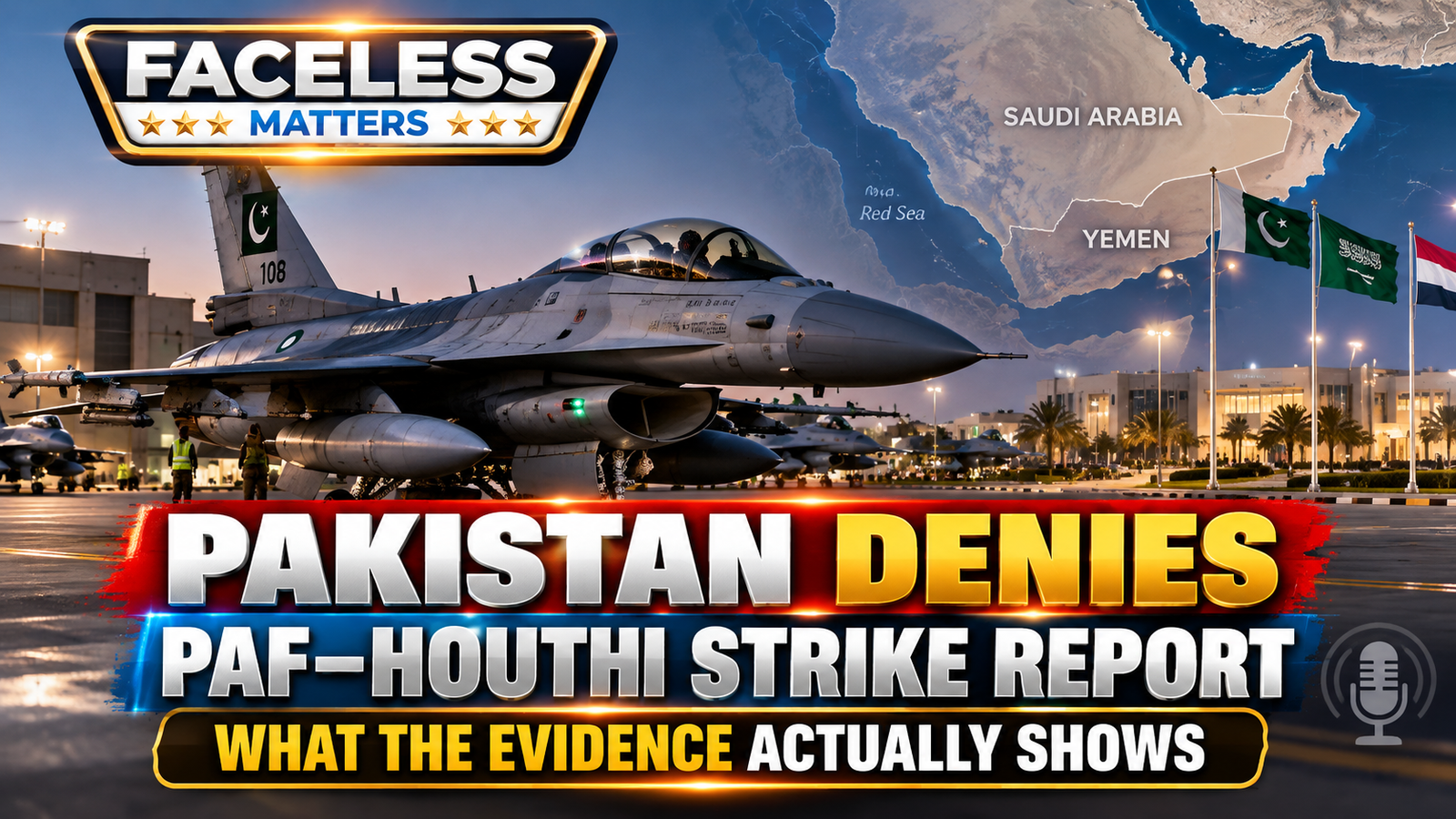
FACELESS MATTERS | International Affairs & Defence | 9 October 2026
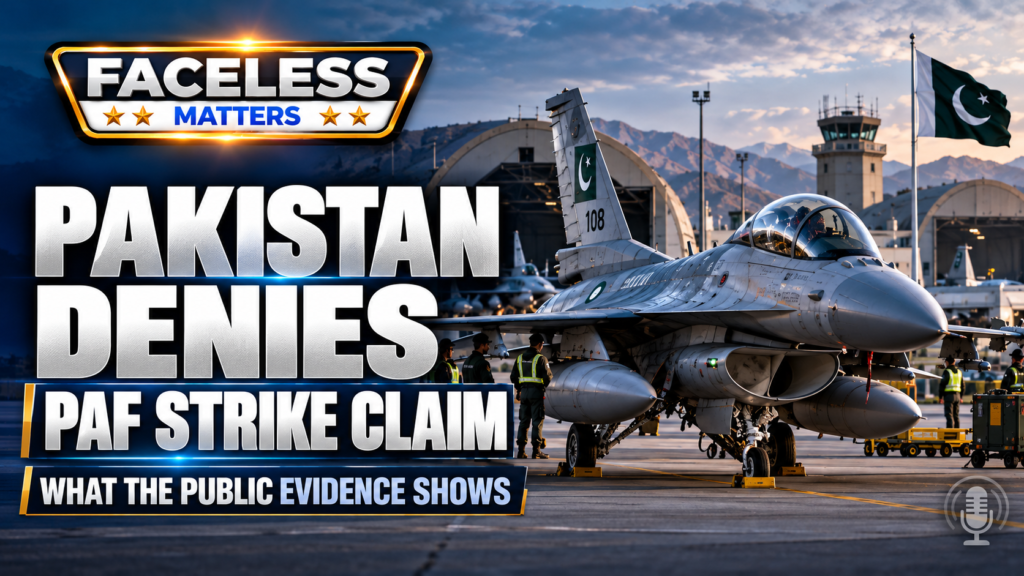
Pakistan Air Force Houthis Report: What the Official Denial Establishes—and What Remains Unverified
Pakistan’s Ministry of Information and Broadcasting has rejected a report attributed to The New York Times claiming that Pakistan Air Force (PAF) fighter jets were being used against Yemen’s Houthi movement. The ministry described the report as “fake and fabricated” and urged international media organisations to avoid speculative reporting about the possible employment of Pakistani military forces under the Makkah Joint Defence Agreement.
The denial, reported by Daily Jang on 9 October 2026, comes amid heightened regional tensions involving Saudi Arabia, Yemen’s Houthis and the recently activated defence framework involving Pakistan, Saudi Arabia and Türkiye. The immediate question is whether Pakistani aircraft have participated in operations against Houthi targets. A broader question concerns the distinction between Pakistan’s defence commitments to Saudi Arabia and evidence of participation in a specific combat operation.
The available reporting on the Pakistan Air Force Houthis claim establishes that Pakistan officially rejected the aircraft-use allegation. It does not, by itself, independently establish the complete operational picture. The distinction matters: a government denial is an official position, while a claim attributed to an unnamed source remains a reported allegation unless independently corroborated.
Key Takeaway
- The available reporting establishes that Pakistan officially rejected the aircraft-use claim.
- The reported claim: Coverage of a New York Times report published on 7 October attributed the assertion about Pakistani fighter jets to an unnamed senior Pakistani military official.
- The defence agreement: Pakistan, Saudi Arabia and Türkiye have a joint defence framework, but the existence of an agreement does not automatically prove that Pakistani aircraft participated in a particular strike.
- The evidence gap: The public information reviewed for this report does not independently verify the aircraft’s alleged combat role.
- The central issue: What Pakistan’s defence commitments mean in practice must be assessed through official statements, verifiable operational information and independent reporting—not speculation alone.
TABLE OF CONTENTS
Pakistan Air Force Houthis Report: What Happened?
On 8 October 2026, Pakistan’s Ministry of Information and Broadcasting issued a public denial concerning the reported use of Pakistan Air Force aircraft against the Houthis. According to the ministry’s statement, the New York Times report attributing such employment to PAF aircraft was “fake and fabricated.”
The ministry also asked international media organisations to avoid speculative reporting concerning the possible employment of Pakistan’s armed forces under the Makkah Joint Defence Agreement. It added that details of any deployment, if necessary, would be provided by the relevant authorities.
Daily Jang reported the denial on 9 October. Radio Pakistan, Dawn and other Pakistani news outlets also reported the government’s response.
The official statement on the Pakistan Air Force Houthis report establishes the government’s position. It does not provide a detailed operational account of every Pakistani military activity connected to Saudi Arabia, nor does the published denial identify the underlying evidence used by the ministry to reject the specific report.
That limitation should be acknowledged rather than filled with assumptions.
What Did the New York Times Report Allegedly Say?
Reporting published on 8 October by Dawn and other outlets described a New York Times report dated 7 October that attributed the claim about PAF fighter jets being used against the Houthis to an unnamed senior Pakistani military official.
The claim emerged during an escalation of Houthi attacks against Saudi targets and growing attention to the implementation of the Makkah Joint Defence Agreement.
The Pakistan Air Force Houthis report remains disputed. Pakistan’s Ministry of Information and Broadcasting did not confirm that PAF aircraft had been assigned to strike Houthi targets. A media report citing an unnamed official shows that the claim was reported, but it does not automatically provide independent confirmation of the underlying military activity.
Pakistan’s military reportedly did not comment to the newspaper on the matter, according to coverage of the original report. The subsequent public denial came from the Ministry of Information and Broadcasting.
A responsible assessment must therefore keep three separate elements in view:
- The media-reported allegation: Pakistani aircraft were allegedly being used against Houthi targets.
- The official response: Pakistan’s Ministry of Information and Broadcasting rejected the claim as false and fabricated.
- The independently verified record: The publicly available sources reviewed here do not independently establish that PAF aircraft carried out the alleged strikes.
These distinctions do not determine which account is correct. They show what is and is not established by the available public reporting.
Why Are the Houthis and Saudi Arabia at the Centre of the Dispute?
The Houthis, also known as Ansar Allah, are a Yemeni political and armed movement that controls substantial territory in Yemen. Their conflict with Yemen’s internationally recognised government and their confrontations with Saudi Arabia have affected regional security for years.
Recent attacks against Saudi targets have intensified concerns about missile and drone threats, the security of airports and infrastructure, and the potential for a wider regional confrontation.
Reports published on 8 October described Houthi attacks affecting Saudi airports and other targets. Reuters also reported a wider regional security crisis involving Houthi attacks and responses by regional actors.
These developments help explain why reports about foreign military involvement attract immediate attention. However, the existence of an escalating conflict does not establish that any particular country’s aircraft took part in a specific operation.
For Pakistan, the distinction is especially consequential. An officially confirmed defensive deployment, air-defence mission, training assignment or logistical contribution would not necessarily mean that Pakistani fighter jets had conducted offensive strikes against Houthi positions in Yemen.
The precise mission, location, command arrangements and operational authority would need to be established through reliable evidence.
What Is the Makkah Joint Defence Agreement?
The Makkah Joint Defence Agreement is a defence framework involving Pakistan, Saudi Arabia and Türkiye. It has become a central part of regional discussions about collective security and responses to threats affecting the participating countries.
The agreement’s existence and the subsequent meetings among the participating states provide context for the current dispute. But a defence agreement and a specific military operation are two different things.
A collective-defence arrangement may involve consultations, intelligence sharing, air defence, force readiness, logistics, training or other capabilities. Which measures are adopted in a particular situation depends on the agreement’s provisions, the decisions of the participating governments and the applicable operational arrangements.
The public statement from Pakistan’s Ministry of Information and Broadcasting did not confirm that PAF aircraft had been assigned to strike Houthi targets. Instead, it explicitly rejected the report making that claim.
It is therefore inaccurate to infer from the agreement alone that Pakistani fighter jets participated in offensive operations in Yemen. Equally, the public denial should not be expanded into claims about every possible military activity unless the relevant authorities or reliable independent evidence establish those details.
Does a Defence Commitment Automatically Mean Offensive Combat?
No. The existence of a defence commitment does not, on its own, establish the nature, location or purpose of a particular military deployment.
Military cooperation can take multiple forms. These may include protecting airspace, defending installations, training personnel, providing technical support, sharing information or participating in combat missions. Those activities are not interchangeable.
In the Pakistan Air Force Houthis report, the question is specific: were PAF aircraft being used against Houthi targets?
Answering that question requires evidence relating to the aircraft, mission and operation. General statements about regional cooperation cannot substitute for that evidence.
A careful report should not describe a defensive commitment as proof of offensive action. It should also avoid assuming that every form of military cooperation is necessarily non-combat. The appropriate conclusion depends on the facts that can be established.
What Evidence Is Publicly Available?
The sources reviewed for the Pakistan Air Force Houthis report support several limited conclusions. This Pakistan Air Force Houthis assessment separates the official denial from the allegation and the evidence available to the public.
Established: Pakistan’s Ministry of Information and Broadcasting publicly rejected the report alleging that PAF aircraft were being used against the Houthis.
Established: Pakistani media outlets reported the ministry’s denial on 8–9 October 2026.
Reported by international media: The New York Times published a report on 7 October that, according to subsequent coverage, attributed the claim about PAF fighter jets to an unnamed senior Pakistani military official.
Not independently established by the public material reviewed: Whether PAF aircraft actually conducted strikes against Houthi targets.
Not established by the denial alone: The full details of Pakistan’s military posture, the exact capabilities deployed in Saudi Arabia, or the complete operational arrangements under the defence agreement.
This is not a finding that the original report was correct or that the government’s denial was incorrect. It is a description of the evidentiary limits of the material available for this report.
Additional confirmation of the Pakistan Air Force Houthis claim could come from an on-the-record statement by the relevant military authorities, verifiable operational documentation, independently corroborated reporting or other reliable evidence directly connected to the alleged mission.
Why the Difference Matters for Pakistan
The question has diplomatic, military and public-information implications.
First, the allegation concerns the possible use of Pakistani military aircraft in a conflict involving Saudi Arabia and the Houthis. Such a claim can influence perceptions of Pakistan’s regional role and its obligations under the defence agreement.
Second, the claim could affect Pakistan’s relations with other regional states, including countries concerned about the expansion of the Yemen conflict.
Third, it raises questions about how the government communicates decisions involving military deployments. Pakistan’s ministry said relevant authorities would provide details of any necessary deployment. The public should distinguish that stated approach from any assumption that a particular mission has already occurred.
Fourth, the dispute illustrates the difficulty of verifying military activity during a fast-moving conflict. Information may come from official statements, anonymous sources, media reports or claims made by parties to the conflict. Each category has different evidentiary value.
Accurate reporting on the Pakistan Air Force Houthis claim requires careful attribution and a clear explanation of uncertainty.
What Should International Media Verify Before Publishing Such Claims?
Reports concerning military aircraft and combat operations should be assessed against several questions:
- Is the claim based on an identified source, an anonymous source or several independently corroborating sources?
- Does the source have direct knowledge of the alleged operation?
- Is the aircraft’s identity or role supported by verifiable evidence?
- Do official statements confirm, deny or leave the matter unanswered?
- Have independent outlets verified the same underlying facts, or are they repeating the original report?
- Does the report distinguish between aircraft being stationed in a country, performing defensive duties and conducting strikes against a target?
- Are the date, location and nature of the alleged operation clearly established?
These questions do not imply that anonymous sources are inherently unreliable. They mean that claims of direct military participation warrant particularly careful scrutiny because their consequences may extend beyond the immediate news cycle.
A second publication repeating a claim is not necessarily independent corroboration if it relies on the same original source.
Regional Implications: Saudi Security, Pakistan and Yemen
The Pakistan Air Force Houthis dispute arrives at a sensitive moment for regional security. Saudi Arabia faces threats linked to the Yemen conflict, while Pakistan has longstanding defence and security relations with the kingdom.
Türkiye is also involved in the trilateral defence framework, making the agreement part of a wider regional security discussion.
If Pakistani aircraft were confirmed to have conducted offensive strikes against Houthi targets, that would be a significant development requiring a clear account of the mission, the government’s position and the implications for Pakistan’s regional commitments. But that conditional assessment must not be mistaken for confirmation that the strikes occurred.
If the allegation remains unverified or is disproved by credible evidence, that distinction would also matter. Incorrect claims about military participation can distort public understanding, create diplomatic friction and obscure the actual scope of a defence agreement.
The immediate priority is therefore verification—not speculation about what Pakistan might do next.
What Happens Next?
Several developments would help clarify the issue:
- Further official clarification: Whether Pakistan’s military or other relevant authorities provide a more detailed account of the reported aircraft use.
- Independent verification: Whether credible reporting or documentary evidence establishes the alleged mission.
- Clarification of the defence framework: Whether Pakistan, Saudi Arabia or Türkiye publicly explain the specific measures being taken under the Makkah Joint Defence Agreement.
- Developments in the Yemen conflict: Whether Houthi attacks, Saudi responses or regional diplomatic initiatives change the security environment.
- Correction or confirmation by the original reporting outlet: Whether additional evidence is published that materially changes the assessment of the original claim.
Until more verifiable information becomes available, readers should be cautious about treating either anonymous-source reporting or categorical official statements as a substitute for a fully documented operational record.
FACELESS MATTERS Analysis
The central issue is not whether Pakistan and Saudi Arabia have defence ties. They do. Nor is the question whether the Houthis and Saudi Arabia are involved in a serious regional security confrontation. Public reporting establishes that they are.
The specific unresolved question in the Pakistan Air Force Houthis report is whether Pakistani aircraft were used against Houthi targets in the operation described by the disputed media report.
Pakistan’s Ministry of Information and Broadcasting has rejected that claim. Media coverage has described the original report as relying on an unnamed Pakistani military source. The public material reviewed for this article does not independently establish the alleged air strikes.
These facts must remain separate.
The denial should be reported accurately as the government’s position. The original claim should be attributed to the reporting that carried it. Neither should be transformed into a broader conclusion unsupported by the available evidence.
The Makkah Joint Defence Agreement provides important context, but its existence cannot independently prove that a specific combat mission took place. The same standard applies to claims about non-participation: conclusions about the full operational picture require evidence that directly addresses the relevant mission.
For FACELESS MATTERS, the responsible conclusion is straightforward: Pakistan has denied that its air force was used against the Houthis, while the specific operational claim remains unverified by the public evidence reviewed for this report. Further authoritative clarification or independently corroborated evidence would be needed to resolve the dispute conclusively.
Final Assessment
Pakistan’s rejection of the report alleging the use of PAF aircraft against the Houthis is a significant official response to a sensitive regional-security claim. The dispute has implications for Pakistan’s defence relationship with Saudi Arabia, the interpretation of the Makkah Joint Defence Agreement and the credibility of reporting about military operations.
The available sources on the Pakistan Air Force Houthis report establish that the Pakistani government rejected the claim. They also establish that international media coverage attributed the original assertion to an unnamed source. They do not, on their own, independently verify whether PAF aircraft carried out the alleged strikes.
The next step should be evidence-based clarification rather than assumptions. Until the operational facts are independently established, the claim should remain attributed and the government’s denial should remain clearly identified as its official position.
Credible defence journalism must distinguish what has been reported, what has been officially stated and what has actually been verified.
INTERNAL READING — FACELESS MATTERS
The following published FACELESS MATTERS articles were checked against their live website pages. Each headline links to its corresponding article, followed by the canonical URL.
Makkah Defense Alliance 2026: 7 Critical Facts on Rapid Deployment
Pakistani Army in Saudi Arabia: 5 Strong, Proven Signals
Makkah Joint Defence Agreement: 3 Critical Istanbul Risks
Makkah Defence Alliance 2026: Critical Haramain Security Update
Asim Munir Saudi Defence Minister Meeting 2026: Important Makkah Agreement Developments
Makkah Defence Alliance: 5 Essential Facts for Pakistan
Pakistan Defense 2026: 5 Critical Security Signals After Balochistan Operations
Pakistan at a Critical Hour: What Regional War, Oil Shock and Political Protests Mean for the Nation
Pakistan at a Critical Hour: JI Long March, Security Crisis and Economic Pressure
SOURCES & EDITORIAL NOTE
Primary source
- Daily Jang — Pakistan rejects report about PAF aircraft being used against the Houthis
- Pakistan Ministry of Information and Broadcasting statement, reported by Radio Pakistan
Independent reporting
- Dawn — Ministry rejects report claiming PAF jets were used against the Houthis
- The Express Tribune — Pakistan denies PAF jets striking Houthis
- Reuters — Regional security developments involving Houthi attacks and Saudi Arabia
- Associated Press — Pakistan’s defence commitment to Saudi Arabia amid Houthi escalation
Editorial Note
This report distinguishes the Pakistani government’s official denial from the claim attributed to an unnamed source in media reporting. The available sources reviewed do not independently establish whether PAF aircraft conducted the alleged strikes. The article does not infer a specific combat mission from the existence of the Makkah Joint Defence Agreement.
The report was prepared using the cited material available as of 9 October 2026. Any subsequent official clarification or independently verified evidence may require an update.