

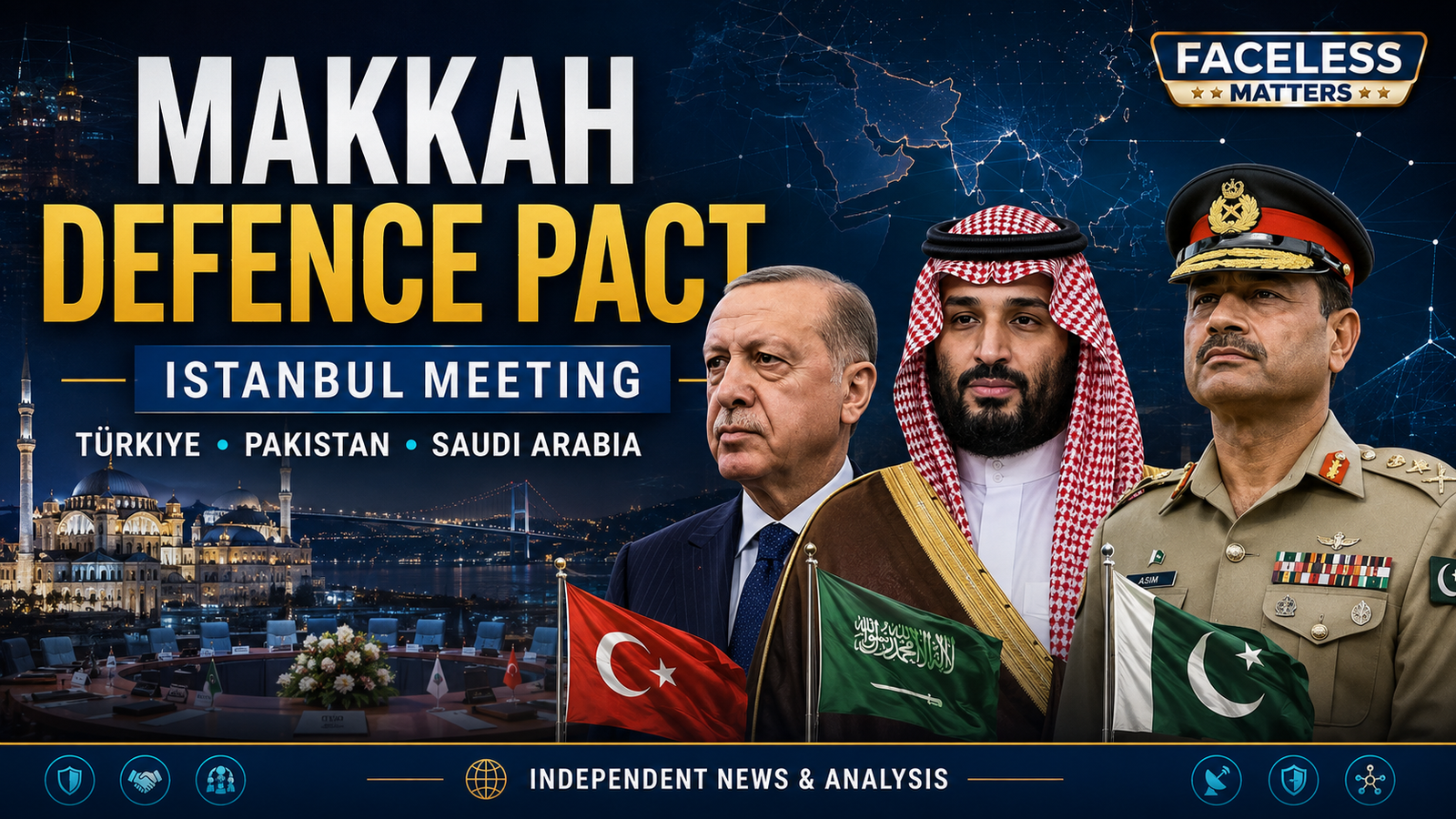
August 31, 2026 | Istanbul
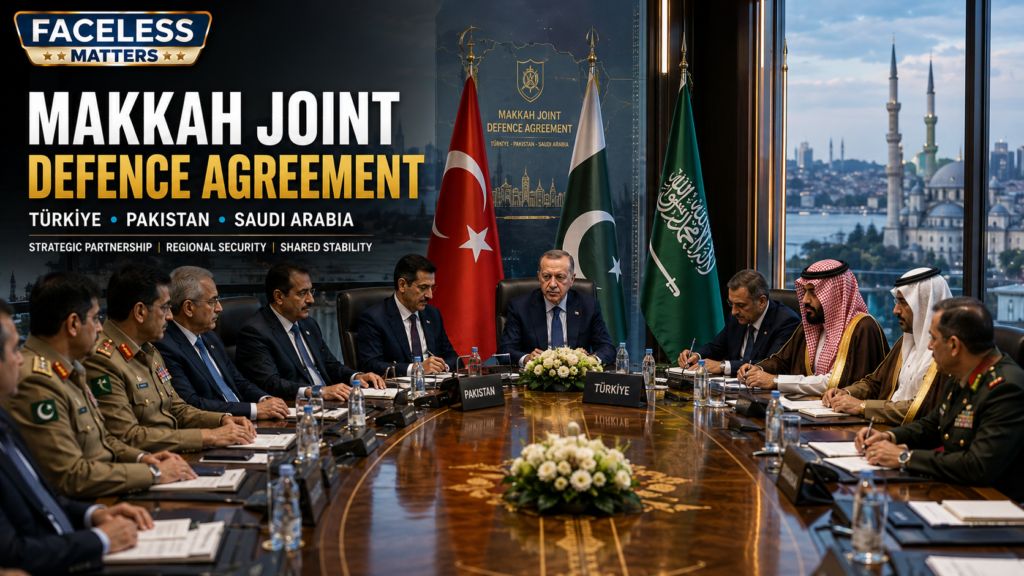
TABLE OF CONTENTS
Türkiye, Pakistan and Saudi Arabia are entering a significant new phase of strategic cooperation as the first meeting of the Strategic Political and Defence Committee established under the Makkah Joint Defence Agreement takes place in Istanbul today.
The meeting was officially confirmed by Türkiye’s Ministry of Foreign Affairs for August 31, 2026, with Turkish Foreign Minister Hakan Fidan, National Defence Minister Yaşar Güler and Chief of the Turkish General Staff General Selçuk Bayraktaroğlu participating alongside Pakistani and Saudi officials.
At face value, the meeting is another diplomatic gathering.
Strategically, however, it represents something more important:
the first institutional test of whether the Makkah Joint Defence Agreement can move from political commitment toward practical regional security cooperation.
A New Strategic Framework Takes Shape
The Makkah Joint Defence Agreement was established by Türkiye, Pakistan and Saudi Arabia as a framework for strengthening defense and security cooperation.
The significance of today’s meeting lies in the creation of an institutional mechanism through which the three countries can discuss security challenges, defense coordination and future cooperation.
This distinction is important.
Signing a defense agreement is a political decision.
Building the institutions required to make that agreement operational is a much longer strategic process.
The Istanbul meeting therefore provides an early indication of how seriously the three governments intend to develop the framework.
Why Istanbul Matters
Türkiye’s decision to host the first committee meeting gives Istanbul an important diplomatic role.
The city connects Europe, the Middle East and Asia and has long served as a major center for Turkish diplomacy.
Holding the first meeting there also highlights Türkiye’s role in developing the trilateral relationship.
According to the official Turkish announcement, the committee was created specifically under the Makkah Joint Defence Agreement and will bring together senior political and defense representatives from the three countries.
This gives the meeting a significance beyond ordinary bilateral consultations.
It is the beginning of a trilateral institutional process.
The Three Strategic Pillars
The emerging partnership brings together three countries with different but complementary strategic capabilities.
Türkiye’s Defense and Technology Capacity
Türkiye has developed a significant domestic defense industry and increasingly emphasizes indigenous military technology, defense exports and strategic autonomy.
Its defense-industrial capabilities give Ankara an important potential role in future cooperation involving technology, training, research and defense production.
Pakistan’s Military and Strategic Experience
Pakistan possesses extensive military experience and established defense relationships across the region.
Its armed forces also maintain significant experience in counterterrorism, conventional military operations and strategic security planning.
Pakistan’s defense-industrial capabilities could provide another important component of future trilateral cooperation.
Saudi Arabia’s Financial and Regional Influence
Saudi Arabia brings substantial financial capacity, strategic geography and significant diplomatic influence across the Middle East.
Riyadh has also placed increasing emphasis on defense localization, advanced technology and the development of domestic industrial capabilities.
The combination creates an interesting strategic equation:
Türkiye contributes technology and defense-industrial expertise.
Pakistan contributes military experience and strategic capabilities.
Saudi Arabia contributes financial strength, regional influence and investment potential.
The challenge is turning these complementary strengths into a coherent institutional framework.
The Real Test Is Implementation
The agreement now faces a critical test as the Istanbul meeting moves the partnership from political commitment toward practical defence coordination.
The Makkah Joint Defence Agreement also carries significance beyond the immediate Istanbul meeting. Its value will ultimately depend on whether Türkiye, Pakistan and Saudi Arabia can convert political alignment into sustained institutional cooperation, credible defence planning and practical coordination. A successful framework could strengthen consultation among the three partners while creating opportunities in defence technology, military training, counterterrorism and industrial cooperation. At the same time, implementation will require clear responsibilities, regular strategic dialogue and measurable objectives. The partnership therefore enters a more consequential phase as the partners begin testing its practical value.
The trilateral defence agreement now faces a critical test as the Istanbul meeting moves the partnership from political commitment toward practical defence coordination.
The Makkah Joint Defence Agreement now moves from diplomatic commitment toward practical implementation, making the Istanbul meeting an important test of how Türkiye, Pakistan and Saudi Arabia translate their strategic understanding into coordinated defence cooperation.
The most important question facing the Makkah Joint Defence Agreement is not whether the three countries can make political declarations.
They can.
The real question is whether they can create effective mechanisms for implementation.
That could eventually involve:
- Regular strategic consultations
- Military-to-military coordination
- Defense-industry cooperation
- Research and development
- Joint training
- Interoperability
- Counterterrorism cooperation
- Intelligence coordination
- Defense technology partnerships
- Institutional coordination mechanisms
Each of these areas requires sustained political commitment.
A treaty can be signed in a single day.
A functioning security architecture can take years to build.
Defense Industry Could Become a Major Economic Driver
One of the potentially most valuable dimensions of the partnership is defense-industrial cooperation.
Modern defense relationships increasingly involve much more than purchasing weapons.
They involve research, technology transfer, domestic manufacturing, maintenance, logistics, software, communications, training and supply chains.
Türkiye has developed a growing defense-export sector.
Pakistan has established defense manufacturing capabilities.
Saudi Arabia is seeking greater defense localization and industrial development.
If these three systems can be connected effectively, the partnership could potentially produce commercial and technological opportunities alongside military benefits.
That could make defense cooperation an important component of the wider strategic investment, technology and economic cooperation agenda.
Interoperability May Be More Important Than Weapons
A common mistake in analyzing defense partnerships is to focus exclusively on weapons.
The more difficult issue is interoperability.
Three militaries can possess sophisticated equipment while still facing major difficulties operating together if their communications, procedures, logistics and command structures are not compatible.
Interoperability can require:
common procedures, coordinated training, communications compatibility, logistics planning and regular joint exercises.
If the Makkah framework eventually produces these mechanisms, its strategic value could become considerably greater.
Counterterrorism and Regional Security
Counterterrorism cooperation could also become an important practical component.
Türkiye, Pakistan and Saudi Arabia have each faced different security challenges and developed distinct approaches to counterterrorism and national security.
Cooperation could potentially involve intelligence sharing, training, border security, threat assessment and institutional knowledge exchange.
However, effective security cooperation also requires careful attention to international law, civilian protection and responsible information handling.
A credible regional security framework must demonstrate that stronger security capabilities can coexist with responsible diplomacy.
Is This a New Military Alliance?
This is where careful analysis is essential.
It would be premature to describe the Makkah framework as a fully integrated military alliance.
The official Turkish announcement confirms the committee meeting, but the announcement itself does not establish that the three countries have created a NATO-style integrated military command structure.
Therefore, the more accurate description at this stage is:
a trilateral defense and security cooperation framework that is beginning to develop institutional mechanisms.
Its eventual strategic weight will depend on what the three governments actually build.
The Geopolitical Dimension
The partnership also has wider geopolitical significance.
Türkiye occupies a strategically important position between Europe, the Black Sea, the Middle East and Central Asia.
Pakistan sits at the intersection of South Asia, Central Asia and the Arabian Sea.
Saudi Arabia occupies a central position in the Gulf and wider Middle Eastern security environment.
Together, the three countries connect several strategically important regions.
That geographical combination gives the partnership potential importance beyond traditional bilateral defense cooperation.
However, it also creates a diplomatic responsibility.
The framework must avoid unnecessary escalation and remain focused on its stated security and defense objectives.
FACELESS MATTERS Strategic Analysis
The most important development emerging from Istanbul may not be a dramatic announcement.
It may be something much less visible:
institution building.
If the committee develops regular meetings, clearly defined responsibilities, defense-industry projects, military coordination mechanisms and a practical implementation roadmap, the Makkah Joint Defence Agreement could gradually develop into a durable regional security framework.
If these mechanisms remain weak, the agreement could remain primarily a political statement.
That is why today’s meeting deserves attention.
The strategic value of the agreement will ultimately be determined by what happens after the cameras leave the room.
Three Things FACELESS MATTERS Will Watch
1. Institutionalization
Will the three countries establish permanent mechanisms for implementing the agreement?
2. Defense-industrial cooperation
Will political commitments translate into joint production, technology, research and investment?
3. Military interoperability
Will the three armed forces move toward more structured training, coordination and operational compatibility?
These indicators will tell us far more about the agreement’s future than ceremonial statements alone.
A Strategic Opportunity — With Strategic Risks
There is considerable potential.
Türkiye can contribute defense technology and industrial expertise.
Pakistan can contribute military experience and strategic capabilities.
Saudi Arabia can contribute investment capacity and regional diplomatic weight.
But strategic partnerships also require careful management.
Different national priorities, different threat perceptions and different relationships with global powers can complicate cooperation.
The strongest model would therefore be one that increases collective defensive capability while maintaining diplomatic flexibility.
That balance could prove crucial.
What Today’s Meeting Really Represents
The Istanbul meeting should not be viewed simply as another diplomatic event.
It is the first significant opportunity for Türkiye, Pakistan and Saudi Arabia to demonstrate whether the Makkah Joint Defence Agreement can evolve into a functioning institutional framework.
The agreement’s long-term significance will depend on implementation, military coordination, defense-industrial cooperation, strategic communication and sustained political commitment.
For now, the most accurate conclusion is neither to exaggerate the agreement nor to dismiss it.
The framework is still being built.
And Istanbul is where the construction begins.
INTERNAL LINKS
1. Pakistan’s National Security & Counterterrorism — Read our analysis of Pakistan’s continuing terrorism and national-security challenges, including the importance of coordinated national efforts for security, stability and peace. Read: The Role of Institutions and Citizens in Ending Pakistan Terrorism
2. The Wider Global Security Environment — Explore our analysis of the major geopolitical, energy and international-security risks shaping the global environment in 2026 and understand how developments in one region can affect wider strategic stability. Read: World News 2026: 4 Major Global Risks to Watch
3. Regional Security, Energy & Strategic Pressure — Our analysis of the Strait of Hormuz crisis examines how regional instability can affect energy security, shipping, economic stability and the strategic calculations of countries across Asia and the Middle East. Read: Strait of Hormuz Crisis: Oil Above $90 in 2026
FACELESS MATTERS Editorial Note
This article is an original FACELESS MATTERS news analysis based on publicly available official information. The Istanbul meeting is officially scheduled for August 31, 2026. Future developments, decisions or statements emerging from the meeting may require this article to be updated.
Source verification: Republic of Türkiye Ministry of Foreign Affairs. The official announcement confirms the date, location and participation framework for the inaugural Strategic Political and Defence Committee meeting.
FACELESS MATTERS
Independent News, Analysis & Digital Media
For editorial questions, corrections, source concerns or legitimate inquiries:
Visit facelessmatters.com
Follow FACELESS MATTERS on every platform.
Educational & Editorial Note:
This content is provided for informational and educational purposes. Strategic analysis represents interpretation based on publicly available information and should not be treated as official government policy, military advice, financial advice or a prediction of future events.
[…] Makkah Joint Defence Agreement: Istanbul Meeting Tests a New Trilateral Security Framework — FACELESS MATTERS’ earlier analysis examines the first Strategic Political and Defence Committee meeting and explains how the three countries are attempting to convert the original agreement into practical defence cooperation. Read the FACELESS MATTERS analysis […]