

FACELESS MATTERS | International Affairs & Defence | 9 October 2026
Pakistan’s Military Spokesperson Explains the Agreement’s Defensive Purpose, Operational Flexibility and Regional Peace Priorities
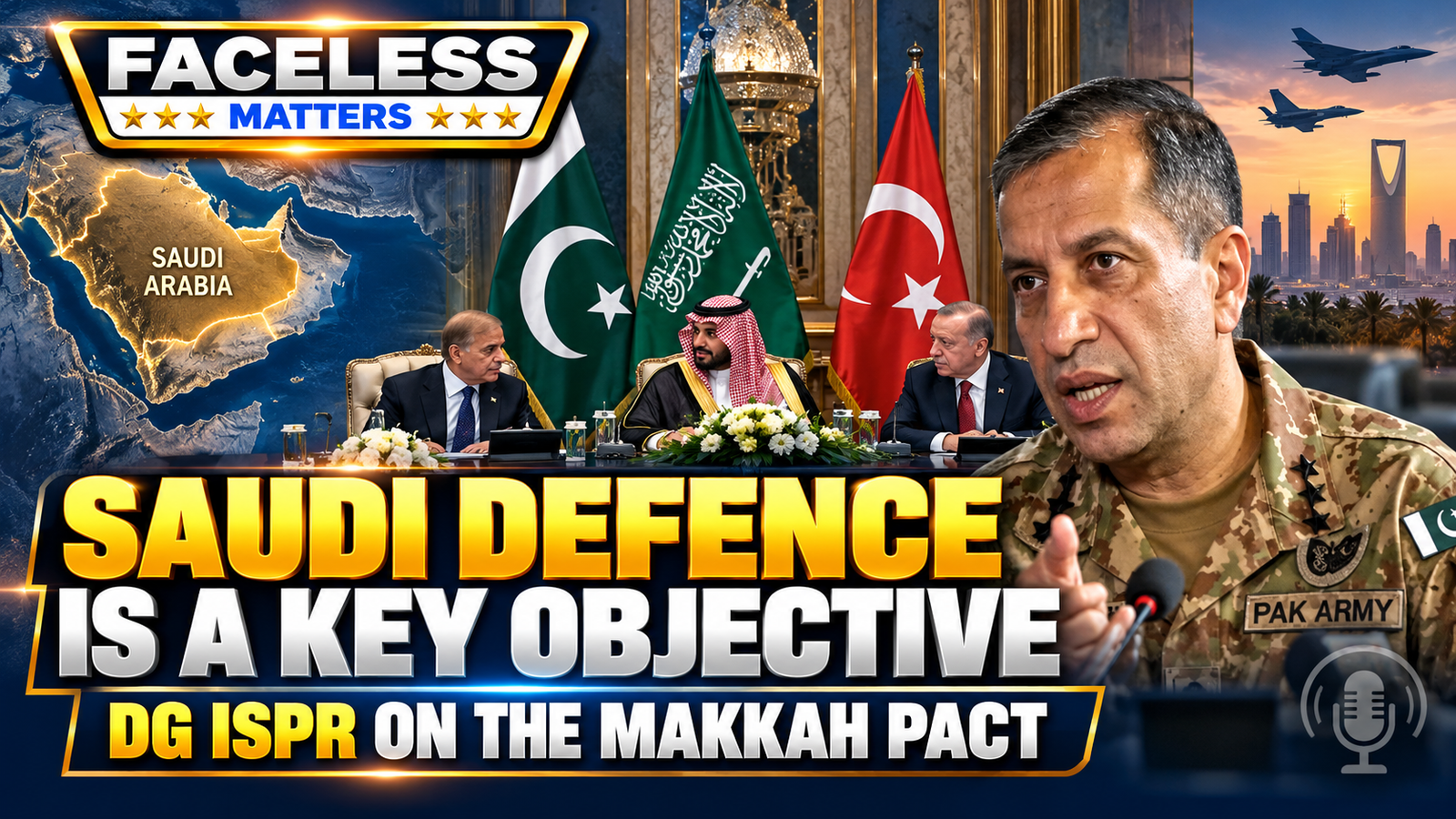
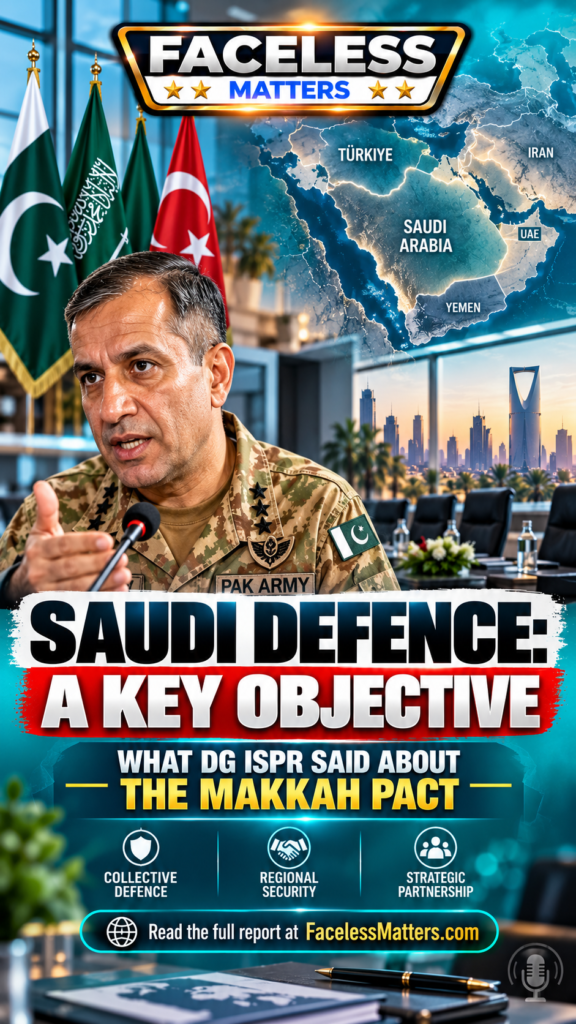
Makkah defence agreement has placed Saudi Arabia’s security among its stated objectives, according to Pakistan’s military spokesperson. Lieutenant General Ahmed Sharif Chaudhry, Director General of Inter-Services Public Relations (DG ISPR), reaffirmed Islamabad’s commitment to the kingdom’s security while emphasising that the arrangement is defensive in nature. He also said operational commanders would determine how the agreement is implemented, including which forces or capabilities may be used and how they would be employed.
The remarks, reported by Daily Jang on 9 October 2026, come as Pakistan, Saudi Arabia and Türkiye develop their trilateral defence framework amid heightened regional security concerns. The agreement links the security of its signatories through collective-defence commitments, but the public statements do not disclose every operational detail.
The distinction matters when assessing the Makkah defence agreement. A declared commitment to defend a partner country is not, by itself, confirmation of a specific deployment, combat mission or operational timetable. Understanding the agreement requires separating its stated purpose from the decisions that may follow under its implementation.
Key Takeaways
- Saudi Arabia’s defence is a stated objective: DG ISPR said the agreement includes defending the kingdom.
- The arrangement is described as defensive: Pakistan’s official position presents the framework as a means of collective deterrence and security cooperation, not an alliance directed against a named country.
- Operational decisions remain distinct: According to the reported remarks, operational commanders will determine the force composition and manner of employment.
- Collective defence does not automatically mean offensive action: The nature of any particular mission must be established through authoritative information.
- Diplomacy remains part of Pakistan’s stated approach: DG ISPR also emphasised negotiations, de-escalation and a peaceful resolution of regional disputes.
What Did DG ISPR Say About the Makkah Defence Agreement?
In the report published by Daily Jang, Lieutenant General Ahmed Sharif Chaudhry described the Makkah Joint Defence Agreement as a framework that did not emerge suddenly. He referred to the longstanding defence relationship among Pakistan, Saudi Arabia and Türkiye and said Pakistani forces had been present in Saudi Arabia across different capabilities and fields for decades.
He explained that implementation of the agreement would have defensive effects. Questions about which force or unit might be assigned, how it would be employed and what form a particular deployment could take would be determined by operational commanders.
His remarks also addressed the agreement’s wider strategic purpose. He said it was not intended to classify countries simply as friends or enemies, but that defending Saudi Arabia was one of its objectives.
The comments establish Pakistan’s publicly stated position on the Makkah defence agreement. They do not provide a complete operational plan or specify every force, capability or mission that might be authorised in the future.
That distinction is central to accurate defence reporting: a statement of strategic purpose should not be presented as confirmation of undisclosed operational decisions.
What Is the Makkah Joint Defence Agreement?
Pakistan, Saudi Arabia and Türkiye signed the Makkah Joint Defence Agreement in Makkah on 7 August 2026. Pakistan’s Foreign Ministry described the accord as defensive in nature, aimed at strengthening collective deterrence, protecting sovereignty and territorial integrity, and contributing to regional peace and stability.
The agreement’s central collective-defence principle states that an armed attack against one signatory is to be regarded as an attack against all three. This establishes a shared security commitment, although the specific response to a particular situation depends on the agreement, the decisions of the participating governments and applicable legal and operational arrangements.
The framework is also intended to strengthen defence cooperation among the three countries. In practice, such cooperation can encompass consultations, planning, training, readiness, information-sharing and other defensive capabilities. The precise activities undertaken under this agreement should be identified through official statements or independently verified reporting rather than assumed.
The Makkah defence agreement’s significance therefore extends beyond a single announcement. It creates a framework through which the participating states can coordinate their approach to common security concerns.
However, the existence of a framework does not establish that every possible military option has been approved or activated.
Why Is Defending Saudi Arabia a Key Objective?
Saudi Arabia is an important strategic partner for Pakistan. The two countries have maintained longstanding diplomatic, economic, religious and defence ties, while their security relationship has included military cooperation over several decades.
The kingdom’s security is also connected to wider regional stability. Threats to populated areas, critical infrastructure or essential transport and energy facilities can have consequences beyond national borders. For Pakistan, instability in the Gulf may affect diplomatic priorities, economic interests and the wider security environment.
DG ISPR’s statement places the defence of Saudi Arabia within the Makkah defence agreement’s declared purpose. It communicates that Pakistan regards the kingdom’s security as an important element of the trilateral arrangement.
The statement should not, however, be interpreted as proof of a particular military response to every possible threat. The scope of any response would depend on the circumstances, the relevant decisions and the framework’s applicable provisions.
A public commitment establishes a strategic position. Operational details establish how that position is translated into action.
Does the Agreement Mean Pakistan Will Enter Every Regional Conflict?
The Makkah defence agreement’s collective-defence language should not be confused with automatic confirmation of a particular combat mission.
An alliance can establish shared responsibilities without making every operational decision public in advance. The response to a security incident may require consultations, assessments of the threat, decisions by authorised officials and coordination among the participating states.
DG ISPR’s reported comments reinforce this distinction by placing decisions about force selection and employment in the hands of operational commanders.
The public reporting does not disclose a complete list of circumstances in which particular capabilities would be used. It also does not establish that every form of military cooperation under the agreement would involve direct combat.
For example, military support may involve readiness, surveillance, reconnaissance, training, logistics or air-defence functions. These activities have different purposes and should not be treated as interchangeable with offensive strikes.
The responsible conclusion is that the agreement provides a collective-defence framework, while the nature of any specific operation must be assessed on its own evidence.
What Role Do Operational Commanders Play?
DG ISPR’s remarks highlight the difference between political or strategic commitments and operational execution.
Governments establish policy, approve arrangements and determine the broad objectives of defence cooperation. Military commanders then work within their authorised responsibilities to plan and execute activities.
The selection of personnel, units or capabilities may depend on the nature of a threat, operational requirements, readiness, command arrangements and the decisions authorised by the participating states. These are general features of military planning, not confirmation of undisclosed provisions specific to this agreement.
The public statement indicates that operational commanders would decide how the Makkah defence agreement is implemented. It does not identify a specific force package, deployment schedule, rules of engagement or mission assignment.
Those details should not be invented to fill gaps in the public record.
The agreement’s implementation should instead be followed through official announcements, relevant joint statements and credible reporting that distinguishes confirmed decisions from speculation.
Collective Deterrence: The Agreement’s Wider Strategic Purpose
Collective deterrence seeks to discourage aggression by making clear that a threat against one participant may prompt a coordinated response from the others.
The Makkah defence agreement gives Pakistan, Saudi Arabia and Türkiye a framework for communicating their shared security commitments. The expectation of coordinated action may influence how potential threats are assessed, although the actual effectiveness of deterrence cannot be established from a declaration alone.
Several factors will shape its practical impact.
Defence coordination
The three countries may seek to improve consultation and coordination so that their security assessments and responses are better aligned.
Military readiness
The framework can provide a basis for preparing relevant forces and capabilities under approved arrangements. Readiness, however, should not be confused with confirmation that a new deployment has occurred.
Interoperability
Cooperation may involve improving the ability of participating forces to communicate, plan and work together. The extent of such integration would require evidence from subsequent activities and official announcements.
Strategic communication
The agreement communicates that the participating countries intend to cooperate on shared security concerns. Its practical meaning will depend on implementation, not merely on public declarations.
These are potential functions of collective-defence cooperation. They should not be presented as confirmed outcomes unless supported by further evidence.
Is the Agreement Directed Against a Specific Country?
Pakistan’s official position is that the Makkah defence agreement is defensive and is not directed against any particular country. The Foreign Ministry’s statement following the signing also emphasised sovereignty, collective deterrence and peaceful regional relations.
DG ISPR’s reported remarks are consistent with that stated position. He said the agreement’s purpose was not to categorise countries as enemies or friends, while identifying Saudi Arabia’s defence as one of its objectives.
This framing is important because defence agreements can be interpreted differently by neighbouring states and external observers. A collective-security arrangement may reassure participating countries while raising questions elsewhere about its future scope and practical consequences.
Those questions are best answered through the agreement’s published terms, official explanations and observable implementation. Speculation about an undisclosed target or an assumed offensive purpose should not replace evidence.
At the same time, describing a pact as defensive does not eliminate the need to scrutinise how it is implemented. Transparency about its legal basis, operational scope and diplomatic objectives can help reduce misunderstandings.
Pakistan’s Diplomatic Position: Defence and Dialogue
DG ISPR also spoke about efforts to end the conflict involving Iran and the United States, saying Pakistan would continue working for an agreement, reduced differences and a peaceful resolution through negotiations. He emphasised that the conflict should not expand further.
These comments place the defence agreement within a broader public message that combines security commitments with diplomacy.
Defence cooperation and diplomatic engagement are not necessarily contradictory. States can strengthen their ability to protect themselves while also seeking negotiations to prevent escalation. Whether those parallel approaches succeed depends on the conduct of the parties, diplomatic progress and developments on the ground.
For Pakistan, maintaining a stated commitment to Saudi security while supporting peaceful conflict resolution presents a significant foreign-policy balancing task. The country has interests in regional stability and in preventing disputes from widening into a broader confrontation.
The available report records DG ISPR’s stated preference for negotiations and de-escalation. It does not, by itself, establish the outcome of any diplomatic initiative or guarantee that a settlement will be reached.
What Should Readers Watch Next?
Several developments may help clarify how the agreement evolves. Readers should distinguish between a formal announcement, a proposal under discussion and a measure that has actually been implemented. Statements issued by the governments involved can help establish whether new procedures, consultations or cooperation arrangements have been approved. Independent reporting may provide additional context, but operational claims should be checked against credible evidence wherever possible.
The timing, scope and practical consequences of any new measure should not be assumed before they are confirmed. When following the Makkah defence agreement, readers should distinguish between an official announcement, a proposal under discussion and a measure that has actually been implemented. Statements from Pakistan, Saudi Arabia and Türkiye may clarify whether new consultations, procedures or cooperation arrangements have been approved.
Joint statements can help establish the stated purpose of a decision, while credible independent reporting may add context about its regional significance. However, a general reference to readiness or cooperation does not necessarily confirm a new deployment, a specific unit assignment or a combat mission. Those claims require reliable evidence. Readers should also consider whether an announcement describes an intention, an agreement in principle or a completed action,
Because these stages are not interchangeable. If officials do not disclose operational details, that gap should be reported transparently rather than filled with speculation. This evidence-based approach makes it easier to assess future developments fairly, compare official statements with verified reporting and understand how the defence framework evolves without assuming that every possible measure has already been activated.
Official implementation announcements: Statements from Pakistan, Saudi Arabia and Türkiye may explain the steps taken under their approved arrangements.
Operational clarification: Authorised officials may provide additional information about the nature of specific defensive measures, subject to legitimate confidentiality requirements.
Trilateral coordination: Further meetings and joint statements may indicate how the participating countries intend to coordinate their security commitments.
Diplomatic developments: Efforts to reduce regional tensions and pursue negotiations will remain relevant to the security environment in which the agreement operates.
Evidence of practical outcomes: Readiness improvements, formal institutional arrangements and publicly confirmed activities may help demonstrate how the agreement moves from principle to implementation.
These indicators can provide a clearer picture of the Makkah defence agreement without assuming that an unannounced deployment or combat operation has taken place.
What the Public Statement Establishes—and What It Does Not
The Daily Jang report supports several clear conclusions about Pakistan’s public position.
First, DG ISPR identified Saudi Arabia’s defence as one objective of the Makkah Joint Defence Agreement.
Second, he described the agreement’s implementation as defensive and said operational commanders would decide how forces or capabilities would be used.
Third, he referred to Pakistan’s longstanding military presence in Saudi Arabia and emphasised regional peace and negotiated solutions to wider disputes.
The report does not disclose the complete operational structure of the agreement. It does not specify every unit or capability that might be assigned, provide a comprehensive deployment timetable, or confirm a particular combat mission.
Those limitations matter when evaluating official statements and their wider implications. Reporting what an official has said is different from claiming that every possible implication has already become operational reality. Readers should examine the wording of official announcements carefully and distinguish confirmed decisions from future possibilities. A statement of intent does not necessarily establish that a policy has been implemented, while an agreement does not automatically confirm that every related procedure is active.
Reliable reporting should identify who made a statement, what was actually confirmed and which details remain undisclosed. When evidence is incomplete, FACELESS MATTERS distinguishes verified facts from assumptions. Further official statements and credible reporting may clarify unresolved operational and diplomatic questions.
Further authoritative information will be needed to clarify the remaining details.
FACELESS MATTERS Analysis
The most important aspect of DG ISPR’s statement on the Makkah defence agreement is the combination of a clear strategic commitment and an acknowledgement that implementation requires operational decisions.
Identifying Saudi Arabia’s defence as a key objective communicates the importance Pakistan attaches to the kingdom’s security. The collective-defence framework also provides a structure for Pakistan, Saudi Arabia and Türkiye to coordinate their responses to shared security concerns.
But the agreement’s long-term significance will depend on how its provisions are implemented. Public declarations can establish intent; they cannot, by themselves, demonstrate the exact scope, readiness or results of military cooperation.
The emphasis on operational commanders also highlights why speculation about specific deployments should be treated cautiously. Without authoritative information, it would be premature to assume which forces will be used, what their missions would involve or whether a particular regional confrontation would trigger a specific response.
The diplomatic dimension is equally important. DG ISPR’s reported support for negotiations suggests that Pakistan’s public messaging combines defence preparedness with an expressed interest in preventing further escalation. The practical relationship between those priorities will become clearer through subsequent statements and developments.
For FACELESS MATTERS, the central finding is straightforward: Pakistan has publicly identified Saudi Arabia’s defence as one purpose of the Makkah Joint Defence Agreement, while leaving the details of operational implementation to the authorised military decision-making process.
Conclusion
DG ISPR’s remarks clarify Pakistan’s stated position on the Makkah Joint Defence Agreement: defending Saudi Arabia is one of its objectives, and the framework is presented as defensive rather than as an alliance aimed at a particular country. The agreement links Pakistan, Saudi Arabia and Türkiye through collective-defence commitments, but its operational meaning must be established through official decisions and verifiable information.
The distinction between strategic commitment and operational action should remain central to any assessment. The public statement does not disclose every deployment detail or confirm a specific combat mission. Further official clarification and credible reporting will be needed to assess how the agreement develops in practice.
For now, the clearest reading is that Pakistan has reaffirmed its commitment to Saudi security while also expressing support for diplomacy, negotiations and regional stability. The Makkah defence agreement’s significance will ultimately be measured by its implementation, its contribution to deterrence and its ability to support security without unnecessarily widening regional conflict.
INTERNAL READING — FACELESS MATTERS
Makkah Defense Alliance 2026: 7 Critical Facts on Rapid Deployment
Pakistani Army in Saudi Arabia: 5 Strong, Proven Signals
Makkah Joint Defence Agreement: 3 Critical Istanbul Risks
Makkah Defence Alliance 2026: Critical Haramain Security
Asim Munir Saudi Defence Minister Meeting 2026: Vital Update
Makkah Defence Alliance: 5 Remarkable Gains for Pakistan
Pakistan Defense 2026: 5 Critical Security Signals
Pakistan Regional Crisis 2026: Critical Oil & Security Risks
Pakistan JI Long March 2026: Key Security & Economic Risks
SOURCES & EDITORIAL NOTE
Primary report
Daily Jang — DG ISPR says defending Saudi Arabia is one objective of the Makkah defence agreement
Official agreement statement
Pakistan Ministry of Foreign Affairs — Message on the signing of the Makkah Joint Defence Agreement
Independent reporting
Dawn — DG ISPR says Pakistani troops are present in Saudi Arabia across multiple domains
Dawn — Pakistan, Türkiye and Saudi Arabia agree to rapid force deployment under the Makkah pact
Editorial Note
This article distinguishes DG ISPR’s reported statements from analysis of their possible strategic implications. The agreement’s stated defensive purpose and collective-defence framework are described using the available reporting and official statements. No undisclosed deployment, specific combat mission or operational outcome is presented as confirmed.
Prepared by FACELESS MATTERS using the cited material available as of 9 October 2026. Subsequent official clarification or independently verified information may require an update.