

TABLE OF CONTENTS
Good Morning from FACELESS MATTERS — August 20, 2026
The global energy market is entering a sensitive phase as geopolitical tensions, disrupted maritime traffic and tighter LNG flows combine to keep oil prices elevated. The Global Energy Supply Crisis 2026 is becoming a major market issue as oil, LNG and electricity systems face growing pressure from shipping disruptions, supply risks and higher energy costs.
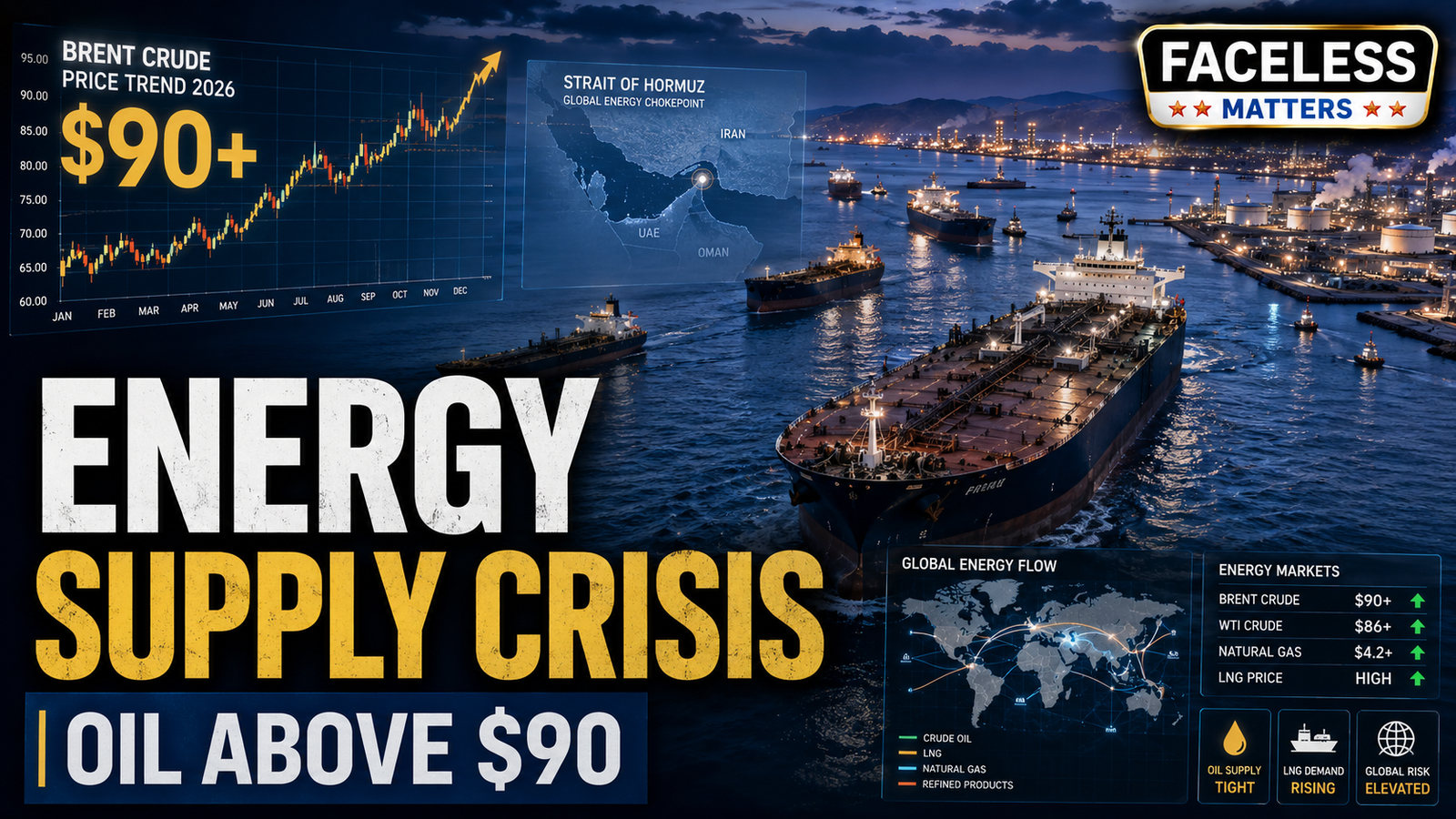
Brent crude has moved above the $90-per-barrel level again, with Reuters reporting Brent October futures at about $91.87 per barrel on August 20. The latest move marks a fifth consecutive session of gains, while concerns over Middle East supply security remain central to market sentiment.
At the same time, Europe is facing renewed natural-gas pressure, with LNG shipments through the Gulf disrupted and competition for available cargoes increasing between European and Asian buyers.
The result is a broader problem than a simple increase in crude prices.
The Global Energy Supply Crisis 2026 is increasingly becoming a question of how quickly energy systems can adapt when oil, gas, LNG and electricity markets are exposed to the same geopolitical shock.
1. Why the Global Energy Supply Crisis 2026 Matters
Energy markets normally absorb disruptions through alternative suppliers, inventory adjustments, flexible transportation and changes in demand.
The current environment is more complicated.
The Strait of Hormuz remains one of the world’s most important energy shipping corridors, and current traffic levels remain significantly below normal according to recent reporting. That reduction matters because a disruption to maritime flows can affect more than crude oil.
It can also influence refined products, LNG availability, shipping costs, insurance premiums and the cost structure of energy-intensive industries.
This is why the present situation should be viewed as a multi-layer energy-security event rather than simply another oil-price rally.
The Global Energy Supply Crisis 2026 is becoming a wider energy security and economic issue as oil, LNG and electricity markets face growing pressure.
When physical supply becomes uncertain, financial markets often react before actual shortages appear.
That expectation effect can push prices higher.
2. Oil Above $90 Is Becoming the Market’s Main Signal
The most visible part of the current energy story is crude oil.
Brent crude has remained above $90 while West Texas Intermediate has also moved higher. Reuters reported Brent near $91.87 and noted that both major benchmarks were at their strongest levels since July 24.
Higher oil prices create several transmission channels.
First, transportation becomes more expensive.
Second, industrial operating costs can rise.
Third, governments face greater pressure to protect consumers from higher fuel costs.
Fourth, inflation expectations can become more difficult to control.
The market therefore watches oil not only as a commodity but also as a signal for the wider macroeconomic environment.
The important question is whether prices remain elevated because of temporary geopolitical risk or whether prolonged supply constraints create a more persistent structural energy shock.
That distinction will matter for central banks, businesses and households.
3. Strait of Hormuz Is the Critical Energy Chokepoint
The Strait of Hormuz has become the central geographic issue in the current energy market.
The waterway is strategically important because a large share of global oil and LNG trade passes through the Gulf region.
Recent reporting indicates that shipping activity through the corridor remains well below pre-war levels, increasing uncertainty for exporters, importers and shipping companies.
Even when energy infrastructure itself remains physically intact, reduced traffic can create a supply problem.
Tankers may wait longer.
Insurance costs can increase.
Routes may become less predictable.
Cargoes can be delayed.
Refiners may begin competing more aggressively for available crude.
These effects can raise the final cost of energy without a complete shutdown of production.
That is one of the most important characteristics of the Global Energy Supply Crisis 2026.
The crisis does not necessarily require every field, refinery or pipeline to stop operating.
A sufficient reduction in reliable transportation can produce market stress on its own.
4. Europe Is Facing a Renewed Natural-Gas Problem
Oil is only one part of the story.
Natural gas has become another major pressure point.
Recent reporting indicates that European natural-gas futures are near their highest levels since early 2023, while disruptions to LNG flows through the Gulf are increasing competition between Europe and Asia for available cargoes.
The Global Energy Supply Crisis 2026 also shows how closely energy markets are connected to geopolitics, shipping and international trade.
This creates a difficult situation for Europe.
Gas is important for heating.
It is also important for electricity generation and industrial production.
When LNG shipments become less reliable, importers have fewer options for rebuilding inventories.
The timing is especially important because energy markets are already thinking about winter demand.
A prolonged supply constraint could therefore increase the value of every available LNG cargo.
The market may then experience competition not simply between companies, but between major regions.
5. LNG Is Becoming a Strategic Security Asset
The growing importance of LNG changes how governments think about energy security.
LNG provides flexibility because cargoes can theoretically be redirected between destinations.
But that flexibility has limits.
Available cargoes are finite.
Shipping capacity is limited.
Regasification infrastructure is not evenly distributed.
And prices can rise rapidly when several large buyers compete for the same supply.
This means LNG has moved beyond being merely a fuel-market product.
It is increasingly becoming a strategic security asset.
For Europe and Asia, maintaining reliable LNG access can influence industrial competitiveness, electricity prices and national energy-security policy.
The present crisis therefore highlights an important structural lesson:
Energy security depends on infrastructure, logistics and geopolitical stability at the same time.
6. Electricity Markets Are Not Isolated From Oil and Gas
One of the most important misconceptions is that higher crude prices affect only gasoline and transportation.
The wider impact can be much larger.
Natural gas is still important to electricity generation in several major markets.
When gas becomes more expensive, electricity costs can rise in systems that depend heavily on gas-fired generation.
This can affect manufacturers, data centers, commercial buildings and households.
At the same time, energy-intensive technology sectors are increasing electricity demand.
The global economy is therefore facing two simultaneous pressures:
more demand for electricity, and greater uncertainty around parts of the fuel system supporting that electricity.
That combination makes investment in grids, storage, nuclear generation, renewables and flexible power capacity increasingly important.
7. AI Is Quietly Increasing the Energy Challenge
The energy story is also becoming a technology story.
The rapid development of artificial intelligence is increasing demand for data centers, high-performance computing and electricity-intensive infrastructure.
The AI infrastructure expansion discussed by FACELESS MATTERS in previous coverage is therefore directly connected to the energy market.
The larger the computing infrastructure becomes, the more important reliable electricity supply becomes.
That creates a strategic connection:
AI expansion → data-center growth → electricity demand → grid investment → energy-security pressure.
The issue is not simply whether the world can produce enough electricity.
It is whether electricity can be delivered where demand is growing fastest and at a predictable cost.
This makes energy infrastructure one of the most important limiting factors for the next phase of technological growth.
8. What Higher Energy Costs Mean for Businesses
Businesses are especially sensitive to energy-market volatility because many costs are difficult to adjust quickly.
Manufacturers may face higher fuel and electricity expenses.
Airlines may face higher jet-fuel costs.
Shipping companies may pay higher bunker-fuel and insurance costs.
Chemical and industrial producers may face higher feedstock and power costs.
Data-center operators may face both higher electricity prices and stronger pressure to secure long-term energy supply.
The result is that energy-price volatility can influence investment decisions even when crude oil itself represents only a fraction of a company’s total expenses.
For businesses and investors, the Global Energy Supply Crisis 2026 highlights the importance of preparing for higher energy costs and supply uncertainty.
Businesses may respond by increasing inventories, signing longer-term contracts, investing in efficiency or shifting production toward locations with more reliable energy.
9. What Consumers Should Watch
Consumers ultimately experience the energy market through transportation, electricity, heating and the cost of goods.
Higher crude prices can increase fuel costs.
Higher gas prices can raise electricity-generation costs in some markets.
Higher industrial costs can eventually appear in consumer products.
The impact varies significantly by country because governments use different taxes, subsidies, price controls and energy mixes.
That is why a global energy shock does not translate into an identical household impact everywhere.
Nevertheless, sustained energy inflation can become a broader cost-of-living problem.
Recent reporting from the UK illustrates that energy pressures are already influencing inflation and household costs.
10. Pakistan Faces Its Own Energy Exposure
Pakistan is particularly sensitive to imported fuel prices because energy costs can quickly affect transportation, electricity generation, industry and household budgets.
Recent reporting indicates that Pakistan has also approved the high-level design of a long-term National Integrated Energy Plan for 2027–2060, designed to coordinate electricity, gas and petroleum planning.
Meanwhile, domestic fuel prices have recently moved higher, adding another layer of pressure for consumers and businesses.
For Pakistan, the wider lesson is clear.
Energy security cannot depend exclusively on importing fuel whenever international prices rise.
Long-term planning must also consider domestic generation, transmission infrastructure, efficiency, renewable capacity, storage, gas availability and the financial sustainability of the power sector.
11. What Happens Next?
Several developments could determine whether the Global Energy Supply Crisis 2026 becomes a prolonged market shock.
First, markets will continue watching the security situation around the Strait of Hormuz.
Second, investors will monitor tanker traffic and actual physical energy flows rather than relying only on political statements.
Third, LNG prices and European storage levels will remain important indicators.
Fourth, crude inventories and refinery operations will determine whether higher oil prices are reinforced by tighter product markets.
Recent U.S. inventory data provides a counterweight to the geopolitical risk: U.S. crude inventories increased by 4.4 million barrels in the latest reporting week, offering some relief on the supply side.
This creates an important market conflict.
Geopolitical risk is pushing prices upward.
Higher inventories and softer demand can push prices downward.
The direction of the next major move may depend on which force becomes stronger.
12. The Bigger Picture
The current energy market is revealing a deeper structural shift.
For many years, energy security was often treated primarily as a question of production capacity.
Today, the concept is broader.
Energy security means reliable production.
It means secure transport.
It means functioning infrastructure.
It means access to LNG.
It means resilient electricity grids.
It means sufficient storage.
And increasingly, it means having enough power capacity to support digital infrastructure and artificial-intelligence growth.
The Global Energy Supply Crisis 2026 therefore represents more than a temporary increase in crude prices.
It is a test of how resilient the global energy system has become.
The future of global energy markets will depend on how effectively governments and companies balance supply security, affordability, infrastructure investment and geopolitical risk.
CONCLUSION
The Global Energy Supply Crisis 2026 shows how closely oil, LNG, shipping, electricity and national energy security are connected.
Continued disruption around the Strait of Hormuz could keep energy markets sensitive to supply risks, transportation costs and geopolitical developments.
The Global Energy Supply Crisis 2026 is also creating wider concerns for energy security, transportation and global trade.
Monitoring the Global Energy Supply Crisis 2026 remains important for governments, businesses and consumers as energy markets continue to face uncertainty.
For consumers, businesses and governments, the key issue is no longer only the price of oil but the resilience of the wider energy system.
The Global Energy Supply Crisis 2026 will ultimately depend on how quickly supply, transportation and energy security pressures can be managed.
INTERNAL READING
1. Global Bond Market Selloff: Why Borrowing Costs Are Rising in 2026
Use this as a macroeconomic connection because higher energy prices can influence inflation, interest rates and borrowing costs.
2. The AI Infrastructure Boom: Nvidia, OpenAI and the Global Race for Data Centers, Chips and Power
Use this for the connection between rising electricity demand, data centers, AI infrastructure and global power investment.
3. Pakistan Digital Economy Initiative 2026: Powerful Digital Growth
Use this as a Pakistan-focused technology and infrastructure connection because digital expansion also increases demand for reliable energy and electricity infrastructure.
SOURCE VERIFICATION & ANALYSIS
Reuters — Oil prices and Strait of Hormuz supply concerns, August 20, 2026.
Reuters — Middle East energy shipping and oil-market developments, August 2026.
U.S. Energy Information Administration — U.S. petroleum inventory data, August 2026.
Financial Times — UK electricity-market and energy-system pressures, August 2026.
The Wall Street Journal — Energy and Utilities Market developments, August 2026.
The Wall Street Journal — European natural-gas and LNG supply pressures, August 2026.
The Times — UK household energy-cost outlook, August 2026.
The Guardian — Energy-driven inflation developments, August 2026.
Pakistan energy-policy reporting — National Integrated Energy Plan 2027–2060, August 2026.
FACELESS MATTERS — Existing economic, technology and energy coverage for contextual internal linking.
STRATEGIC INSIGHT
The next phase of the global energy market may not be determined by oil production alone.
The emerging equation is increasingly:
Energy Security + Shipping Reliability + LNG Access + Grid Capacity = Sustainable Economic Growth
Countries that can secure diversified energy supplies while expanding reliable electricity infrastructure may gain an important strategic advantage.
For businesses, energy resilience is becoming a competitive issue.
For governments, energy security is becoming an economic-policy issue.
For consumers, the outcome will increasingly appear through fuel, electricity and living costs.
EDUCATIONAL NOTE
This report is published for informational and educational purposes. It does not constitute financial, investment, legal or energy-sector professional advice. Energy markets can change rapidly in response to geopolitical events, inventories, weather, demand and policy decisions. Readers should verify important developments through authoritative sources before making professional, business or investment decisions.
FACELESS MATTERS presents independent editorial analysis designed to help readers understand major developments in energy, economics, technology, cybersecurity and global affairs.
[…] Global Bond Market Selloff: Why Borrowing Costs Are Rising in 2026 […]
[…] 1. Global Energy Supply Crisis 2026: Oil and Hormuz Risks […]
[…] Global Energy Supply Crisis 2026: What Happens Next?یہ مضمون آبنائے ہرمز، تیل، قدرتی گیس، شپنگ اور عالمی […]
[…] Global Energy Supply Crisis 2026: What Happens Next? […]
[…] 1. Global Energy Supply Crisis 2026: What Happens Next?یہ مضمون آبنائے ہرمز، تیل، قدرتی گیس، شپنگ اور عالمی توانائی سلامتی کے وسیع اثرات کو مزید تفصیل سے بیان کرے گا۔ […]
[…] Global Energy Supply Crisis 2026: What Happens Next? […]
[…] 1. Global Energy Supply Crisis 2026: Oil and Hormuz Risks […]