
TABLE OF CONTENTS
Strategic Execution Mode
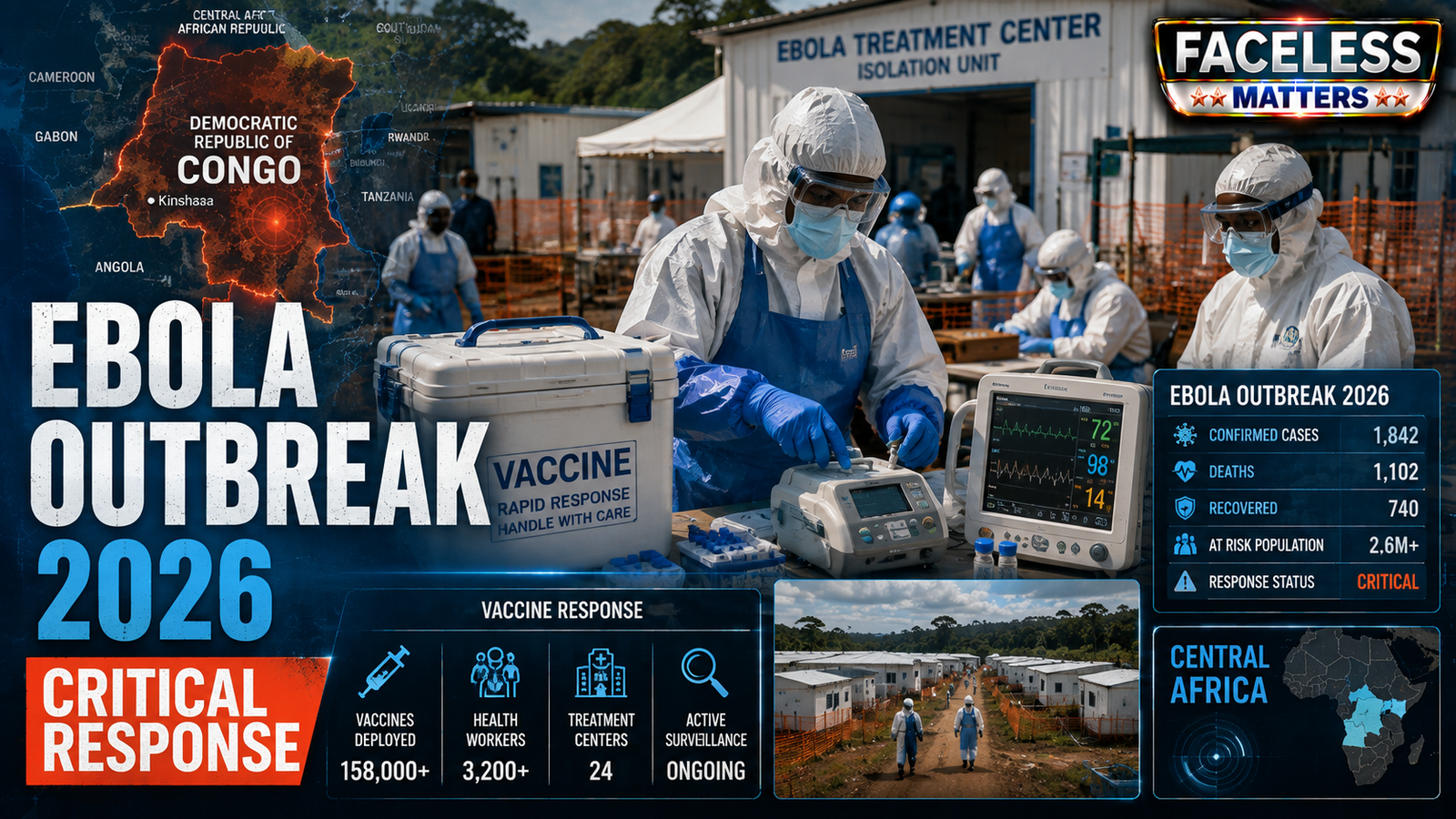
The Ebola Outbreak 2026 in the Democratic Republic of Congo has become one of the most significant global health stories of August, with the outbreak surpassing the country’s previous Ebola epidemics and placing renewed attention on disease surveillance, emergency medical care, vaccine research and international health security.
The current outbreak is caused by Bundibugyo virus, a distinct Ebola species for which there is currently no licensed vaccine specifically approved for prevention. The situation is particularly important because the widely known Ervebo vaccine is licensed for Ebola virus disease caused by Ebola virus, not Bundibugyo virus. WHO has been evaluating whether Ervebo could provide some cross-protection, while researchers prepare controlled studies to generate better evidence. World Health Organization
The latest development came on August 20, when the World Health Organization announced that the Democratic Republic of Congo is set to receive 70,000 doses of Ervebo as part of the response. Reuters reported that the allocation is intended to support the emergency response while research evaluates the vaccine’s potential usefulness against Bundibugyo virus. Reuters
That distinction is essential.
The arrival of vaccine doses should not be interpreted as confirmation that Ervebo is already proven to prevent Bundibugyo virus disease. WHO’s current position is more cautious: evidence remains insufficient to establish its effectiveness against this virus, while the WHO technical advisory group has recommended prioritizing Ervebo for inclusion in a Phase 3 research study. World Health Organization
The Ebola Outbreak 2026 therefore represents two simultaneous challenges: controlling an expanding infectious-disease emergency and generating reliable scientific evidence under difficult conditions.
1. Why the Ebola Outbreak 2026 Matters
The Ebola Outbreak 2026 is important because it demonstrates how quickly an infectious disease can become a major international health-security concern when detection, treatment capacity and surveillance systems are placed under pressure.
According to Reuters, the Democratic Republic of Congo had recorded more than 5,000 confirmed cases and 2,378 deaths by August 2026, making the current outbreak the largest Ebola epidemic recorded in the country. Reuters
WHO’s most recent detailed Disease Outbreak News report dated August 14 recorded 4,665 confirmed cases and 2,184 deaths as of August 12, with transmission reported across 54 health zones in six provinces. The difference between reporting dates and data systems is important when interpreting rapidly changing outbreak numbers. World Health Organization
The outbreak is not simply a story about case numbers.
It is also a test of:
- disease surveillance,
- laboratory capacity,
- rapid diagnosis,
- healthcare infrastructure,
- infection prevention,
- community engagement,
- healthcare-worker protection,
- vaccine research,
- treatment research,
- and cross-border preparedness.
When several of these systems face pressure simultaneously, an outbreak can become much harder to contain.
2. Congo’s Largest Recorded Ebola Outbreak
The Ebola Outbreak 2026 has surpassed previous Ebola outbreaks recorded in the Democratic Republic of Congo.
Reuters reported on August 16 that the outbreak had already exceeded the country’s 2018–2020 epidemic in deaths, making it the deadliest Ebola outbreak in Congo’s history. Reuters
WHO reported that the outbreak initially centered on Mongbwalu health zone in Ituri Province before expanding into additional provinces and health zones. By August 12, six provinces were affected.
The geographical expansion matters because disease control becomes increasingly difficult as transmission moves between communities and across transportation routes.
Population movement adds another layer of complexity.
WHO has repeatedly emphasized that insecurity, displacement and cross-border movement complicate outbreak response and increase the risk of geographical spread. World Health Organization
This is why public-health authorities cannot focus only on hospitals.
Effective outbreak control requires community-level surveillance and rapid identification of suspected cases before transmission chains become difficult to reconstruct.
3. Understanding the Bundibugyo Virus
One of the most important facts about the current Ebola Outbreak 2026 is that it involves the Bundibugyo virus.
Ebola is not a single uniform virus. Several orthoebolaviruses can cause disease in humans.
The Bundibugyo virus is different from the Ebola virus species for which Ervebo was developed and licensed.
WHO states that there is currently one licensed and WHO-prequalified vaccine for Ebola virus disease caused by EBOV: Ervebo. There are currently no licensed vaccines specifically for Bundibugyo virus disease. World Health Organization
This distinction is critical because headlines can easily create the impression that an existing Ebola vaccine automatically provides protection against every Ebola species.
Scientific evidence does not support that assumption.
The current outbreak has therefore created an urgent need for both immediate public-health action and controlled research.
4. Why the Vaccine Question Is Complicated
The central vaccine question is straightforward:
Can Ervebo protect people against Bundibugyo virus?
The scientific answer is not yet definitive.
WHO previously concluded that the available evidence on cross-protection was insufficient to reliably estimate vaccine effectiveness against Bundibugyo virus. The organization recommended that Ervebo should not be used as a routine programmatic intervention for Bundibugyo outbreaks outside controlled research settings. World Health Organization
However, new research has continued.
The Ebola Outbreak 2026 also highlights the importance of surveillance, treatment capacity and evidence-based public-health decisions.
In August, WHO’s Technical Advisory Group on Candidate Vaccine Prioritization reviewed emerging evidence, including laboratory and animal studies. Its updated recommendation was that Ervebo should be prioritized for inclusion in a Phase 3 research study during the current outbreak. World Health Organization
This creates an important distinction between:
Emergency vaccination as a proven intervention
and
Vaccination within a scientifically controlled research program.
The second approach can help researchers determine whether a vaccine actually works against the specific virus responsible for the outbreak.
5. The 70,000-Dose Ervebo Development
The latest major development is the planned arrival of 70,000 Ervebo doses.
Reuters reported on August 20 that WHO announced the allocation of these doses to support the response in Congo. Reuters
The doses should not automatically be interpreted as a declaration that Ervebo is proven against Bundibugyo virus.
Instead, they form part of a broader strategy combining emergency response and scientific evaluation.
WHO’s recent technical work has emphasized the need to generate better evidence because the existing data on cross-protection remain limited.
This is an important lesson for health reporting.
A headline such as “Ebola vaccine arrives” can be technically accurate while still leaving readers with an incomplete understanding of what the vaccine can and cannot currently be expected to do.
Responsible health journalism must provide the missing context.
6. Surveillance and Treatment Remain Critical
Vaccines are only one part of outbreak control.
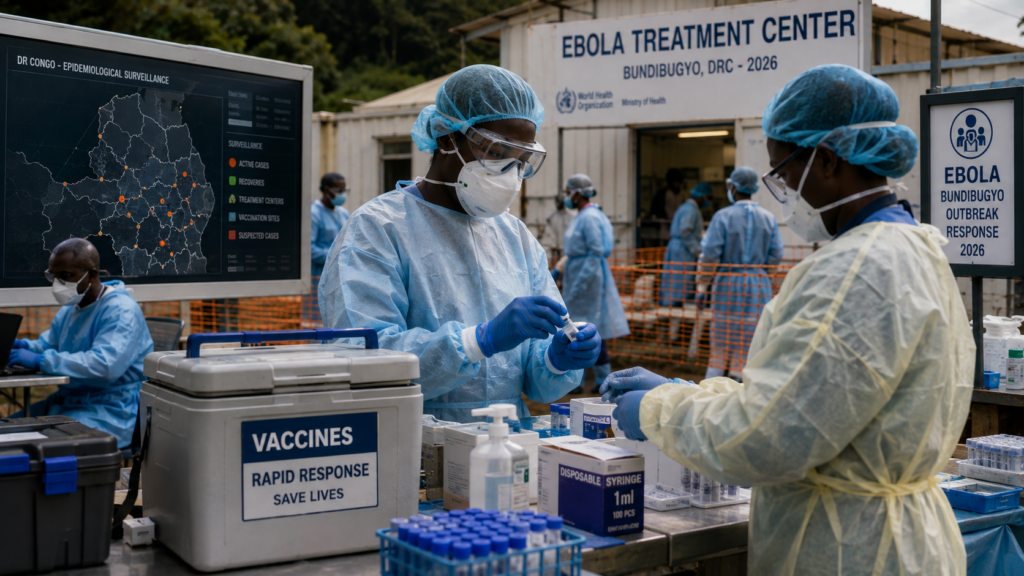
WHO continues to emphasize rapid recognition of cases, testing, optimized supportive care, infection prevention and control, surveillance and community engagement. World Health Organization
Early diagnosis can make a major difference.
When patients are identified quickly, healthcare teams can isolate suspected cases, test samples, trace contacts and provide appropriate clinical care.
This also helps reduce the risk that patients unknowingly expose family members, healthcare workers or other community contacts.
Treatment capacity is equally important.
WHO reported that treatment centers were being expanded and healthcare workers were being trained as part of the response. World Health Organization
The current outbreak also highlights why healthcare-worker protection is essential.
A disease response can lose momentum if healthcare workers become infected, facilities become unsafe or communities lose confidence in medical services.
7. Why International Health Security Matters
The Ebola Outbreak 2026 is primarily a crisis inside the Democratic Republic of Congo, but its implications extend beyond national borders.
WHO has classified the event as a Public Health Emergency of International Concern because of the severity of the outbreak and its potential for international spread. World Health Organization
Cross-border preparedness is particularly important in regions where people regularly travel for work, family, trade and humanitarian activity.
Uganda previously experienced Bundibugyo virus transmission linked to the wider outbreak. WHO reported that Uganda declared its outbreak over in July after meeting the required period without new locally transmitted cases, although the country remained at risk of reintroduction because transmission continued in neighboring Congo. World Health Organization
This illustrates an important principle of global health security:
Ending local transmission does not necessarily eliminate regional risk.
Continued surveillance remains necessary while transmission persists elsewhere.
8. The Role of Clinical Research
Scientific research has become a central part of the response.
WHO reported that a clinical trial for potential treatments against Bundibugyo virus began enrollment in July. The PARTNERS trial was operating at clinical management facilities in Ituri province and had enrolled more than 100 confirmed cases by the August 14 WHO update. World Health Organization
This work matters because there are no approved treatments specifically established for Bundibugyo virus disease.
Researchers need reliable evidence to determine which interventions can improve survival.
The same principle applies to vaccines.
Instead of assuming that a vaccine designed for one Ebola species will automatically work against another, researchers must measure its effectiveness under controlled conditions.
That scientific process can be slower than public expectations, but it is essential for trustworthy medicine.
9. What Other Countries Should Watch
The outbreak offers several lessons for health systems around the world.
Early Detection
Disease surveillance must identify unusual clusters quickly.
Laboratory Capacity
Fast and accurate testing allows healthcare teams to distinguish suspected infections and organize appropriate response measures.
Healthcare Protection
Hospitals and health workers need infection-prevention systems that remain functional during prolonged emergencies.
Community Trust
Public-health measures are more effective when communities understand why they are necessary.
Cross-Border Coordination
Neighboring countries need surveillance and preparedness systems even when they have no active local transmission.
Research Readiness
Candidate vaccines and treatments should be evaluated before a crisis becomes overwhelming whenever possible.
These principles apply far beyond Ebola.
They are part of the broader architecture of global health security.
10. What Happens Next
The next phase of the Ebola Outbreak 2026 will depend on several factors.
First, authorities need to slow transmission through surveillance, testing, treatment, infection prevention and community engagement.
Second, the international response needs sufficient resources to maintain those systems.
Third, researchers need to determine whether candidate medical interventions can provide meaningful protection or improve outcomes.
Fourth, neighboring countries must maintain preparedness while transmission continues in Congo.
WHO has emphasized that the outbreak can still be brought under control if response capacity is scaled up adequately. Reuters reported on August 18 that WHO officials believed containment within approximately three months remained possible if sufficient resources were mobilized. Reuters
That possibility makes the current period especially important.
The longer transmission remains undetected, the more difficult and expensive containment becomes.
CONCLUSION
The Ebola Outbreak 2026 is a critical test of modern global health preparedness.
The Democratic Republic of Congo is facing its largest recorded Ebola outbreak, while the international response is simultaneously dealing with a scientific challenge: the virus responsible is Bundibugyo virus, for which there is currently no licensed vaccine specifically approved for prevention. Reuters
The planned allocation of 70,000 Ervebo doses is therefore significant, but it should be understood correctly. The vaccine is licensed for Ebola virus disease caused by EBOV, while its potential protection against Bundibugyo virus is still being evaluated through research. Reuters
The wider response remains dependent on surveillance, rapid diagnosis, supportive clinical care, infection prevention, healthcare-worker protection, community engagement and international coordination.
The most important lesson is simple:
A fast-moving health emergency requires both immediate action and reliable evidence.
That balance will determine how effectively the world responds to this outbreak and how much can be learned to prepare for future infectious-disease threats.
INTERNAL READING
1. Global Energy Supply Crisis 2026: Oil and Hormuz Risks
This report provides additional context on how oil supply disruptions and geopolitical risk can influence inflation, transportation costs and global markets.
2. The Digital Gold Rush: AI and Human Intelligence Redefining Wealth
This analysis provides broader context on AI investment, digital infrastructure and the changing economics of wealth creation.
3. The Price of Policy: A Strategic Financial Audit
This financial investigation examines the relationship between policy decisions, capital flows and political influence.
SOURCE VERIFICATION & ANALYSIS
WHO — Disease Outbreak News: Ebola disease caused by Bundibugyo virus, Democratic Republic of Congo, August 14, 2026. World Health Organization
WHO — Immunization, Vaccines and Biologicals: Ebola disease vaccine information. World Health Organization
WHO — Technical Advisory Group on Candidate Vaccine Prioritization, August 7, 2026. World Health Organization
WHO — Emergency guidance on Ervebo during Bundibugyo virus disease outbreaks. World Health Organization
WHO — Ebola outbreak response information for the Democratic Republic of Congo. World Health Organization
Reuters — Congo to receive 70,000 Ervebo vaccines, August 20, 2026. Reuters
Reuters — Congo Ebola cases exceed 5,000, August 19, 2026. Reuters
Reuters — Congo Ebola outbreak becomes deadliest in country’s history, August 16, 2026. Reuters
Reuters — WHO says Congo Ebola outbreak can still be controlled within three months, August 18, 2026. Reuters
WHO — Extraordinary SAGE meeting on Ervebo and Bundibugyo virus, August 19, 2026. World Health Organization
FACELESS MATTERS ANALYSIS
The Ebola Outbreak 2026 demonstrates why health information must be evaluated through evidence, context and source verification.
A vaccine shipment does not automatically mean that a vaccine has been proven effective against every related virus.
A rising case count does not by itself explain why transmission is increasing.
And a public-health emergency cannot be evaluated solely through dramatic headlines.
The most reliable approach is to compare official outbreak data, scientific guidance, clinical research and independent reporting.
For readers, the key questions are:
What virus is causing the outbreak?
What evidence exists for available vaccines or treatments?
What are health authorities actually recommending?
Which claims are confirmed and which remain under investigation?
That approach helps prevent health misinformation while keeping the public informed about genuine risks.
Educational Note: This article is for general information and health-news awareness. It is not a diagnosis, treatment recommendation or substitute for advice from a qualified healthcare professional.
FACELESS MATTERS — Verified Information. Strategic Analysis. Responsible Reporting.