

1 October 2026
Key Takeaway
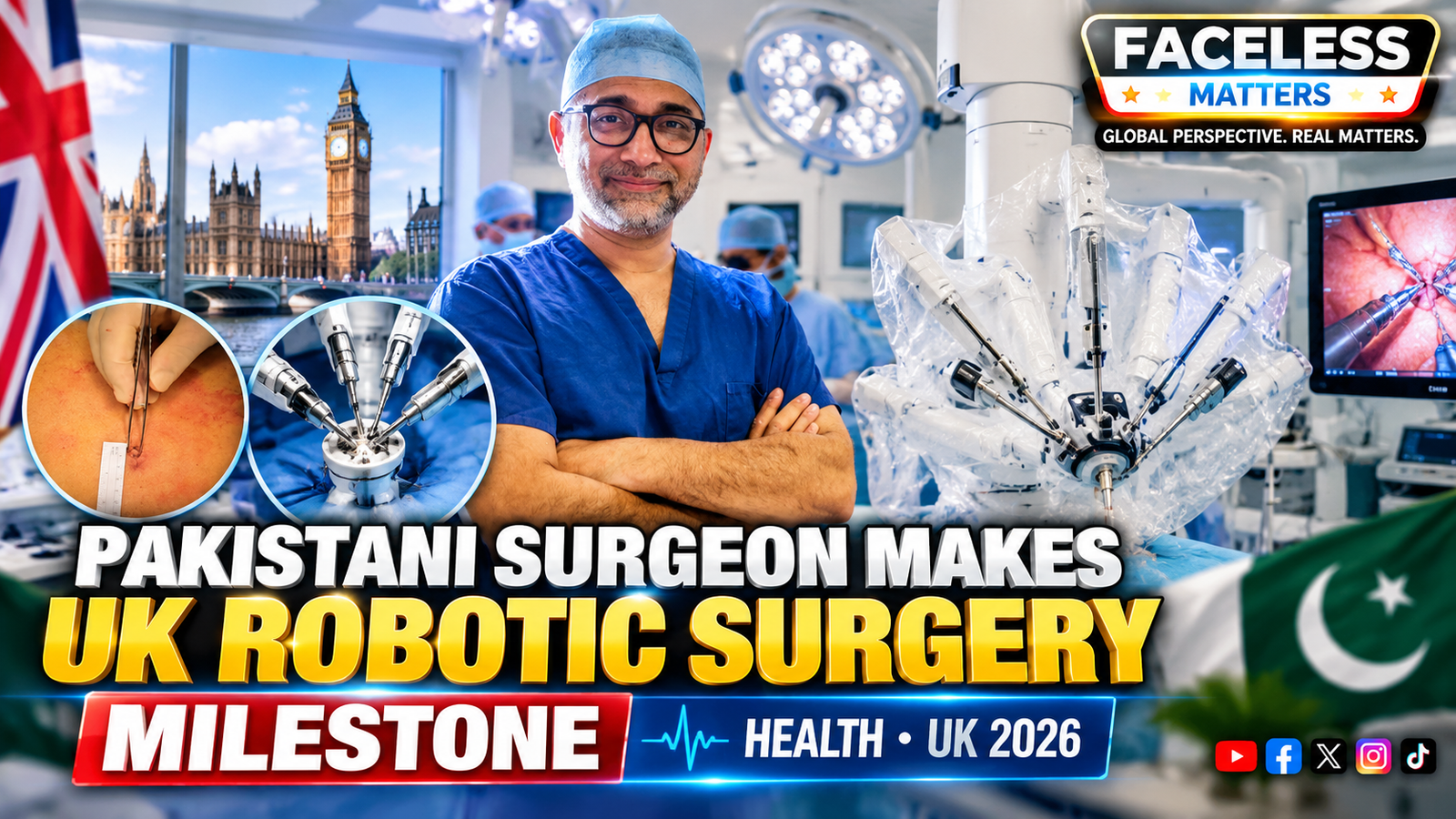
British-Pakistani consultant gynaecologist and robotic surgeon Dr Amer Raza has emerged as a prominent figure in the development of single-port robotic gynecological surgery in the United Kingdom.
According to current reporting from Jang and Geo News, Dr Raza’s programme at Cromwell Hospital in London has performed more than 400 procedures using the technology. The programme has also expanded from benign gynecological procedures into highly complex endometriosis operations and has become a training and observation destination for surgeons from the UK and abroad.
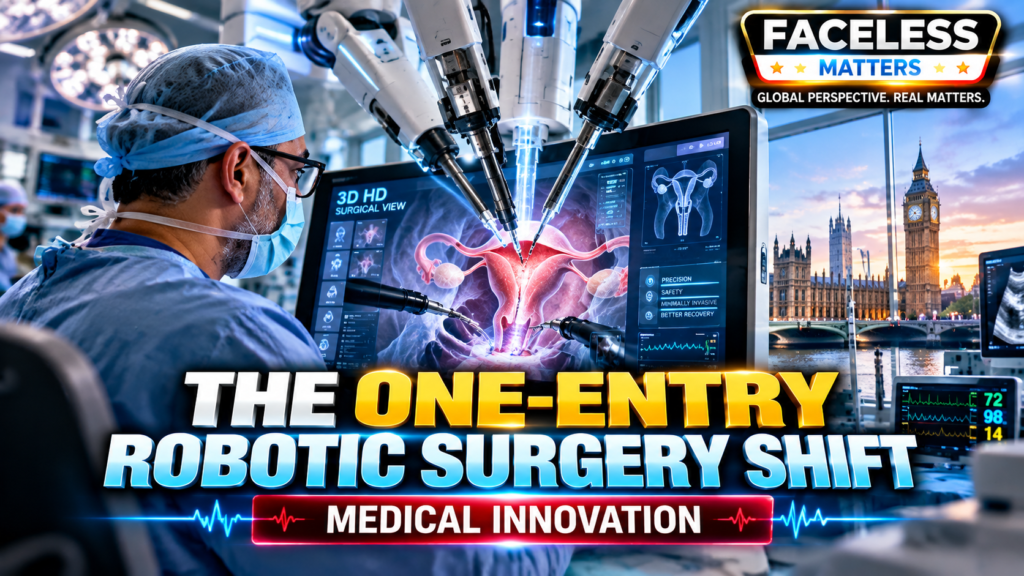
The development is significant because single-port robotic surgery is designed to allow a camera and multiple robotic instruments to operate through one abdominal entry point rather than the several incisions generally associated with conventional multi-port robotic surgery.
کیا ہوا؟ — What Happened?
A Pakistani-born surgeon working in Britain has become associated with a major development in minimally invasive gynecological surgery. The programme also shows how single-port robotic surgery can move into a structured clinical service when specialist expertise, operating-room teams and appropriate technology are combined.
Dr Amer Raza, a British-Pakistani consultant gynaecologist and robotic surgeon, has led a programme at London’s Cromwell Hospital that has now completed more than 400 procedures using single-port robotic technology, according to reporting published on 1 October 2026.
The programme is notable not simply because of the number of procedures.
Its development has also involved increasingly complex cases, particularly advanced endometriosis surgery. The programme has attracted surgeons and consultants from Britain, Europe, the United States and other countries who visit London to observe procedures and learn about the technology.
Cromwell Hospital itself says it became the first hospital in the UK to perform gynaecology and hepato-pancreato-biliary operations using the da Vinci Single Port system. The hospital installed the system in March 2025.
That provides important context for understanding Dr Raza’s current milestone. It also shows that single-port robotic surgery is being evaluated within an established hospital environment, where training, patient selection, governance and evidence remain important alongside advanced equipment.
Who Is Dr Amer Raza?
Dr Amer Raza is a consultant gynaecologist and robotic surgeon based at Cromwell Hospital in London.
Cromwell Hospital describes him as a specialist in advanced laparoscopic and robotic surgery for endometriosis, pelvic pain and complex gynaecological disease. The hospital also identifies him as a pioneer of single-port robotic surgery for gynaecology in the UK and an educator who trains surgeons from Britain, Europe and beyond.
Dr Raza graduated from Nishtar Medical College in Multan, Pakistan, before developing his professional career in the United Kingdom.
Current reporting says he has worked in Britain for more than 25 years and has developed expertise in advanced endometriosis treatment, minimally invasive surgery and robotic surgery.
His professional story therefore connects medical education in Pakistan with specialist surgical practice and training in the UK.
What Is Single-Port Robotic Surgery?
Single-port robotic surgery is a form of minimally invasive surgery in which a robotic system is used through a single entry point.
In conventional multi-port robotic procedures, surgeons generally use several abdominal incisions to introduce a camera and robotic instruments.
The single-port approach is designed differently.
Cromwell Hospital describes its da Vinci SP system as a robotic-assisted platform that allows minimally invasive surgery through a single incision. The system provides the surgeon with a three-dimensional view and uses miniature instruments that can operate inside the body through the single access point.
This does not mean that every patient or every procedure is automatically suitable for single-port surgery.
Patient selection, the disease being treated, anatomy, surgical complexity and the clinical judgment of the treating team remain important.
The significance of the technology is therefore better understood as an additional surgical platform rather than a universal replacement for other approaches.
Why the 400-Procedure Milestone Matters
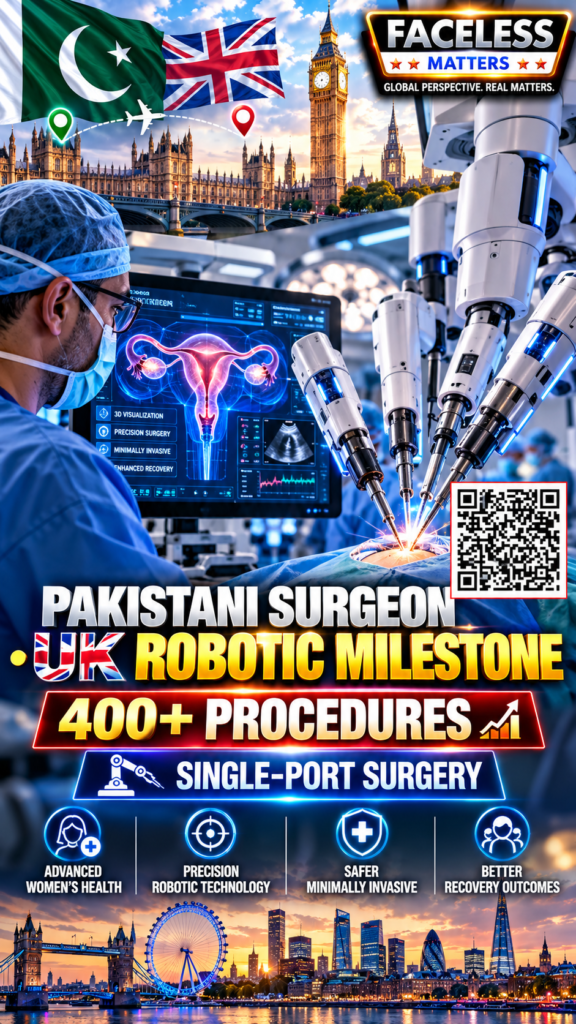
The more than 400 procedures reported by the programme provide an important measure of how the technology has moved beyond an isolated demonstration. For single-port robotic surgery, increasing experience can create opportunities to refine workflows and develop training pathways, although procedure volume alone cannot establish better outcomes.
Cromwell Hospital previously reported in October 2025 that Mr Amer Raza had treated 100 gynaecology patients using the da Vinci Single Port system. The hospital also said he performed the first gynaecological operation on the da Vinci SP in the UK.
The latest reporting indicates that the programme has now passed 400 procedures.
That progression suggests that the technology has moved into a substantially larger clinical programme.
However, procedure volume alone should not be interpreted as proof that one surgical technique is universally superior.
Medical outcomes require more detailed measures, including patient selection, complications, recovery, long-term outcomes and comparisons with appropriate alternative approaches.
That distinction is particularly important when reporting rapidly developing medical technology.
From Routine Procedures to Complex Endometriosis
One of the most notable developments is the expansion of the programme into complex endometriosis surgery.
According to current reporting, Dr Raza and his team have used single-port robotic technology for cases involving severe endometriosis and complex anatomical areas.
Endometriosis can affect organs beyond the reproductive system.
Depending on the disease, it can involve areas including the bowel, bladder, ureters, nerves and, in complex cases, the diaphragm.
This makes advanced endometriosis surgery particularly demanding.
The Society of Robotic Surgery’s 2026 programme also lists research involving single-port robotic discoid excision for rectosigmoid endometriosis, with Dr Amer Raza among the authors/presenters. The abstract describes deep infiltrating rectosigmoid endometriosis as one of the challenging forms of advanced disease and reports an initial ten-case experience examining feasibility, safety and perioperative outcomes.
The study itself describes an initial experience, so its findings should not be treated as proof of universal superiority. Its importance is that it illustrates the type of complex surgery now being investigated using the single-port approach.
The Training and International Learning Centre
The story also extends beyond operations performed on patients.
More than 100 surgeons from the UK and abroad have reportedly visited Dr Raza’s centre to learn about single-port robotic gynecological surgery. This is relevant because wider adoption of single-port robotic surgery requires clinicians to understand both its capabilities and limitations. Structured education and supervised experience can help specialists assess its use in particular procedures.
This creates a second dimension to the development.
A medical technology becomes more influential when specialists can learn how it is used, understand its limitations and evaluate how it fits into different clinical settings.
Cromwell Hospital also describes Dr Raza as an educator who teaches surgeons across the UK, Europe and internationally.
In that sense, the programme is becoming not only a clinical service but also a training environment.
For advanced surgery, education and observation can be particularly important because the technology itself does not replace surgical judgment.
The surgeon still has to determine whether a procedure is appropriate, how the operation should be conducted and how potential complications should be managed.
Two Master Surgeon Accreditations
Another significant part of Dr Raza’s professional profile is his reported receipt of two Master Surgeon accreditations in Robotic Surgery and Advanced Endometriosis Care.
Geo News and The News report that he became the only consultant in Europe holding both such Master Surgeon accreditations, following external review by the US-based Surgical Review Corporation (SRC). The reported assessment included surgical practice, outcomes, complications, governance and patient-care standards.
This detail is important because it provides context beyond the number of operations performed.
Professional accreditation is different from a claim that a particular surgical technique is better for every patient.
The distinction matters in health reporting.
A surgeon’s credentials, the technology used, procedure volume and clinical outcomes are related but separate measures.
Readers should therefore consider all of them independently.
The Wider Importance for Women’s Health
The development takes place against a broader global challenge involving women’s health.
Endometriosis can cause pain and can affect fertility and quality of life. Advanced cases may require multidisciplinary treatment involving gynaecologists and other specialists.
Robotic systems can potentially provide surgeons with enhanced visualization, instrument dexterity and control in selected minimally invasive procedures.
Cromwell Hospital says its da Vinci SP system offers live three-dimensional visualization and miniature instruments designed for work in narrow spaces.
But technology should not be confused with guaranteed patient outcomes.
The value of a robotic system ultimately depends on appropriate patient selection, surgeon expertise, clinical governance, evidence, safety and long-term outcomes.
That is why the expansion of single-port robotic surgery is worth following as an area of medical innovation rather than simply as a technology success story.
What This Means for Pakistan
Dr Raza’s story also has a direct Pakistan connection.
He received his initial medical education at Nishtar Medical College in Multan and has maintained professional links with Pakistan despite spending most of his career in Britain.
According to current reporting, he regularly travels to Pakistan and wants to work with partners to transfer advanced robotic surgical technology and procedures to the country.
If such cooperation expands, the potential significance would extend beyond one surgeon.
Modern surgical technology requires more than purchasing a robotic platform.
It also requires:
- trained surgeons;
- specialist nurses;
- operating-room teams;
- maintenance and technical support;
- patient-selection systems;
- clinical governance;
- data collection;
- training programmes;
- and long-term follow-up.
For Pakistan, the knowledge-transfer component could therefore be as important as the equipment itself.
What Happens Next?
The next stage will likely be measured not simply by how many procedures are performed, but by the quality and transparency of clinical outcomes.
Important questions include:
1. How will long-term outcomes be measured?
Procedure numbers are useful, but patient outcomes provide deeper information.
2. Which cases are most suitable?
Single-port robotic surgery may be valuable in selected cases, but suitability depends on individual clinical circumstances.
3. Will training expand?
The arrival of surgeons from different countries indicates growing interest in the technology. Formal training and proctoring could determine how widely the technique spreads.
4. Can the model be transferred to Pakistan?
Technology transfer would require infrastructure, trained personnel, financing, governance and appropriate patient pathways.
5. What will the evidence show?
Future clinical studies will be important in determining where single-port robotic procedures provide meaningful advantages and where other surgical approaches remain more appropriate.
FACELESS MATTERS Analysis — اصل تجزیہ
The most important part of this story is not simply that a Pakistani-born surgeon has reached a reported 400-plus procedures. The broader issue is how single-port robotic surgery is becoming part of a wider ecosystem involving specialist expertise, surgical education, technology development and international knowledge exchange. That ecosystem may shape how responsibly the technique expands.
The deeper development is the convergence of robotics, minimally invasive surgery, specialist training and international medical collaboration.
The story also demonstrates how medical innovation increasingly crosses national boundaries.
A surgeon educated in Pakistan can develop advanced expertise in Britain, participate in international research and potentially help transfer knowledge back to Pakistan.
That creates a model of medical knowledge moving in both directions.
At the same time, responsible health journalism requires caution.
A sophisticated robotic platform does not automatically mean better treatment for every patient.
A high procedure count does not independently establish superiority.
And a professional accreditation does not replace peer-reviewed evidence.
The strongest way to understand the development is therefore to see it as an important expansion of the clinical use and training around single-port robotic technology, while allowing longer-term clinical evidence to establish where the approach offers the greatest benefits.
Why This Story Matters Beyond the Operating Room
The development has implications for several sectors.
Healthcare: Advanced minimally invasive techniques may expand the options available to selected patients.
Medical education: Training centres can help surgeons understand new robotic systems.
Technology: Robotic surgery demonstrates how advanced computing, visualization and precision instruments are becoming part of clinical medicine.
Pakistan: Internationally trained Pakistani medical professionals can potentially contribute to technology and knowledge transfer.
Women’s health: Complex endometriosis remains an important area where advanced surgical expertise can affect pain, fertility and quality of life.
Medical research: Early clinical experiences can lead to larger studies examining safety, effectiveness and long-term outcomes.
This makes the story broader than an individual professional achievement.
It is also a story about how medical technology is moving from equipment demonstration toward specialized clinical ecosystems.
Conclusion — نتیجہ
Dr Amer Raza’s work at Cromwell Hospital represents a notable development in single-port robotic gynecological surgery in the United Kingdom.
Current reporting says his programme has now completed more than 400 procedures, while more than 100 surgeons from Britain and abroad have visited the centre for observation and training. The programme has also expanded into complex endometriosis procedures.
Cromwell Hospital’s own records confirm the wider development of da Vinci SP gynaecological surgery at the hospital, including its position as the first UK hospital to use the system for gynaecology and HPB surgery.
For Pakistan, the story carries an additional dimension because Dr Raza’s medical education began in Multan and he has expressed an intention to help transfer advanced surgical knowledge and technology to Pakistan.
The next measure of this innovation will be continued clinical evidence, patient outcomes, training quality and responsible expansion.
That is where the real long-term significance of robotic surgery will be determined.
INTERNAL READING — FACELESS MATTERS
Maryam Nawaz Cancer Treatment 2026: Critical 100-Patient Update
10–12 Hours at Your Desk? The Silent Health Risks of Ignoring Water, Urine and Bowel Urges
AI DATA CENTERS 2026: CRITICAL POWER RACE RESHAPES TECHNOLOGY
AI Agents at the Edge: OpenAI’s RubyGems Incident Raises a Bigger Warning
What Is Artificial Intelligence?
SOURCES & EDITORIAL NOTE
Jang — Pakistani Surgeon Sets New UK Milestone in Single-Port Robotic Gynecological Surgery
Geo News — British-Pakistani Surgeon Sets New UK Record With Single-Port Robotic Surgery
Cromwell Hospital — First UK Hospital to Perform Gynaecology and HPB Operations Using da Vinci SP
Cromwell Hospital — Mr Amer Raza, Consultant Gynaecologist
Society of Robotic Surgery — Single-Port Robotic Discoid Excision for Rectosigmoid Endometriosis
Editorial Note
This article is based primarily on the 1 October 2026 reporting from Jang/Geo News and supporting information published by Cromwell Hospital and the Society of Robotic Surgery. Claims concerning procedure numbers, professional accreditations and training activity are attributed to the relevant sources. The article does not present robotic surgery as universally superior to other surgical methods and does not provide individualized medical advice.