

6 September 2026 | Islamabad
TABLE OF CONTENTS
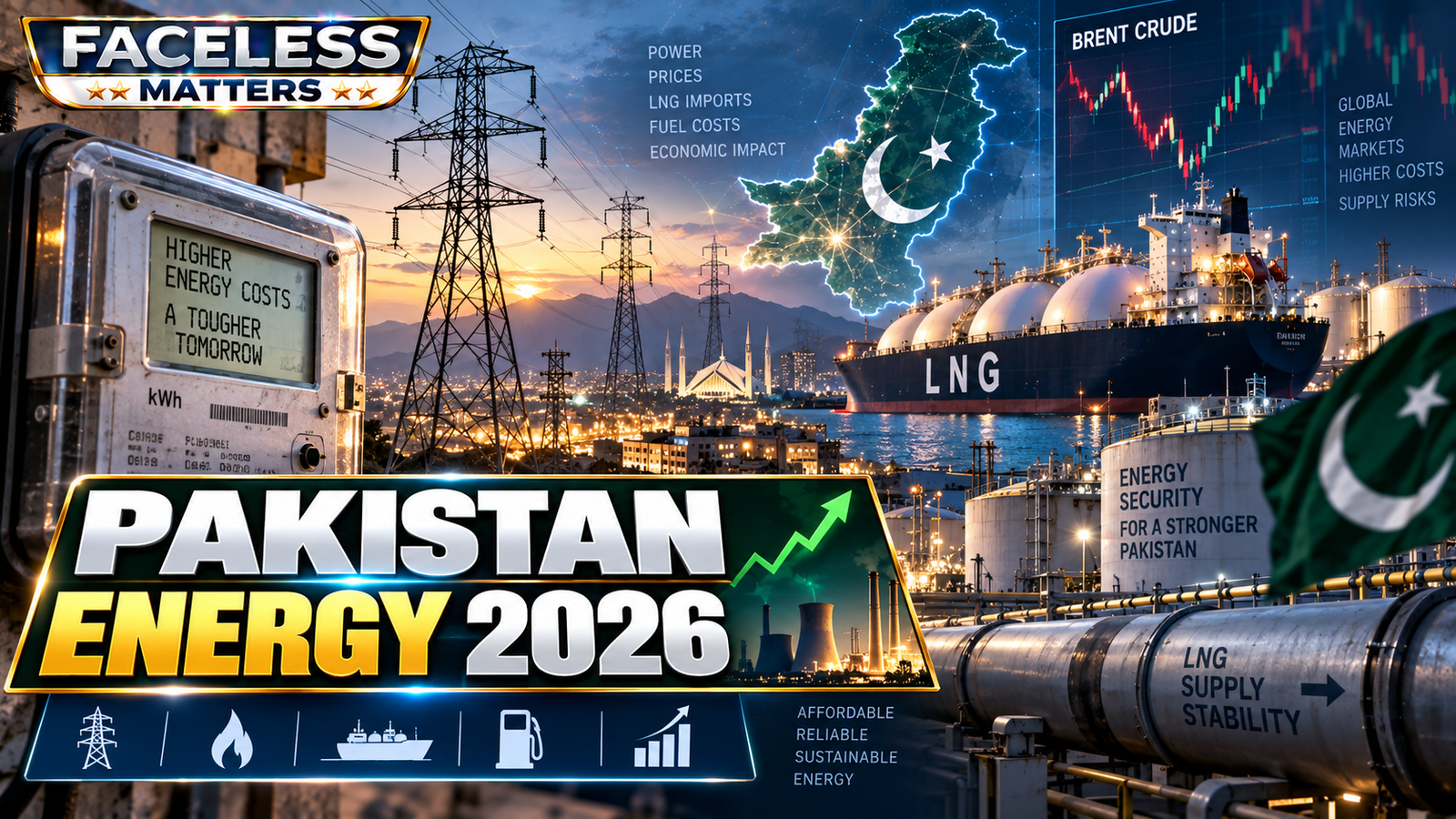
Pakistan Energy 2026 has entered another critical phase. Electricity consumers are facing fresh tariff pressure, LNG procurement remains exposed to international price volatility, and global oil markets are reacting to renewed geopolitical disruption around the Middle East.
The latest developments are not isolated price stories. They reveal how closely Pakistan’s electricity bills, LNG imports, fuel prices, foreign-exchange exposure, industrial competitiveness and energy security are connected.
Recent reporting shows that NEPRA has approved a Rs2.58-per-unit increase through monthly and quarterly adjustments, adding billions of rupees to the burden on consumers. At the same time, Pakistan’s fuel market is operating under a new mechanism that allows faster adjustments to international oil-price movements.
Internationally, Brent crude ended the latest week at $96.28 per barrel, while West Texas Intermediate settled at $91.48, with oil prices rising sharply over the week as geopolitical tensions and shipping disruptions continued to influence markets.
For Pakistan, this creates a crucial question:
Can the country achieve more reliable and affordable energy while remaining exposed to imported LNG, international oil prices and a financially stressed power sector?
That is the real Pakistan Energy 2026 story behind the latest headlines.
1. Electricity Costs Are Becoming a Major Economic Pressure Point
The most immediate development for Pakistani consumers is the latest electricity tariff adjustment.
NEPRA has allowed an additional Rs2.06 per unit under the July 2026 Fuel Cost Adjustment, while a separate quarterly adjustment of roughly Rs0.52 per unit is being recovered over September, October and November.
According to Dawn, the FCA alone represents an estimated Rs33 billion burden, while the quarterly adjustment adds another roughly Rs12.7 billion. Some categories, including lifeline and certain prepaid consumers, have received exemptions under the notified mechanism.
Geo News similarly reported the Rs2.58-per-unit combined increase and highlighted the additional financial burden on consumers.
This matters beyond household electricity bills.
Higher electricity costs affect:
- Manufacturing
- Retail businesses
- Commercial offices
- Agriculture
- Cold-storage facilities
- Export industries
- Small and medium enterprises
- Data centers
- Telecom infrastructure
- Electric-vehicle charging
- Household purchasing power
In Pakistan Energy 2026, electricity is an input into almost every part of the economy.
When its cost rises, businesses may either absorb the increase, reduce margins or transfer part of the cost to consumers.
That makes energy pricing an inflation issue as well as an electricity-sector issue.
FACELESS MATTERS Analysis
The deeper challenge is that the tariff mechanism can pass higher fuel and system costs through to consumers, but that does not automatically solve the structural causes of expensive electricity.
Pakistan needs to improve the efficiency of generation, transmission and distribution while reducing unnecessary losses and strengthening the financial sustainability of the power sector.
Otherwise, consumers can repeatedly face adjustments without seeing equivalent improvements in reliability.
2. LNG Has Become One of Pakistan’s Biggest Energy Vulnerabilities
Pakistan’s energy system also remains closely linked to imported liquefied natural gas.
That exposure matters because LNG prices can move dramatically when global shipping routes, supply availability or geopolitical conditions change.
Recent reporting indicates that Pakistan LNG Limited rejected a September spot cargo bid from BP Singapore at approximately $26.969 per million British thermal units, after receiving only one offer.
The decision followed disruptions affecting power generation and concerns around LNG cargo availability.
This creates a difficult balance.
Buying expensive LNG can increase power-generation costs.
Rejecting expensive cargoes can create supply shortages if alternative arrangements are not available.
Either way, the power sector faces a difficult procurement decision.
Why LNG Procurement Matters
Pakistan Energy 2026 is also shaped by long-term LNG arrangements with Qatar, while disruptions and reduced availability can increase dependence on spot-market purchases.
That creates exposure to:
- Global LNG prices
- Shipping costs
- Geopolitical risk
- Currency movements
- Seasonal demand
- Supply-chain disruptions
- International competition for cargoes
This is why energy security cannot simply mean having enough generating capacity.
A country can possess power plants and still face an energy crisis if the fuel required to operate those plants becomes unavailable or unaffordable.
3. The Strait of Hormuz Is Still a Global Energy Risk
The international energy market is facing another major vulnerability: disruption around the Strait of Hormuz.
The waterway remains one of the world’s most important energy corridors, particularly for oil and LNG shipments from the Gulf.
Reuters reported that LNG cargoes from Qatar and the UAE have recently been transferred between ships outside the Strait of Hormuz to maintain deliveries to destinations including India and Japan.
The unusual ship-to-ship transfers demonstrate how energy companies and shipping operators are adapting to persistent disruption. Reuters also reported that Asian spot LNG prices had climbed to $23.20 per mmBtu, more than twice their pre-conflict level.
For Pakistan Energy 2026, the implications are significant.
The country does not need to be directly involved in the geopolitical conflict to experience its economic consequences.
Higher global energy prices can increase:
Import costs → electricity-generation costs → transportation costs → production costs → inflationary pressure.
That chain is one of the most important energy-market risks facing Pakistan.
4. Oil Prices Are Creating Another Inflationary Risk
The global oil market has also entered a more volatile phase.
Reuters reported that Brent crude ended the week at $96.28 per barrel, gaining 7.6% during the week, while WTI increased by almost 10%. The report linked the movement to renewed U.S.-Iran military exchanges, Middle Eastern supply concerns and continuing disruption around major shipping routes.
For Pakistan, higher oil prices can affect much more than petrol stations.
They influence:
- Transport costs
- Freight charges
- Agricultural machinery
- Electricity generation
- Industrial production
- Aviation
- Logistics
- Imported inflation
- Current-account pressure
This is particularly important because Pakistan remains heavily dependent on imported petroleum.
The country therefore faces a structural vulnerability: when international energy prices rise, domestic consumers and businesses can feel the impact even when domestic demand has not changed significantly.
5. Pakistan’s New Fuel Pricing Mechanism Could Change the Market
Another important development is the government’s move toward more frequent petroleum-price adjustments.
Geo News reported that petrol was reduced by Rs3.13 per litre to Rs345.87, while high-speed diesel increased by Rs3.74 to Rs378.05 per litre, with the revised rates effective through September 7.
The report said the government had moved toward a daily review mechanism based on international oil-price movements, using a seven-day average.
Under Pakistan Energy 2026, this represents a major change in how consumers experience global oil volatility.
Under a more frequent adjustment system, international price movements can be transmitted to the domestic market faster.
That has both advantages and risks.
Potential Advantage
Consumers may receive faster relief when international prices decline.
Potential Risk
Consumers may also experience faster increases when global prices rise.
For businesses, this creates a stronger need for energy-cost planning.
Transport companies, manufacturers, logistics operators and agricultural businesses may need to monitor international oil markets more closely than before.
What Does Pakistan Energy 2026 Mean for Businesses?
Pakistan Energy 2026 shows that energy costs are increasingly becoming a strategic business variable.
For manufacturers, electricity and fuel costs directly affect production margins.
For exporters, higher domestic energy costs can weaken international competitiveness.
For logistics companies, diesel prices influence transportation costs.
For technology businesses, electricity reliability affects data centers and digital infrastructure.
For agriculture, fuel prices influence irrigation, harvesting and transportation.
This means Pakistan Energy 2026 is not simply a story about utility bills.
It is increasingly a story about business competitiveness, investment confidence and economic productivity.
The Hidden Cost: Energy Security
Energy security is often misunderstood as simply having enough electricity.
A more complete definition includes four major dimensions:
1. Availability
Can sufficient energy be obtained?
2. Affordability
Can consumers and businesses pay for it?
3. Reliability
Can the system deliver energy consistently?
4. Resilience
Can the country withstand international supply disruptions?
Pakistan faces challenges across all four.
The latest electricity adjustment highlights affordability.
LNG procurement challenges highlight availability and international exposure.
Power-sector financial problems affect reliability.
And Middle Eastern geopolitical disruption tests resilience.
This is why a long-term energy strategy must address the entire system rather than focusing on one fuel or one tariff adjustment.
Energy Security and Pakistan’s Investment Environment
Energy availability is also important for investors.
An industrial investor does not only ask whether electricity is available today.
The investor also asks:
- What will electricity cost next year?
- Is supply reliable?
- Can fuel be secured?
- How predictable are tariffs?
- What happens if global oil prices surge?
- Can the grid support new industrial capacity?
- How stable is the regulatory environment?
For Pakistan Energy 2026, predictability can be almost as important as price.
A country with slightly higher energy costs but stable and predictable supply can sometimes be more attractive than a country where prices are lower but disruptions are frequent.
For Pakistan, improving energy predictability could therefore support long-term investment, industrial expansion and export growth.
Energy Efficiency Could Become the Next Competitive Advantage
Under Pakistan Energy 2026, Pakistan’s energy strategy should not rely exclusively on producing more energy.
It should also focus on consuming energy more efficiently.
That means greater attention to:
- Industrial energy efficiency
- Smart electricity meters
- Transmission upgrades
- Distribution modernization
- Renewable-energy integration
- Battery storage
- Efficient cooling systems
- Building standards
- Demand-side management
- Digital grid technology
Energy efficiency can reduce pressure without requiring equivalent increases in fuel imports.
For businesses, energy efficiency can become a direct cost-saving strategy.
For government, it can reduce pressure on imported fuel and the electricity system.
For consumers, it can lower long-term energy expenditure.
Renewable Energy Is Becoming More Strategically Important
Pakistan’s exposure to imported oil and LNG also strengthens the case for diversified domestic energy sources.
Solar power, hydropower, wind energy and other domestic resources can reduce some forms of imported-fuel exposure.
But diversification must be carefully managed.
Renewable generation also requires:
- Grid investment
- Transmission capacity
- Storage solutions
- System balancing
- Regulatory stability
- Modern forecasting
- Flexible generation
The objective should therefore not be to replace one dependency with another.
The stronger strategy is to create a diversified energy portfolio in which imported fuels, domestic resources, renewable generation, storage and efficient transmission work together.
The Energy-Finance Connection
Pakistan Energy 2026 also shows that Pakistan’s energy problem is closely connected to public finance.
When power-sector costs rise, governments can face difficult choices involving:
- Tariff adjustments
- Subsidies
- Circular debt
- Public-sector liabilities
- Fuel procurement
- Development spending
If consumers are protected from every increase through subsidies, fiscal pressure can increase.
If all increases are passed directly to consumers, inflation and household pressure can rise.
The challenge is finding a sustainable middle ground.
That requires structural reforms rather than simply changing the price every month.
FACELESS MATTERS Analysis: The Five Signals That Matter Most
Signal 1: Energy prices are becoming a macroeconomic issue
The latest electricity and petroleum developments demonstrate that energy pricing directly affects inflation, business costs and household purchasing power.
Pakistan Energy 2026 should therefore be viewed as part of the country’s wider macroeconomic strategy.
Signal 2: LNG remains a major vulnerability
Imported LNG provides essential flexibility for the power system, but international prices and shipping disruptions can quickly change the economics.
Long-term contracts, diversified suppliers and domestic alternatives therefore matter.
Signal 3: Global geopolitics is entering domestic energy policy
The Middle East conflict demonstrates how geopolitical events can influence Pakistani energy costs without Pakistan controlling the underlying events.
This makes strategic energy planning increasingly important.
Signal 4: Energy efficiency can become an economic strategy
Reducing wasted electricity and fuel can sometimes deliver benefits faster than building entirely new generation capacity.
Efficiency should therefore be treated as an economic investment.
Signal 5: Energy security is now inseparable from investment
Businesses need reliable and predictable energy.
If Pakistan can improve affordability, reliability and supply resilience simultaneously, the benefits could extend into manufacturing, exports, technology and infrastructure investment.
What Pakistan Should Watch Next
The next phase of the energy story should be judged through measurable indicators.
1. Global oil prices
Does Brent remain near elevated levels, or does geopolitical risk premium begin to decline?
2. LNG procurement
Can Pakistan secure sufficient LNG at commercially sustainable prices?
3. Electricity tariffs
Will further fuel-cost adjustments increase consumer pressure?
4. Power-sector reforms
Can structural inefficiencies and financial losses be reduced?
5. Renewable integration
Can solar, wind and hydropower expand without creating new grid-management problems?
6. Energy investment
Can Pakistan attract investment into generation, transmission, storage and energy infrastructure?
7. Industrial competitiveness
Can energy costs become predictable enough to support long-term manufacturing and export planning?
These indicators will provide a much clearer picture than any single monthly tariff announcement.
Why Energy Security Matters for Pakistan’s Economy
Pakistan’s energy challenge has reached a point where it cannot be separated from economic strategy.
A reliable energy system supports:
Industry + exports + agriculture + technology + investment + employment.
An unstable or excessively expensive energy system can undermine all six.
That is why energy reform should be viewed as an economic-development priority rather than simply a utility-sector problem.
The country needs an energy model that is financially sustainable, technologically modern and sufficiently diversified to withstand external shocks.
FACELESS MATTERS Strategic Assessment
The latest electricity tariff increase, LNG procurement pressure and global oil-market volatility point toward one central conclusion:
Pakistan’s energy security is increasingly a question of resilience.
The country cannot control global oil prices.
It cannot control geopolitical disruptions in major international shipping corridors.
It cannot eliminate every fluctuation in LNG markets.
But it can improve the way its energy system responds.
That means strengthening domestic generation diversity, improving transmission and distribution, reducing waste, expanding renewable energy, improving LNG procurement strategy and creating more predictable energy regulation.
The long-term objective should be simple:
More reliable energy, lower structural vulnerability and greater economic predictability.
That combination would matter not only for consumers but also for investors, manufacturers and Pakistan’s broader economic-growth strategy.
Final FACELESS MATTERS Assessment
The latest energy developments reveal a deeper transformation in Pakistan’s economic environment.
Electricity consumers are facing new tariff adjustments.
LNG procurement remains vulnerable to international prices and supply disruptions.
Petroleum pricing is becoming more responsive to global market movements.
And international oil markets remain sensitive to geopolitical risk.
Together, these developments show why energy security is becoming one of Pakistan’s most important economic-policy questions.
The country’s next challenge is not simply producing more electricity or importing more fuel.
It is building an energy system capable of delivering affordable, reliable and resilient power and fuel while protecting economic competitiveness.
That is the real test for Pakistan Energy 2026.
INTERNAL LINKS
1. Pakistan Petrol Price: 5 Business Risks After Fresh Hike — پاکستان میں fuel-price volatility، petroleum pricing، transport costs اور business expenses کے اثرات کو سمجھنے کے لیے یہ تازہ Business analysis مفید ہے۔
2. Pakistan Debt Repayment 2026: A Major Test of Fiscal Management — یہ analysis Pakistan کے fiscal management، debt pressure، financial stability اور economic resilience کا پس منظر فراہم کرتا ہے، جو energy costs کے broader economic impact کو سمجھنے میں مدد دیتا ہے۔
3. Pakistan Digital Economy Initiative 2026: Powerful Digital Growth — Pakistan کی digital infrastructure، technology investment، IT growth اور reliable electricity کی بڑھتی ہوئی اہمیت کے حوالے سے اس Energy story سے براہِ راست متعلق ہے۔
TRUSTED EXTERNAL SOURCES
- Dawn — NEPRA raises electricity costs by Rs2.58 per unit
- Geo News — Pakistan fuel prices and daily pricing mechanism
- Geo News — NEPRA electricity tariff increase
- Reuters — Oil ends week higher amid renewed US-Iran tensions
- Reuters — LNG cargoes transferred outside Strait of Hormuz
SOURCE VERIFICATION & FACELESS MATTERS ANALYSIS
The electricity tariff figures are based on NEPRA-related reporting by Dawn and Geo News. The LNG procurement development is based on reporting citing Pakistan LNG procurement sources. Global oil and LNG-market developments are supported by Reuters reporting.
The FACELESS MATTERS Analysis and FACELESS MATTERS Strategic Assessment sections are editorial interpretation based on the reported developments. They should not be treated as official government policy, guaranteed forecasts or investment advice.
This article is for informational and educational purposes and does not constitute legal, financial, investment or energy-market advice.
For editorial questions, corrections or source concerns: info@facelessmatters.com
[…] Pakistan Energy 2026: 5 Critical Signals From Power Costs, LNG and Global Oil Markets […]
[…] 3. [Pakistan Energy 2026: 5 Critical Signals From Power Costs, LNG and Global Oil Markets] — energy security، electricity infrastructure اور global energy risks کے broader context کے لیے۔ Pakistan Energy 2026: 5 Critical Signals From Power Costs, LNG and Global Oil Markets […]
[…] 2. [Pakistan Energy 2026: 5 Critical Signals From Power Costs, LNG and Global Oil Markets] — energy costs، global shocks اور پاکستان کی economic resilience کے تناظر میں مفید reading۔ Pakistan Energy 2026: 5 Critical Signals From Power Costs, LNG and Global Oil Markets […]
[…] Pakistan Energy 2026: 5 Critical Signals From Power Costs, LNG and Global Oil Markets — A recent FACELESS MATTERS analysis demonstrating how digital infrastructure, economic resilience and national systems increasingly intersect. […]
[…] Pakistan Energy 2026: 5 Critical Signals From Power Costs, LNG and Global Oil Markets […]
[…] Pakistan Energy 2026: 5 Critical Signals From Power Costs, LNG and Global Oil Markets […]
[…] Pakistan Energy 2026: 5 Critical Signals From Power Costs, LNG and Global Oil Markets […]
[…] Pakistan Energy 2026: 5 Critical Signals From Power Costs, LNG and Global Oil Markets […]
[…] Pakistan Energy 2026: 5 Critical Signals From Power Costs, LNG and Global Oil Markets […]