

TABLE OF CONTENTS
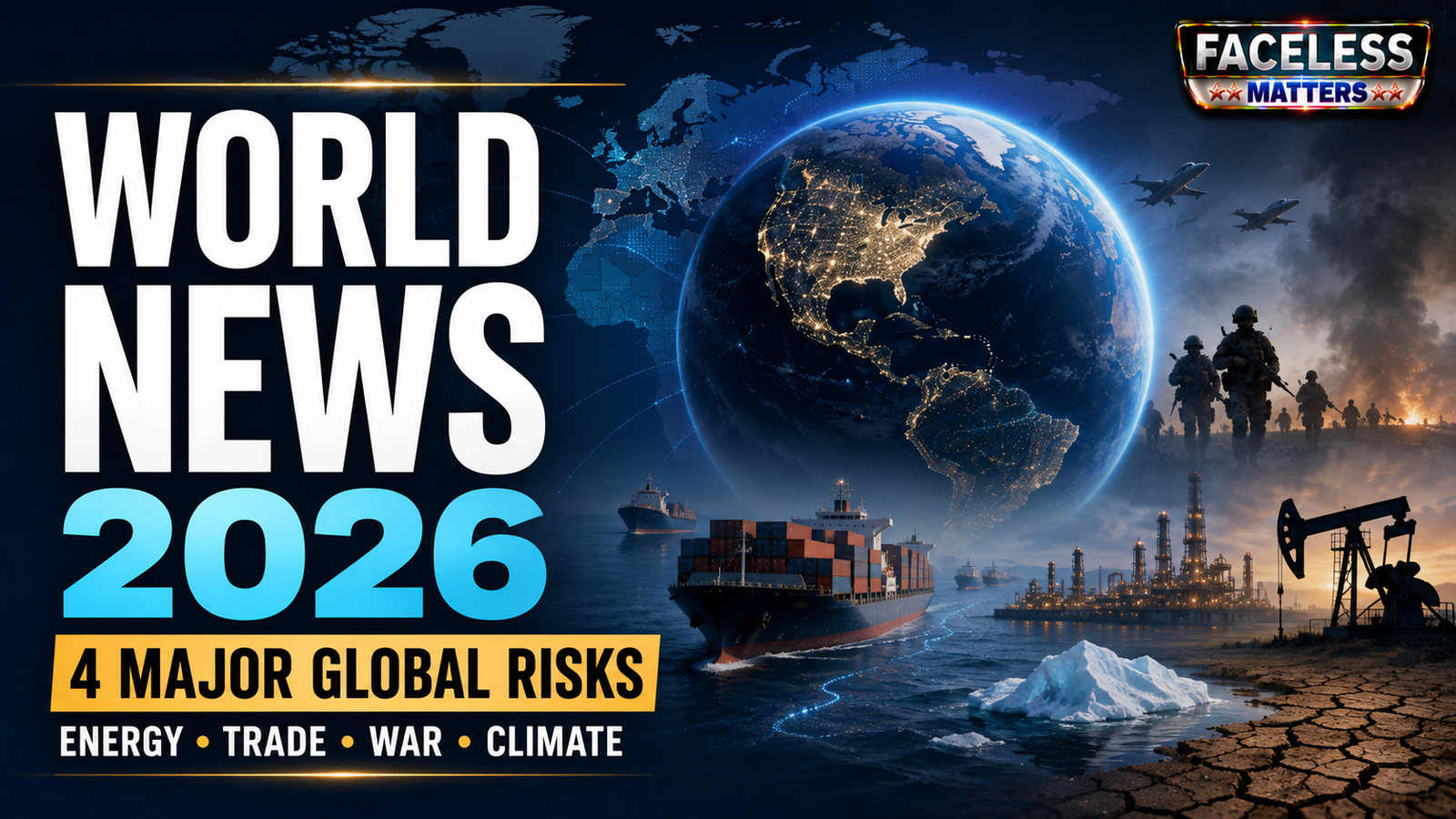
World News 2026 is increasingly defined by interconnected pressures rather than isolated events. Security crises, energy disruptions, trade disputes and climate risks are now affecting one another, creating a more complicated environment for governments, businesses and households.
As of August 22, 2026, four developments deserve particular attention: the continuing Iran conflict and disruption around the Strait of Hormuz, intensified Russian attacks on Ukraine, a fresh trade confrontation between the United States and Canada, and forecasts for an unusually strong El Niño.
World News 2026 is increasingly shaped by interconnected developments in security, energy, trade and climate.
These developments are different in nature, but they share one important characteristic: their consequences can extend far beyond the countries directly involved.
World News 2026: Why Global Risks Are Becoming Connected
International news is no longer only about what happens inside a country’s borders.
A conflict in a strategically important region can influence energy prices. Higher energy costs can affect transportation and inflation. Trade restrictions can increase costs for manufacturers and consumers. Climate-related disruption can put additional pressure on food production and supply chains.
For readers following World News 2026, these developments show how events in one region can quickly affect markets, governments and communities elsewhere.
This interconnected environment means that businesses and policymakers increasingly have to watch several risks at the same time.
The current global picture illustrates that trend clearly.
Iran Conflict Keeps Energy Security in Focus
One of the most important stories shaping World News 2026 is the continuing confrontation involving Iran and the United States.
Associated Press reported on August 22 that Iranian President Masoud Pezeshkian said the international community had effectively accepted Iran’s claim of victory, while the United States was continuing to increase economic pressure through sanctions. The report also noted that the Strait of Hormuz had remained closed for nearly six months.
The Strait of Hormuz matters because it is one of the world’s most strategically important energy corridors.
Any prolonged disruption around such a route can create uncertainty for oil markets, shipping companies, insurers and industries that depend heavily on energy.
The consequences are not necessarily limited to fuel prices.
Higher transportation and energy costs can eventually feed into the prices of manufactured goods, food distribution and other services. Central banks may then face a more difficult policy environment if inflation remains persistent.
Reuters has also highlighted energy-driven inflation and disruptions to oil supplies as major concerns for global markets in the current environment.
Why the Strait of Hormuz Matters
The significance of the Strait extends beyond the Middle East.
Energy markets are globally connected. A disruption in one strategic corridor can encourage countries and companies to seek alternative suppliers, routes and storage capacity.
That can increase the importance of pipelines, ports, rail connections and alternative shipping routes.
It also explains why governments are increasingly discussing energy diversification and infrastructure resilience.
For businesses, the lesson is straightforward: energy security is becoming an economic-security issue.
Ukraine War Enters Another Dangerous Phase
The war in Ukraine remains another major pillar of World News 2026.
Recent reporting from Kyiv describes continued Russian missile attacks, with civilian areas and infrastructure coming under pressure. The Guardian reported that Kyiv residents were increasingly relying on metro stations for shelter and that the city was facing difficulties related to air-defence capacity.
The conflict has consequences far beyond battlefield developments.
Ukraine is an important agricultural producer and a significant part of the wider European security environment. Continued attacks on infrastructure can affect electricity, transportation, logistics and reconstruction requirements.
For Europe, the conflict also remains connected to questions about defence spending, energy security and long-term strategic planning.
The international economic consequences are equally important.
Governments must balance military support, humanitarian assistance and domestic economic priorities. Companies operating across Europe must also consider transportation routes, energy costs and geopolitical risk.
This is why Ukraine remains a central issue in international security discussions.
US–Canada Trade Dispute Creates a New Economic Flashpoint
Another major development arrived in North America.
On August 22, the United States imposed 50% tariffs on some Canadian goods after trade negotiations between the two countries failed. Canada responded by saying it would retaliate on a dollar-for-dollar basis. Reuters reported that the affected U.S. tariffs cover about $20 billion of Canadian goods, representing just over 5% of Canada’s exports to the United States.
The immediate economic impact may be limited compared with the size of overall bilateral trade, but the political significance is much larger.
The United States and Canada are long-standing allies and major trading partners. A prolonged dispute could complicate wider negotiations over the North American trade framework.
Tariffs can also influence business decisions.
Companies may respond by changing suppliers, increasing inventories, moving production or looking for alternative markets.
Consumers can ultimately feel the effects if higher import costs are passed through supply chains.
For international businesses, the broader lesson is that trade policy has become an increasingly important part of strategic planning.
Climate Risk Adds Another Global Challenge
The fourth major development is different from the geopolitical conflicts but potentially just as important over time.
Forecasters are warning that the developing El Niño event could become exceptionally strong.
Reuters reported that Britain’s Met Office expects the 2026 event to potentially become the strongest El Niño in living memory, with equatorial Pacific sea-surface temperatures forecast to rise by more than 3°C later this year. The Met Office also said 2027 could replace 2024 as the warmest year on record.
El Niño is a natural climate pattern, but a strong event can influence weather conditions across different parts of the world.
Its effects can include changes in rainfall, drought risk, flooding, agricultural conditions and fisheries.
That makes it an economic issue as well as a climate story.
Food producers, insurers, governments and supply-chain companies may all have to prepare for greater uncertainty.
Reuters has also highlighted the potential economic costs associated with severe El Niño events, including effects on agriculture and fisheries.
Taken together, World News 2026 reflects a world where security, energy, trade and climate risks are becoming increasingly connected.
What These Four Stories Have in Common
At first glance, Iran, Ukraine, North American trade and El Niño appear unrelated.
But they reveal the same global trend: resilience is becoming more valuable than simple efficiency.
For decades, businesses often focused heavily on minimizing costs and maximizing global connectivity.
That model created enormous economic benefits.
But it also created dependencies.
A shipping disruption, trade barrier, conflict or extreme weather event can expose those dependencies very quickly.
Governments are therefore increasingly interested in:
- Energy diversification
- Domestic manufacturing
- Strategic reserves
- Alternative shipping routes
- Defence infrastructure
- Food security
- Supply-chain resilience
- Digital infrastructure
- Climate adaptation
These areas are likely to remain important investment themes.
Why Businesses Should Pay Attention
The impact of World News 2026 is not limited to governments and financial markets.
Small and large businesses can also be affected.
An importer may face higher freight costs.
A manufacturer may need a different supplier.
A retailer may have to adjust prices.
A technology company may need to reconsider data-centre energy requirements.
A farmer may face changing weather conditions.
A financial institution may have to reassess geopolitical and credit risks.
This is why international news increasingly matters to everyday economic decisions.
The most successful companies may not necessarily be those that predict every crisis correctly.
Instead, they may be those that can adapt quickly when conditions change.
Energy, Trade and Technology Are Becoming More Important
Another important theme is the relationship between energy and technology.
Artificial intelligence, data centres and advanced manufacturing require large amounts of reliable electricity.
At the same time, geopolitical uncertainty is making energy security more important.
That creates opportunities for investment in electricity generation, transmission networks, storage, grids and other infrastructure.
The same principle applies to trade.
As companies attempt to make supply chains more resilient, investment may increasingly move toward regional manufacturing and alternative production centres.
This could create opportunities in logistics, industrial technology, cybersecurity, energy infrastructure and digital services.
What Could Happen Next?
The next several months will depend heavily on whether governments can reduce geopolitical and economic uncertainty.
In the Middle East, investors will watch developments around Iran, sanctions, shipping and the Strait of Hormuz.
In Europe, attention will remain focused on the Ukraine war, air defence and the broader security environment.
In North America, markets will watch whether Washington and Ottawa can reopen meaningful trade negotiations.
On the climate front, governments and agricultural markets will monitor the evolution of El Niño and its regional effects.
None of these developments has a simple outcome.
That is precisely why they deserve continued attention.
A More Uncertain Global Economy
The biggest lesson from the current World News 2026 landscape is that global risks are becoming increasingly interconnected.
Energy affects inflation.
Inflation affects interest rates.
Interest rates affect borrowing costs.
Trade disputes affect supply chains.
Climate conditions affect agriculture.
Wars affect energy, logistics and government spending.
These connections create a world in which a development thousands of kilometres away can eventually affect businesses and consumers in another country.
For governments, the priority is resilience.
For companies, the priority is flexibility.
For households, understanding the broader global environment can help explain why prices, markets and economic conditions sometimes change unexpectedly.
Strategic Outlook for the Rest of 2026
The rest of 2026 could therefore be defined by four questions:
Can geopolitical conflicts be contained?
Can global energy markets stabilize?
Can major trading partners prevent tariff disputes from becoming prolonged economic conflicts?
Can governments prepare for increasingly disruptive climate conditions?
The answers will influence markets, investment decisions, international relations and economic growth.
The global economy remains highly connected, but that connectivity also means global shocks can travel quickly.
The countries and companies best prepared for uncertainty may have an advantage as the year progresses.
Suggested Future Internal Article
1. Global Bond Market Selloff: Why Borrowing Costs Are Rising in 2026
Use this article to explain how geopolitical risk, energy prices and inflation can influence bond yields, interest rates and global borrowing costs.
Global Bond Market Selloff: Why Borrowing Costs Are Rising in 2026
2. The AI Infrastructure Boom: Nvidia, OpenAI and the Global Race for Data Centers, Chips and Power
Use this as a technology and infrastructure connection, especially around electricity demand, AI data centres, semiconductor investment and global power infrastructure.
The AI Infrastructure Boom: Nvidia, OpenAI and the Global Race for Data Centers, Chips and Power
3. Pakistan Digital Economy Initiative 2026: Powerful Digital Growth
Use this as the Pakistan-focused connection for digital infrastructure, electricity demand, cloud infrastructure and the wider global technology economy.
Pakistan Digital Economy Initiative 2026: Powerful Digital Growth
SOURCE VERIFICATION & ANALYSIS
Source Verification & Analysis: This report was prepared using current international reporting and cross-checked against multiple major news and information sources available on August 22, 2026, including Reuters, Associated Press, The Guardian, Dawn, Anadolu Agency, Financial Times and other international reporting. Key areas checked included the Iran conflict and Strait of Hormuz, Ukraine security developments, United States–Canada tariff developments and the emerging 2026 El Niño forecast. The article separates reported developments from broader strategic analysis and avoids presenting predictions as confirmed facts.
Sources checked: Reuters, Associated Press, The Guardian, Financial Times, Dawn, Anadolu Agency, Global News, Le Monde, El País, and other international reporting.
[…] World News 2026: 4 Major Global Risks to Watch […]
[…] World News 2026: 4 Major Global Risks to Watch — World News | RecentThis recent FACELESS MATTERS analysis examines how global events, […]
[…] World News 2026: 4 Major Global Risks to Watch — A newer World News analysis connecting climate risk with energy, trade and geopolitical […]
[…] [World News 2026: 4 Major Global Risks to Watch] — A recent World News analysis examining how Iran, energy security, trade and global geopolitical […]
[…] درمیانی مدت / World News: World News 2026: 4 Major Global Risks to Watch — 22 اگست 2026 کی World News رپورٹ میں US–Canada trade dispute کو ایک اہم […]
[…] 1. World News 2026: 4 Major Global Risks to Watch […]
[…] World News 2026: 4 Major Global Risks to Watch […]
[…] World News 2026: 4 Major Global Risks to Watch […]
[…] World News 2026: 4 Major Global Risks to WatchEnergy security، geopolitical conflict اور عالمی risk environment کا broader analysis۔ […]
[…] World News 2026: 4 Major Global Risks to Watch — Connects the Iran conflict with global energy, trade, geopolitical and economic risks. […]
[…] 2. The Wider Global Security Environment — Explore our analysis of the major geopolitical, energy and international-security risks shaping the global environment in 2026 and understand how developments in one region can affect wider strategic stability. Read: World News 2026: 4 Major Global Risks to Watch […]
[…] World News 2026: 4 Major Global Risks to Watch — World News | RecentThis broader global-risk report places the Iran conflict alongside energy, […]
[…] 2. [World News 2026: 4 Major Global Risks to Watch] — World News | RecentThis broader international analysis connects the Iran conflict, energy security, trade, climate risk and global economic uncertainty. World News 2026: 4 Major Global Risks to Watch […]
[…] World News 2026: 4 Major Global Risks to Watch […]
[…] 2. World News 2026: 4 Major Global Risks to Watchایران تنازع، energy security، geopolitical risk اور عالمی سطح پر emerging risks کے وسیع تناظر کے لیے متعلقہ internal reading ہے۔ World News 2026: 4 Major Global Risks to Watch […]
[…] World News 2026: 4 Major Global Risks to Watch […]