

TABLE OF CONTENTS
The story of Field Marshal Syed Asim Munir cannot be understood properly by beginning with the military uniform. Before commissioning, command appointments and national-security responsibilities, there was a young man growing up in Rawalpindi within a family and community environment shaped by education, religious learning and ordinary urban life.
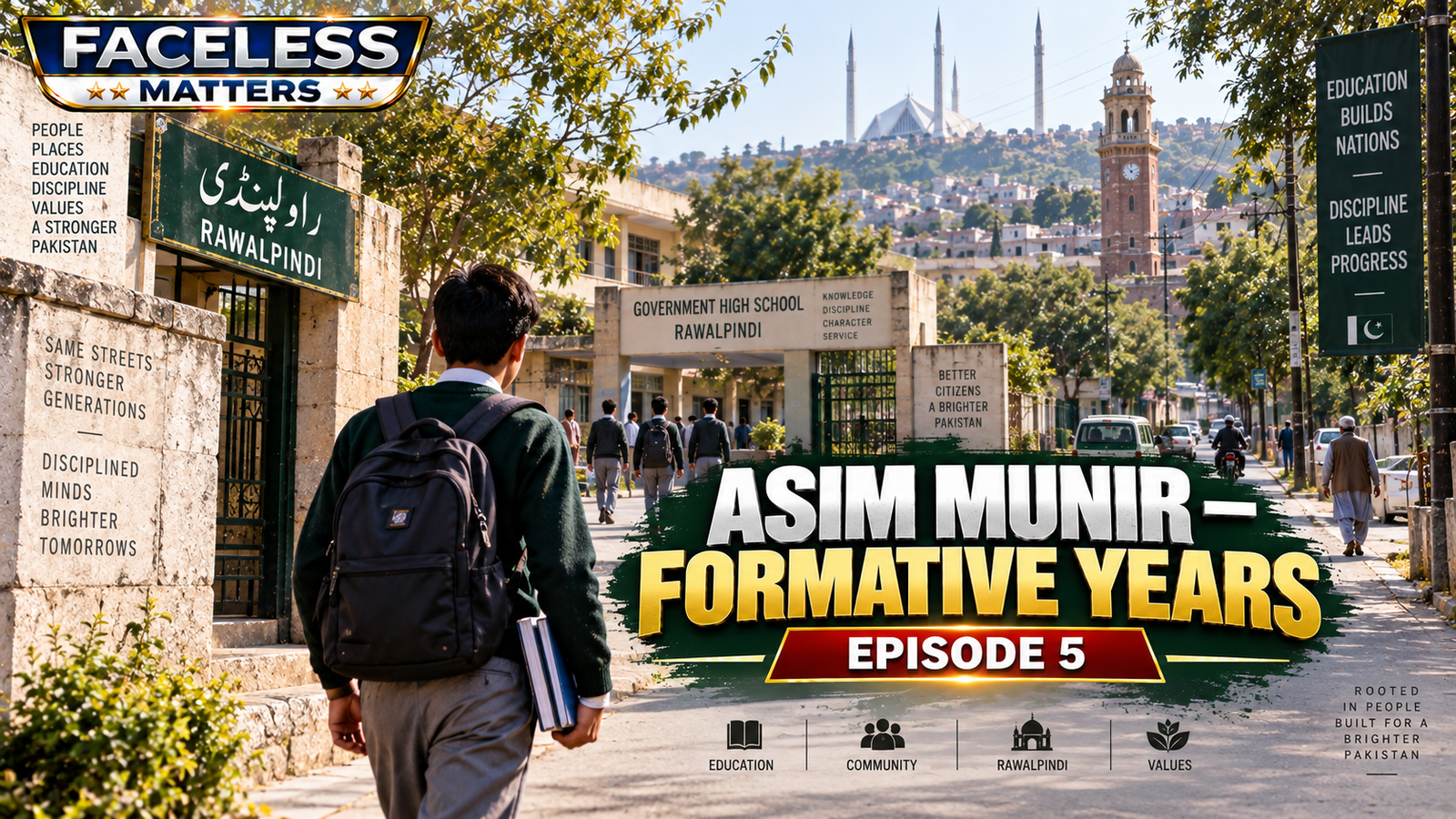
Episode 5 moves the biography one step forward. Earlier episodes established the family’s reported roots in Jalandhar, its migration to Pakistan, settlement in Rawalpindi, the Dheri Hassanabad environment and the documented role of Syed Sarwar Munir. This episode focuses more directly on the young Asim Munir: his formative environment, education, reported interests, religious learning and the gradual transition from childhood toward the choices that eventually led him into military service.
The available public record is not a private diary. It does not provide a complete account of every school day, friendship, ambition or family conversation. A responsible biography must therefore work with the evidence that exists while avoiding the temptation to fill gaps with attractive but unsupported stories.
That distinction is particularly important when examining the Asim Munir formative years. These years provide context, but they should not be turned into a predetermined explanation for everything that happened later.
From Family Background to Personal Development
Episode 4 examined Syed Sarwar Munir and the family environment associated with the young Asim Munir. Episode 5 changes the lens.
The central question is no longer simply who his father was or where the family came from.
It is:
What was happening in the life of the young Asim Munir as he moved from childhood toward adolescence and adulthood?
Published biographical accounts consistently place his early life in Rawalpindi. India Today reports that he was born there and received early religious education at Markazi Madrasa Dar-ul-Tajweed. Other reporting also associates his family with Dheri Hassanabad and describes his father as an educator and imam. India Today — biographical profile ThePrint — biographical profile
These details establish an environment.
They do not establish every personal experience.
That distinction allows the biography to move from family history toward personal development without inventing private details. The Asim Munir formative years are best understood through the documented setting of Rawalpindi, where family life, education, religious learning and community experience formed the immediate environment.
The Asim Munir formative years also represent a period in which the available public record becomes more focused on education and youth than on later military responsibilities. Examining the Asim Munir formative years carefully helps separate documented experiences from assumptions about future leadership. The Asim Munir formative years should therefore be treated as a stage of personal development rather than as a predetermined explanation of his later career.
Within the Asim Munir formative years, education and community life provide useful context, but the evidence does not establish a single cause for his eventual professional choices. A responsible account of the Asim Munir formative years must also recognize the limits of the available public record. For that reason, the Asim Munir formative years are presented here as documented context that prepares the reader for the transition toward military training.
The Asim Munir formative years should therefore be understood as a period in which several influences existed together: family expectations, formal education, religious study, community life and ordinary youth activities.
Only later would these elements intersect with military training and professional responsibility.
Rawalpindi as the Setting of Youth
Rawalpindi is more than a location on a birth certificate.
For the purposes of this biography, it is the city in which the family settled and where the young Asim Munir spent his early years.
Published accounts connect the Munir family with Dheri Hassanabad and identify Rawalpindi as the setting of his birth and early education. The city therefore provides continuity between the family history established in earlier episodes and the personal development examined here.
Rawalpindi has a distinctive place in Pakistan’s modern history. It is a major urban centre, a longstanding military and administrative location and a city containing schools, religious institutions, markets, residential communities and diverse social networks.
But it would be too simple to say that growing up in Rawalpindi automatically produced a military career.
Millions of people have lived in the city without entering military service.
The importance of Rawalpindi is therefore contextual.
It was the environment in which the young Asim Munir received education, interacted with his community and developed before making the professional choices that eventually changed the direction of his life.
The Asim Munir formative years should be read through that combination of place and personal development.
Education as an Early Foundation
Education appears repeatedly in the available accounts of Munir’s early life.
The most clearly reported element is his early religious education at Markazi Madrasa Dar-ul-Tajweed in Rawalpindi. India Today and The Indian Express both identify the institution as part of his early educational background. The Indian Express — early education and military pathway
The significance of this detail should be handled carefully.
It tells us that religious education was part of his early life.
It does not tell us that every later professional decision was determined by that education.
A long-form biography should distinguish between influence, context and causation.
Religious learning can form one part of a person’s intellectual and cultural development. At the same time, later professional choices may emerge from a much wider combination of education, personality, opportunity, institutional environment and personal decision-making.
This is one reason the Asim Munir formative years deserve more careful treatment than a short biographical paragraph can provide.
The evidence gives us a starting point.
The later career gives us the outcome.
The relationship between the two requires interpretation rather than assumption.
Religious Learning Within a Broader Educational Environment
The available reporting describes a family environment in which formal education and religious learning existed alongside one another.
That is consistent with the background established in Episode 4.
Syed Sarwar Munir was reported as an educator and imam. His son’s early education included Markazi Madrasa Dar-ul-Tajweed. Together, these details indicate that education was not an incidental feature of the household.
But education itself is broader than one institution.
A young person can learn through school, family, religious institutions, friends, sports and community life. Each environment contributes different forms of knowledge and social experience.
The Asim Munir formative years therefore should not be reduced to a single educational institution.
The available record supports the presence of religious learning.
It does not provide a complete curriculum, timetable or day-to-day educational record.
That is where editorial restraint becomes important.
A biography should be detailed enough to be useful but cautious enough to remain credible.
The Reported Role of Cricket
One of the more interesting details in published accounts is that Munir was also associated with local cricket during his youth, reportedly playing as a fast bowler.
This detail appears in biographical reference material and has been repeated in accounts of his early life.
Cricket provides a useful reminder that the formative years of a future senior military commander were not simply a sequence of formal lessons and religious study.
Youth also includes ordinary interests.
Sport can involve discipline, competition, teamwork and repeated practice, but it would be speculative to claim that playing cricket directly prepared Munir for military command.
The more defensible point is simply that the young man participated in an ordinary social activity that was deeply familiar in Pakistani culture.
That makes the biography more human without requiring invention.
The Asim Munir formative years were therefore not only about institutions.
They were also about the ordinary experiences through which young people develop interests, friendships and habits.
Discipline Without Mythology
The word “discipline” appears naturally in discussions of both religious education and military life.
But this creates a potential problem.
It is tempting to construct a neat narrative in which early religious study supposedly produced discipline, discipline produced military ambition and military ambition eventually produced national leadership.
Real lives are rarely that simple.
The available sources do not establish such a direct chain.
What they do establish is that religious education formed part of Munir’s background and that he later entered a highly structured military institution.
Between those two points were personal decisions and experiences that are not fully documented in the public record.
Therefore, this biography should resist retrospective storytelling.
The Asim Munir formative years can be examined for context without being transformed into a prophecy about his future.
That approach is not less interesting.
It is more historically responsible.
The Importance of a Gradual Transition
A person’s transition from childhood to professional life usually happens gradually.
In Munir’s case, the public record allows us to identify broad stages.
First came family settlement and childhood in Rawalpindi.
Then came early education and religious learning.
Youth activities and community life existed within that environment.
Later came military training.
The Government of Pakistan records that Munir was commissioned in April 1986 into the 23 Frontier Force Regiment after the 17th Officers Training School course and that he received the Sword of Honour. Government of Pakistan — official biographical record
That official record is important because it establishes the later transition into professional military life.
But Episode 5 stops before turning the article into a full military-career account.
The purpose here is to understand the period immediately before that transition.
What the Sources Establish About the Young Asim Munir
A careful reading of the available sources allows several points to be stated with confidence.
He was born in Rawalpindi in 1968.
His family had roots connected with Jalandhar and migrated to Pakistan after Partition.
The family eventually became associated with Dheri Hassanabad in Rawalpindi.
His father, Syed Sarwar Munir, was reported as an educator and imam.
Asim Munir received early religious education at Markazi Madrasa Dar-ul-Tajweed.
Published biographical accounts also report that he participated in local cricket as a fast bowler.
These details create a useful outline of the young man’s environment.
What they do not provide is equally important.
They do not provide a complete record of his school performance.
They do not establish every childhood ambition.
They do not document every friendship.
They do not provide a verified account of private family conversations about his future.
And they do not prove that military service was predetermined from childhood.
The distinction between documented evidence and interpretation remains central.
What We Should Not Assume
Biographies of prominent figures often become more speculative as they move into childhood.
There is a natural temptation to search for a single moment that supposedly explains the entire adult personality.
That approach is rarely justified.
We should not assume, without evidence, that:
- his father’s profession predetermined his career;
- religious education automatically produced military ambition;
- cricket directly developed his leadership abilities;
- Rawalpindi alone explains his professional choices;
- a specific childhood experience caused his decision to enter military service;
- every later characteristic can be traced to the family environment.
None of these conclusions is established by the available public record.
The purpose of studying the Asim Munir formative years is instead to identify the circumstances that can be documented.
This approach also protects the biography from becoming a heroic origin story.
The young person does not need to be portrayed as destined for greatness.
The later career can be evaluated on its own evidence.
The Difference Between Environment and Destiny
This distinction is one of the most important ideas in the series.
Environment matters.
But environment is not destiny.
A family can create educational opportunities without determining what a child will eventually do.
A religious institution can provide knowledge without determining a person’s complete worldview.
A city can provide social networks without dictating a career.
A sport can teach habits without producing a particular profession.
This is particularly relevant to the Asim Munir formative years because the public record contains enough information to establish a meaningful environment but not enough to reconstruct every internal motivation.
A serious biography should therefore avoid pretending that the evidence is stronger than it is.
The value of the Asim Munir formative years lies in the documented sequence.
From Youth Toward Military Ambition
At some point, the biography must move from environment to choice.
The public record confirms that this eventually happened through the Officers Training School pathway.
The Government of Pakistan’s official profile states that Munir was commissioned in April 1986 into the 23 Frontier Force Regiment and received the Sword of Honour of the 17th OTS course.
That transition represents a major change in the biography.
Before it, the story is primarily about family, education and personal development.
After it, the story increasingly becomes institutional.
Training, postings, command responsibilities and professional performance begin to shape the narrative.
Episode 5 therefore stands at an important bridge.
It is the final stage in the series where the emphasis remains heavily on the young person’s formative environment before the military career takes over.
The Asim Munir formative years are consequently not a side note.
They are the bridge between the family story and the professional biography.
FACELESS MATTERS Analysis: What the Formative Years Actually Tell Us
The strongest conclusion from the evidence is not that childhood explains the Field Marshal.
It is that the available record shows a young man developing within several overlapping institutions.
Family provided the immediate social environment.
Rawalpindi provided the geographical setting.
Education provided structured learning.
Religious study provided another form of instruction.
Community life provided social experience.
Youth activities such as cricket provided an ordinary outlet outside formal education.
Military service came later and introduced a new institutional framework.
That sequence is more useful than a simplistic cause-and-effect story.
It also explains why the biography is being written chronologically.
If the reader begins with the Field Marshal’s present position, it is easy to assume that the early years were simply preparation for a predetermined destination.
But history is usually clearer when viewed one stage at a time.
The young Asim Munir did not begin life with a publicly known military career.
He developed within a particular family and city, received education and religious instruction, experienced ordinary youth and eventually entered military training.
The evidence allows us to describe that progression.
It does not allow us to rewrite it as destiny.
Why Rawalpindi Matters Beyond Geography
Rawalpindi deserves another look because it appears repeatedly across the opening episodes.
It is the place where the family settled.
It is the reported birthplace of Asim Munir.
It is where early religious education took place.
It is the urban environment in which his youth unfolded.
And it is closely associated with Pakistan’s military establishment.
These overlapping identities make the city an important setting for the biography.
Still, geography should not become an exaggerated explanation.
Many young people grow up in Rawalpindi.
Only a small number enter the highest levels of military leadership.
The significance of the city is therefore that it forms part of the documented setting—not that it mechanically produced the outcome.
That is a distinction worth maintaining throughout a serious biography.
A Young Person Before the Public Figure
One benefit of examining the formative years is that it changes how a reader sees a public figure.
The later Field Marshal is associated with strategic decisions, national defence, military command and international security.
The young person was not yet operating in that world.
He was living within a family environment, studying, participating in community life and developing through ordinary stages of youth.
That does not diminish the later career.
It gives it human and chronological context.
The biography becomes a story of development rather than a list of appointments.
This is particularly important for FACELESS MATTERS because the purpose of a 100-episode series is to examine the journey rather than simply repeat the final résumé.
What Remains Unknown
The public record remains incomplete in several areas.
There is no comprehensive publicly available childhood diary.
There is no verified record of every school attended during every year of youth.
There is limited publicly documented information about friendships, private ambitions and family conversations.
There is also no reliable basis for reconstructing the exact moment when military service became a personal ambition.
These gaps should remain visible.
A biography does not become stronger by hiding uncertainty.
It becomes stronger by distinguishing known facts from reasonable interpretation and from unknown details.
That editorial principle will continue through the later episodes.
From Formative Years to the Military Institution
The chronology now reaches its natural turning point.
The family story has been established.
The Rawalpindi environment has been examined.
The father’s role has been documented.
Early religious education has been identified.
Youth activities have been placed in context.
The next major change is institutional: entry into military training.
The official record provides a clear milestone in April 1986, when Munir was commissioned into the 23 Frontier Force Regiment after the 17th OTS course and received the Sword of Honour.
That is where the next phase of the biography begins.
Episode 5 therefore closes not with a dramatic claim about destiny, but with a documented transition.
The young man from Rawalpindi was moving into a professional institution that would define the next several decades of his life.
FACELESS MATTERS Strategic Perspective
There is a broader lesson in this stage of the biography.
Institutions do not operate in isolation from personal history.
A military officer enters an institution carrying educational experiences, social habits, family influences and personal values.
But institutions also reshape individuals.
Military training imposes new standards, responsibilities and professional expectations.
This means the next stage of Asim Munir’s biography should not be read as a continuation of childhood by another name.
It is a new environment.
The Officers Training School introduced a different form of discipline, assessment and professional competition.
The Sword of Honour recorded by the Government of Pakistan indicates that his performance during that stage received formal recognition.
Understanding that transition is more valuable than trying to claim that the outcome was predetermined.
Conclusion: Before the Uniform, There Was a Young Man
The Asim Munir formative years provide the bridge between family history and professional history.
The documented record places the young Asim Munir in Rawalpindi, within a family associated with education and religious service. It records early religious education at Markazi Madrasa Dar-ul-Tajweed and published accounts also describe local cricket as part of his youth.
These facts provide context.
They do not provide a complete psychological portrait.
They do not prove that military leadership was predetermined.
They do not justify turning ordinary childhood experiences into a heroic legend.
What they do provide is a credible chronology.
A family settled in Rawalpindi.
A young man grew up there.
Education and religious learning formed part of his environment.
Community and youth activities were part of ordinary life.
Then, in 1986, the path moved into military training and professional service.
That transition will become the focus of the next stage of the biography.
The strength of this series depends on preserving that sequence.
The family background explains the beginning.
The formative years show the developing individual.
The military institution explains the professional transformation.
And the later episodes will examine the decisions, responsibilities and achievements that followed.
For now, Episode 5 ends where childhood gives way to institution.
The next chapter begins at the Officers Training School.
Source Verification & Analysis
The principal claims in this episode were cross-checked against published biographical reporting and official Government of Pakistan material.
- Government of Pakistan — Press Information Department — Official biographical record confirming April 1986 commissioning into the 23 Frontier Force Regiment, the 17th OTS course, Sword of Honour and later military education and appointments.
- India Today — “The rise and rise of a General” — Reports Munir’s birth in Rawalpindi, his father’s educational and religious roles and his early education at Markazi Madrasa Dar-ul-Tajweed.
- The Indian Express — early education and military pathway — Reports his early education at Markazi Madrasah Dar-ul-Tajweed and subsequent Officers Training School pathway.
- ThePrint — biographical profile — Provides additional reporting on family roots, Dheri Hassanabad, religious education and the transition into military service.
- Reuters factbox via ThePrint — Additional background on his early life and professional chronology.
Where sources differ on precise personal details or the chronology of some aspects of his religious education, this episode deliberately uses the common documented ground and avoids presenting uncertain details as established fact.
Fresh News Link
A current official report provides useful present-day context for the later stages of this biography. On September 5, 2026, Radio Pakistan reported that Field Marshal Syed Asim Munir, in his roles as Chief of Army Staff and Chief of Defence Forces, visited Quetta Garrison and reviewed the security environment, operational preparedness, institutional coordination and links between stability and economic development in Balochistan.
Read the latest official Radio Pakistan report
INTERNAL READING — FACELESS MATTERS
1. Asim Munir Childhood — Episode 3: Powerful Foundations
This directly precedes the present episode and examines Dheri Hassanabad, childhood environment and the early educational setting.
2. Asim Munir Family History — Episode 2: The Remarkable Journey from Jalandhar to Pakistan
This provides the documented family-migration context that precedes the Rawalpindi formative years.
3. Asim Munir Early Life — Episode 1: Family Roots
The opening episode establishes the earliest family, educational and social foundations of the 100-episode biography.
Suggested Future Internal Articles
Episode 6 — Asim Munir Military Ambition: From Education to Service
Focus: the transition from education and formative development toward the decision to enter military training.
Episode 7 — Asim Munir OTS 1986: The Road to Commissioning
Focus: Officers Training School, the 17th OTS course, Sword of Honour and commissioning into the 23 Frontier Force Regiment.
Episode 8 — Asim Munir Early Military Career: The First Professional Chapter
Focus: the documented beginning of his commissioned military career and the early responsibilities that followed.
[…] Asim Munir Formative Years — Episode 5: Growing Up in Rawalpindihttps://facelessmatters.com/asim-munir-formative-years-episode-5/ […]
[…] Asim Munir Formative Years — Episode 5: Growing Up in Rawalpindihttps://facelessmatters.com/asim-munir-formative-years-episode-5/ […]
[…] Asim Munir Formative Years — Episode 5: Growing Up in Rawalpindi […]
[…] Asim Munir Formative Years — Episode 5: Remarkable Youth […]