

Date
1986 onward
TABLE OF CONTENTS
Key Takeaway
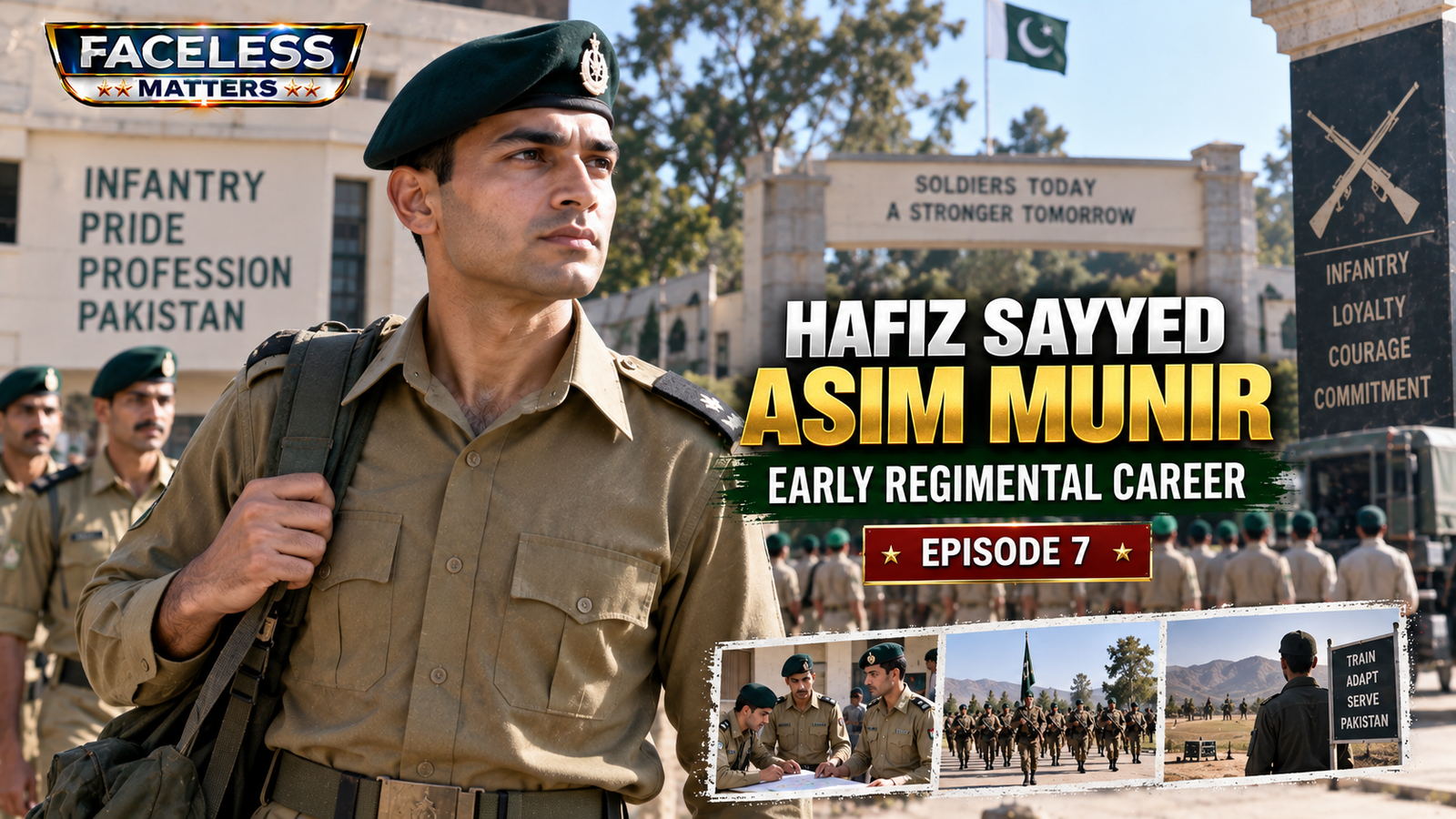
The Hafiz Sayyed Asim Munir early regimental career began with a decisive professional transition: after completing the 17th Officers Training School course, receiving the Sword of Honour and being commissioned in April 1986, Hafiz Sayyed Asim Munir entered the 23 Frontier Force Regiment.
Article Content
From Commissioning to the Regiment
After commissioning in April 1986 into the 23 Frontier Force Regiment, Hafiz Sayyed Asim Munir entered the part of military life that public biographies often describe too quickly.
The training milestone was already behind him.
The Sword of Honour of the 17th Officers Training School course had established a documented mark of performance. The next task was different.
A commissioned officer had to develop within a functioning regiment, absorb professional responsibilities and build experience over time.
This episode focuses on that transition without inventing a private diary or assigning undocumented duties.
The available public record confirms the commissioning regiment and later identifies the 23 Frontier Force Regiment as his parent unit. It also records that he eventually commanded that parent unit.
Those facts provide a reliable framework for understanding the beginning of his professional regimental career.
Why the 23 Frontier Force Regiment Matters
The regiment is more than a name in a career summary.
It is the institutional starting point of the Hafiz Sayyed Asim Munir early regimental career, and the official record later identifies the same unit as his parent regiment.
That continuity gives the early period particular significance.
The officer who entered the regiment as a young commissioned soldier would, decades later, be recorded as having commanded his parent unit.
The later command does not mean that his future was predetermined in 1986.
It means that the regiment remained a recurring institutional connection across a long career.
This distinction is important in historical writing.
Later achievements can easily distort the way early events are understood. Knowing that an officer eventually reached senior command can make every early assignment appear like a deliberate step toward that destination.
The evidence does not support such hindsight.
In 1986, the documented fact was much simpler: a young officer had completed OTS and entered the 23 Frontier Force Regiment.
The Young Officer Inside a Professional Institution
A regiment is a professional institution, not simply a location.
A newly commissioned officer enters a hierarchy in which responsibilities are connected to collective performance, discipline, training and readiness.
The early years of the Hafiz Sayyed Asim Munir early regimental career therefore matter even when the public record does not preserve every individual episode.
They represent the first sustained professional environment in which the officer had to apply what had been learned during training.
The shift from course performance to institutional service is a meaningful stage in any military career.
It is also a stage where professional development is gradual.
A young officer does not arrive with the experience of a senior commander.
Experience is accumulated through assignments, interaction with other officers and soldiers, exposure to unit requirements and increasing responsibility.
The public sources available for this biography do not permit a detailed reconstruction of each of those experiences.
That limitation is not a reason to omit the stage altogether.
It is a reason to describe it carefully.
What the Official Record Establishes
The strongest primary source for the basic chronology is the Government of Pakistan’s Press Information Department.
Its published biographical record states that Syed Asim Munir was commissioned in April 1986 in the 23 Frontier Force Regiment and received the Sword of Honour of the 17th OTS Course.
The same record later lists a career containing command, staff and instructional assignments.
It identifies major staff appointments including Brigade Major of a deployed Infantry Brigade, General Staff Officer Grade-2 in the Chief of General Staff Secretariat, Directing Staff in Command and Staff College, Quetta, and Chief of Staff of a Strike Corps. It also records that he commanded his parent unit, 23 Frontier Force Regiment, along with later formations.
Those later appointments are important because they show the scale of professional development that followed.
They should not, however, be projected backward as if they describe his responsibilities immediately after commissioning.
The public record gives us a starting point and later milestones.
The intermediate stages must be treated with appropriate caution.
From Cadet Standards to Regimental Responsibility
At OTS, performance was evaluated within a training institution.
After commissioning, professional performance became part of a larger military system.
The distinction matters because a young officer’s development is no longer measured only by examination or course performance.
The officer becomes part of an organization whose effectiveness depends on teamwork, discipline, communication and readiness.
The Hafiz Sayyed Asim Munir early regimental career should therefore be viewed as a period of professional application.
The Sword of Honour is a documented achievement from the training stage.
Regimental service was the next environment in which professional capability could develop.
It would be inappropriate to claim that the award itself guaranteed later command.
It did not.
It provides evidence of recognized performance during one particular stage.
The later career had to be built over many years.
The Importance of Not Inventing Missing Details
Long biographies face a particular risk: when the record is incomplete, writers may feel pressure to supply a story.
That approach can make an article appear detailed while weakening its reliability.
For this reason, this episode does not assign a specific first posting unless it is independently supported.
It does not create a dramatic first-day story.
It does not invent conversations with instructors or senior officers.
It does not attribute private ambitions that are absent from reliable sources.
The Hafiz Sayyed Asim Munir early regimental career is therefore presented through what the record can actually establish.
This approach also protects the wider 100-episode series.
Each episode can leave some questions for later research instead of forcing every gap to be filled immediately.
A credible biography is not required to know everything.
It is required to distinguish known information from inference.
A Parent Regiment That Reappears Later
The later record creates an interesting chronological loop.
The Government of Pakistan states that Hafiz Sayyed Asim Munir eventually commanded his parent unit, the 23 Frontier Force Regiment.
That fact allows the early regimental chapter to be understood as the first point of a relationship that continued across decades.
The connection is stronger because it is institutional rather than speculative.
The regiment is documented at the beginning of commissioned service and again at a later command stage.
This does not mean every part of his career remained inside the same unit.
The official record shows a much broader professional journey involving command, staff and instructional assignments.
Instead, the parent regiment provides one fixed reference point inside a changing career.
For a long-form biography, such reference points are useful because they help readers understand continuity without simplifying the entire career.
Professional Development Happens in Stages
The Hafiz Sayyed Asim Munir early regimental career should also be understood within the broader logic of military professional development.
An officer begins with training.
Then comes service.
Over time, professional education and varied assignments can expand an officer’s perspective.
Staff work can expose an officer to planning and coordination beyond a single unit.
Instructional roles can require communication and the transmission of professional knowledge.
Command assignments introduce responsibility for larger organizations.
The official biography later records all of these categories in Hafiz Sayyed Asim Munir’s career.
Episode 7 does not claim that all of those later responsibilities existed during the earliest regimental years.
Instead, it identifies the early regiment as the institutional foundation from which a much longer professional journey developed.
That is a more defensible interpretation of the available record.
From the Regiment to Wider Professional Experience
The early regimental stage should not be isolated from what came later, but it should not be merged with it either.
The later official record identifies advanced education at institutions including the Fuji School in Japan, Command and Staff College in Quetta, the Malaysian Armed Forces Command and Staff College in Kuala Lumpur and National Defence University in Islamabad.
It also records staff and command appointments.
Those milestones show that military careers develop through different forms of experience.
The Hafiz Sayyed Asim Munir early regimental career belongs to the first of these professional layers: unit-level service after commissioning.
The importance of that layer is not that it contains a hidden prediction of the future.
Its importance is that it represents the first professional environment in which the officer began accumulating experience as a commissioned member of the Pakistan Army.
Why Early Regimental Experience Matters
Early regimental service matters in a biography because institutions shape professional habits.
A young officer learns how a unit functions.
He becomes familiar with the relationship between orders and execution.
He encounters the practical requirements of discipline and readiness.
He works within a hierarchy.
He develops professional relationships.
Not every one of these experiences becomes public record.
That is normal.
The historical task is therefore not to reconstruct imaginary scenes.
It is to explain the institutional setting in which professional development occurred.
For the Hafiz Sayyed Asim Munir early regimental career, the 23 Frontier Force Regiment provides that setting.
The later career can then be understood as a sequence of expanding responsibilities rather than a sudden jump from commissioning to senior leadership.
The Distance Between 1986 and Senior Command
One of the most important points in this episode is the amount of time involved.
Commissioning occurred in 1986.
Senior national responsibilities came decades later.
Between those points were years of service, education, appointments and professional development.
The official record demonstrates that the later career included a wide range of roles, but it does not reduce the journey to one straight line.
This is why the Hafiz Sayyed Asim Munir early regimental career should not be written as though senior command was already visible.
A young officer entering a regiment in 1986 had a professional future ahead of him, not a publicly known destination.
The historical value of the early period lies in documenting the beginning of that journey.
A Career Built Through Institutional Experience
The military career described in later official records includes unit command, formation command, staff responsibilities and instructional work.
Those categories suggest a career that broadened over time.
But broadening does not happen all at once.
The early regimental period belongs to the first professional layer.
The Hafiz Sayyed Asim Munir early regimental career therefore deserves its own place in the chronology because it separates the training stage from the later command stage.
That separation also makes the biography easier for readers to follow.
Episode 6 examined the transition into service.
Episode 7 examines the beginning of service.
Later episodes can then examine education, command development and other professional stages as the evidence allows.
FACELESS MATTERS Analysis: The Value of a Careful Timeline
The strongest editorial lesson from this episode is simple: chronology creates credibility.
A reader should be able to see where one stage ends and another begins.
The military transition did not instantly produce senior leadership.
The young officer entered a regiment.
The professional experience accumulated.
Later education expanded the range of skills and knowledge.
Staff assignments exposed him to broader institutional work.
Command assignments increased the scale of responsibility.
The official record supports the existence of these later categories, even though it does not give us a complete narrative of every early-year assignment.
This is why FACELESS MATTERS is treating the Hafiz Sayyed Asim Munir early regimental career as a foundation rather than a dramatic legend.
The goal is not to make every paragraph sound historic.
The goal is to explain why the documented sequence matters.
That approach is especially valuable in a 100-episode biography because it prevents the early chapters from being rewritten through the lens of later events.
What We Can Say With Confidence
Several conclusions are strong enough to state clearly.
Hafiz Sayyed Asim Munir was commissioned in April 1986.
The commissioning was into the 23 Frontier Force Regiment.
The official record later identifies that regiment as his parent unit.
The same record states that he eventually commanded the parent unit.
The military career later included command, staff and instructional responsibilities.
These facts provide a firm framework for Episode 7.
What they do not provide is a complete public account of every junior-officer posting or private experience immediately following commissioning.
The article therefore avoids presenting such details as established fact.
This is not merely a sourcing preference.
It is part of the editorial method of the FACELESS MATTERS biography series.
What We Should Not Assume
The evidence does not justify claiming that a particular early posting directly caused a later appointment unless a reliable source establishes that connection.
It does not justify assigning private motives to career decisions.
It does not justify turning the parent-regiment connection into a claim that the entire later career was predetermined.
It does not justify inventing conversations, battlefield stories or personal reflections.
The Hafiz Sayyed Asim Munir early regimental career is significant without any of those additions.
The facts are enough: commissioning, entry into the 23 Frontier Force Regiment, professional development and the beginning of a decades-long military career.
The Professional Identity Begins to Take Shape
Commissioning created a new professional identity, but that identity would evolve.
The Hafiz Sayyed Asim Munir early regimental career also marks the beginning of practical professional service after formal officer training.
A junior officer’s experience is not the same as that of a senior commander.
The responsibilities, knowledge and institutional perspective grow over time.
That is why a biography should not treat a 1986 officer as if he already possessed the experience associated with later decades.
The Hafiz Sayyed Asim Munir early regimental career is valuable precisely because it shows the starting point before those later responsibilities existed.
It also provides a useful bridge from Episode 6 to the professional chapters that follow.
The family and formative years remain part of the biography, but the center of gravity has now moved into military institutions.
The First Regimental Chapter in Context
The Hafiz Sayyed Asim Munir early regimental career should be understood within the institutional character of the Frontier Force tradition. After commissioning, a young officer entered an established professional structure shaped by hierarchy, discipline, teamwork, training and operational readiness.
The available public record does not provide a complete account of his precise early duties or individual appointments during this period. This episode therefore focuses on the documented transition into regimental service rather than assigning responsibilities that reliable sources do not establish.
This distinction is important to the chronology of the biography. The early regimental years represent the beginning of practical professional service, while specific appointments and later responsibilities can be examined separately when supported by reliable records.
What Happens Next
The next episodes can examine the documented professional progression that followed the early regimental stage.
Where reliable sources establish particular assignments, those assignments can be examined individually.
Where the record remains incomplete, the series will say so.
This allows the biography to grow without sacrificing accuracy.
The official Government of Pakistan profile already provides several later milestones that can serve as anchors for future episodes, including staff appointments, instructional responsibilities, command of the parent regiment and later formation commands.
Those are not being folded into Episode 7 as if they happened immediately after commissioning.
They belong to the later stages of the journey.
Conclusion: The First Professional Chapter
The beginning of a long military career can look ordinary when viewed from the perspective of its final outcome.
That is precisely why it deserves careful treatment.
In April 1986, Hafiz Sayyed Asim Munir was commissioned into the 23 Frontier Force Regiment after completing the 17th OTS course and receiving the Sword of Honour. The Government of Pakistan confirms these milestones, while Dawn’s contemporary profile likewise records the OTS route, 1986 commissioning and 23 Frontier Force Regiment.
The next stage was professional regimental service.
The available public record does not allow every early assignment to be reconstructed in detail, but it clearly establishes the regiment as the starting point of his commissioned career and later identifies it as his parent unit.
The Hafiz Sayyed Asim Munir early regimental career therefore represents the first professional chapter after training.
It is not presented as a prophecy of later senior command.
It is presented as the beginning of a process.
A young officer entered a professional institution.
Experience would accumulate.
Responsibilities would expand.
Further education and varied assignments would follow.
Much later, the career would reach national and international significance.
But those later chapters should be allowed to stand on their own evidence.
Episode 7 has one clear purpose: to mark the beginning of professional regimental life after commissioning and to establish the 23 Frontier Force Regiment as an important institutional anchor in the biography.
That is enough for this stage of the journey.
INTERNAL READING — FACELESS MATTERS
Asim Munir Military Transition — Episode 6: From Education Toward Service
https://facelessmatters.com/asim-munir-military-transition-episode-6/
Asim Munir Formative Years — Episode 5: Growing Up in Rawalpindi
https://facelessmatters.com/asim-munir-formative-years-episode-5/
Asim Munir Father — Episode 4: Remarkable Family Legacy
https://facelessmatters.com/asim-munir-father-episode-4/
Asim Munir Childhood — Episode 3: Powerful Foundations
https://facelessmatters.com/asim-munir-childhood-episode-3/
Asim Munir Family History — Episode 2: The Remarkable Journey from Jalandhar to Pakistan
https://facelessmatters.com/asim-munir-family-history/
Gutenberg action: paste each exact URL line directly beneath its clickable headline so WordPress generates the native Post Preview / Embed Card. The five FACELESS MATTERS articles above were verified as published internal articles and selected for chronological relevance.
SOURCES & EDITORIAL NOTE
Government of Pakistan — Press Information Department: The official record confirms April 1986 commissioning into the 23 Frontier Force Regiment, the Sword of Honour of the 17th OTS Course, later command/staff/instructional assignments and command of the parent unit. Government of Pakistan — Official Biographical Record
Dawn — 25 November 2022: Dawn’s profile confirms the OTS route at Mangla, the 17th Officers Training Course, 1986 commissioning into the 23 Frontier Force Regiment and Sword of Honour. Dawn — Gen Asim Munir Profile
Editorial Note: This episode deliberately avoids undocumented first postings, private conversations, personal motivations and invented early-career stories. Where the public record establishes the institutional beginning but not every individual assignment, the article states that limitation rather than filling the gap with speculation.