

TABLE OF CONTENTS
FACELESS MATTERS — Environment | August 28, 2026
The environmental story unfolding across South Asia is becoming increasingly interconnected. A devastating glacier-related disaster along the Nepal–China border has once again demonstrated how vulnerable mountain environments can become when unstable ice, rock, intense rainfall and river systems interact. Reuters reports that a glacier collapse near Langtang Lirung triggered a massive avalanche and debris flow, devastating communities and infrastructure, while authorities remain concerned about additional flood risks.
For Pakistan, the lesson is broader than the disaster itself.
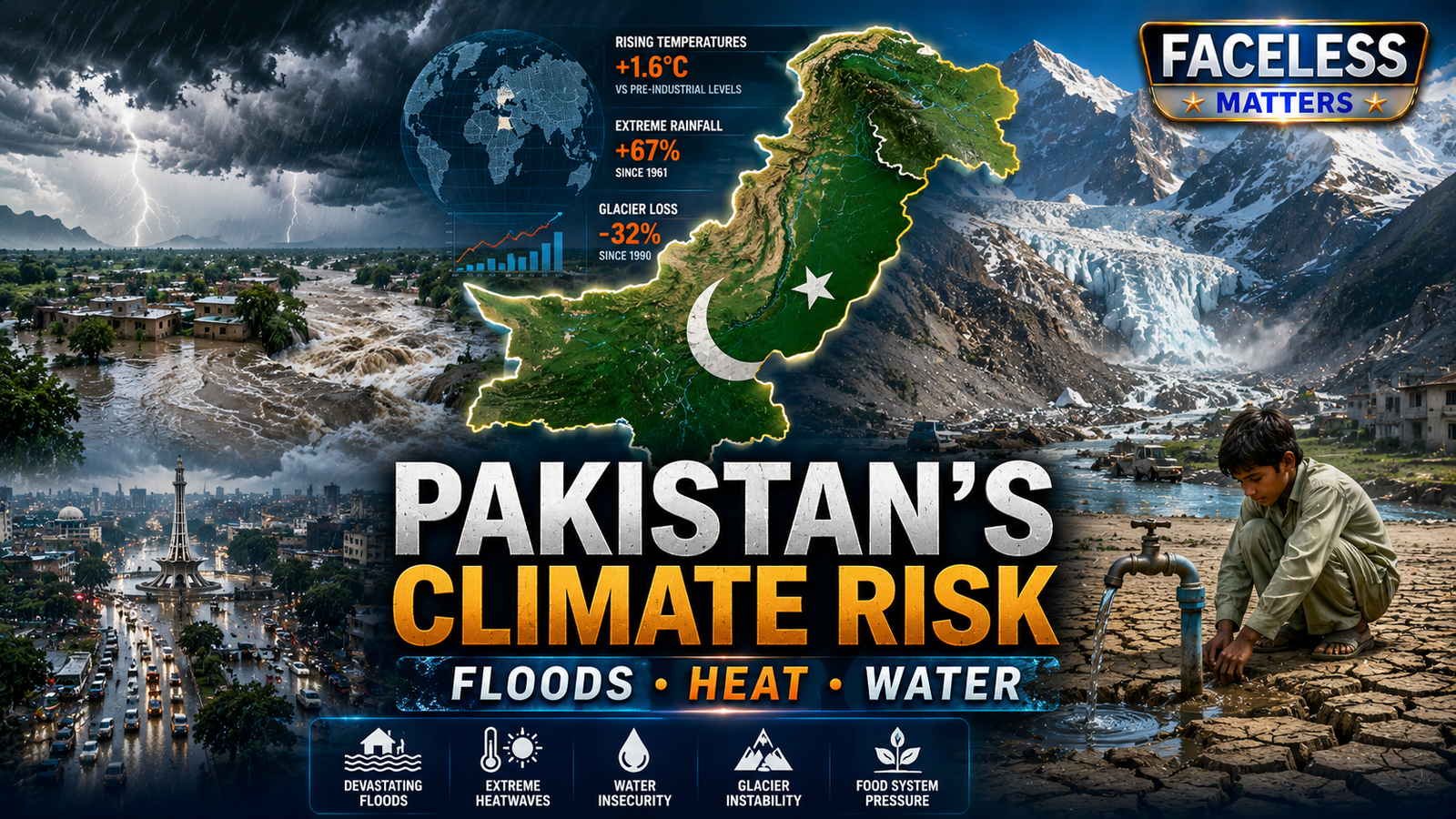
Pakistan Climate Risk 2026 is no longer simply a discussion about temperature, rainfall or individual floods. It is increasingly a question of how water, agriculture, cities, glaciers, infrastructure, food security and economic stability interact.
1. Why the Latest Himalayan Disaster Matters for Pakistan
The Himalayas and surrounding mountain systems form one of the most important environmental regions for South Asia.
Water originating in mountain areas feeds major river systems, supports agriculture and contributes to drinking-water supplies and hydropower.
That makes changes in mountain environments strategically important for Pakistan.
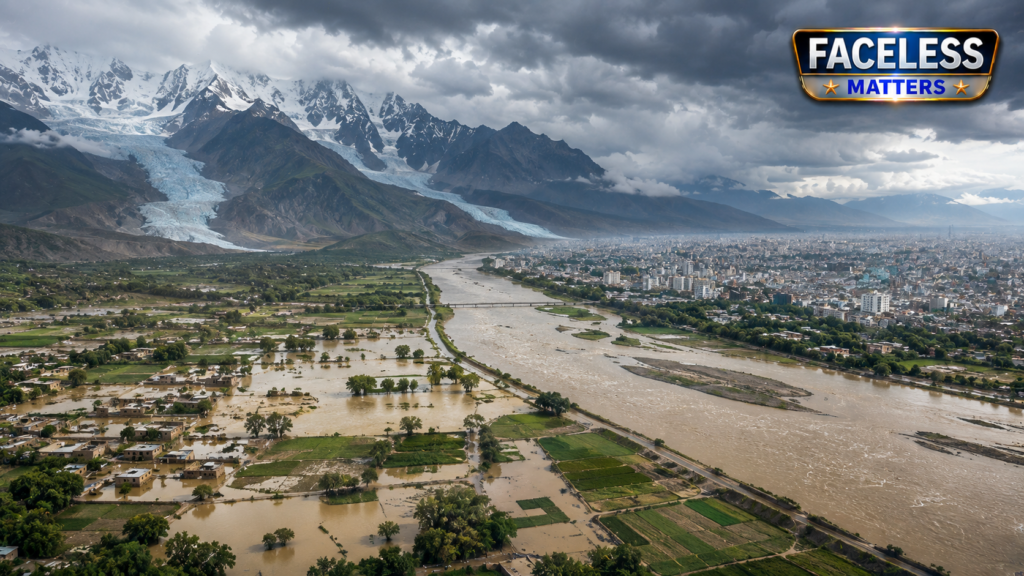
The latest Nepal–Tibet disaster shows how quickly instability in high-altitude environments can translate into destructive flooding and infrastructure damage. Reuters reported that the August 26 glacier collapse generated a high-speed debris flow that travelled through the river valley, destroying homes, roads and power infrastructure. Experts cited in the report said climate change was a likely contributor to the instability.
The implication is not that every flood in Pakistan is directly caused by climate change.
The more important lesson is that environmental systems are connected.
This is precisely why Pakistan Climate Risk 2026 needs to be examined through a wider resilience framework rather than through isolated weather events.
2. Pakistan’s Climate Exposure Is Becoming More Complex
Pakistan already faces several environmental pressures.
These include:
- extreme heat;
- intense rainfall;
- urban flooding;
- drought;
- water insecurity;
- glacier instability;
- agricultural stress;
- ecosystem degradation; and
- climate-related migration.
Geo News recently highlighted Pakistan’s climate migration problem, describing how floods, droughts and rising seas are uprooting communities across the country.
That development is particularly important because migration is not only a humanitarian issue.
It can become an economic issue.
When families lose agricultural land or homes, they may move toward cities.
When large numbers of people move toward already crowded urban areas, pressure increases on housing, employment, transport, sanitation, electricity and water.
Therefore, Pakistan Climate Risk 2026 should also be understood as an urban-planning and economic-resilience challenge.
3. Water Security Could Become the Central Environmental Question
Among all environmental challenges, water may eventually become one of the most consequential.
Pakistan’s agricultural economy depends heavily on predictable water availability.
But climate change can make that predictability more difficult.
Heavy rainfall does not necessarily solve water shortages.
A country can experience destructive flooding while still facing water stress at other times of the year.
This apparent contradiction is one of the most important characteristics of modern climate risk.
Too much water can arrive too quickly.
Too little water can remain available during critical agricultural periods.
That creates a difficult planning environment for farmers, cities, industries and governments.
Geo News has previously described water insecurity as part of the interconnected climate challenge facing Pakistan, alongside extreme heat, drought, glacier instability and intense rainfall.
The policy objective of Pakistan Climate Risk 2026 should therefore not simply be flood control.
It should be water resilience.
4. Floods Are Also an Infrastructure Problem
Flood damage is often measured through destroyed homes, roads or crops.
But the deeper economic impact can continue long after floodwater disappears.
Road networks can be damaged.
Railways can be disrupted.
Electricity infrastructure can require expensive repairs.
Agricultural production can fall.
Supply chains can be interrupted.
Insurance losses can increase.
Small businesses can lose inventory and working capital.
This means climate resilience should increasingly be incorporated into infrastructure investment.
Drainage systems, floodplain management, river monitoring, early-warning technology and emergency-response networks are not merely environmental projects.
They are economic infrastructure.
The same principle applies to Pakistan’s cities.
A modern urban area needs to be designed for the environmental conditions it is likely to experience—not simply the conditions it experienced decades ago.
That is a central lesson of Pakistan Climate Risk 2026.
5. Karachi and the Urban Environment
Pakistan’s largest cities face a particularly difficult environmental challenge.
Heavy rainfall can overwhelm drainage systems.
At the same time, high temperatures increase electricity demand for cooling.
This creates a dual pressure:
more water during extreme rainfall events, but greater demand for energy and water during periods of intense heat.
Geo News has previously examined how heavy rainfall can turn Karachi, Hyderabad and Sukkur into scenes of serious urban disruption, with roads flooded and ordinary economic activity interrupted.
The solution for Pakistan Climate Risk 2026 requires more than emergency pumping after a storm.
Cities need long-term drainage investment, protection of natural waterways, preservation of wetlands and improved land-use planning.
Urban trees and green spaces can also become part of climate adaptation.
Interestingly, Jang’s recent reporting has highlighted concerns over the removal of decades-old trees in Karachi, demonstrating that environmental protection is also a question of urban planning and public policy.
6. Agriculture Faces a Double Challenge
Agriculture sits directly at the intersection of climate and economic risk.
Farmers require water at the right time.
They also need temperatures that remain within tolerable ranges for crops.
Extreme rainfall can destroy crops.
Extreme heat can reduce yields.
Drought can increase irrigation pressure.
Flooding can damage soil, roads and storage facilities.
The result is an agricultural system that increasingly requires better forecasting and adaptation.
Pakistan therefore has an opportunity to expand climate-smart agriculture through:
- efficient irrigation;
- improved water storage;
- drought- and heat-tolerant crops;
- better weather forecasting;
- modern agricultural insurance;
- improved storage and logistics; and
- stronger farmer access to climate information.
The economic value of these measures could be substantial because preventing losses is often cheaper than rebuilding after a disaster.
7. Glacier Stability Deserves Greater Attention
The latest Himalayan disaster also raises a critical question about glacier monitoring.
Glaciers are not simply frozen reservoirs.
Mountain environments are dynamic systems.
Changes in ice, rock, snow, rainfall and temperature can influence slope stability and downstream water flows.
The Reuters investigation into the Nepal disaster reported that the glacier collapse produced an enormous debris flow and that additional flood risks remained because vulnerable lakes had formed in the affected region.
Pakistan contains major mountain and glacier systems of its own.
That makes early-warning infrastructure particularly important.
Satellite monitoring, ground sensors, river gauges and community-based warning systems can provide valuable time for evacuation and emergency response.
In a rapidly changing climate, information can become a form of infrastructure.
8. Climate Risk Is Also Economic Risk
One of the biggest lessons from Pakistan Climate Risk 2026 is to treat environmental protection as part of economic development.
The two are increasingly connected.
A flood can become a supply-chain disruption.
A drought can become a food-price problem.
Extreme heat can increase electricity demand.
Water shortages can affect industrial production.
Climate-related migration can increase pressure on cities.
Infrastructure damage can increase government expenditure.
This means Pakistan Climate Risk 2026 is also relevant to businesses, investors, insurers, banks and policymakers.
Companies should increasingly ask:
- Where are our facilities located?
- Are our suppliers exposed to flooding?
- How secure is our water supply?
- What happens if extreme heat reduces productivity?
- How resilient are our transport routes?
- Do our insurance policies reflect emerging climate risks?
These questions are becoming part of responsible long-term business planning.
9. The International Dimension
Pakistan’s environmental challenges cannot be separated from international climate developments.
The latest Nepal disaster demonstrates the regional dimension of Himalayan instability.
International reporting has increasingly connected extreme weather, glacier changes, wildfires, ocean warming and food-system disruption.
That means environmental policy is becoming a global coordination issue.
Developing countries need access to climate finance, technology, scientific data and early-warning systems.
Pakistan’s interests therefore include not only domestic environmental reform but also effective participation in international climate negotiations.
Pakistan Climate Risk 2026 can strengthen the country’s position by presenting measurable adaptation priorities and transparent resilience projects.
10. What Pakistan Should Prioritize Now
A serious environmental strategy could focus on five areas.
First: Water resilience
Pakistan needs stronger water storage, conservation, irrigation efficiency and flood-management systems.
Second: Early warning
Weather, glacier and river monitoring should be integrated into a national early-warning framework.
Third: Climate-resilient cities
Urban planning should account for heat, flooding, drainage, green spaces and water availability.
Fourth: Agricultural adaptation
Farmers need better climate information, resilient crops, insurance and efficient irrigation.
Fifth: Environmental governance
Environmental rules are useful only when they are consistently enforced.
This last point is critical.
Pakistan has repeatedly demonstrated that it can recognize climate threats.
The harder challenge is maintaining policy attention after the immediate disaster disappears.
Geo News has described this wider governance problem as a gap between recognizing climate vulnerability and actually implementing sustained climate action.
11. The Bigger Lesson From Today’s Environmental News
The latest Nepal–Tibet catastrophe should not be viewed only as another distant natural disaster.
It is a reminder of how rapidly environmental instability can move from mountains into communities, roads, rivers, power systems and economies.
For Pakistan, the appropriate response is neither panic nor complacency.
It is preparation.
The country needs better environmental data, stronger infrastructure, improved water management and faster early-warning systems.
At the same time, policymakers need to recognize that climate resilience is not simply an environmental ministry responsibility.
It involves finance, agriculture, energy, transport, urban development, health, disaster management and national planning.
That is why Pakistan Climate Risk 2026 represents a much larger strategic question than weather forecasting.
12. FACELESS MATTERS Strategic Assessment
The evidence available today points toward a simple conclusion:
Climate risk is becoming a systems problem.
A glacier event can become a flood.
A flood can become an infrastructure crisis.
An infrastructure crisis can become an economic loss.
Economic losses can affect food prices, employment and public finances.
Water stress can encourage migration.
Migration can increase urban pressure.
The individual events are different, but the system connecting them is increasingly important.
For Pakistan, the most valuable environmental investment may therefore be resilience itself.
Resilience means knowing where risks are developing, having the infrastructure to withstand them and possessing the institutional capacity to respond quickly.
The future environmental advantage will not necessarily belong to countries that experience the fewest climate shocks.
It may belong to countries that recover from those shocks fastest.
That is the strategic meaning of Pakistan Climate Risk 2026.
INTERNAL READING — Related FACELESS MATTERS Analysis
For readers who want to explore the wider connection between environment, global risk and energy, these three FACELESS MATTERS reports provide useful context:
1. Permafrost Thaw 2026: Critical Climate Tipping Point Risks — A recent Environment analysis examining permafrost thaw, extreme heat, wildfire risk and climate-system feedbacks.
2. World News 2026: 4 Major Global Risks to Watch — A newer World News analysis connecting climate risk with energy, trade and geopolitical developments.
3. Strait of Hormuz Crisis: Oil Above $90 in 2026 — An Economy analysis showing how energy security, shipping disruption and economic pressures can interact with wider global risks.
SOURCE VERIFICATION & ANALYSIS
Geo News: Climate migration in Pakistan; climate governance, water insecurity, floods and environmental resilience.
Daily Jang: Latest national/international environmental coverage, including Nepal/Tibet flooding and Karachi’s environmental/urban tree concerns.
Reuters: Nepal–China border glacier collapse, landslide and catastrophic flooding; climate-related environmental instability.
Pakistan Meteorological Department / related reporting: Pakistan’s recurring monsoon exposure, heavy rainfall, flash-flood and landslide risks.
EDUCATIONAL NOTE
This article is published by FACELESS MATTERS for informational, educational and editorial analysis purposes. Environmental conditions, forecasts and scientific assessments can change as new evidence becomes available. Readers should consult official Pakistani authorities, meteorological agencies and scientific institutions for decisions involving immediate safety or emergency conditions.
[…] [Iran’s Mysterious Shockwaves: Seismic Event or Strategic Signal?] — An older Global News / Geopolitics analysis showing why extraordinary claims involving Iran […]