

TABLE OF CONTENTS
Why Iran U.S. Sanctions 2026 Matter Now
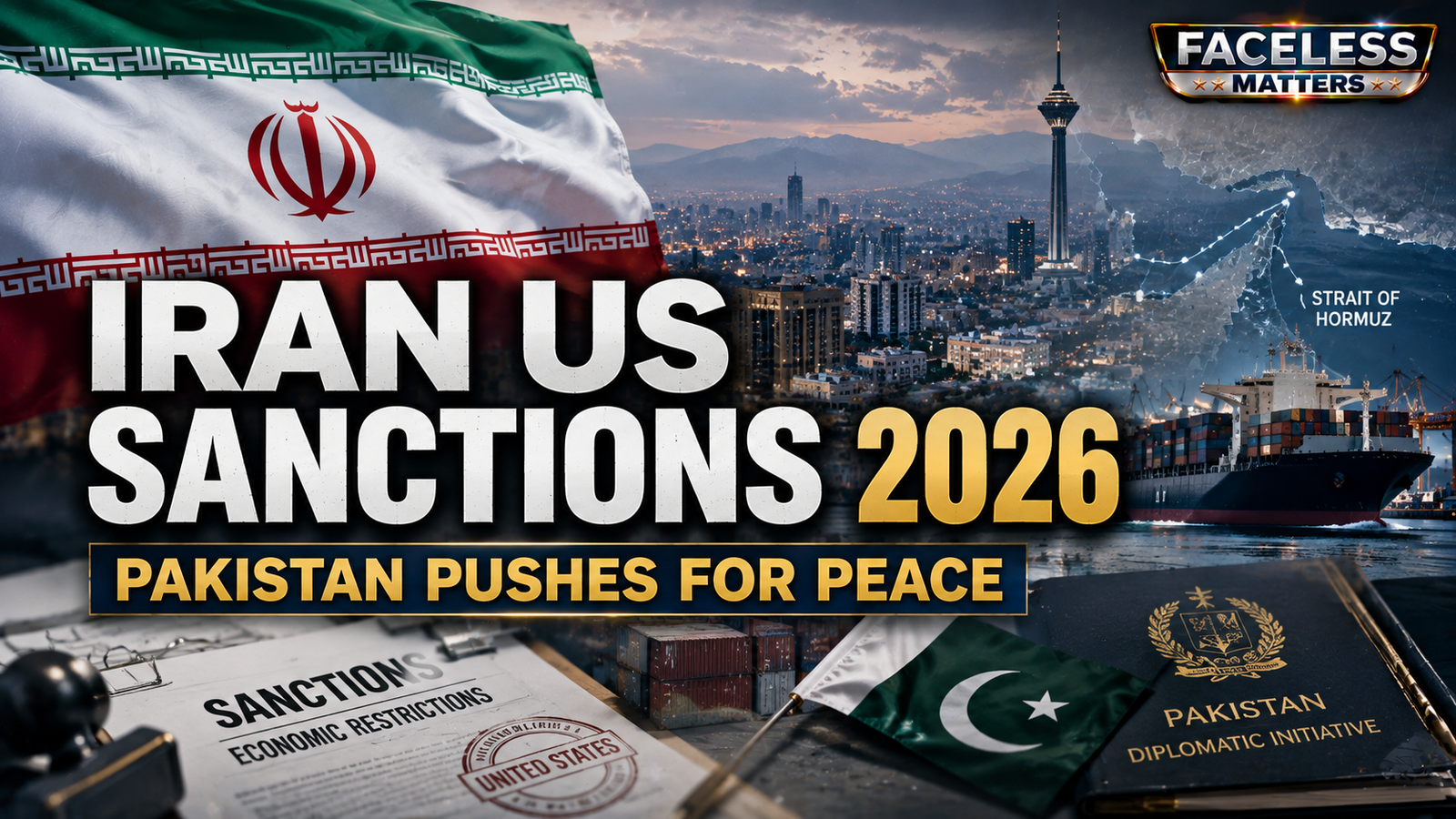
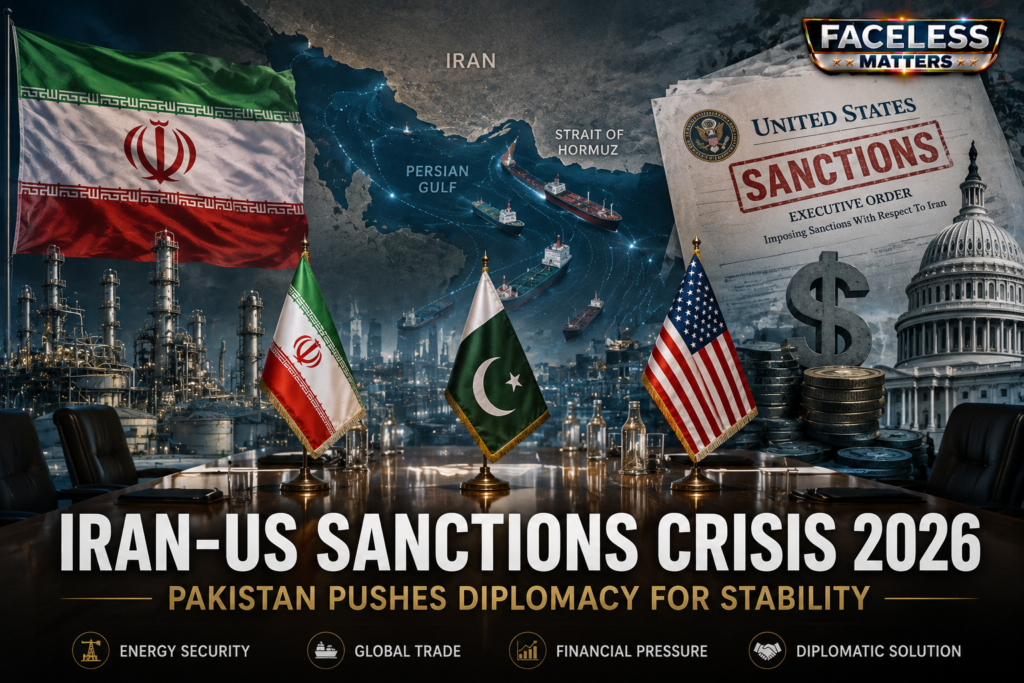
The latest phase of the sanctions crisis is becoming a major test of economic pressure, regional diplomacy and international stability, with Pakistan seeking a diplomatic path toward regional stability. It is becoming a wider test of international trade, energy security, regional diplomacy and the ability of governments to prevent economic pressure from turning into another cycle of military escalation.
On August 25, the U.S. Treasury announced a broad sanctions campaign targeting Iranian-linked entities, individuals and vessels. The measures also focus on foreign networks accused of supporting Iran’s military, oil, financial and procurement activities. Reuters reported that the campaign included nearly 60 designations and additional pressure on foreign partners.
The significance of Iran U.S. Sanctions 2026 is therefore much broader than the number of sanctioned entities.
The central question surrounding Iran U.S. Sanctions 2026 is whether economic pressure can change Tehran’s strategic calculations without creating additional instability across the Middle East.
Washington’s New Economic Pressure Campaign
The United States has described its new approach as Operation Economic Outcast, a campaign designed to restrict the financial and commercial channels supporting Iran.
The strategy behind Iran U.S. Sanctions 2026 includes sanctions against Iranian-linked organizations and pressure on foreign companies and governments that continue certain economic relationships with Tehran.
Under Iran U.S. Sanctions 2026, Washington has also warned that countries assisting Iran could face secondary sanctions.
That creates a difficult calculation for international businesses.
Companies operating between the United States, Iran, the Gulf states and Asian markets must consider not only commercial opportunity but also sanctions exposure, banking restrictions, shipping risks and compliance requirements.
The result is a geopolitical environment in which financial decisions can become strategic decisions.
Iran Signals Resistance
Iran has responded by rejecting the pressure and signaling that it will continue defending its national interests.
Iranian officials have described the sanctions as economic aggression while maintaining that Tehran is prepared to withstand the pressure.
Iranian President Masoud Pezeshkian has acknowledged that the country’s economic situation is difficult, but the government continues to present resistance and national sovereignty as central principles. Recent reporting also indicates that Tehran continues to leave the door open to diplomacy while refusing to accept U.S. pressure on Washington’s terms.
This creates a complicated strategic equation.
Iran must manage economic pressure without appearing to surrender strategic interests, while the United States must demonstrate that sanctions can produce political results without causing uncontrolled regional escalation.
Pakistan’s diplomatic role in Iran U.S. Sanctions 2026
Pakistan has emerged as one of the most closely watched regional diplomatic actors.
Field Marshal Asim Munir’s August 24 visit to Tehran was described by Pakistan’s Foreign Office as part of Islamabad’s own mediation efforts rather than a mission as a U.S. envoy.
Pakistan said the discussions focused on regional de-escalation, breaking the military stalemate and exploring a negotiated settlement.
That distinction is important.
Islamabad is attempting to maintain working relationships with both sides while avoiding being placed inside the conflict.
Pakistan’s geographic position also gives the country a direct interest in regional stability. Prolonged disruption in the Gulf can affect energy prices, shipping, inflation and trade routes that matter to Pakistan’s economy.
Diplomacy is therefore not simply a foreign-policy exercise for Islamabad.
It is also an economic and national-security calculation.
Why the Strait of Hormuz Remains Critical
The Strait of Hormuz remains one of the most important strategic pressure points in the crisis.
The waterway is central to global energy transportation, meaning prolonged disruption can affect oil prices, shipping insurance, freight costs and inflation far beyond the Middle East.
FACELESS MATTERS recently examined how uncertainty around Hormuz has already kept global energy markets under pressure, with shipping disruption becoming a major risk alongside the price of crude oil.
This is why diplomacy around Iran cannot be separated from energy security.
A political disagreement can quickly become an economic problem for countries thousands of miles away.
The Economic Pressure Beyond Iran
The most important feature of the current U.S. strategy is that the pressure extends beyond Iranian borders.
If foreign banks, shipping companies, traders and intermediaries believe that dealing with Iran could expose them to U.S. penalties, they may reduce their activities even when those activities are legal under their own domestic systems.
That can make sanctions more powerful.
But it can also produce unintended consequences.
Trade can move through alternative jurisdictions. Businesses can restructure supply chains. Countries can search for alternative payment arrangements. Shipping companies can change routes.
The economic system therefore adapts.
The effectiveness of sanctions ultimately depends not only on how many entities are designated but also on how successfully the targeted economy and its partners can adjust.
Energy Markets and Global Trade
Energy is one of the biggest transmission channels.
Higher geopolitical risk can increase the cost of crude oil, insurance and transportation. Those costs can then affect manufacturers, airlines, logistics companies and consumers.
For Asian economies that import large volumes of energy, the consequences can be especially significant.
Pakistan also has reason to watch these developments closely.
Higher energy costs can place additional pressure on foreign-exchange reserves, transportation costs, electricity prices and inflation.
This means Pakistan has an economic interest in seeing diplomatic channels remain open.
What the U.S. Wants to Achieve
The U.S. strategy appears designed to increase the cost of Iran’s military, financial and energy-related activities while encouraging a change in Tehran’s behavior.
The administration has emphasized economic pressure as a means of achieving strategic objectives without necessarily relying on another major military operation.
President Donald Trump said on August 27 that the United States was not currently engaged in talks with Iran and that Washington was concentrating on economic pressure.
The challenge is determining how much pressure is enough.
If sanctions become too weak, they may fail to change Iranian calculations.
If they become too severe, they could deepen economic hardship, encourage retaliation or reduce diplomatic space.
What Iran Wants to Protect
Iran’s leadership faces pressure on multiple fronts.
The government wants to protect national sovereignty, maintain strategic capabilities and avoid accepting conditions that could be interpreted domestically as surrender.
At the same time, economic pressure is difficult to ignore.
The country’s leadership must manage inflation, trade restrictions, energy challenges and public expectations while maintaining its geopolitical position.
That is why the current situation is unlikely to be resolved through sanctions alone.
Economic pressure may create leverage, but diplomacy is needed to convert leverage into an agreement.
Pakistan’s Strategic Balancing Act
Pakistan’s role is particularly sensitive.
Islamabad cannot afford to become a direct participant in the conflict, but it can potentially provide diplomatic space for communication.
The Foreign Office has explicitly framed the recent Tehran visit around de-escalation and negotiations.
This approach gives Pakistan an opportunity to strengthen its regional diplomatic profile while protecting its own economic interests.
However, mediation requires credibility.
Pakistan must remain sufficiently trusted by both sides to keep communication channels open.
That is a difficult balance, particularly when Washington and Tehran remain far apart.
The Bigger Diplomatic Question
The biggest question surrounding Iran U.S. Sanctions 2026 is not whether economic pressure can hurt Iran.
It clearly can.
The more important question is whether economic pressure can produce a sustainable diplomatic outcome.
History shows that sanctions can influence state behavior, but their effects depend heavily on political objectives, enforcement, international cooperation and the willingness of the targeted government to negotiate.
The current environment is even more complicated because the dispute is connected to energy markets, maritime security and regional military tensions.
That makes diplomacy more valuable, not less.
FACELESS MATTERS Positive Analysis
The most constructive path is one that keeps economic pressure and diplomacy from becoming mutually exclusive.
The United States can pursue its stated security objectives while preserving space for negotiations.
Iran can defend its national interests while recognizing that prolonged economic isolation carries substantial costs.
Pakistan and other regional countries can encourage dialogue rather than allowing the crisis to become permanently militarized.
The objective should not simply be to determine which side can impose the greatest pressure.
The objective should be to find a framework capable of reducing the risk of a wider conflict.
What Could Happen Next
Three broad developments deserve attention.
First: Washington could continue expanding sanctions against Iranian financial, oil and procurement networks.
Second: Tehran could attempt to reduce the economic impact through alternative trade channels while maintaining its political resistance.
Third: Regional mediators, including Pakistan, could continue trying to create conditions for renewed negotiations.
The Strait of Hormuz will remain an important indicator.
Any meaningful improvement in shipping conditions could reduce some economic pressure.
Conversely, further disruption could increase global energy and inflation risks.
Conclusion: Sanctions, Diplomacy and Regional Stability
Iran U.S. Sanctions 2026 represent a major test of economic statecraft and regional diplomacy.
Washington is increasing pressure on Iran and on foreign networks connected to Iranian trade and finance. Tehran is signaling that it will resist the campaign while leaving some room for diplomatic engagement. Pakistan is attempting to use its regional position to encourage de-escalation and a negotiated settlement.
The situation remains fluid.
The most important development to watch is whether economic pressure creates genuine diplomatic leverage or instead pushes the region toward another cycle of confrontation.
For Pakistan, the stakes are particularly high because regional instability can affect energy prices, trade, shipping and domestic economic conditions.
For the wider world, the crisis demonstrates how closely modern geopolitics, financial systems and energy security are connected.
The next phase may therefore be decided not only by military strength, but by the ability of governments to convert pressure into diplomacy.
SOURCE VERIFICATION & ANALYSIS
Reuters — U.S. sanctions campaign targeting Iranian military, oil, financial and procurement networks, August 25, 2026.
Reuters — U.S. economic pressure strategy and the Trump administration’s position on Iran, August 27, 2026.
Associated Press — Iranian response to U.S. sanctions and continuing regional confrontation, August 29, 2026.
Pakistan Foreign Office — Clarification regarding Field Marshal Asim Munir’s August 24 Tehran visit and Pakistan’s mediation role.
The UK Parliament House of Commons Library — Iran in 2026 briefing covering the conflict, sanctions, Strait of Hormuz and diplomatic situation.
CBS News — Latest reporting on Iran’s response to U.S. economic pressure.
FACELESS MATTERS — Internal analysis of the Strait of Hormuz crisis and global energy-security implications.
INTERNAL READING
1. Strait of Hormuz Crisis: Oil Above $90 in 2026 — Economy | Very Recent
This recent FACELESS MATTERS analysis explains how Iran-related instability around the Strait of Hormuz can affect oil prices, shipping, inflation and Pakistan’s economic outlook.
2. World News 2026: 4 Major Global Risks to Watch — World News | Recent
This broader global-risk report places the Iran conflict alongside energy, trade, security and climate developments, helping readers understand the wider geopolitical environment.
This article is published for educational, informational and geopolitical awareness purposes. It distinguishes reported developments from FACELESS MATTERS analysis and does not present forecasts as confirmed outcomes.
FACELESS MATTERS does not support violence or illegal activity. Readers should consult official government and institutional sources for consequential decisions.