

FACELESS MATTERS — August 30, 2026
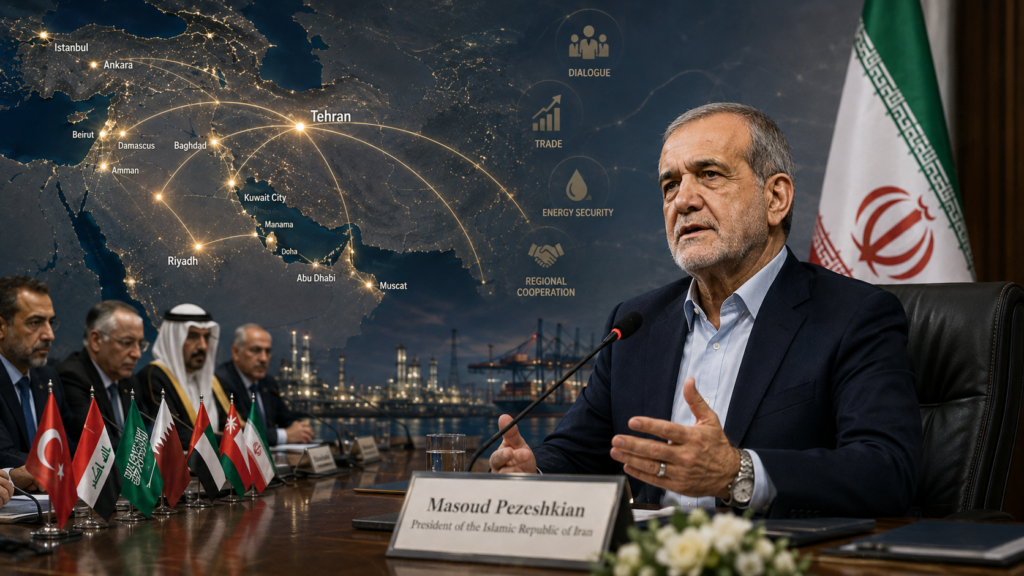
TABLE OF CONTENTS
Iranian President Masoud Pezeshkian has delivered a message that reaches far beyond Iran’s domestic politics: if lasting peace and stability are to take hold internationally, he argues that the process must emerge from within West Asia itself.
His statement comes at an important moment for regional diplomacy. Recent Iranian messaging has simultaneously emphasized resistance to external pressure, dialogue over warfare, stronger cooperation among Muslim countries and the need for regional governments to assume greater responsibility for their collective security.
For FACELESS MATTERS, the significance of the Masoud Pezeshkian Regional Peace message lies not only in what Iran’s president said, but in the geopolitical model behind it.
The Masoud Pezeshkian Regional Peace message therefore deserves attention as a broader diplomatic proposal rather than simply another presidential statement.
Why Pezeshkian’s Latest Message Matters
The central theme of Pezeshkian’s latest remarks is straightforward: Iran says it does not want war, but it also says it will not submit to threats.
Speaking on August 29, the Iranian president stressed national unity and said Iran would stand against aggression. In the same remarks, he argued that if global peace and stability are to be established, they must emerge from within the region.
That combination is important.
It places deterrence and diplomacy inside the same political framework.
In this context, Masoud Pezeshkian Regional Peace connects regional ownership with practical diplomacy, suggesting that neighboring states can play a greater role in preventing future crises.
This makes the Masoud Pezeshkian Regional Peace narrative relevant not only to Iran but also to Pakistan, Qatar, Iraq, Oman and other governments trying to contain geopolitical instability.
Iran Says It Does Not Seek War
Pezeshkian has repeatedly stated that Iran does not seek an expansion of conflict.
During talks with Qatari Prime Minister and Foreign Minister Sheikh Mohammed bin Abdulrahman Al Thani, he argued that unresolved issues should be handled through dialogue rather than war and supported resuming implementation of the Islamabad memorandum of understanding.
This distinction is central to understanding Iran’s current diplomatic messaging.
Tehran wants to portray itself as capable of resisting military and economic pressure while remaining open to negotiated arrangements.
That does not mean the disagreements have disappeared.
Instead, it creates two competing forces: deterrence and negotiation.
The durability of any diplomatic opening will depend on whether governments can keep those forces from moving in opposite directions.
Regional Peace as a West Asian Responsibility
The broader strategic concept behind the Masoud Pezeshkian Regional Peace position is regional ownership.
For decades, West Asian security has been heavily affected by outside military involvement, alliances, sanctions, proxy competition and energy geopolitics.
Pezeshkian’s argument suggests another model: neighboring states should increase direct political, commercial, cultural and security engagement.
Iran’s president made a similar case during talks with Iraqi Supreme Judicial Council head Faiq Zaidan, calling for stronger cooperation among Muslim countries across political, economic, cultural and social fields.
From a geopolitical perspective, that idea has significant implications.
Regional cooperation can potentially create diplomatic channels that remain active even when relations between major powers deteriorate.
The Economic Value of Regional Stability
Peace is not merely a political objective.
It has an economic value.
West Asia contains some of the world’s most important oil and gas producers, maritime routes, ports, sovereign investment funds and emerging logistics corridors.
Persistent geopolitical instability can increase:
- shipping insurance costs,
- energy-price volatility,
- investment risk,
- supply-chain disruption,
- sovereign financing pressure,
- inflation uncertainty.
For international businesses, these factors can influence everything from transportation costs to long-term capital allocation.
This is why Middle East stability, geopolitical risk management, energy security, international trade, foreign investment, financial markets and supply-chain resilience are increasingly interconnected high-value economic themes.
A diplomatic breakthrough can therefore produce benefits well beyond politics.
Regional stability also affects investor confidence across West Asia. When diplomatic tensions rise, businesses face higher transportation costs, insurance exposure and uncertainty over future investment decisions. Credible diplomatic engagement can improve expectations even before a political settlement is reached. For Pakistan, the Gulf states and other regional economies, sustained dialogue can therefore have practical commercial value. Regional cooperation can reduce uncertainty around trade routes, energy supplies, infrastructure projects and cross-border investment, making diplomacy an important part of long-term economic security.
Iran’s Push for Muslim-Country Cooperation
Another recurring component of Pezeshkian’s strategy is stronger cooperation among Muslim-majority states.
Iran argues that closer economic and political coordination would make regional countries less vulnerable to external pressure.
Whether every regional government shares Tehran’s interpretation is another question.
West Asia contains substantial political differences, competing national interests and different relationships with Washington.
Therefore, regional unity should not be interpreted as a single political bloc.
A more realistic objective would be a network of overlapping diplomatic arrangements in which governments disagree on some strategic questions while cooperating on trade, infrastructure, maritime security and crisis management.
That would represent a more practical version of the Masoud Pezeshkian Regional Peace concept.
The Pakistan Connection
Pakistan has become particularly relevant to the current diplomatic picture.
Earlier in August, Pezeshkian met Pakistan’s Army Chief Field Marshal Asim Munir and publicly appreciated Pakistan’s mediation efforts aimed at regional peace and security.
He expressed hope that political will and cooperation could help achieve objectives associated with the Islamabad memorandum of understanding. Field Marshal Munir, according to the report, said Pakistan would continue acting as a facilitator.
That places Islamabad in an interesting geopolitical position.
Pakistan maintains important relationships across the Gulf while sharing a border with Iran and maintaining its own strategic relations with the United States and China.
This also gives the Masoud Pezeshkian Regional Peace concept a practical dimension because Pakistan can potentially help maintain communication between governments with different strategic interests.
Qatar and the Diplomatic Track
Qatar represents another important diplomatic channel.
Doha has developed considerable experience as a mediator in difficult international disputes.
During Pezeshkian’s recent meeting with Qatar’s prime minister, the Iranian president thanked Qatar for its mediation efforts and argued that dialogue should replace warfare in resolving outstanding disagreements.
This suggests that the emerging diplomatic structure is not dependent on a single intermediary.
Pakistan and Qatar can potentially perform different functions.
That redundancy can be valuable because complex negotiations rarely move in a straight line.
Strait of Hormuz and Global Energy Security
Any serious discussion of West Asian stability must include the Strait of Hormuz.
The waterway is strategically important to global energy transportation, meaning political or military instability around it can quickly influence oil prices, shipping costs and financial-market expectations.
The economic consequences can spread far beyond the region.
Asian economies dependent on imported energy are particularly exposed to sustained disruption.
For Pakistan, higher energy prices can also create pressure through import costs, inflation and the external account.
Therefore, regional peace, oil prices, energy security and global trade are part of the same strategic equation.
This is where diplomacy can have a measurable economic value.
Why the United States Still Matters
Regional ownership does not mean outside powers suddenly become irrelevant.
The United States remains deeply connected to the region through military relationships, sanctions policy, diplomacy, financial infrastructure and strategic partnerships.
Pezeshkian has recently called on Washington to change its approach toward Tehran and honor commitments that Iran associates with the Islamabad framework.
This creates an important contradiction.
Iran is advocating greater regional independence while simultaneously negotiating issues that require US participation.
The practical outcome may therefore be neither complete regional autonomy nor complete external management.
It could instead be a hybrid security architecture.
Such an arrangement would not require regional states to abandon their existing international partnerships. Instead, the Masoud Pezeshkian Regional Peace approach could work through parallel diplomatic channels, allowing regional governments to address immediate security concerns while larger powers remain involved where their interests are directly affected.
FACELESS MATTERS Strategic Analysis
The most important feature of the Masoud Pezeshkian Regional Peace message is the attempt to redefine where diplomatic initiative should originate.
For years, major crises in West Asia have frequently produced international negotiations led or heavily influenced by external powers.
Pezeshkian’s argument reverses that logic.
It says regional governments should become the principal architects of their own stability.
FACELESS MATTERS assesses that three structural forces will determine whether such an approach can succeed.
First is political trust. Governments cannot construct durable regional security mechanisms without reliable diplomatic communication.
Second is economic interdependence. Countries with meaningful trade, investment and infrastructure relationships acquire stronger incentives to prevent conflict.
Third is crisis-management architecture. Regional states need channels that remain operational during periods of confrontation.
This is why Pakistan, Qatar, Oman and other potential intermediaries matter.
Their strategic value is greatest when communication between principal rivals becomes difficult.
Three Possible Regional Scenarios
Scenario 1 — Diplomatic Stabilization
Iran, regional governments and external powers maintain negotiations.
Military escalation declines, trade confidence improves and pressure on strategic shipping corridors gradually eases.
This would be the most favorable scenario for regional investment, energy markets, global trade and economic stability.
Scenario 2 — Managed Tension
Political disputes remain unresolved, but governments avoid large-scale escalation.
Negotiations continue intermittently while sanctions and strategic competition remain in place.
This may be the most realistic medium-term outcome.
Scenario 3 — Renewed Escalation
Diplomatic channels fail and confrontation intensifies.
That could rapidly increase geopolitical risk premiums in oil, shipping, insurance and financial markets.
The consequences would not remain confined to Iran or neighboring states.
What Governments and Markets Should Watch
Several indicators now deserve close attention.
Watch whether Pakistan’s facilitation continues, whether Qatar’s diplomatic engagement expands, whether implementation discussions surrounding the Islamabad framework produce measurable progress, and whether tensions around strategic maritime routes decline.
Markets will also monitor oil prices, shipping traffic, sanctions policy and diplomatic statements from Washington and Tehran.
The Masoud Pezeshkian Regional Peace proposal matters because its success would ultimately be measured by whether regional diplomacy can reduce the economic and security costs created by recurring confrontation.
They clearly do.
The more important question is whether a regional diplomatic structure can prevent those disagreements from repeatedly becoming wider security crises.
INTERNAL READING — Continue Exploring FACELESS MATTERS
1. Fresh / Markets:
Global Markets 2026: Proven AI Gains Face a Major Test — Published August 28, this analysis explains how geopolitical risk, oil, inflation and financial-market expectations are interacting globally.
2. Recent / Economy:
Strait of Hormuz Crisis: Oil Above $90 in 2026 — A deeper look at the energy and shipping dimension behind current West Asian instability and its consequences for Pakistan and global markets.
Source Verification & Analysis
The original story supplied for this report was published by Daily Jang on August 30, 2026, under the headline reporting Pezeshkian’s statement that global peace and stability must emerge from the region. Daily Jang’s current World News listing confirms both the headline and publication date.
For independent contextual verification, FACELESS MATTERS cross-checked recent reporting on Pezeshkian’s statements. Tasnim reported on August 29 that he said Iran does not seek war, would resist aggression, and argued that peace and stability must emerge from within the region. Separate recent reporting documents his calls for dialogue, cooperation with Qatar, stronger Muslim-country coordination and Pakistan’s mediatory role.
Primary news source: Daily Jang World News
Contextual verification: Tasnim — President: Iran Won’t Bow to Threats
Conclusion: Can Regional Diplomacy Become the New Security Model?
The Masoud Pezeshkian Regional Peace message ultimately presents West Asia with a larger strategic question.
Can a region historically shaped by geopolitical competition develop stronger mechanisms for managing its own crises?
Iran’s president argues that it can.
Whether that vision becomes reality will depend not on speeches alone but on diplomacy, enforceable agreements, economic cooperation and the willingness of competing governments to preserve communication during crises.
Pakistan and Qatar’s recent diplomatic activity suggests that regional intermediaries may have an increasingly important role.
For businesses and global markets, the stakes are equally significant.
A more stable West Asia could reduce geopolitical risk, protect energy flows and improve investment confidence. Renewed escalation could produce exactly the opposite.
FACELESS MATTERS assessment: the decisive development to watch is whether today’s language of regional ownership begins producing durable diplomatic mechanisms. That transition—not rhetoric alone—would indicate that the region’s security architecture is genuinely changing.
Editorial & Educational Note
This report combines verified news developments with clearly identified FACELESS MATTERS analysis. Statements attributed to political leaders represent their reported positions and should not be interpreted as endorsement by FACELESS MATTERS. Developing geopolitical events may change as new diplomatic or official information emerges.