


TABLE OF CONTENTS
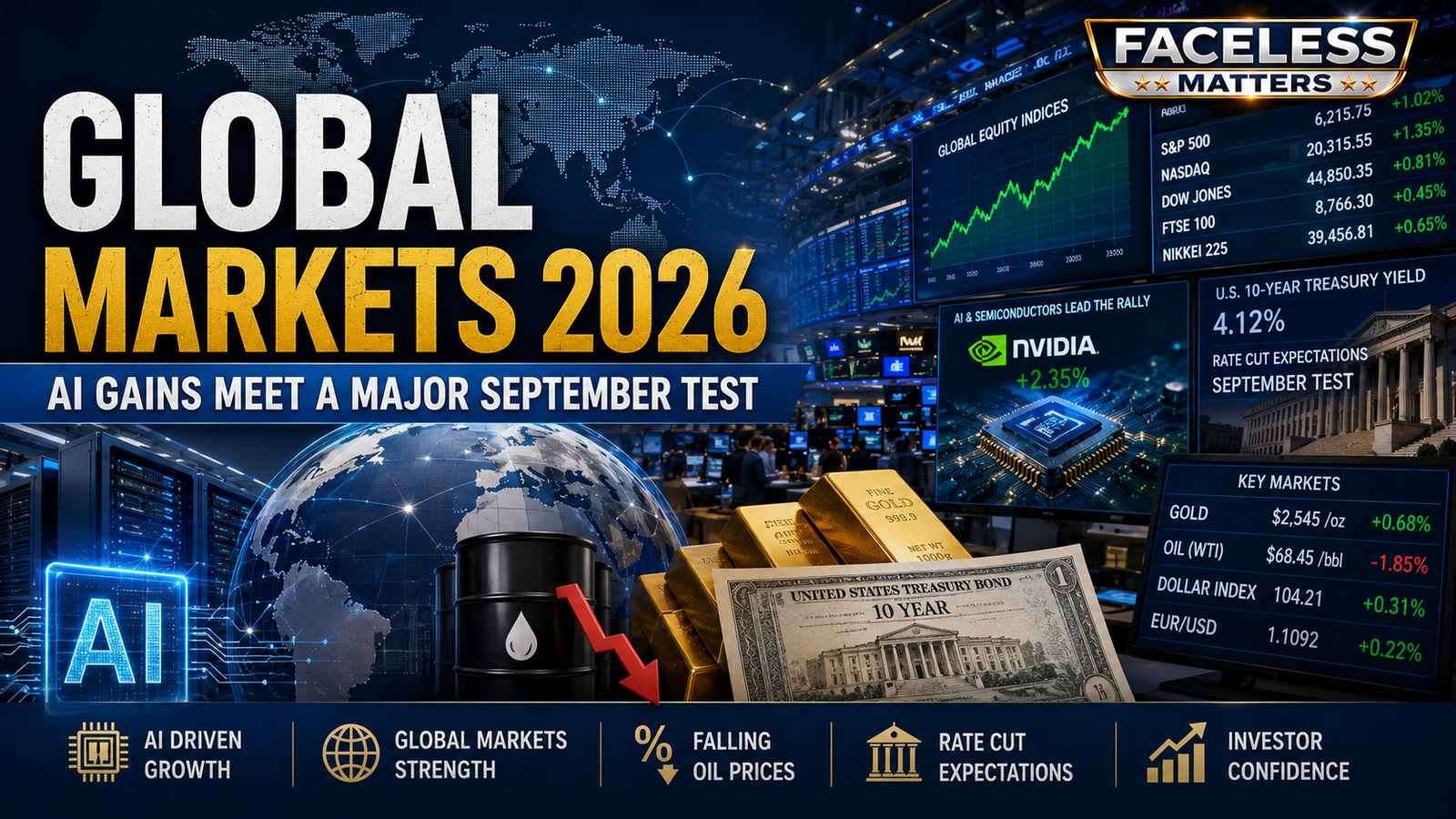
Global Markets 2026: Proven AI Gains Face a Major Test
Global financial markets are ending August with an unusually mixed but constructive picture.
Technology stocks and artificial intelligence remain powerful sources of investor optimism. Lower oil prices are providing some relief to inflation-sensitive markets, while global equities are again approaching record territory.
At the same time, the bond market is sending a much more cautious signal.
Long-term government yields remain elevated, inflation is still a concern and investors are preparing for a September that could bring important central-bank decisions and fresh economic data.
The latest global market picture therefore cannot be described simply as bullish or bearish.
It is becoming a story of strong corporate growth meeting a more demanding monetary environment.
Reuters reported on August 28 that the MSCI All-Country World Index was up about 0.5% for the week and close to its previous record, while European and Asia-Pacific markets also posted modest gains. Brent crude was around $89.7 per barrel and on track for a weekly decline of about 5%.
The positive market mood has also been supported by Nvidia’s strong outlook for AI-related demand.
But investors are not ignoring the risks.
The Federal Reserve remains focused on inflation, long-term Treasury yields are elevated and September is shaping up as an important month for global financial markets.
What Is Driving Markets Today?
Global Markets 2026 are being shaped by several powerful forces, including artificial intelligence, energy prices, bond yields and changing expectations for monetary policy.
Several forces are moving markets simultaneously.
The first is technology.
Nvidia’s latest outlook has reinforced investor confidence in continued artificial-intelligence investment. Reuters reported that Nvidia expects approximately 70% revenue growth for its upcoming fiscal year, easing some concerns about whether AI demand can justify the enormous investment being made across the technology industry.
The second factor is oil.
Brent crude has fallen during the week, partly because investors are watching diplomatic developments surrounding Iran and Oman and the future of traffic through the Strait of Hormuz. Lower crude prices can reduce some immediate inflation pressure.
The third factor is monetary policy.
Investors are closely watching Federal Reserve Chair Kevin Warsh’s policy signals as inflation remains above the Fed’s 2% target.
The fourth is the bond market.
Long-term Treasury yields remain high, creating a different message from the optimism visible in technology stocks.
FACELESS MATTERS Analysis
The most encouraging feature of the current market environment is that growth expectations remain alive despite multiple external pressures.
That suggests investors are not simply buying because risk has disappeared.
They are increasingly differentiating between sectors, companies and economic themes.
That is healthier than a market in which everything rises together without regard to fundamentals.
Why AI Remains the Strongest Market Theme
Global Markets 2026 continue to reflect strong investor interest in artificial intelligence and the infrastructure required to support its expansion.
Artificial intelligence has become one of the most important investment themes in global markets.
Nvidia’s latest earnings outlook reinforced the argument that demand for AI computing infrastructure remains substantial.
Reuters reported that Nvidia’s projected revenue growth helped ease concerns about whether the AI investment cycle could continue at its current scale.
The AI theme is no longer limited to semiconductor companies.
It now affects:
- data centers;
- electricity generation;
- cooling infrastructure;
- networking;
- cloud computing;
- software;
- cybersecurity;
- construction;
- industrial equipment;
- and telecommunications.
This creates a broader economic effect.
AI investment is increasingly becoming an infrastructure story.
FACELESS MATTERS Analysis
This is one of the most positive structural developments for markets.
The AI boom is creating demand across multiple industries rather than benefiting only one company or one technology.
That does not mean every AI-related investment will succeed.
It means the underlying technological transformation is becoming economically broader.
For investors and businesses, the opportunity may therefore be larger than the headline semiconductor rally suggests.
Nvidia and the Technology Leadership
Nvidia remains one of the most closely watched companies in the global technology sector.
Its latest forecast has provided an important confidence signal for the broader AI industry.
Reuters reported that Nvidia projected roughly 70% revenue growth for the upcoming fiscal year ending January 2028.
The significance goes beyond Nvidia’s own earnings.
Strong demand for AI chips indicates that companies continue to invest heavily in computational capacity.
That supports a wider ecosystem.
Semiconductor manufacturers, cloud providers, data-center operators and power suppliers can all benefit from sustained infrastructure spending.
But markets must also distinguish between genuine long-term demand and excessive valuations.
For Global Markets 2026, Nvidia’s outlook is important because semiconductor demand remains closely connected to the wider technology investment cycle.
FACELESS MATTERS Analysis
The positive lesson from Nvidia’s outlook is that AI demand has not yet shown the kind of structural weakness that would undermine the entire technology investment cycle.
The next challenge is proving that this demand can translate into sustainable productivity gains.
If businesses begin using AI to produce more efficiently, the market story becomes much stronger because the technology starts contributing to real economic output rather than simply attracting investment capital.
Why Falling Oil Prices Are Helping
Global Markets 2026 are also responding to changes in energy prices because cheaper oil can reduce some inflation and business-cost pressures.
Oil prices have become one of the most important macroeconomic variables for global markets.
Brent crude was around $89.7 per barrel on Friday and was heading toward a weekly decline of roughly 5%.
For markets, lower oil prices can have several positive effects.
They can reduce:
- transportation costs;
- industrial input costs;
- inflation pressure;
- energy-sector stress;
- and household fuel expenses.
For central banks, lower energy prices can also make inflation management somewhat easier.
That is particularly important while investors are assessing interest-rate policy.
However, geopolitical risks remain.
The Strait of Hormuz continues to be a major source of uncertainty for energy markets.
Reuters noted that developments involving Iran and Oman are being closely watched because of their potential implications for traffic through the strategic waterway.
FACELESS MATTERS Analysis
The decline in oil prices is a welcome development for markets.
But investors should not assume that geopolitical energy risks have disappeared.
The positive scenario is that diplomatic progress gradually improves energy flows and reduces the risk premium in crude.
If that happens, lower oil prices could reinforce the broader disinflationary trend.
That would be constructive for both equities and consumers.
The Bond Market Sends a Different Signal
Global Markets 2026 are receiving a more cautious signal from elevated long-term bond yields, which continue to influence borrowing costs and asset valuations.
While equities are showing resilience, the bond market remains more cautious.
The U.S. 30-year Treasury yield was around 5.21%, while the 10-year yield was approximately 4.69% on Friday. Reuters noted that long-term yields in Germany and France also reached multi-year highs.
Higher long-term yields matter because they influence the cost of borrowing throughout the economy.
They can affect:
- mortgages;
- corporate financing;
- government debt;
- infrastructure investment;
- equity valuations;
- and emerging-market capital flows.
The bond market is therefore an important counterweight to the optimism visible in technology stocks.
FACELESS MATTERS Analysis
This does not automatically mean that stocks are heading for a downturn.
It means the market is becoming more selective.
Companies with strong cash flows, strong balance sheets and credible growth prospects may continue to attract capital even when the cost of money is high.
That can actually improve market quality over time.
Why September Could Be Important
Global Markets 2026 could receive greater direction in September as investors assess inflation data, central-bank policy and economic growth.
September is shaping up as a major month for global markets.
The Federal Reserve’s September 16 meeting is one of the most important events on the calendar.
Reuters reported that futures were pricing roughly a one-in-three chance of a September rate increase, while a hike was fully priced by December.
Investors are therefore paying close attention to inflation, labour-market data and central-bank communication.
The Bank of Japan’s September meeting is another important event.
European monetary policy and fiscal developments will also remain relevant.
FACELESS MATTERS Analysis
September should not automatically be viewed as a danger month.
It can also become a clarity month.
If central banks provide clearer guidance, inflation remains manageable and energy prices continue easing, markets could receive a stronger foundation for the final part of 2026.
Uncertainty is often more damaging than a known policy direction.
The Dollar and Global Capital Flows
Currency movements remain an important part of Global Markets 2026 because changes in the dollar can influence international investment flows.
The U.S. dollar remained relatively steady on Friday.
Reuters reported that the dollar was slightly firmer against major currencies, with the dollar around 159.67 yen, the euro near $1.1646 and sterling around $1.3587.
Currency stability is important for emerging markets.
A stronger dollar can increase the cost of dollar-denominated debt and imported commodities.
A more stable dollar environment can provide some relief.
However, global capital flows remain sensitive to U.S. interest rates.
If Treasury yields rise significantly, investors may redirect capital toward dollar assets.
That can affect emerging-market equities and bonds.
Gold and the Search for Diversification
Gold remains another important market signal.
Spot gold was around $4,593 per ounce on Friday, according to Reuters.
Gold has attracted strong interest during 2026 because investors continue to consider inflation, geopolitical uncertainty, government debt and currency risks.
Reuters reported that commodity funds, led by gold and precious metals, attracted their highest weekly inflows in six months, reaching approximately $4.21 billion.
The strength of gold also shows how Global Markets 2026 are encouraging investors to consider diversification across several asset classes.
FACELESS MATTERS Analysis
Gold’s strength does not necessarily mean investors expect a financial crisis.
It can simply reflect diversification.
In a market environment where equities, bonds, currencies and commodities respond differently to the same macroeconomic forces, investors have a reason to spread risk across asset classes.
That is a constructive sign of portfolio diversification rather than automatic panic.
Global Equity Fund Flows
Global Markets 2026 are showing signs of selective capital rotation rather than a simple move into or out of risk assets.
There is another interesting signal in global fund flows.
Reuters reported that global equity funds experienced their first weekly outflow since May 20 during the week ending August 26, with withdrawals of approximately $5.87 billion. U.S. equity funds recorded net sales of about $22.33 billion.
At the same time, European equity funds attracted around $7.92 billion, while Asian equity funds received approximately $4.8 billion.
Technology funds also attracted about $3.2 billion.
Emerging-market equity funds recorded their seventh consecutive weekly inflow, at around $709 million.
FACELESS MATTERS Analysis
This is one of the more encouraging signals for global markets.
Capital is not simply leaving equities.
It appears to be rotating.
Investors are becoming more selective about geography, sectors and asset classes.
That can create opportunities for markets outside the United States, especially when valuations and growth expectations become more attractive.
Pakistan’s Market Joins the Positive Trend
Global Markets 2026 also matter for Pakistan because international risk appetite, oil prices and global interest rates can influence the PSX.
Pakistan’s equity market also ended Friday on a positive note.
According to the Pakistan Stock Exchange, the KSE-100 index closed at 177,696.50, gaining 373.73 points or 0.21%. Total market volume was approximately 658.33 million shares, with traded value of about Rs31.45 billion.
The broader market remained mixed.
The PSX reported:
- 202 advancing stocks
- 257 declining stocks
- 109 unchanged stocks
The KSE-30 index declined 0.35%, while the KSE-100 remained positive.
Mettis Global reported that buying interest in commercial banks and technology stocks helped the benchmark finish higher, while several other stocks declined.
FACELESS MATTERS Analysis
The most important message from the PSX session is not simply that the KSE-100 rose.
It is that Pakistan’s market continues to show resilience despite a complicated global environment.
The next opportunity for Pakistan would be to translate market resilience into broader investor confidence, stronger corporate investment and deeper participation.
What the PSX Performance Means
Pakistan’s market remains sensitive to:
- interest rates;
- oil prices;
- currency stability;
- IMF developments;
- foreign flows;
- corporate earnings;
- and geopolitical risk.
The current global environment provides both opportunities and challenges.
Lower oil prices can help an import-dependent economy.
A more stable global risk environment can support emerging markets.
But higher global bond yields can make international financing more expensive.
FACELESS MATTERS Analysis
Pakistan’s positive market performance should be viewed as a sign of relative resilience, not a guarantee of continuous gains.
The stronger long-term story would be a combination of:
stable macroeconomic policy + improving corporate earnings + stronger foreign-exchange reserves + lower energy pressure + productive investment.
That combination would provide a much healthier foundation for the PSX.
FACELESS MATTERS Analysis: This Is a Quality Rally
The current global market environment has one particularly positive characteristic.
The rally is being driven by identifiable economic themes.
Technology is responding to strong AI demand.
Oil is responding to changing geopolitical expectations.
Bonds are responding to inflation and fiscal concerns.
Gold is responding to diversification demand.
Emerging markets are attracting selective capital.
This is very different from a market where every asset rises simply because liquidity is abundant.
FACELESS MATTERS Positive Assessment
The current environment suggests that investors are becoming more sophisticated in their allocation decisions.
That is positive for healthy market development.
It rewards companies that demonstrate real growth and encourages investors to assess fundamentals rather than simply follow momentum.
The Biggest Risks for September
Despite the positive market tone, several risks deserve attention.
1. Inflation
Persistent inflation could force central banks to maintain restrictive policy.
2. Bond Yields
Further increases in long-term yields could pressure expensive growth stocks.
3. Oil
A renewed disruption around the Strait of Hormuz could quickly reverse the recent decline in crude prices.
4. Geopolitical Risk
The Middle East remains an important source of uncertainty.
5. Government Debt
High debt levels are increasing sensitivity to borrowing costs.
6. AI Valuations
Technology companies need to convert enormous AI investment into sustainable earnings and productivity.
7. Currency Volatility
A stronger dollar could create pressure for emerging markets.
What Investors Should Watch
The direction of Global Markets 2026 will depend heavily on inflation, interest rates, corporate earnings, energy prices and investor confidence.
The next phase of global markets 2026 will depend on several indicators.
Federal Reserve communication
Markets need clarity about the path of interest rates.
Inflation
A continued moderation in inflation would support a more constructive environment.
Oil prices
Lower energy costs would be supportive for global consumers and businesses.
AI earnings
Investors will watch whether AI spending continues translating into revenue and productivity.
Treasury yields
Long-term borrowing costs remain one of the most important market variables.
Emerging-market flows
Continued inflows would provide an encouraging signal for markets such as Pakistan.
Corporate earnings
Fundamental earnings growth will increasingly matter as monetary conditions remain demanding.
Why AI Could Continue Supporting Markets
AI remains one of the strongest structural growth themes in the global economy.
The technology is increasingly being deployed across:
- financial services;
- manufacturing;
- logistics;
- healthcare;
- cybersecurity;
- energy;
- education;
- and software.
The resulting investment cycle is creating demand for infrastructure.
This can support economic growth even if individual technology stocks experience periods of volatility.
FACELESS MATTERS Positive Analysis
The most promising aspect of AI is not the stock-market excitement.
It is the possibility of higher productivity.
If companies can produce more output with fewer resources, AI can eventually improve profit margins, wages and economic growth.
That is the fundamental reason the AI theme deserves continued attention.
FACELESS MATTERS Positive Strategic Outlook
The current market environment contains several positive signals.
Global equities remain resilient.
Technology demand remains strong.
Oil prices have recently eased.
Emerging-market funds continue to receive capital.
Pakistan’s KSE-100 has maintained a strong overall level.
These factors suggest that markets are not behaving as though a broad financial crisis is imminent.
At the same time, investors are becoming more cautious about inflation, government debt and long-term borrowing costs.
That combination can actually be healthy.
FACELESS MATTERS Analysis
A market does not need unlimited optimism to perform well.
It needs a credible economic foundation.
At present, the foundation is mixed but constructive.
The strongest scenario would be:
AI growth + lower energy pressure + stable inflation + clearer central-bank policy + continued corporate earnings growth.
That combination could provide a favourable environment for equities through the remainder of 2026.
What Happens Next?
The immediate focus will shift toward September.
The Federal Reserve meeting on September 16 is particularly important.
Investors will also monitor the Bank of Japan, European monetary policy, global employment data, inflation readings and energy-market developments. Reuters has highlighted these events as part of a crowded September risk calendar.
For Pakistan, investors will continue watching:
- IMF developments;
- foreign-exchange reserves;
- the rupee;
- interest rates;
- corporate earnings;
- oil prices;
- and foreign investment flows.
The next few weeks therefore have the potential to provide greater clarity rather than simply greater volatility.
The Bigger Market Question
Global Markets 2026 will increasingly reward companies that combine genuine earnings growth with strong productivity and disciplined financial management.
Global Markets 2026 are entering the next phase with a stronger focus on quality, productivity and sustainable earnings. This positive shift can favour companies that manage costs carefully, invest in technology and maintain healthy balance sheets. For long-term market participants, improving fundamentals can create opportunities even when interest rates, bond yields and geopolitical risks continue to influence daily price movements.
The central challenge for Global Markets 2026 is whether strong corporate growth can continue while the cost of money remains relatively high.
The central question for global markets 2026 is no longer simply:
“Will markets rise or fall?”
The better question is:
“Can corporate growth remain strong while the cost of money stays elevated?”
If the answer is yes, markets may continue to reward companies with strong earnings and genuine growth opportunities.
If inflation forces central banks into tighter policy, valuations could come under pressure.
That is why September will matter.
FINAL FACELESS MATTERS STRATEGIC ASSESSMENT
The latest market data present a cautiously positive picture.
Global equities are showing resilience.
Technology and AI remain powerful growth engines.
Oil has recently moved lower.
Emerging-market funds continue to attract capital.
Pakistan’s KSE-100 has also ended the week positively.
At the same time, elevated long-term bond yields and persistent inflation remain important risks.
The positive interpretation is that markets are absorbing these risks rather than collapsing under them.
That resilience matters.
It suggests that investors continue to see genuine economic opportunities despite geopolitical and monetary uncertainty.
FACELESS MATTERS believes the strongest market opportunity for the remainder of 2026 will likely come from quality, productivity and genuine earnings growth rather than speculation alone.
AI remains the clearest structural growth theme.
Lower oil prices can provide additional support.
And if inflation becomes more manageable, clearer central-bank policy could strengthen investor confidence.
For Pakistan, the combination of improving macroeconomic stability and continued global appetite for emerging-market assets creates a constructive opportunity — provided domestic reforms, corporate earnings and financial stability continue improving.
The market message today is not “risk is gone.”
It is that opportunity remains — and disciplined investors are becoming more selective about where they find it.
6. INTERNAL FACELESS MATTERS READING
1. Bond Market 2026: Rising Yields Trigger a Market Crisis — Finance | August 21, 2026
This recent Finance analysis directly connects rising Treasury yields, inflation, government debt and pressure on global equities, making it highly relevant to today’s bond-market story.
2. The AI Infrastructure Boom: Nvidia, OpenAI and the Global Race for Data Centers, Chips and Power — Business | August 19, 2026
This medium-recent Business analysis explores the physical infrastructure behind the AI boom — chips, data centers, electricity and investment — providing deeper context for today’s technology-led market strength.
7. SOURCE VERIFICATION & ANALYSIS
Reuters — Global Markets: Global equities, oil prices, Treasury yields, currencies, gold and Federal Reserve expectations on August 28, 2026.
Reuters — September Market Risks: Inflation, government debt, geopolitical risk, central-bank meetings and energy-market uncertainty.
Reuters — Wall Street: Federal Reserve Chair Kevin Warsh, AI-sector momentum and U.S. equity performance.
Reuters — Global Fund Flows: Equity, bond, technology, commodity and emerging-market fund flows.
Pakistan Stock Exchange: Official August 28, 2026 market summary and KSE-100 closing data.
Mettis Global: Pakistan Stock Exchange closing analysis, sector performance and individual market movers.
Business Recorder: KSE-100 closing performance and market context.
This article separates reported market data from FACELESS MATTERS editorial analysis and does not present market forecasts as guaranteed outcomes.
8. EDUCATIONAL & ADSENSE-SAFE NOTE
Educational Note:
This article is intended for general news, educational and market-awareness purposes. It is not personalized investment, trading, tax or financial advice. Market prices can move rapidly, and past performance does not guarantee future results. Readers should independently evaluate financial decisions and consider professional advice where appropriate.
[…] Global Markets 2026: Proven AI Gains Face a Major Test […]
[…] Fresh / Markets:Global Markets 2026: Proven AI Gains Face a Major Test — Published August 28, this analysis explains how geopolitical risk, oil, inflation and […]
[…] Global Markets 2026: Proven AI Gains Face a Major Test — Fresh / Markets: 28 اگست 2026 کی یہ تازہ Markets رپورٹ global bond yields، […]
[…] تازہ / Markets: Global Markets 2026: Proven AI Gains Face a Major Test — 28 اگست 2026 کی تازہ Markets رپورٹ global trade، geopolitical risk، oil […]
[…] Global Markets 2026: Proven AI Gains Face a Major Test — Markets | […]
[…] Global Markets 2026: Proven AI Gains Face a Major Testعالمی مارکیٹس، investor sentiment اور بڑے معاشی رجحانات کے تعلق کو سمجھنے کے لیے تازہ Markets analysis۔ […]
[…] 2. Global Markets 2026: Proven AI Gains Face a Major Test […]
[…] Global Markets 2026: Proven AI Gains Face a Major Testجغرافیائی کشیدگی کے عالمی markets اور سرمایہ کاری کے ماحول پر ممکنہ اثرات کو سمجھنے کے لیے۔ […]
[…] Global Markets 2026: Proven AI Gains Face a Major Test […]