

TABLE OF CONTENTS
Why the Roman Space Telescope Matters Now
The Roman Space Telescope 2026 mission is moving toward one of the most anticipated space milestones of the month.
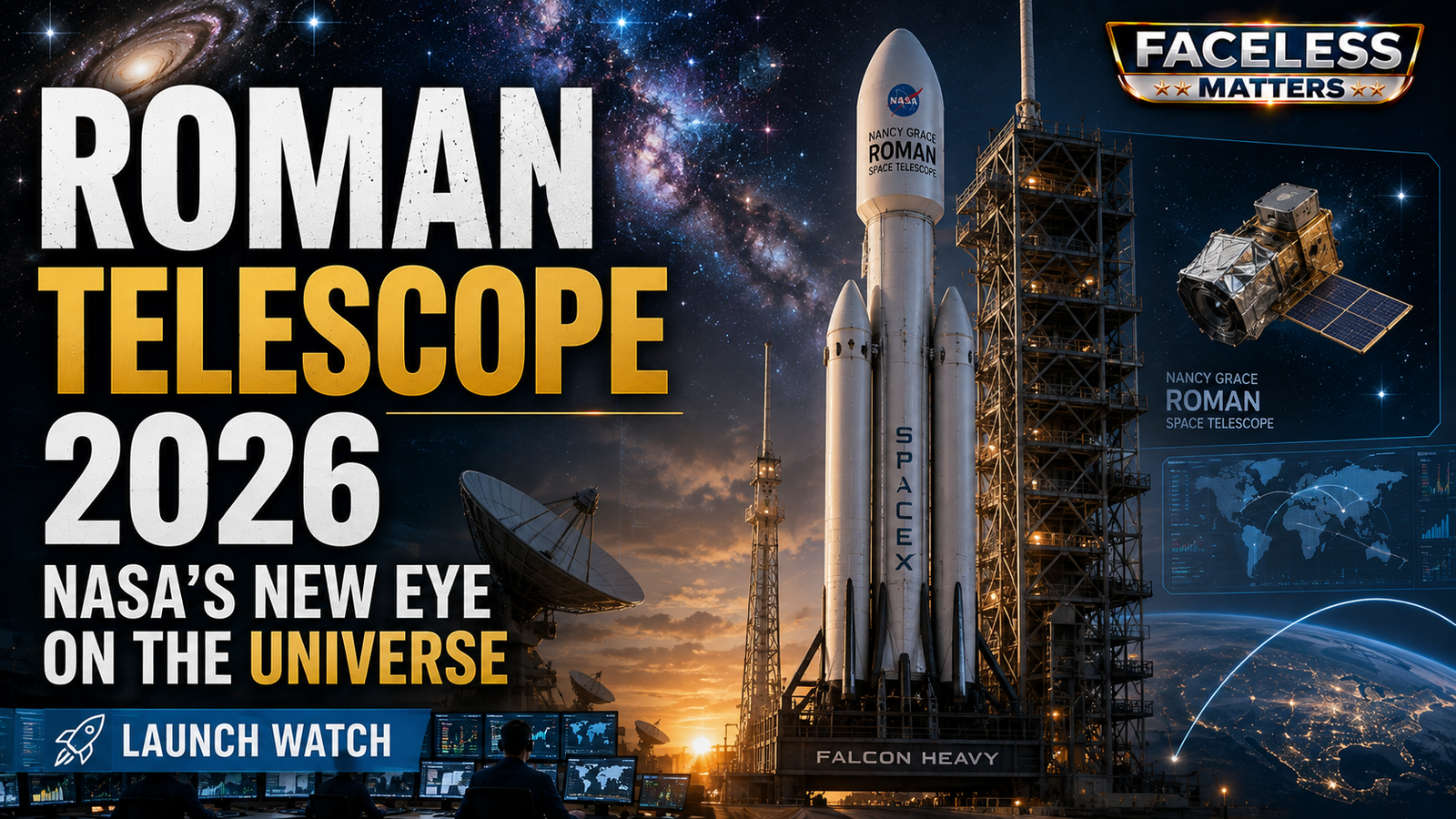
NASA’s Nancy Grace Roman Space Telescope is scheduled for launch no earlier than August 30, 2026, aboard a SpaceX Falcon Heavy from Kennedy Space Center in Florida. The currently reported launch time is 7:26 a.m. EDT, or 11:26 GMT.
The Roman Space Telescope 2026 mission goes well beyond another rocket launch, representing a major scientific milestone.
Roman is designed to investigate some of the biggest unanswered questions in modern astronomy, including dark energy, dark matter, exoplanets and the evolution of distant stars and galaxies.
For FACELESS MATTERS, the most interesting part of this story is the combination of science, technology, data and long-term space infrastructure.
Humanity is entering a period in which space exploration is becoming increasingly connected to commercial technology, advanced computing, satellite communications and scientific investment.
Roman represents that transition.
A Major Launch Window Approaches
The final days before a major space launch are filled with technical checks, weather assessments and mission-readiness decisions, making the Roman Space Telescope 2026 launch an important milestone for modern astronomy.
According to recent reporting, the Roman spacecraft has already undergone extensive preparation, including fueling, payload integration and launch rehearsals. The mission has been formally progressing toward the August 30 launch opportunity.
The telescope is expected to travel approximately 930,000 miles to the Sun-Earth Lagrange Point 2, where it can conduct observations from a highly useful position in space. The journey is expected to take roughly 30 days, followed by a commissioning period before scientific operations begin.
For this mission, the launch itself is only the beginning.
The real value of the mission will be measured through the scientific data it produces over the years that follow, making it more than simply a launch event.
What Roman Will Study
One of Roman’s most important goals is understanding dark energy.
Scientists know that the universe is expanding, but the nature of the force associated with the accelerated expansion remains one of the biggest mysteries in cosmology.
Roman is expected to help scientists investigate this mystery through large-scale astronomical surveys.
Its mission also includes the study of exoplanets.
Thousands of planets have already been discovered outside our solar system, but the scientific challenge is moving from simple discovery toward understanding the broader population of planets and planetary systems.
Roman’s wide field of view can provide a powerful complement to other observatories.
This makes the mission valuable not because it replaces existing telescopes, but because it expands the overall scientific toolkit.
How Roman Complements James Webb
The Roman Space Telescope and the James Webb Space Telescope are sometimes presented as competitors.
That is not the most useful way to understand them.
Their capabilities are different and can complement one another.
James Webb has become famous for detailed observations of distant galaxies, stars and planetary systems.
Roman is designed for wide-field surveys, allowing scientists to examine much larger portions of the sky.
Recent reporting describes Roman’s field of view as dramatically broader than Webb’s, creating the possibility of identifying large numbers of targets and then using other observatories for more detailed follow-up observations.
This is an important development in modern scientific research.
The Roman Space Telescope 2026 shows why the future of astronomy will increasingly depend on cooperation between multiple instruments rather than a single “best” telescope.
That means the observatory could become an important part of a wider astronomical data ecosystem.
The Bigger Space Economy
The importance of Roman also extends beyond pure science.
The global space economy is expanding through satellite communications, Earth observation, navigation, launch services, scientific research and commercial spaceflight.
Every major mission requires engineers, software developers, data scientists, manufacturers, launch specialists, communications professionals and scientific institutions.
That creates economic activity across multiple sectors.
Advanced satellite technology can also support applications on Earth, including communications, weather monitoring, mapping, environmental research and disaster response.
This is why space investment should not be viewed simply as government spending.
When managed effectively, space programs can contribute to technological innovation and create knowledge that eventually moves into other industries.
Why Space Technology Matters to Earth
Space research can sometimes appear disconnected from everyday life.
In reality, modern societies depend heavily on orbital infrastructure.
Communications networks, navigation systems, weather forecasting, remote sensing and environmental monitoring all benefit from space-based technology.
The growing importance of satellite communications also means that secure and reliable orbital infrastructure has become a strategic issue.
The more dependent economies become on digital connectivity, the more important the resilience of space infrastructure becomes.
This creates opportunities for aerospace engineering, satellite manufacturing, data analytics and commercial space services.
The Roman Space Telescope 2026 mission is primarily scientific, but it exists inside this much larger technological ecosystem.The future of astronomy will increasingly depend on cooperation between multiple instruments rather than a single “best” telescope.
U.S. Space Strategy Is Expanding
Another major space development this week came from the U.S. government.
On August 28, President Donald Trump signed an executive order establishing a U.S. Space Academy, intended to train future professionals for careers connected with space exploration, research and protection of space infrastructure. NASA Administrator Jared Isaacman is expected to lead an eight-member commission responsible for developing the institution.
The announcement demonstrates that space policy is increasingly being treated as a long-term national capability.
The United States is simultaneously focusing on lunar exploration, Mars ambitions, commercial launch systems and the development of a skilled workforce.
That combination matters.
Space leadership cannot depend only on rockets.
It requires education, engineering, research, manufacturing, software, cybersecurity and sustained investment.
The New Space Race Is About More Than Rockets
The traditional Space Race was primarily defined by national competition.
The modern space environment is more complicated.
Governments remain central players, but private companies now play a major role in launch services, satellite networks and spacecraft development.
SpaceX’s launch activity demonstrates how quickly commercial launch operations have expanded.
Recent reporting also noted that SpaceX launched another batch of Starlink satellites from California on August 26, marking the company’s 101st Falcon 9 launch of 2026.
That launch cadence illustrates how the commercial space industry is becoming an increasingly important part of orbital infrastructure.
The result is a space environment in which government missions and private-sector capabilities increasingly overlap.
FACELESS MATTERS Positive Analysis
FACELESS MATTERS sees the current space environment as a constructive long-term development.
The most positive aspect is not simply the number of launches.
It is the growing connection between science, commercial technology and human capital.
A successful mission could generate valuable scientific data, as outlined by the NASA Roman Space Telescope mission
Commercial launch providers can reduce access barriers.
Satellite networks can expand connectivity.
Advanced sensors can improve Earth observation.
And a stronger education pipeline can produce the engineers and scientists required for the next generation.
This creates a reinforcing cycle.
Better research creates new technology.
New technology creates new commercial opportunities.
Commercial opportunities attract investment.
Investment supports further research.
That cycle can strengthen the global space economy.
What Could Go Right
There are several reasons to remain optimistic about the Roman Space Telescope 2026 mission.
First, the spacecraft has already passed through an extensive preparation process.
Second, the mission has a clear scientific purpose.
Third, Roman is designed to complement rather than duplicate existing observatories.
Fourth, the broader space industry is developing rapidly.
Fifth, the expansion of commercial spaceflight is creating new infrastructure around scientific missions.
These factors do not eliminate launch or operational risks.
Space missions remain technically complex.
But the overall direction is encouraging.
The scientific community increasingly has access to multiple powerful instruments operating together.
That is a major advantage.
What Investors and Technology Watchers Should Observe
The space sector deserves attention from anyone following long-term technology trends.
Several areas are particularly important.
Satellite Technology
The demand for satellites continues to grow across communications, Earth observation and scientific research.
Launch Services
Reusable rockets and higher launch frequencies are changing the economics of getting payloads into orbit.
Space Data
The value of space infrastructure increasingly depends on the data generated by satellites and scientific instruments.
Aerospace Engineering
Complex missions require highly specialized engineering talent.
Commercial Spaceflight
Private companies are becoming increasingly important partners in government-led missions.
Space-Based Communications
Satellite connectivity can play a major role in expanding communications infrastructure.
These areas collectively demonstrate why the space economy is becoming a serious technology and investment theme.
The Bigger Question for Space Exploration
The most interesting question is no longer simply:
Can humanity launch another telescope?
The better question is:
What can humanity discover when multiple advanced observatories, computing systems and commercial space networks operate together?
That question changes the perspective.
A telescope is not merely a machine.
It is a data-generation platform.
The information produced by Roman could support years of research by scientists around the world.
Its discoveries could help refine our understanding of the universe and generate new questions for future missions.
This is how scientific progress normally works.
One mission answers some questions while creating others.
FACELESS MATTERS Strategic View
The current space environment should therefore be viewed with measured optimism.
There is no reason to assume every space project will succeed.
Launch delays, funding pressures, technical failures and changing political priorities remain genuine risks.
But the broader trajectory is positive.
The combination of public investment, commercial innovation and scientific cooperation is creating an increasingly capable space ecosystem.
For developing countries, including Pakistan, this trend also carries lessons.
Countries do not necessarily need to build every component of a space ecosystem independently.
They can develop specialized capabilities in satellite data, software, remote sensing, communications, education and scientific research.
That approach can create practical economic value while contributing to national technological capacity.
A New Era of Scientific Discovery
The Roman Space Telescope 2026 mission arrives at an interesting moment for global space science.
The world is simultaneously experiencing rapid progress in artificial intelligence, computing, satellite technology and commercial spaceflight.
These technologies increasingly reinforce one another.
Advanced computing can process enormous astronomical datasets.
Artificial intelligence can help researchers identify patterns.
Satellite infrastructure can deliver new forms of Earth and space data.
And improved launch systems can place more sophisticated instruments into orbit.
The result could be a new era in which space science becomes more data-driven and interconnected than ever before.
Conclusion: Looking Beyond the Launch
The Roman Space Telescope 2026 mission is more than a countdown to another rocket launch.
It represents a broader shift in how humanity studies space.
The Roman Space Telescope 2026 mission combines advanced astronomy, aerospace engineering, scientific research and increasingly sophisticated orbital infrastructure.
If the launch and deployment proceed successfully, Roman could become one of the most important scientific observatories of the coming decade.
FACELESS MATTERS’ positive assessment is straightforward:
The future of space exploration looks increasingly collaborative, technological and data-driven.
The greatest opportunity is not simply reaching farther into space.
It is learning how to use the information we gather there to improve our understanding of the universe and accelerate innovation on Earth.
The next generation of space exploration is already taking shape.
And the Roman Space Telescope may soon provide one of its clearest new windows into the universe.
INTERNAL READING
For readers interested in the wider scientific and strategic context, FACELESS MATTERS has previously examined space exploration, digital transformation and energy security from different perspectives. These three tested site references come from different categories and different publication periods:
1. Technology / recent: Pakistan Digital Economy Initiative 2026: Powerful Digital Growth — Relevant to the technology, connectivity and digital infrastructure side of the modern space economy.
2. Economy / very recent: Strait of Hormuz Crisis: Oil Above $90 in 2026 — Provides useful context on energy security and the geopolitical forces that also influence strategic infrastructure and technology.
For the Roman Space Telescope 2026 mission, the launch itself is only the beginning.For the Roman Space Telescope 2026 mission, the launch itself is only the beginning.