

TABLE OF CONTENTS
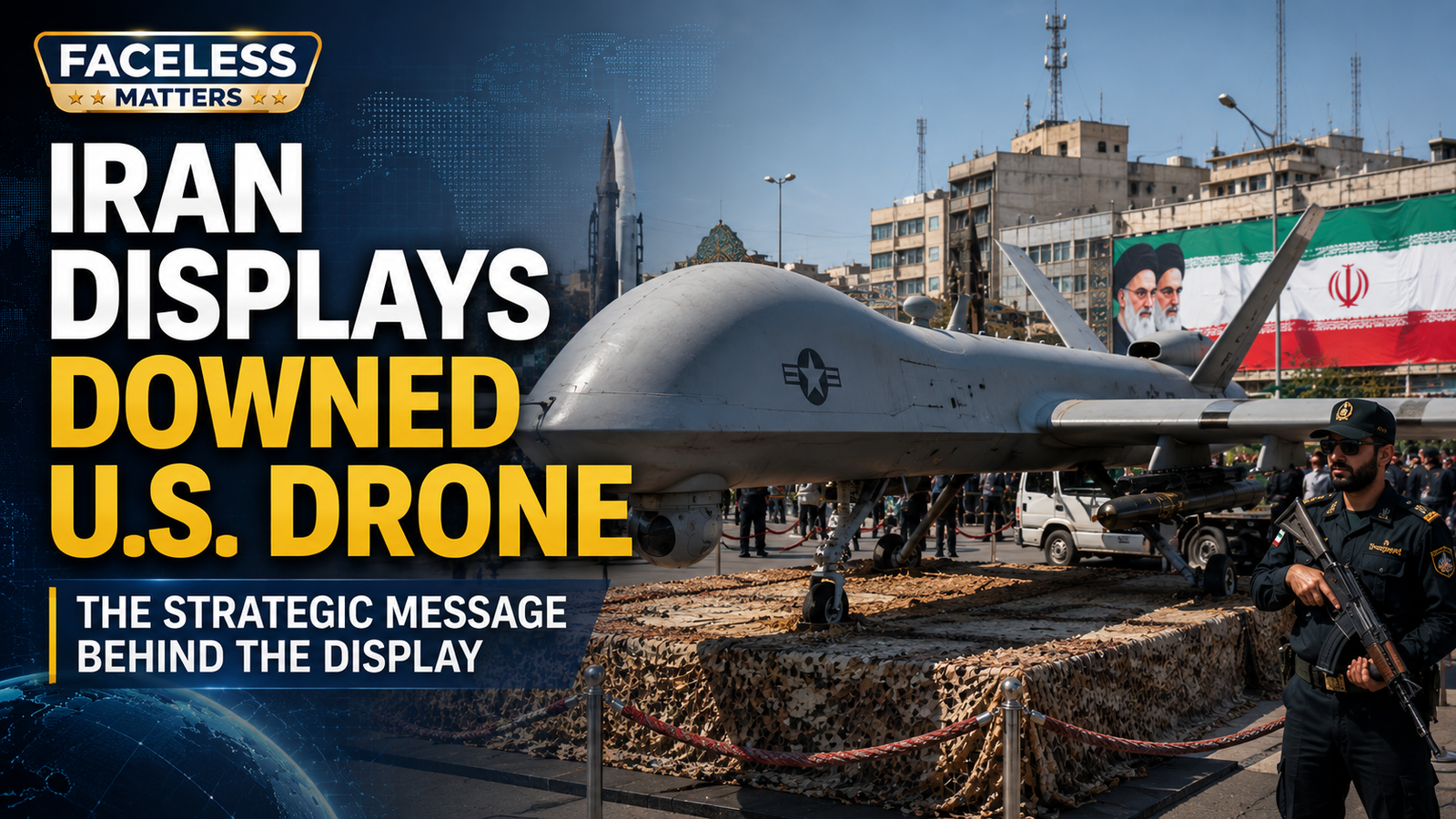
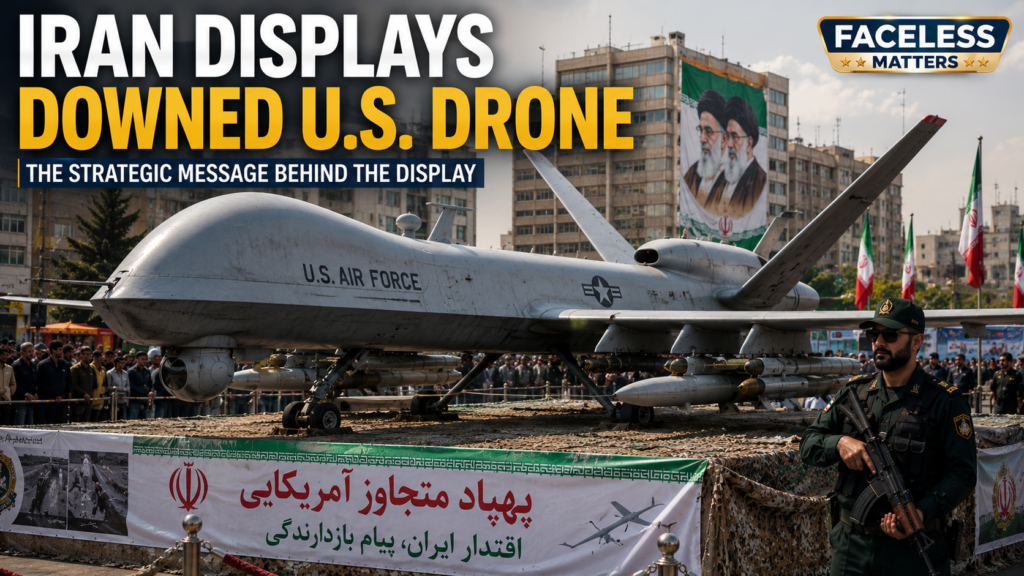
The reported public display of a downed U.S. drone in Iran is more than an unusual military image. It is also a carefully visible form of strategic communication.
According to the supplied Jang News liveblog, Iran displayed aircraft destroyed during the war, with the report specifically noting that newly released images showed the remains of a U.S. F-15 fighter aircraft. The accessible Jang liveblog is dated August 8, 2026, so the exact timing of the drone display shown in the supplied image should be treated as part of that reported coverage rather than automatically presented as a new September 3 development.
At the same time, the broader military confrontation remains active. The U.S. Central Command said on September 1 that American forces had completed another wave of strikes against Iranian military targets, including air-defence sites, radar systems, maritime facilities, mine-laying capabilities and communications sites.
That wider context makes the Iran US Drone story strategically relevant.
The image of a downed unmanned aircraft can become a message about vulnerability, technological competition and deterrence, making the Iran US Drone display strategically relevant.
What the Iran US Drone Display Actually Shows
The first point is simple but important: a displayed aircraft wreckage is evidence of a military loss only in the narrow sense that the physical remains are being presented.
It does not, by itself, establish every detail surrounding how the aircraft was brought down.
The supplied Jang coverage reports that Iran presented destroyed American and Israeli aircraft for public viewing and that images showed the remains of an American F-15.
The distinction matters because modern military conflicts are also information wars.
Each side has an incentive to emphasize evidence that supports its own narrative.
For that reason, FACELESS MATTERS separates the reported display from broader conclusions about battlefield performance.
The display is real as a reported event.
The precise circumstances behind every displayed aircraft require independent verification.
That is the responsible way to read military imagery.
Why a Downed Drone Has Strategic Value
A military drone represents something larger than an aircraft.
It represents surveillance, intelligence gathering, precision strike capability, communications infrastructure and the increasingly important role of unmanned systems in modern warfare.
The United States has publicly confirmed the extensive use of drones during its Iran operations. A CENTCOM fact sheet lists the MQ-9 among the U.S. aerial systems employed during Operation Epic Fury.
That makes any credible loss of an American unmanned aircraft potentially significant.
But the strategic value of displaying such an aircraft goes beyond the equipment itself.
Iran can use the physical object to communicate several messages simultaneously:
- U.S. technology is not invulnerable.
- Iranian air-defence capabilities remain relevant.
- The conflict has produced tangible costs for Washington.
- Military technology can become political messaging.
- The battlefield is also an information environment.
This is why the Iran US Drone display deserves analysis beyond the headline.
Drone Warfare Has Changed the Battlefield
Drones have transformed military operations because they can remain airborne for long periods, collect intelligence, monitor movement and, depending on the platform, conduct precision attacks.
Their value is therefore not limited to the physical aircraft.
A drone can be part of a wider intelligence network involving satellites, command centres, communications links, sensors and human operators.
Destroying one aircraft does not automatically destroy that network.
This is one of the most important points missing from simplistic battlefield narratives.
A downed drone may represent a tactical success for one side while having limited impact on the opposing force’s overall military capacity, which is why the Iran US Drone story requires careful context.
The United States operates a large and technologically sophisticated military system.
Iran, meanwhile, has invested heavily in air defence, missiles, drones and asymmetric capabilities.
The competition is therefore not simply:
drone versus air defence.
It is a broader contest between surveillance, electronic warfare, command-and-control systems, air-defence networks and strike capabilities.
The Psychological and Political Message
Publicly displaying military equipment has a long history.
Captured tanks, aircraft and weapons have often been used to demonstrate battlefield resilience and national confidence.
A drone is particularly useful for this purpose because it is visually recognizable as a symbol of modern military technology.
The Iran US Drone display can therefore serve as a form of psychological communication.
The intended audience is not necessarily limited to the Iranian public.
It can include:
- U.S. policymakers;
- regional governments;
- military planners;
- international media;
- domestic audiences;
- and potential adversaries.
The message can be interpreted as:
Technology alone does not guarantee operational dominance.
That is a powerful political argument, even when the actual military significance of a single aircraft remains limited.
What It Means for U.S. Military Technology
It would be an analytical mistake to interpret the reported display as proof that American drone technology has failed.
The United States continues to operate sophisticated unmanned systems across the region.
CENTCOM’s own public material describes aerial drones as part of its operational capabilities and confirms continued military activity against Iranian targets.
The more useful question is whether the loss of individual unmanned platforms can reveal vulnerabilities.
Modern drones face several potential threats:
- Integrated air-defence systems
- Radar detection
- Electronic warfare
- Communications disruption
- Missile interception
- Navigation interference
- Cyber and command-link vulnerabilities
The future of military drone operations will increasingly depend on how well these risks can be managed.
That is relevant far beyond Iran.
It affects the United States, China, Russia, Türkiye, Israel, Pakistan and other countries developing increasingly sophisticated unmanned systems.
Iran’s Wider Strategic Communication
The aircraft display also fits into a broader pattern of strategic messaging.
Iran has repeatedly emphasized its ability to resist military pressure while highlighting its missile, drone and air-defence capabilities.
However, public messaging should not automatically be confused with battlefield balance.
A government may highlight a single successful interception because it has high symbolic value.
That does not tell the entire story of the conflict.
For readers, investors and policymakers, the more meaningful indicators are broader:
- operational tempo;
- military losses;
- air-defence survivability;
- infrastructure damage;
- logistics;
- economic pressure;
- diplomatic developments;
- and the ability of each side to sustain operations.
That is where the strategic picture becomes more complicated.
The Strait of Hormuz Connection
The drone story cannot be separated completely from the wider regional security environment.
The Strait of Hormuz remains one of the world’s most important energy corridors, and recent military developments have raised renewed concerns over commercial shipping and oil markets.
CENTCOM said its September 1 strikes followed attempted Iranian attacks involving commercial shipping in the Strait of Hormuz and U.S. personnel.
Reuters reported on September 3 that renewed U.S.–Iran hostilities had pushed Brent crude to a six-week high of about $97 per barrel during the day’s trading, while shipping through the strategic waterway remained a major concern.
Reuters — Oil market and Middle East developments
This creates an important economic connection.
Military escalation can affect:
security → shipping → insurance → energy costs → inflation → investment
For Pakistan and other energy-importing economies, that chain is particularly important.
FACELESS MATTERS Analysis: Symbolism vs Military Reality
The strongest interpretation of the Iran US Drone display is not that one side has suddenly achieved complete military superiority.
The stronger conclusion is that unmanned warfare has become both a battlefield tool and an information weapon.
Iran benefits from showing tangible evidence of an American military loss.
The United States benefits from demonstrating that it can continue conducting operations despite individual losses.
Both narratives can coexist.
A single aircraft can be lost without changing the overall military balance.
Likewise, repeated losses of expensive platforms can eventually force military planners to change tactics, routes, altitudes, electronic-warfare measures or force protection.
That is the real strategic question.
How quickly can each side learn?
Military advantage increasingly depends not simply on possessing advanced technology, but on adapting faster than the opponent.
What Could Go Right?
There are several ways this development could have a stabilizing effect.
First, the public display could reinforce deterrence by demonstrating the costs associated with aerial operations.
Second, it could encourage both sides to reassess the risks of escalation.
Third, the visibility of military losses could strengthen arguments for diplomacy.
Fourth, a better understanding of drone vulnerabilities could encourage greater investment in defensive technologies rather than indiscriminate escalation.
The most positive outcome would be for the military lesson to become a diplomatic lesson.
Modern weapons can demonstrate capability.
They cannot, by themselves, produce lasting political stability.
What Could Go Wrong?
The opposite outcome is also possible.
Publicly displayed military losses can become politically useful propaganda.
That can increase pressure on governments to retaliate.
A cycle may then emerge:
loss → public humiliation → retaliation → counter-retaliation → wider escalation
That is particularly dangerous in a conflict already connected to maritime security and global energy markets.
Reuters reported that the latest escalation had already contributed to renewed concern over civilian casualties and regional instability.
The humanitarian dimension must therefore remain central to any serious analysis.
Military technology should not be discussed only in terms of performance.
Its human and economic consequences matter equally.
The Wider Regional Equation
The significance of the Iran US Drone story extends beyond Tehran and Washington.
Middle Eastern states are watching how air-defence systems perform.
Asian energy importers are watching the Strait of Hormuz.
Shipping companies are watching maritime risk.
Insurers are watching war-risk premiums.
Investors are watching oil prices.
Technology companies are watching demand for autonomous systems and counter-drone technologies.
Defence industries are watching procurement priorities.
This is why seemingly isolated battlefield events can have broader economic consequences.
A single military incident may be small.
A pattern of repeated incidents can become strategically significant.
What Happens Next?
The next major indicators will not simply be additional photographs of destroyed equipment.
More important questions include:
- Will U.S.–Iran military operations intensify or decline?
- Will commercial shipping through Hormuz normalize?
- Will air-defence systems become more effective?
- Will unmanned aircraft operations change?
- Will diplomatic channels reopen?
- Will oil prices remain elevated?
- Will regional governments push harder for de-escalation?
These indicators will tell us considerably more than any individual battlefield image.
The Iran US Drone display is therefore best understood as one piece of a much larger strategic puzzle.
Final FACELESS MATTERS Assessment
Iran’s reported public display of a downed U.S. drone is visually powerful because it converts an invisible contest over surveillance and air power into something physical and understandable.
For policymakers, the Iran US Drone episode also offers a lesson about the changing economics of modern warfare. Advanced unmanned systems can reduce risks for personnel, but their loss can create financial and reputational costs. This makes resilience and rapid technological adaptation increasingly important. For regional economies, the broader concern is whether military incidents trigger higher energy prices, insurance costs, shipping disruptions and weaker investor confidence. The event therefore extends beyond the aircraft itself into security, commerce and economic planning.
But the image should not be allowed to replace analysis.
The reported display demonstrates the political value of military technology in the information age, giving the Iran US Drone story significance beyond the battlefield.
It also highlights a deeper reality: advanced weapons are increasingly vulnerable to sophisticated countermeasures, while every military success can become part of a wider narrative designed to influence public opinion and strategic calculations.
For Washington, the lesson is about survivability, adaptation and operational risk.
For Tehran, the lesson is that demonstrating capability can strengthen deterrence but may also encourage escalation.
For the region, the larger concern is whether military competition remains contained or begins affecting energy infrastructure and commercial shipping on a much wider scale.
And for the global economy, the most important indicator may ultimately be neither the drone nor the photograph.
It may be the price of energy, the movement of ships and the ability of diplomacy to prevent the next escalation.
INTERNAL LINKS
1. Makkah Defence Alliance: 5 Essential Facts for Pakistan — A recent FACELESS MATTERS analysis examining Pakistan, Türkiye and Saudi Arabia’s emerging security framework and the changing regional security architecture.
Makkah Defence Alliance: 5 Essential Facts for Pakistan
2. Strait of Hormuz Crisis: Oil Above $90 in 2026 — An economy-focused analysis of Hormuz, shipping disruption, oil prices, inflation and the potential impact on Pakistan and global markets.
Strait of Hormuz Crisis: Oil Above $90 in 2026
TRUSTED EXTERNAL SOURCES
Jang News — The supplied liveblog reporting the display of destroyed U.S. and Israeli aircraft and identifying U.S. F-15 wreckage in the released imagery.
U.S. Central Command — Official September 1 statement confirming another wave of U.S. strikes against Iranian military targets and providing the U.S. operational account.
Reuters — Independent reporting on the latest escalation, civilian impact, oil prices and Strait of Hormuz risks.
U.S. Central Command — Official Releases
SOURCE VERIFICATION & FACELESS MATTERS ANALYSIS
This report uses the supplied Jang News liveblog as the source for the reported display of destroyed American and Israeli aircraft. The accessible Jang page currently carries August 8, 2026 entries and specifically states that released images showed remains of a U.S. F-15.
For the broader strategic context, FACELESS MATTERS cross-checked the military situation against the U.S. Central Command’s September 1 official release, which confirms U.S. strikes against Iranian military targets, and against Reuters reporting published September 3 concerning the latest escalation, civilian casualties, oil prices and maritime risks.
FACELESS MATTERS analysis in this article concerns the strategic meaning, psychological effect, technology implications and economic consequences of the reported event. These analytical conclusions should not be interpreted as independently confirmed battlefield claims.
Editorial Note
FACELESS MATTERS distinguishes verified reporting from analysis and does not present unverified military claims, future scenarios or political narratives as established facts.
This article is intended for informational, educational and analytical purposes. It is not financial, investment, legal, military or professional advice.
For corrections, source concerns or editorial inquiries: info@facelessmatters.com
[…] Iran US Drone Display: 5 Strategic Signals Behind the Move — A recent FACELESS MATTERS analysis of Iran-U.S. military technology, strategic messaging and the wider confrontation. […]
[…] Iran US Drone Display: 5 Strategic Signals Behind the Moveایران-امریکا کشیدگی، military signalling اور information warfare کے تناظر میں متعلقہ تجزیہ۔ […]
[…] Iran US Drone Display: 5 Strategic Signals Behind the Move […]