

TABLE OF CONTENTS
September 3, 2026 | Islamabad
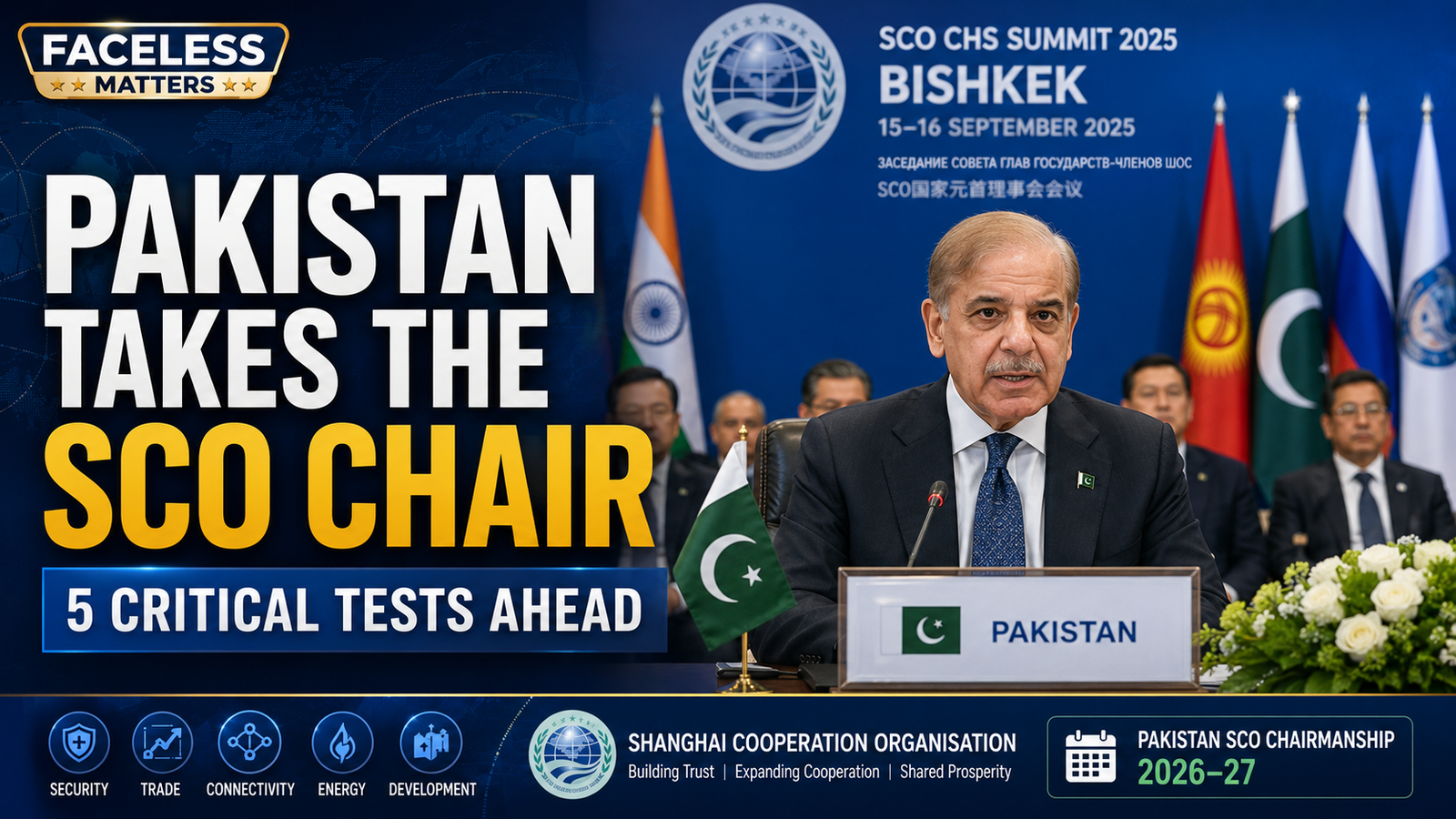
Pakistan has entered a new phase of regional diplomacy after Prime Minister Shehbaz Sharif’s participation in the Shanghai Cooperation Organisation summit in Bishkek. The immediate headlines focused on the summit, Pakistan’s assumption of the organisation’s Council of Heads of State chairmanship for 2026–27, and the prime minister’s bilateral engagement with Kyrgyzstan. But the more important question now is what Islamabad can actually deliver during the year ahead.
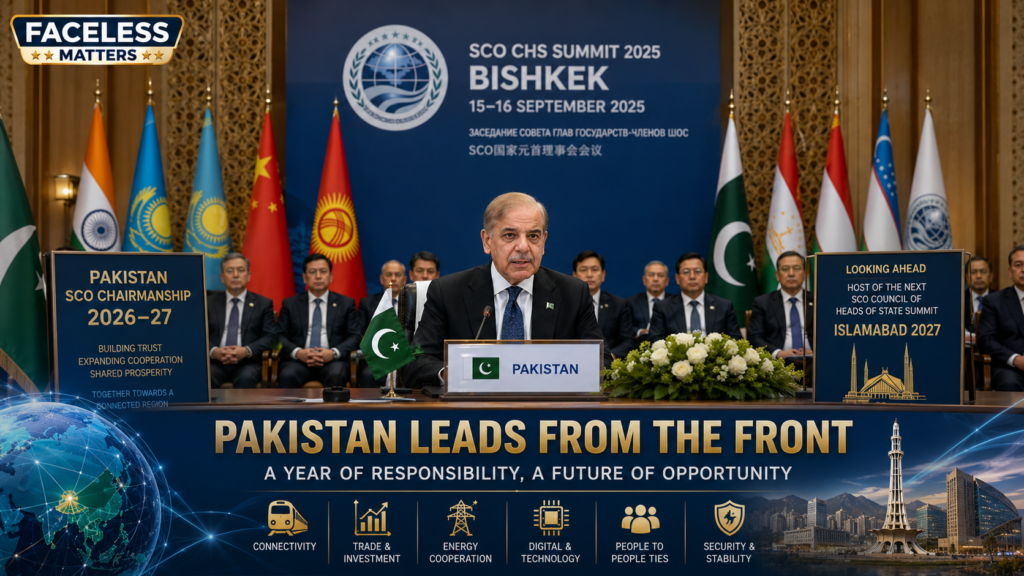
The Pakistan SCO Chairmanship begins after a summit that brought together major Eurasian powers and placed issues such as regional security, connectivity, energy, trade and economic cooperation at the centre of discussion. Pakistan is also preparing to host the next SCO Council of Heads of State summit in Islamabad in 2027.
This makes the coming year more than a ceremonial diplomatic assignment. It is an opportunity to demonstrate whether Pakistan can convert summit-level diplomacy into practical regional outcomes.
What Has Changed After Bishkek?
The Pakistan SCO Chairmanship gives Islamabad a platform to shape the organisation’s agenda during its 2026–27 term.
Pakistan’s Foreign Office had identified the 2027 Islamabad summit as the major event of the chairmanship. The government has also presented regional connectivity, economic cooperation and practical engagement as important priorities.
Prime Minister Shehbaz Sharif used his Bishkek address to highlight secure energy corridors, regional rail and road connectivity, resilient supply chains, information technology and economic cooperation. He also argued that greater connectivity is strategically important for the wider SCO region.
The challenge now is implementation.
A successful chairmanship cannot be measured simply by the number of meetings held or declarations adopted. It should be judged by whether participating states move toward concrete cooperation.
That is where the Pakistan SCO Chairmanship faces its first major test.
1. Can Pakistan Turn Connectivity Into Commerce?
Connectivity is one of the strongest themes emerging from Pakistan’s regional diplomacy.
Pakistan sits on the Arabian Sea and possesses major ports that can potentially connect landlocked Central Asian economies with international maritime markets. At the same time, Central Asian states offer Pakistan access to new markets, investment opportunities and potential overland trade routes.
But geography does not automatically create commercial corridors.
Transport infrastructure, customs procedures, border management, financing, insurance, security and predictable regulations all influence whether a corridor becomes economically competitive.
During the Bishkek engagement, Pakistan also discussed connectivity with Kyrgyzstan. Radio Pakistan reported that Pakistan and Kyrgyzstan agreed to strengthen connectivity through road, rail and air links alongside cooperation in healthcare, pharmaceuticals, IT, minerals, agriculture, digital technologies and infrastructure.
This gives the Pakistan SCO Chairmanship an important economic dimension.
If Islamabad can promote practical discussions around transport corridors, customs facilitation, digital trade and regional logistics, the chairmanship could support Pakistan’s long-term trade strategy.
2. The $200 Million Pakistan-Kyrgyzstan Test
The most measurable economic development from the Bishkek visit was the agreement between Pakistan and Kyrgyzstan to work toward increasing bilateral trade to $200 million within two years.
Radio Pakistan reported that current bilateral trade was approximately $16 million, making the proposed increase ambitious. The two sides signed a formal agreement rather than relying solely on another memorandum of understanding.
This is important because it provides a measurable benchmark.
The Pakistan SCO Chairmanship itself cannot create bilateral trade, but it can create diplomatic momentum for regional economic integration.
The real test will be whether companies begin using the routes, whether financial institutions support transactions, whether exporters find competitive markets and whether governments remove practical barriers.
The difference between a political announcement and an economic result is substantial.
FACELESS MATTERS therefore views the $200 million target as a useful indicator to monitor over the next two years rather than as a guaranteed outcome.
3. Security Without Turning the SCO Into a Bloc
Security remains one of the central concerns of the SCO.
At Bishkek, Prime Minister Shehbaz Sharif described terrorism as one of the region’s most serious threats and argued for stronger regional cooperation. He also linked lasting peace with the ability of the region to realise its economic potential.
However, the SCO is not a conventional military alliance.
Its members have different foreign-policy priorities, economic interests and bilateral disputes. India and Pakistan remain an obvious example of how political disagreements can exist inside the same multilateral institution.
The Pakistan SCO Chairmanship therefore requires diplomatic balance.
Islamabad will need to promote counterterrorism cooperation without allowing the organisation’s economic and development agenda to be overwhelmed by political confrontation.
The strongest approach would be to keep the emphasis on shared interests: counterterrorism, border security, organised crime, cyber threats, energy security and protection of trade routes.
4. Energy and Technology Could Become Economic Multipliers
Energy security and technology could provide some of the most valuable areas for practical cooperation.
Prime Minister Shehbaz Sharif identified energy and information technology among the priorities of Pakistan’s SCO chairmanship. He also highlighted secure energy corridors and regional infrastructure.
For Pakistan, this is commercially significant.
The country needs reliable energy supplies, greater digital capacity and stronger technology investment. Central Asian states possess substantial natural resources and growing interest in digital transformation.
The opportunity is not limited to conventional energy.
There is potential for cooperation in renewable energy, electricity transmission, digital payments, artificial intelligence, telecommunications, e-commerce, data infrastructure and technology services.
Pakistan’s growing IT sector could benefit from stronger connections with Central Asian markets if regulatory and payment barriers are addressed.
This makes the Pakistan SCO Chairmanship potentially relevant to technology investment as well as traditional diplomacy.
5. The 2027 Islamabad Summit Is the Final Scorecard
The most visible responsibility of the Pakistan SCO Chairmanship will be the hosting of the next Council of Heads of State summit in Islamabad in 2027.
That summit will provide an opportunity for Pakistan to demonstrate organisational capacity and diplomatic effectiveness.
But hosting a successful summit should not be confused with achieving successful policy outcomes.
By 2027, observers will have a much stronger basis for judging whether the 2026–27 chairmanship produced meaningful progress.
Questions will include:
- Did regional trade increase?
- Did connectivity projects move forward?
- Did investment flows improve?
- Did energy cooperation become more practical?
- Did digital and technology partnerships expand?
- Did security cooperation produce measurable results?
- Did Pakistan successfully maintain consensus among diverse SCO members?
Those indicators will matter far more than ceremonial photographs.
FACELESS MATTERS Analysis: The Real Opportunity
The current SCO chairmanship arrives at an interesting moment for Eurasian diplomacy.
For Islamabad, the next phase should focus on practical delivery rather than symbolism alone. Progress will depend on whether governments can reduce trade barriers, improve transport links, encourage private investment and develop credible technology partnerships. Regular evaluation of these areas can also help Pakistan demonstrate measurable progress before the 2027 Islamabad summit.
The SCO brings together countries with enormous populations, major energy resources, large consumer markets and significant geopolitical influence. At the same time, its members do not always share the same strategic priorities.
That means Pakistan should avoid presenting the chairmanship as a geopolitical contest between blocs.
A more commercially focused strategy could be more useful.
Pakistan can position itself as a facilitator of connectivity, trade, technology and regional dialogue.
That approach also has an economic logic.
If Pakistan becomes a more reliable gateway between Central Asia and the Arabian Sea, the potential benefits extend beyond government diplomacy. Ports, logistics companies, banks, exporters, technology firms, construction companies and tourism businesses could all participate.
The opportunity is real, but so are the constraints.
Infrastructure requires financing. Trade requires competitiveness. Connectivity requires security. Investment requires policy stability.
These are long-term projects rather than short-term political announcements.
Pakistan and Kyrgyzstan: A Useful Starting Point
The Kyrgyzstan visit provides an immediate example of what Pakistan hopes to achieve through broader regional engagement.
The two countries agreed to strengthen their economic partnership, with discussions covering trade, investment, industrial cooperation and business-to-business contacts.
The Kyrgyz President’s personal airport farewell to Prime Minister Shehbaz Sharif also highlighted the political warmth surrounding the relationship. Pakistan’s official news agency described the gesture as an unusual display of hospitality.
But diplomatic warmth must eventually produce measurable results.
That is particularly important for Pakistan because the country needs export growth, foreign investment, improved logistics and stronger access to international markets.
Kyrgyzstan can be one part of that wider strategy.
The Wider Central Asia Equation
For Pakistan SCO Chairmanship, the wider Central Asian opportunity extends beyond summit diplomacy. Stronger institutional links with Central Asian economies can support trade facilitation, logistics, digital services, investment flows and private-sector partnerships. The real measure of progress will be whether political commitments translate into practical commercial channels, faster connectivity and repeatable business opportunities. This approach would also strengthen Pakistan’s role as a bridge between South Asia, Central Asia and wider Eurasian markets, provided that infrastructure, customs coordination and regulatory cooperation move forward together.
Pakistan’s Central Asia strategy cannot depend on a single bilateral relationship.
Uzbekistan, Kazakhstan, Tajikistan and Kyrgyzstan all offer different economic opportunities and connectivity possibilities.
Dawn reported that Prime Minister Shehbaz Sharif also discussed trade, investment and connectivity with Uzbekistan during the Bishkek summit, including the potential of the Uzbekistan-Afghanistan-Pakistan Railway and greater use of Pakistan’s ports.
This broader approach is strategically important.
The Central Asian market is not simply a destination for Pakistani exports. It can become part of a two-way commercial network involving logistics, investment, energy, tourism, agriculture, pharmaceuticals and technology.
The Pakistan SCO Chairmanship gives Islamabad an institutional platform from which to promote this wider vision.
This broader approach can turn diplomatic coordination into measurable gains for exporters, investors, logistics providers, technology firms and regional consumers across connected markets over time too.
What Could Go Right?
Several developments could strengthen Pakistan’s position.
First, stronger political relations could encourage businesses to explore new markets.
Second, better transport arrangements could reduce trade costs.
Third, digital connectivity could make cross-border business easier.
Fourth, energy cooperation could create new investment opportunities.
Fifth, the 2027 Islamabad summit could bring senior governments, investors and business leaders together around specific projects.
If these elements reinforce each other, Pakistan could emerge from its SCO chairmanship with stronger economic links across Central Asia.
What Could Go Wrong?
There are also clear risks.
Regional political disputes could dominate the agenda.
Security concerns could restrict overland connectivity.
Large infrastructure projects could face financing challenges.
Trade targets could remain aspirational if businesses do not find sufficient commercial incentives.
And diplomatic declarations could outpace institutional implementation.
These risks do not make the strategy impossible. They simply show why execution matters.
FACELESS MATTERS Strategic Assessment: What to Watch Next
The Pakistan SCO Chairmanship should now be followed through measurable indicators rather than political rhetoric.
FACELESS MATTERS will focus on five developments:
1. Trade: Whether Pakistan’s trade with Central Asian states begins showing sustained growth.
2. Connectivity: Whether road, rail, air and multimodal transport projects move from discussions toward implementation.
3. Investment: Whether Pakistani and foreign companies commit capital to projects linked to regional markets.
4. Technology: Whether IT, digital economy, artificial intelligence and e-commerce cooperation produce commercial partnerships.
5. Diplomacy: Whether Pakistan can maintain consensus and constructive engagement among the SCO’s diverse members.
These indicators will provide a more objective picture of the chairmanship.
What Happens Next?
The immediate task for Islamabad is implementation.
Pakistan has already secured the diplomatic platform. It now needs to use that platform to create practical economic value.
The Kyrgyzstan agreement provides one measurable example. The proposed $200 million trade target can be monitored. Connectivity commitments can be evaluated. Investment announcements can be tracked.
The 2027 Islamabad summit should ideally arrive with a record of progress rather than simply another collection of declarations.
That would give Pakistan a stronger position within the SCO and a more credible regional economic narrative.
Final FACELESS MATTERS Assessment
The Pakistan SCO Chairmanship is an important diplomatic responsibility, but its long-term value will depend on what Pakistan accomplishes beyond the summit stage.
Bishkek provided the political launch.
The year ahead must provide the practical results.
For Pakistan, the strongest opportunity lies in connecting diplomacy with economic policy: linking Central Asian markets with Pakistani ports, expanding trade, attracting investment, improving transport corridors, strengthening energy cooperation and opening new technology partnerships.
The relationship with Kyrgyzstan offers an early test, particularly through the $200 million bilateral trade target and the broader agreement on economic cooperation.
The next test will be whether similar practical progress can be encouraged across the wider SCO framework.
FACELESS MATTERS believes Pakistan should approach its chairmanship as a delivery year, not simply a diplomatic year.
If Islamabad can turn regional goodwill into measurable trade, investment, connectivity and technology partnerships, the Pakistan SCO Chairmanship could become an important step in Pakistan’s broader economic and foreign-policy strategy.
If implementation remains slow, the opportunity could be reduced to another cycle of summit declarations.
The difference will be determined not in conference halls, but through contracts, transport routes, investment decisions, business partnerships and measurable economic activity.
INTERNAL LINKS
- Makkah Defence Alliance: 5 Essential Facts for Pakistan — Explore FACELESS MATTERS’ analysis of Pakistan’s evolving regional defence partnerships and their wider strategic implications.
- Pakistan Debt Repayment 2026: A Major Test of Fiscal Management — Read our economic analysis of Pakistan’s debt position, fiscal management and financial stability, providing important context for the country’s international economic strategy.
- Pakistan Terrorism in 2026: President & PM Renew Resolve — Examine the security dimension of Pakistan’s regional strategy and the importance of stability for long-term economic connectivity.
TRUSTED EXTERNAL SOURCES
- Associated Press of Pakistan (APP) — Official confirmation of Pakistan’s SCO engagement, Kyrgyzstan visit and bilateral trade developments.
- Radio Pakistan — Official reporting on the Pakistan-Kyrgyzstan $200 million trade target and economic partnership. Read Radio Pakistan
- Ministry of Foreign Affairs, Pakistan — Official diplomatic statements and information on Pakistan’s Kyrgyzstan visit and SCO chairmanship. Pakistan Foreign Office
- Dawn — Independent Pakistani coverage of the Bishkek SCO summit and Pakistan’s regional connectivity agenda. Read Dawn coverage
SOURCE VERIFICATION & EDITORIAL NOTE
This report was prepared using current September 2026 reporting and official Pakistani sources. The central factual developments — Pakistan’s SCO Council of Heads of State chairmanship for 2026–27, the Bishkek summit, Pakistan-Kyrgyzstan economic discussions and the $200 million bilateral trade target — are supported by official government and national news sources.
FACELESS MATTERS analysis in this article is clearly separated from reported facts. Forecasts regarding trade, investment, connectivity and regional economic outcomes are analytical assessments, not official government forecasts or guarantees.
FACELESS MATTERS
Independent News, Analysis & Digital Media
For editorial questions, corrections, source concerns or legitimate inquiries:
info@facelessmatters.com
Educational & Editorial Note: This content is provided for informational and educational purposes. Strategic analysis represents interpretation based on publicly available information and should not be treated as official government policy, financial advice, investment advice or a prediction of future events.
[…] Pakistan SCO Chairmanship 2026–27: 5 Critical Tests After Bishkek — FACELESS MATTERS — Fresh World News analysis examining Pakistan’s regional diplomacy, connectivity, economic cooperation and implementation challenges. […]
[…] Pakistan SCO Chairmanship 2026–27: 5 Critical Tests Ahead — Connects Pakistan’s economic and diplomatic strategy with regional connectivity, international partnerships and the wider environment for cross-border digital and financial cooperation. […]
[…] 2. Pakistan SCO Chairmanship 2026–27: 5 Critical Tests After Bishkek […]
[…] Pakistan SCO Chairmanship: 5 Critical Tests Ahead — Examines Pakistan’s wider diplomatic and strategic role as regional powers reshape their partnerships and economic relationships. Read the Pakistan SCO analysis […]
[…] Pakistan SCO Chairmanship 2026–27: 5 Critical Tests After Bishkek […]