

September 2, 2026 | Bishkek, Kyrgyzstan
The real test for Pakistan-Kyrgyzstan relations is not how warmly leaders greet each other.
TABLE OF CONTENTS
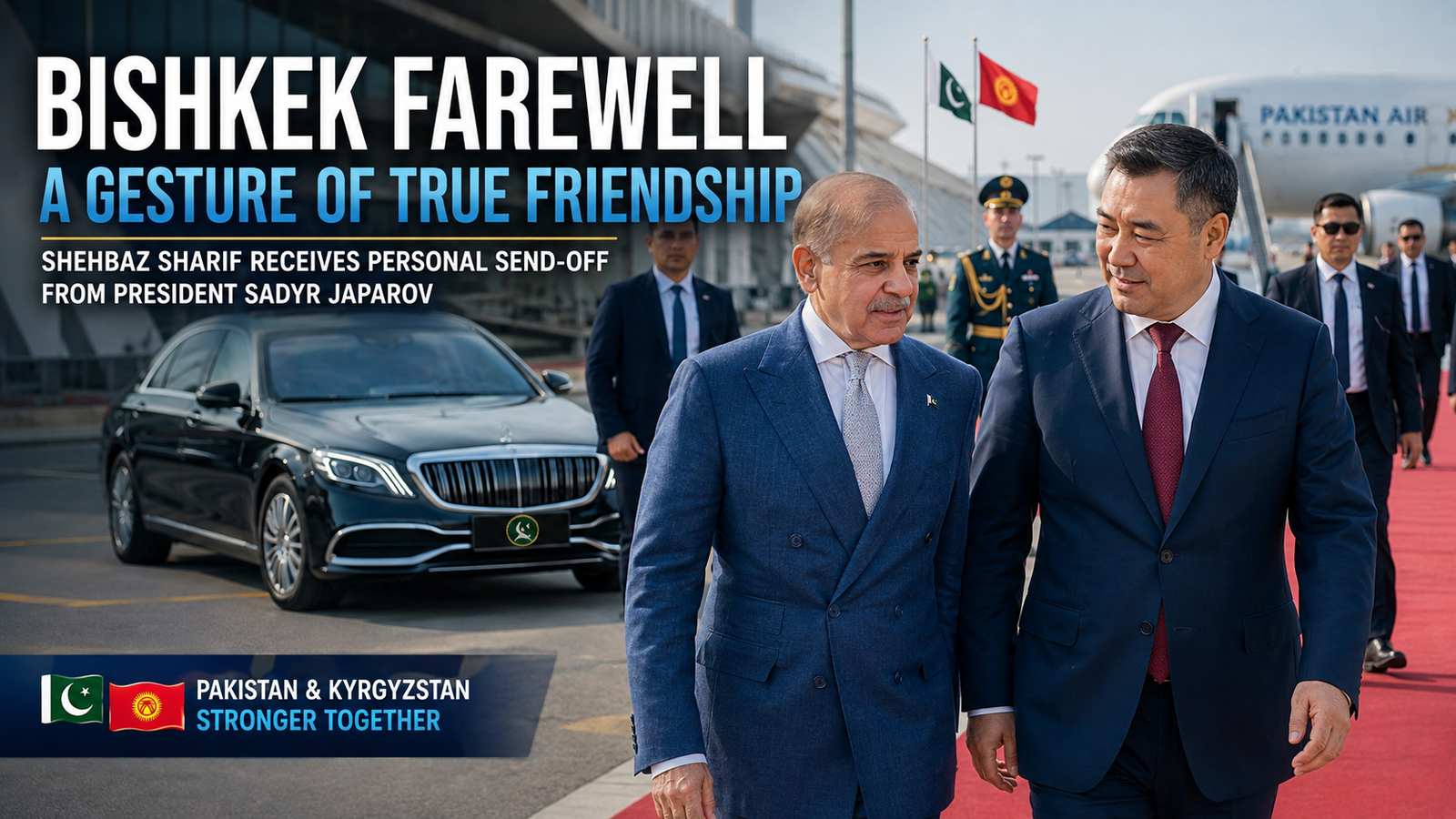
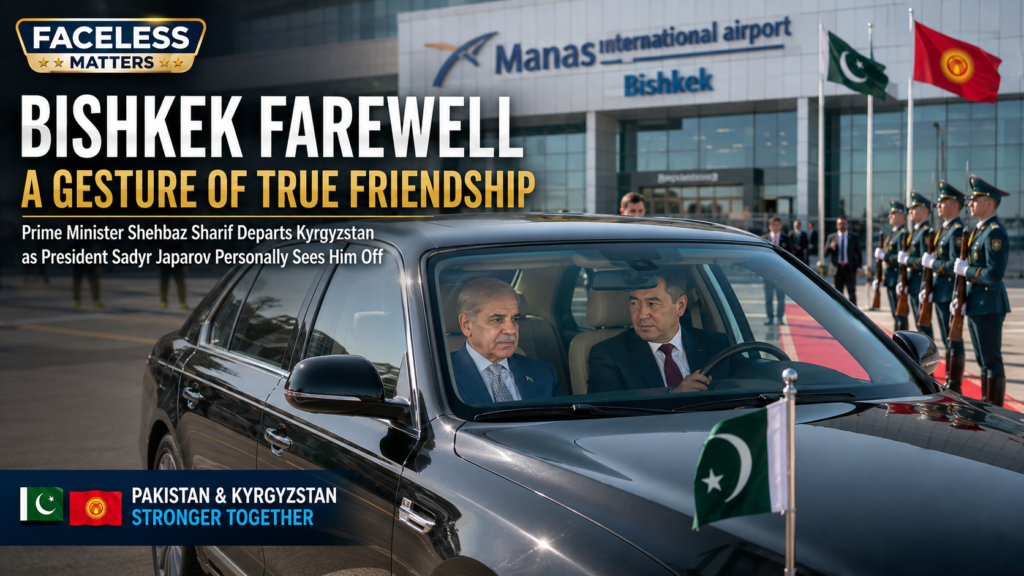
Prime Minister Muhammad Shehbaz Sharif’s three-day visit to Kyrgyzstan ended with an unusually personal diplomatic gesture: Kyrgyz President Sadyr Japarov personally drove to the airport to see the Pakistani prime minister off. The gesture, reported by Daily Jang and subsequently confirmed by Pakistan’s official media channels, stood out because presidential airport farewells are normally handled through formal protocol and official delegations.
The moment was more than a visually striking diplomatic scene. It came at the conclusion of a visit that included the Shanghai Cooperation Organisation (SCO) summit, bilateral discussions and efforts to expand Pakistan-Kyrgyzstan economic and strategic cooperation.
The Kyrgyz President’s personal involvement in the departure therefore provides a useful window into the political warmth that Islamabad and Bishkek are seeking to build.
An Unusual Display of Hospitality
According to the Associated Press of Pakistan, President Sadyr Japarov personally drove the vehicle to see Prime Minister Shehbaz Sharif off at the airport. Pakistan’s Radio Pakistan independently reported the same development and described the gesture as demonstrating the growing warmth in bilateral relations.
Diplomatic protocol often contains carefully defined ceremonies, especially when heads of government travel abroad. A leader personally taking the wheel for an airport farewell is therefore unusual enough to attract attention.
But the significance should not be exaggerated.
The gesture does not by itself constitute a new treaty or a major policy agreement. Its value is primarily diplomatic and symbolic. It signals personal goodwill at a moment when both countries are attempting to translate long-standing friendly relations into more practical cooperation.
That distinction matters.
A warm diplomatic gesture can create political momentum, but sustained relations ultimately depend on trade, investment, connectivity, institutional dialogue and implementation.
Why Shehbaz Sharif Was in Kyrgyzstan
Prime Minister Shehbaz Sharif travelled to Bishkek from August 31 to September 2 for the SCO Council of Heads of State meeting and SCO Plus Summit. Pakistan also assumed the chairmanship of the SCO Council of Heads of State for 2026–27, with the next summit scheduled to be hosted by Islamabad.
The visit therefore had two dimensions.
The first was multilateral diplomacy through the SCO.
The second was bilateral engagement with Kyrgyzstan.
Pakistan’s Foreign Office said the bilateral agenda included trade and investment, energy, regional connectivity, education, tourism and people-to-people exchanges.
This wider agenda is important because the Kyrgyz President and Pakistan’s leadership are seeking to make Central Asian connectivity a more practical part of their economic relationship, rather than relying on diplomacy alone.
For Islamabad, deeper engagement with Central Asian states can potentially improve access to new markets, transport corridors and investment opportunities.
For Kyrgyzstan, the Kyrgyz President’s government can view Pakistan’s ports and access to the Arabian Sea as another potential route toward South Asian and international markets.
The Economic Story Behind the Warm Gesture
One of the more significant outcomes of the visit was the decision to work toward increasing bilateral trade.
Pakistan and Kyrgyzstan agreed on a target of $200 million in bilateral trade within two years. Radio Pakistan reported that the current trade volume was approximately $16 million, meaning the proposed target represents a substantial expansion if it can be achieved.
This is where the diplomatic symbolism becomes connected to economic policy.
This wider agenda is important because the Kyrgyz President and Pakistan’s leadership are seeking to make Central Asian connectivity a more practical part of their economic relationship, rather than relying on diplomacy alone.
It is whether that political goodwill produces measurable economic activity.
That could include:
- Higher bilateral trade
- Better transit arrangements
- New investment projects
- Greater business-to-business contact
- Stronger transport connectivity
- Cooperation in energy and agriculture
- Expansion of tourism
- Technology and digital-economy cooperation
The two countries also signed multiple agreements and memoranda during the visit, covering areas including transit trade, education, science and technology, climate-related cooperation, virtual assets, postal services and e-commerce.
These areas show that the relationship is gradually moving beyond traditional diplomatic language.
The Central Asia Connectivity Question
For Pakistan, Kyrgyzstan is strategically relevant because of geography.
Pakistan is connected to the Arabian Sea, while Kyrgyzstan is a landlocked Central Asian country.
That creates a natural economic logic for connectivity.
But geography alone does not create trade corridors.
Transport infrastructure, customs procedures, border management, commercial agreements, financing and political stability all determine whether connectivity becomes commercially viable.
This is why the economic dimension of the visit may ultimately prove more important than the airport farewell.
The Kyrgyz President’s gesture generated the headline, but connectivity and trade will determine whether the relationship generates lasting economic value.
SCO Diplomacy Adds Another Layer
The timing of the visit also matters because Pakistan has assumed the SCO chairmanship for 2026–27.
During his SCO address in Bishkek, Prime Minister Shehbaz Sharif highlighted regional connectivity, secure energy corridors, resilient supply chains and economic cooperation. He also proposed cooperation in areas including IT, artificial intelligence, energy, poverty reduction, disaster management, health, culture and sports.
This broader agenda fits naturally with Pakistan’s Central Asia strategy.
The country is seeking stronger links between South Asia, Central Asia and the wider international trading system.
Kyrgyzstan can therefore be viewed not merely as a bilateral partner but as part of a larger regional connectivity equation.
FACELESS MATTERS Analysis: What the Gesture Really Means
The airport scene involving the Kyrgyz President is easy to interpret emotionally.
A president driving another country’s prime minister to the airport looks like an extraordinary expression of respect.
It probably is.
But strategic analysis requires looking beyond the image.
The more meaningful question is:
Can personal diplomatic warmth be converted into institutional cooperation?
That is where Pakistan-Kyrgyzstan relations now face their real test.
The two governments have established political momentum. They have discussed a significant increase in trade. They have signed agreements. They have discussed connectivity and multiple areas of economic cooperation.
The next stage is implementation.
If the $200 million trade target begins producing measurable commercial activity, the visit could eventually be remembered as an important step in strengthening economic relations.
If agreements remain largely ceremonial, the long-term impact will naturally be more limited.
This is the difference between diplomatic symbolism and strategic outcomes.
A Relationship With Wider Regional Potential
Pakistan and Kyrgyzstan also share interests through regional organisations including the SCO, ECO and other multilateral platforms.
Their relationship can potentially contribute to a wider South Asia–Central Asia connection.
For Pakistan, deeper Central Asian engagement can diversify economic relationships and strengthen its position as a potential connectivity hub.
For Kyrgyzstan, stronger links with Pakistan can provide additional commercial opportunities through South Asian markets and access to maritime trade routes.
The opportunity is significant, but the Kyrgyz President’s gesture will matter most if it supports infrastructure and commercial competitiveness.
That means future progress should be measured through actual trade volumes, transport links, investment flows and private-sector participation.
Security and Stability Matter Too
Economic connectivity cannot develop effectively without a stable security environment.
Pakistan has repeatedly highlighted regional terrorism and security concerns in international forums. During the SCO summit, Prime Minister Shehbaz Sharif described terrorism as one of the gravest threats affecting the region and called for stronger regional cooperation.
Central Asian connectivity also depends on stable borders, secure transport routes and predictable political conditions.
Consequently, Pakistan-Kyrgyzstan cooperation has both an economic and security dimension.
Greater coordination can support connectivity, while improved connectivity can strengthen economic interdependence.
That combination can create incentives for deeper regional cooperation.
The Human Dimension
There is also an important people-to-people component.
Pakistan and Kyrgyzstan have educational, cultural and tourism connections, while Pakistani students have long had links with Central Asian educational institutions.
The two governments have discussed education, tourism and people-to-people exchanges as part of their wider bilateral agenda.
Such relationships are less visible than presidential meetings, but they can become a durable foundation for bilateral ties.
Students, businesses, tourists and professionals create relationships that continue beyond changes in governments.
What Comes Next?
The airport farewell involving the Kyrgyz President should be viewed as the conclusion of one diplomatic visit — not the conclusion of the relationship.
The more important developments will occur during the months ahead.
FACELESS MATTERS will be watching five indicators:
- Trade growth — whether the $200 million target moves from political commitment toward measurable commercial activity.
- Connectivity — whether transport and transit arrangements become more practical and competitive.
- Investment — whether businesses begin participating more actively in bilateral projects.
- Institutional follow-through — whether signed agreements produce concrete programmes.
- Regional cooperation — whether Pakistan and Kyrgyzstan deepen coordination through the SCO and other regional institutions.
These indicators will provide a much stronger measure of the relationship than ceremonial diplomacy alone.
Final FACELESS MATTERS Assessment
The Kyrgyz President personally driving Prime Minister Shehbaz Sharif to the airport was undoubtedly an unusual and meaningful diplomatic gesture.
It reflected the warmth that both governments are currently projecting in their bilateral relationship.
But the bigger story is developing underneath the image.
Pakistan and Kyrgyzstan are attempting to transform political goodwill into trade, investment, connectivity, education, technology and regional cooperation.
The proposed $200 million trade target is particularly important because it creates a measurable benchmark.
If the two countries can convert agreements into commercial activity, improve connectivity and strengthen institutional cooperation, the relationship could become considerably more important for both South Asia and Central Asia.
The airport farewell therefore matters — but mainly as a symbol.
The real measure of this diplomatic warmth will be what Pakistan and Kyrgyzstan build after the leaders return home.
FACELESS MATTERS will continue to follow the implementation, economic outcomes and wider strategic implications of Pakistan-Kyrgyzstan relations.
INTERNAL LINKS
- Makkah Defence Alliance: 5 Essential Facts for Pakistan — Explore our analysis of Pakistan’s evolving defence cooperation with Türkiye and Saudi Arabia and understand how new regional security frameworks may reshape Pakistan’s strategic partnerships. Read the FACELESS MATTERS analysis
- Pakistan Debt Repayment 2026: A Major Test of Fiscal Management — Our economic analysis examines Pakistan’s debt management, fiscal space and financial stability, providing useful context for understanding the economic environment in which Pakistan is expanding international partnerships. Read the economic analysis
- The Role of Institutions and Citizens in Ending Pakistan Terrorism — Read our Pakistan security analysis on national resilience, counterterrorism and the importance of coordinated institutional responses to security challenges. Read the Pakistan security analysis
TRUSTED EXTERNAL SOURCES
- Associated Press of Pakistan (APP) — confirmation of President Sadyr Japarov personally driving to the airport to see off Prime Minister Shehbaz Sharif. Read APP report
- Radio Pakistan — official report on the departure, bilateral agreements and $200 million trade target. Read Radio Pakistan report
- Ministry of Foreign Affairs, Pakistan — official background on Prime Minister Shehbaz Sharif’s Kyrgyzstan visit and bilateral agenda. Read the Foreign Office statement
- Dawn — independent Pakistani coverage of the Kyrgyzstan visit and SCO engagements. Read Dawn coverage
SOURCE VERIFICATION & EDITORIAL NOTE
This FACELESS MATTERS report is based on the supplied Daily Jang report and cross-checked against official Pakistani sources including APP, Radio Pakistan and the Ministry of Foreign Affairs, as well as independent reporting from Dawn. The personal airport send-off is independently confirmed by official Pakistani reporting.
This article distinguishes reported facts from FACELESS MATTERS strategic analysis. The economic and geopolitical conclusions are analytical interpretations and should not be treated as official government forecasts.
FACELESS MATTERS
Independent News, Analysis & Digital Media
For editorial questions, corrections, source concerns or legitimate inquiries:
info@facelessmatters.com
Visit: facelessmatters.com
Educational & Editorial Note: This content is provided for informational and educational purposes. Strategic analysis represents interpretation based on publicly available information and should not be treated as official government policy, military advice, financial advice or a prediction of future events.