

TABLE OF CONTENTS
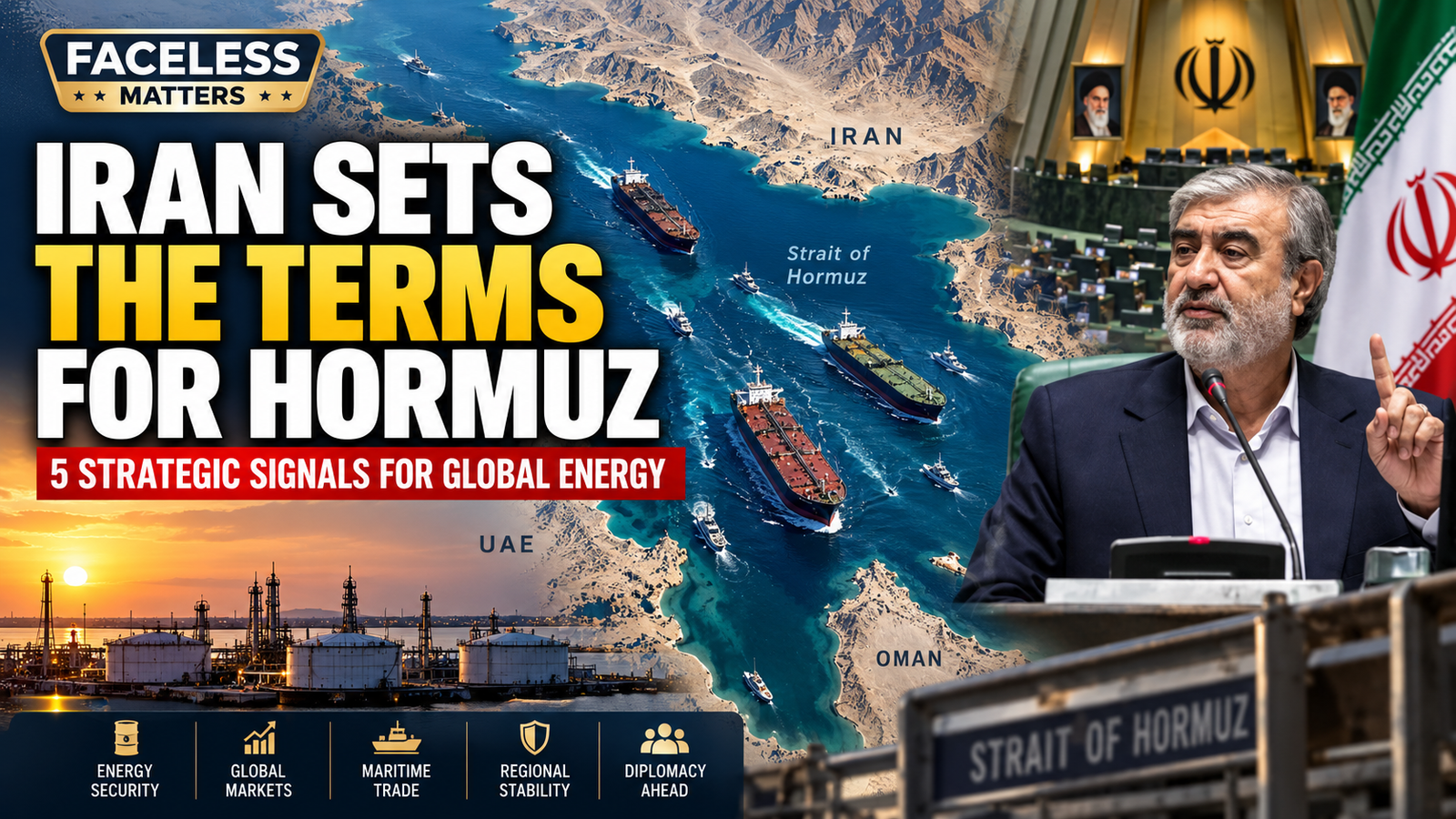
Iran has reinforced its position that the Iran Strait of Hormuz question cannot be separated from Tehran’s security and diplomatic demands. On September 3, the head of Iran’s parliamentary National Security and Foreign Policy Commission said the waterway would not be opened without Iran’s consent.
The statement comes as tensions between Iran and the United States remain high, shipping through the strategic waterway has been heavily disrupted, and global oil prices have reacted to renewed concerns over Middle Eastern supply risks. Reuters reported that Brent crude reached six-week highs amid the latest escalation.
But the significance goes beyond one maritime passage.
The Iran Strait of Hormuz dispute now sits at the intersection of military deterrence, diplomacy, international shipping, energy security, oil prices and the future of regional economic stability.
This article examines five strategic signals behind Tehran’s latest position and what they could mean for global markets and Pakistan.
What Iran Is Saying About Hormuz
Iran’s latest message is straightforward: Tehran does not view reopening the Strait of Hormuz as an ordinary shipping decision.
Ebrahim Azizi, head of Iran’s parliamentary National Security and Foreign Policy Commission, said the strait would not be opened without Iran’s consent, according to reporting carried by Dawn from Iranian state media.
The statement follows a broader pattern.
Iranian officials have repeatedly linked maritime access to the implementation of commitments under the June Islamabad memorandum and to wider security conditions.
On September 2, Iranian Parliament Speaker Mohammad Bagher Qalibaf said the United States must fulfill its commitments before Tehran could proceed toward reopening the waterway.
This means the issue is no longer simply about shipping.
For Tehran, maritime access has become part of a larger negotiation involving sanctions, military activity, security guarantees and diplomatic commitments.
Why the Strait Matters to the World
The strategic importance of the Iran Strait of Hormuz comes from geography and its position between major energy-producing and energy-consuming markets.
The waterway connects the Persian Gulf with the Gulf of Oman and the wider Arabian Sea. Before the current conflict, it carried roughly one-fifth of global oil and liquefied natural gas shipments.
That makes disruption potentially important far beyond Iran.
A prolonged reduction in shipping can influence:
- crude oil prices;
- LNG markets;
- shipping insurance;
- freight costs;
- refinery economics;
- inflation;
- energy security;
- foreign-exchange pressures;
- and global investor sentiment.
The latest market reaction illustrates the connection. Reuters reported on September 4 that Brent crude was around $95.67 per barrel and had gained 7.1% during the week as concerns over Middle Eastern supply disruptions intensified.
The Iran Strait of Hormuz confrontation therefore has an unusually powerful economic transmission mechanism.
A security development in a narrow waterway can eventually reach consumers, manufacturers and investors thousands of kilometres away.
Signal One: Tehran Wants Negotiating Leverage
The first major signal is diplomatic.
Iran appears to be using control over maritime access as leverage in a much broader confrontation with Washington.
Iranian officials have repeatedly connected the reopening question with American commitments and the wider conflict.
Reuters reported in late August that Iran had been preparing conditions for reopening Hormuz, including demands linked to the U.S. blockade, sanctions, compensation and the regional war.
The significance is considerable.
If maritime access becomes part of negotiations, then Hormuz is no longer merely a transportation route. It becomes a bargaining instrument.
That gives Tehran an additional strategic card in the Iran Strait of Hormuz dispute.
However, leverage has limits.
Every additional restriction also increases economic costs for Iran and for other countries dependent on the waterway.
The Iran Strait of Hormuz strategy therefore requires a difficult calculation:
How much pressure can Iran maintain without producing economic consequences that become harder to manage?
That question will become increasingly important if restrictions continue.
Signal Two: Maritime Control Has Become a Strategic Asset
The second signal is that Iran increasingly treats maritime access as a security issue.
Iranian officials have argued that the country has the ability to regulate navigation through the waterway and have resisted attempts to establish arrangements that Tehran considers inconsistent with its security interests.
In late August, Iran’s Supreme National Security Council secretary Mohsen Rezaei said Tehran was considering conditions for reopening Hormuz and described discussions with Oman concerning a possible shipping corridor.
At the same time, Reuters reported that Iran expanded its blacklist of vessels restricted from passing through the strait to 56 ships.
This illustrates how the maritime issue is evolving.
The debate is not only about whether ships can move.
It is increasingly about:
Who determines the rules?
That is a fundamentally different strategic question.
Signal Three: Energy Markets Are Directly Exposed
The third signal is financial.
Hormuz has become a major source of uncertainty for global energy markets.
When traders believe that oil transportation could be disrupted, the market can price in a risk premium even before physical supply shortages become severe.
That affects oil prices, shipping costs and inflation expectations.
Reuters reported that oil prices reached six-week highs on September 3 after renewed U.S.-Iran military escalation. Brent rose to $97.29 per barrel during the session, while WTI reached $93.04.
By September 4, Brent remained elevated despite some intraday moderation.
For businesses, this creates several layers of risk.
Higher crude prices can raise transportation costs.
Higher shipping insurance can increase import expenses.
More expensive energy can raise production costs.
And persistent uncertainty can make companies more cautious about long-term investment.
This is why the Iran Strait of Hormuz issue should also be understood as an energy-market and investment-risk story.
Signal Four: Diplomacy and Security Are Now Linked
The fourth signal is diplomatic.
Iran has not completely abandoned the possibility of negotiation.
President Masoud Pezeshkian said on September 1 that Tehran would reciprocate if Washington returned to its commitments under the interim agreement. Reuters also reported that Tehran continued to connect free navigation through Hormuz with implementation of the agreement.
This creates a complicated strategic structure.
On one side:
Military pressure → deterrence → maritime restrictions
On the other:
Negotiation → commitments → potential maritime normalization
The two tracks are operating simultaneously.
That is why the future of Hormuz cannot be assessed only through military developments.
A diplomatic breakthrough could potentially improve shipping conditions without requiring a permanent military solution.
But if negotiations fail, maritime restrictions could remain an important part of the confrontation.
Signal Five: The Crisis Is Becoming an International Economic Problem
The fifth signal may be the most important.
The Hormuz dispute is increasingly affecting countries that are not direct participants in the Iran-U.S. confrontation.
Asian economies are particularly exposed because many depend heavily on imported energy.
Shipping companies face route and insurance risks.
Refiners must consider supply reliability.
Governments must consider inflation.
Central banks must consider the effect of energy prices on monetary policy.
Investors must evaluate geopolitical risk when pricing assets.
The latest developments have also encouraged other governments to consider their own role in protecting navigation.
Reuters reported that South Korea was reviewing options for supporting freedom of navigation in the Strait of Hormuz, although Seoul clarified that reports of a finalized deployment plan were inaccurate.
That is an important development.
The more countries become involved in maritime security, the more the Hormuz question becomes an international coordination challenge.
Pakistan’s Strategic and Economic Exposure
Pakistan has a particularly strong reason to monitor the situation.
The country is geographically close to the Gulf and depends heavily on imported energy.
Any sustained increase in oil prices can affect:
- the import bill;
- foreign-exchange requirements;
- transportation costs;
- electricity generation;
- inflation;
- and household purchasing power.
This makes the Iran Strait of Hormuz situation relevant to Pakistan even though Islamabad is not a party to the confrontation.
Pakistan also has an important diplomatic interest.
Islamabad previously played a mediation role in the June negotiations between Iran and the United States. The Islamabad memorandum subsequently became an important reference point in discussions over regional de-escalation and maritime access.
That gives Pakistan an opportunity to support diplomacy while protecting its own economic interests.
For Islamabad, the ideal outcome would be a reduction in tensions that restores predictable energy and shipping conditions.
FACELESS MATTERS Analysis: The Real Hormuz Question
The most important question is not simply:
Can Iran keep the Strait of Hormuz restricted?
The deeper question is:
Can maritime pressure produce diplomatic leverage without creating a wider economic crisis?
That distinction matters. This wider perspective also matters for policymakers and businesses assessing resilience. Energy security is no longer only a question of supply; it is increasingly connected to maritime access, insurance, logistics, currency stability, investment planning and diplomatic risk. These factors can shape decisions well beyond the immediate region over time ahead.
Iran has demonstrated that Hormuz can be used as a strategic pressure point.
But every day of disruption also increases uncertainty for international trade.
For Tehran, the objective is therefore not necessarily maximum disruption.
The strategic objective may be to demonstrate that Iran has sufficient influence over the waterway to make maritime security part of any future negotiation.
That is a more sustainable strategic interpretation than assuming Iran simply wants to permanently close the route.
At the same time, the United States and its partners face their own calculation.
They want safe commercial navigation but must avoid turning a maritime confrontation into a broader regional war.
The economic consequences of miscalculation around the Iran Strait of Hormuz could be substantial.
What Could Go Right?
A positive scenario remains possible.
Iran, the United States and regional mediators could eventually agree on practical maritime arrangements.
Oman and other regional states could help facilitate communication.
Pakistan could continue supporting diplomatic channels.
A negotiated framework could gradually restore commercial shipping.
If that happens, several benefits could follow:
- Lower geopolitical risk premiums.
- Greater shipping confidence.
- Reduced pressure on oil prices.
- Improved regional trade conditions.
- Better investor sentiment.
- Greater economic stability for energy-importing countries.
The most constructive outcome for the Iran Strait of Hormuz would therefore not be a military victory for one side.
It would be a predictable maritime framework accepted by the relevant parties.
What Could Go Wrong?
The risks are equally serious.
A prolonged confrontation could push oil prices higher.
More ships could face restrictions.
Insurance costs could rise.
Alternative shipping routes could become more expensive.
Energy-importing countries could experience additional inflation.
And military incidents involving commercial vessels could create pressure for further international intervention.
The most dangerous scenario would be a cycle in which:
maritime restriction → military response → retaliation → tighter restriction → higher energy prices
Such a cycle could become increasingly difficult to reverse.
What Happens Next?
Several developments deserve close attention.
1. Will diplomatic negotiations resume?
Iran has continued to signal that diplomacy remains possible under acceptable conditions, while Washington has emphasized the need for safe maritime passage.
2. Will Hormuz restrictions expand?
Iran has already increased the number of vessels on its blacklist, showing that maritime controls remain an active instrument.
3. Will regional mediators gain influence?
Oman, Qatar and Pakistan have all played roles in regional diplomatic efforts. Their ability to maintain communication channels could become increasingly important.
4. What happens to oil prices?
Markets will closely watch Iran Strait of Hormuz shipping volumes, inventories, alternative supply and the probability of further escalation.
5. Will more countries support maritime security?
South Korea’s current review demonstrates that the issue could gradually involve additional international actors.
Why This Matters Beyond the Gulf
The Iran Strait of Hormuz crisis demonstrates how geography can still shape the global economy in the digital age.
Modern financial markets may operate electronically, but physical energy still needs to move through physical infrastructure.
A narrow waterway can therefore influence:
energy → transportation → inflation → interest rates → investment → economic growth
That chain is what makes Hormuz so important.
For investors, the episode is also a reminder that geopolitical risk is not an abstract concept.
It can directly influence commodity prices, corporate costs, shipping contracts and capital allocation.
For governments, it demonstrates the importance of energy diversification, strategic reserves and resilient supply chains.
For Pakistan, it reinforces the importance of managing external energy exposure while maintaining diplomatic engagement with regional partners.
Final FACELESS MATTERS Strategic Assessment
The latest Iranian warning should not be interpreted simply as another statement in an already crowded regional conflict.
The Iran Strait of Hormuz issue has become a strategic intersection between military deterrence, diplomacy, energy security and global trade.
Tehran is signaling that it wants a major voice in determining the conditions under which maritime traffic returns to normal.
Washington and its partners are focused on freedom of navigation and the security of commercial shipping.
Regional mediators are trying to prevent those positions from developing into a much larger confrontation.
The economic stakes are enormous.
The most responsible interpretation is therefore neither that Hormuz will inevitably remain closed nor that reopening is imminent.
The outcome depends on diplomacy, security guarantees, military developments and the ability of the parties to establish a workable maritime arrangement.
For global investors and businesses, the lesson is clear:
Geopolitical risk can become energy risk, and energy risk can quickly become financial risk.
For Pakistan, the lesson is even more immediate: stability in the Gulf is directly connected to the country’s energy costs, inflation, trade balance and economic resilience.
The next phase of the Hormuz crisis will therefore be watched not only in Tehran and Washington, but also in financial markets, shipping companies, energy ministries and capitals across Asia.
INTERNAL LINKS
1. Makkah Defence Alliance: 5 Essential Facts for Pakistan
A recent FACELESS MATTERS analysis examining Pakistan’s evolving regional security partnerships and their wider strategic implications.
2. Pakistan Debt Repayment 2026: A Major Test of Fiscal Management
This economic analysis provides useful context on Pakistan’s fiscal management, financial stability and investor confidence at a time when energy-price volatility can affect external finances.
3. AI Infrastructure Boom: 7 Shifts in Chips & Data Centers
A Business analysis exploring infrastructure investment, energy requirements, capital allocation and technology-driven economic transformation.
TRUSTED EXTERNAL SOURCES
- Dawn — Iran says Strait of Hormuz cannot reopen without Tehran’s consent
- Reuters — Iran sets conditions for reopening Strait of Hormuz
- Reuters — Iran blacklists more ships trying to sail through Hormuz
- Reuters — Oil set for steepest weekly gain amid intensifying tensions
- Reuters — South Korea reviews options to support Hormuz navigation
SOURCE VERIFICATION & FACELESS MATTERS ANALYSIS
The September 3 Iranian statement concerning Tehran’s consent for reopening the Strait of Hormuz was cross-checked against current reporting from Dawn, while Reuters reporting was used to establish the wider maritime, energy-market and diplomatic context.
The article also incorporates Reuters reporting on current oil-price movements and the latest international discussion around freedom of navigation.
Iranian claims and positions are presented as statements by Iranian officials rather than independently established facts. Likewise, references to future negotiations, shipping normalization or energy-market outcomes are presented as possibilities rather than guaranteed developments.
The FACELESS MATTERS analysis focuses on the strategic relationship between maritime security, diplomacy, energy markets, geopolitical risk, international trade and Pakistan’s economic exposure.
Editorial Note
This article is intended for news, educational and analytical purposes. It does not constitute financial, investment, legal or professional advice. Readers should verify rapidly changing geopolitical and market developments through current authoritative sources.
[…] Iran Strait of Hormuz: 5 Strategic Signals Behind Tehran’s Latest Warningآبنائے ہرمز، ایران کی حکمتِ عملی، عالمی توانائی اور پاکستان پر ممکنہ معاشی اثرات کا تفصیلی تجزیہ۔ […]
[…] Iran Strait of Hormuz: 5 Strategic Signals Behind Tehran’s Latest Warning […]
[…] Iran Strait of Hormuz: 5 Strategic Signals Behind Tehran’s Latest Warning […]
[…] Iran Strait of Hormuz: 5 Strategic Signals Behind Tehran’s Latest Warning […]