

TABLE OF CONTENTS
Science • Space • Research
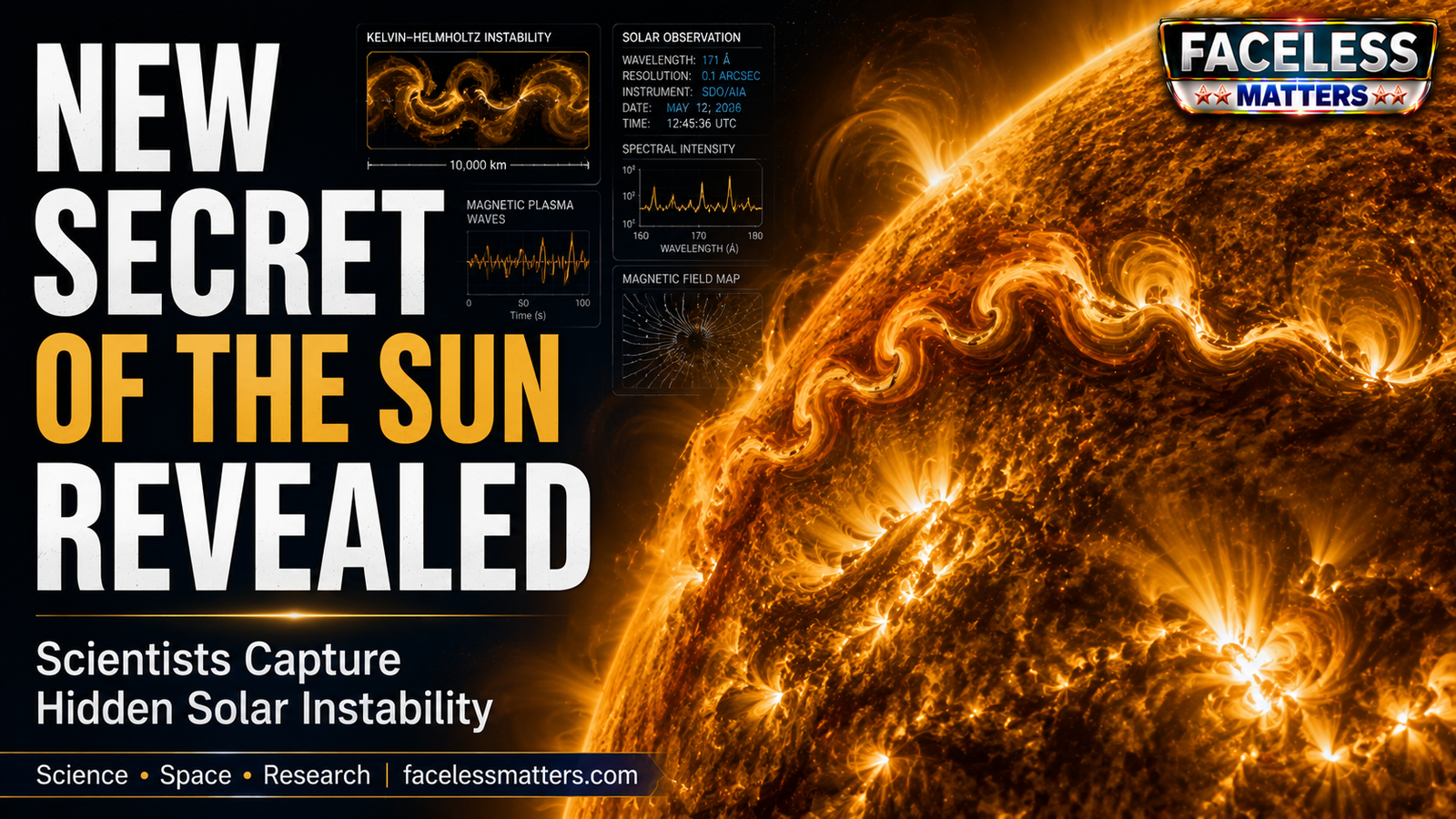
Recent solar research is providing new evidence about solar instability and the complex magnetic processes shaping the Sun’s atmosphere.
Scientists have captured unusually detailed evidence of a physical process taking place on the surface of the Sun, providing researchers with a new way to investigate how solar plasma moves and how magnetic energy is transferred through the Sun’s atmosphere.
The phenomenon is known as Kelvin-Helmholtz instability (KHI). It occurs when layers or streams of fluid or plasma move at different speeds, creating wave-like patterns and swirling structures. Scientists have long expected similar instabilities to occur on the Sun, but new observations from the Daniel K. Inouye Solar Telescope have provided exceptionally detailed evidence of these structures. NCAR News
The discovery is important because the Sun is not a static ball of gas. Its visible surface is a constantly changing environment dominated by moving plasma, magnetic fields and powerful energy flows. Understanding these processes could help scientists explain how energy travels through the solar atmosphere and contributes to some of the Sun’s most powerful activity.
A New Look at the Sun’s Surface
These observations provide a closer look at solar instability and the magnetic processes that shape the Sun’s visible atmosphere.
The observations were made using the Daniel K. Inouye Solar Telescope in Hawaii, one of the world’s most powerful solar telescopes. Researchers combined extremely detailed observations with sophisticated computer simulations to investigate the structures appearing on the Sun’s surface. NCAR News
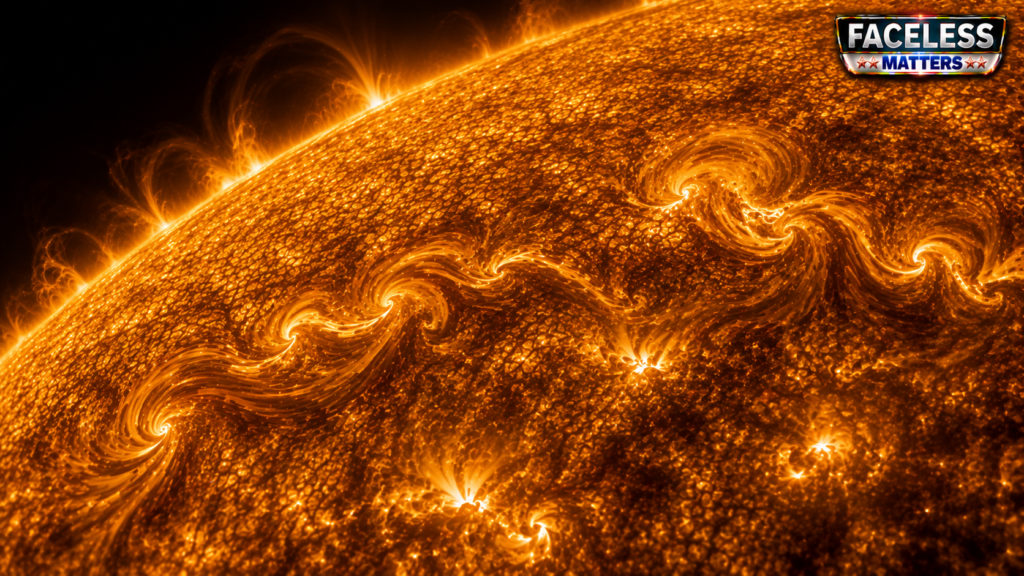
The resulting observations show small-scale bands and vortex-like patterns in the solar photosphere. According to researchers, these structures are associated with Kelvin-Helmholtz instability, a process that can appear when neighboring flows move at different speeds.
On Earth, similar instabilities can be observed in fluid and atmospheric systems. In the Sun, however, the material involved is extremely hot plasma controlled by powerful magnetic fields.
That makes the solar version of the phenomenon particularly valuable for understanding the physics of stars.
What Is Kelvin-Helmholtz Instability?
Kelvin-Helmholtz instability is a physical process that develops when two flowing layers move relative to each other.
On the Sun, this interaction may contribute to forms of solar instability that researchers can now study at much finer scales.
Imagine two streams of material moving in different directions or at different speeds. Instead of remaining perfectly smooth, the boundary between them can develop waves. As the instability grows, those waves can form increasingly complex swirling structures.
The same fundamental physics can appear in many environments, including Earth’s atmosphere, oceans and astrophysical plasma.
On the Sun, researchers are interested in KHI because plasma is strongly connected to magnetic fields. The movement of plasma can influence how magnetic energy is distributed and transported.
The newly observed structures therefore provide scientists with another piece of evidence for understanding the complicated interaction between solar plasma and magnetic fields. NCAR News
Why the Discovery Matters
Studying solar instability can help scientists better understand how energy and magnetic structures move through the solar atmosphere.
The significance of the observation goes beyond producing a more detailed picture of the Sun.
Scientists want to understand how energy moves from the Sun’s surface into its outer atmosphere. The solar corona, despite being much farther from the visible surface, reaches extremely high temperatures. Researchers continue to investigate the mechanisms responsible for this heating.
The newly observed instabilities may help researchers study how energy and magnetic structures move through the solar atmosphere.
Researchers also believe the process could be relevant to the buildup and movement of magnetic energy. That is important because magnetic energy is closely associated with some of the Sun’s most dynamic events, including solar flares and eruptions. NCAR News
This does not mean that every Kelvin-Helmholtz structure automatically produces a solar flare. Rather, the observation gives scientists a new physical process to investigate when studying how energy and magnetic fields behave in active regions.
The Role of the Inouye Solar Telescope
Its high-resolution observations give researchers a powerful way to examine solar instability directly.
The Daniel K. Inouye Solar Telescope is particularly important because solar research depends heavily on resolving very small structures.
The Sun may be approximately 150 million kilometres from Earth, yet the telescope can examine details on its visible surface at extraordinary resolution.
Recent NASA coverage of the observations described the new images as the highest-resolution visible-light observations of the Sun available from this research. NASA’s Astronomy Picture of the Day also highlighted the swirling structures and explained how they may help researchers investigate the movement of energy and magnetic fields. NASA Science
The ability to observe small structures is essential because many solar processes begin or develop at scales that are difficult to distinguish using older instruments.
Higher-resolution observations allow researchers to compare what they see with computer simulations and test whether theoretical models accurately describe the behavior of solar plasma.
Could This Help Explain Solar Flares?
Solar flares are among the most powerful explosions in the solar system. They release enormous amounts of energy and can produce radiation that reaches Earth.
Major solar activity can also be connected to disturbances in space weather, which may affect satellites, radio communications, navigation systems and other technological infrastructure.
The new solar-instability research does not provide a complete explanation for solar flares. However, it could help scientists understand some of the smaller-scale physical processes through which magnetic energy moves and changes in the solar atmosphere.
This distinction is important.
Scientific discoveries rarely provide an instant answer to a major question. Instead, new observations often provide another piece of evidence that can be incorporated into broader models.
In this case, the detailed observation of Kelvin-Helmholtz structures gives researchers another physical mechanism to investigate as they study solar magnetic activity.
A Better Understanding of Solar Instability
The Sun is the primary source of energy for life on Earth, but it is also an extremely complex physical system.
Its surface constantly changes. Plasma rises and falls, magnetic fields emerge and interact, and energy travels through different layers of its atmosphere.
Modern solar telescopes are allowing researchers to study these processes at increasingly smaller scales.
The August 2026 observations are particularly significant because scientists were able to see numerous structures that had previously been difficult to observe directly. Nature highlighted the research as part of its coverage of the Sun’s detailed surface dynamics, noting that the observed band-like and vortex-like structures are associated with Kelvin-Helmholtz instabilities. Nature
What Scientists Will Study Next
Future research will examine whether these structures remain stable or evolve as part of broader solar instability processes.
The discovery opens several areas for further research.
Scientists can now investigate how frequently these instabilities occur, how long they survive, how their structures evolve and how strongly they interact with magnetic fields.
Researchers can also compare future observations with increasingly sophisticated computer simulations.
One important question is whether these structures play a measurable role in transporting energy through the solar atmosphere.
Another is whether their presence changes how scientists understand magnetic activity in regions of the Sun that can eventually produce flares or other energetic events.
These questions will require additional observations and modelling rather than immediate conclusions.
Why Solar Research Matters on Earth
Studying the Sun is not only about understanding astronomy.
Modern civilization relies heavily on space-based and electronic technologies. Satellites provide communication, navigation, weather information and scientific measurements.
Strong solar activity can disturb Earth’s near-space environment. Better understanding of the physical processes behind solar activity can therefore contribute to improved space-weather forecasting.
That could eventually help governments, satellite operators, aviation systems and other technology-dependent industries prepare for periods of increased solar activity.
The new observations are one part of a much larger scientific effort to understand the star at the center of our solar system.
The Bigger Scientific Picture
The latest discovery demonstrates how advances in scientific instruments can change what researchers are able to see.
A phenomenon may have been predicted theoretically for years, but observing it directly and in sufficient detail can provide a much stronger basis for testing scientific models.
That is what makes high-resolution solar observations so valuable.
The Sun continues to reveal structures that were previously hidden from direct observation. Each new observation gives researchers an opportunity to refine their understanding of plasma physics, magnetic fields and stellar atmospheres.
For the public, the discovery is another reminder that even the most familiar object in our sky still contains major scientific mysteries.
For researchers, it represents another opportunity to understand how energy moves through stars.
Strategic Conclusion
A clearer understanding of solar instability could improve scientific models of solar activity and its effects on the space environment around Earth.
The observation of Kelvin-Helmholtz instability on the Sun does not solve the mysteries of solar activity, but it provides scientists with an important new observational window.
The detailed structures captured by the Inouye Solar Telescope demonstrate how modern instruments are allowing researchers to examine solar plasma at unprecedented scales. NCAR News
The next stage will be determining exactly how these instabilities interact with magnetic fields and whether they contribute meaningfully to energy transport, atmospheric heating or the development of solar activity.
The discovery therefore represents more than another impressive solar image. It is a step toward understanding the physical processes that govern our nearest star—and, ultimately, the space environment surrounding Earth.
Continued observation of solar instability will help researchers determine how these structures evolve and interact with magnetic fields over time.
Source Verification & Analysis
- NASA Science
- NASA James Webb Space Telescope Science
- NASA Goddard Space Flight Center
- National Science Foundation
- National Center for Atmospheric Research (NCAR)
- Nature
- Nature Astronomy & Astrophysics coverage
- Daniel K. Inouye Solar Telescope / National Solar Observatory
- Science News
- European Space Agency (ESA)
Verification note: The central scientific claims in this report were cross-checked against NASA, Nature and NCAR/NSF material concerning the August 2026 observations of Kelvin-Helmholtz instability on the Sun. NCAR News
Educational Note
This article is provided for educational and informational purposes. Scientific research continues to evolve, and observations of solar activity do not by themselves establish that a particular process directly causes a solar flare or other event. Further observations, modelling and peer-reviewed research are required before drawing stronger conclusions.
FACELESS MATTERS distinguishes scientific reporting from interpretation and presents developing research with appropriate context.
Suggested Future Internal Article
1. Global Bond Market Selloff: Why Borrowing Costs Are Rising in 2026
Use this as a macroeconomic connection because higher energy prices can influence inflation, interest rates and borrowing costs.
2. The AI Infrastructure Boom: Nvidia, OpenAI and the Global Race for Data Centers, Chips and Power
Use this for the connection between rising electricity demand, data centers, AI infrastructure and global power investment.
3. Pakistan Digital Economy Initiative 2026: Powerful Digital Growth
Use this as a Pakistan-focused technology and infrastructure connection because digital expansion also increases demand for reliable energy and electricity infrastructure.
Social / SEO Footer
Follow FACELESS MATTERS for independent news, science, technology, space research and important developments.
Website: facelessmatters.com