

TABLE OF CONTENTS
The latest intervention by U.S. Congresswoman Delia Ramirez has added a significant political and humanitarian dimension to the continuing conflict involving the United States, Iran and the wider Middle East.
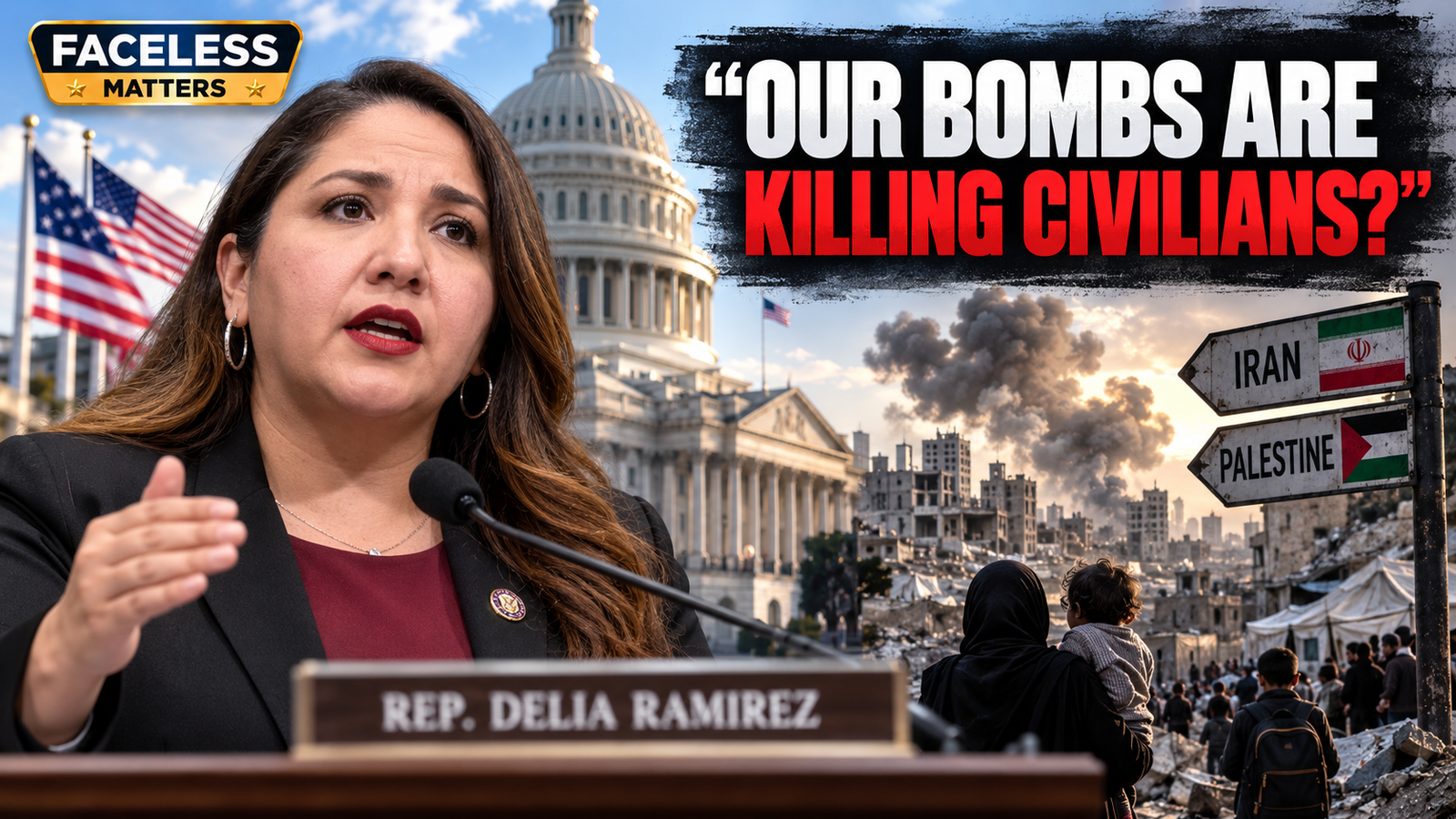
In a statement posted on X on September 3, Ramirez said that a day intended to celebrate a wedding had instead turned into devastation, arguing that American bombs were killing innocent women and children “from Palestine to Iran.” Her comments came amid reports of a deadly incident at a wedding gathering in southern Iran.
Independent reporting has said that a U.S. munition may have directly struck the gathering. India Today, citing Reuters reporting, said weapons experts assessed that the explosion likely resulted from a direct hit by a U.S. munition, while U.S. authorities said the incident was being investigated.
That distinction matters.
A reported civilian casualty incident, an allegation of responsibility and a final legal determination are three different things. FACELESS MATTERS therefore separates the available reporting from political claims and from its own strategic analysis.
What Happened in Southern Iran?
The immediate trigger for the latest political reaction was an explosion reported at a wedding celebration in the town of Kuhestak in southern Iran.
India Today’s live coverage, incorporating Reuters reporting, said four people were killed and 68 injured. It also reported that weapons experts concluded that the blast likely came from a direct hit by a U.S. munition rather than a ricochet. U.S. authorities said the incident was under investigation.
The broader military context is also important.
U.S. forces carried out strikes across southern Iran on September 1 against reported military targets, including air-defence systems, radar installations and communications facilities. The reported wedding incident subsequently became part of the debate over civilian protection and military targeting.
This means readers should avoid presenting preliminary findings as a completed investigation.
The precise target, intelligence assessment, weapon used, operational decisions and circumstances surrounding the explosion require evidence and official investigation.
Why Delia Ramirez’s Statement Matters
Delia Ramirez is a sitting Democratic member of the U.S. House representing Illinois’s 3rd Congressional District.
Her latest statement was not simply criticism of a single military incident. She connected civilian casualties with congressional oversight, weapons transfers and the constitutional role of Congress in decisions involving military force.
Ramirez said Congress could not continue to turn a blind eye to what she described as war crimes by President Donald Trump and Defense Secretary Pete Hegseth. She also called for passage of the Block the Bombs Act, greater congressional authority and an end to what she characterized as an endless war.
Because “war crimes” is a legal term, FACELESS MATTERS presents that wording as Ramirez’s political allegation rather than an independently established judicial conclusion.
Warning One: Civilian Protection Is Becoming a Central Test
The first major signal is humanitarian.
Military operations are judged not only by their intended military objectives but also by the precautions taken to reduce civilian harm and the proportionality of expected civilian losses in relation to legitimate military objectives.
When a strike is reported to have hit a wedding gathering, the political consequences can become substantial even before every operational detail is established.
Civilian casualties can:
- increase congressional scrutiny;
- intensify public opposition;
- create diplomatic pressure;
- damage international confidence;
- and make future military operations politically harder to sustain.
For Delia Ramirez, this humanitarian dimension is central to her criticism.
The wider question for Washington is whether military operations can maintain their strategic objectives while demonstrating credible mechanisms for protecting civilians and investigating allegations when civilian casualties occur.
Warning Two: Congress Is Reopening the War-Powers Debate
The second signal is constitutional and political.
Ramirez’s call for Congress to reclaim its authority reflects the longstanding U.S. debate over executive war powers.
The argument is straightforward: Congress should not merely react after military operations happen. Lawmakers should have meaningful oversight over military force, weapons policy and public funding.
That debate becomes particularly sensitive during prolonged conflicts.
The Block the Bombs Act is one example of the legislative approach associated with Ramirez. Her congressional office says the proposal would condition the transfer of certain offensive weapons to Israel on written assurances concerning their use under U.S. and international law, with congressional approval involved in the process.
The bill does not represent current U.S. law merely because it has congressional sponsors.
Its importance is political: it provides lawmakers with a mechanism for challenging existing weapons-transfer policy.
Warning Three: The Cost of War Extends Beyond the Battlefield
The third warning is economic.
Military conflict consumes public resources, while prolonged operations can create competing demands for government spending.
But the economic consequences do not stop at the U.S. federal budget.
The current U.S.-Iran confrontation is also affecting energy markets, shipping risks and inflation expectations.
Reuters reported on September 4 that Brent crude was around $95.67 per barrel, while U.S. West Texas Intermediate was around $91.56. Brent was heading toward a weekly gain of about 7.1%, while WTI was up roughly 9.8% over the week.
Higher oil prices can feed into:
energy costs → transportation → production → consumer prices → inflation → interest-rate expectations
That chain matters for the United States, Europe, Asia and energy-importing economies around the world.
Therefore, Delia Ramirez’s criticism of taxpayer spending intersects with a much broader economic question: how much financial and economic pressure can prolonged conflict create?
Warning Four: U.S. Domestic Politics Are Becoming Part of the Conflict
The fourth signal is political polarization.
The Iran conflict is taking place alongside disagreements in Washington over military authority, weapons transfers, civilian casualties and government spending.
Delia Ramirez represents one prominent position within that debate.
Her comments are likely to attract support from voters and advocacy groups focused on civilian protection, human rights and restrictions on military intervention.
At the same time, supporters of a harder military policy may argue that pressure against Iran is necessary to protect American interests, commercial shipping and regional security.
The significance goes beyond one congresswoman.
If more lawmakers adopt similar positions, congressional pressure could increase for:
- investigations;
- hearings;
- military reporting requirements;
- funding restrictions;
- war-powers resolutions;
- and greater transparency surrounding targeting decisions.
If the administration retains sufficient congressional support, however, immediate legislative change could remain limited.
Warning Five: America’s Global Reputation Is Also at Stake
The fifth warning reaches beyond Washington.
The United States is a major military, financial, technological and diplomatic power.
Its actions are closely watched by European governments, Asian allies, Middle Eastern states, international organizations, businesses and investors.
Allegations of civilian harm can therefore create a reputational problem even while investigations are ongoing.
U.S. allies may demand greater transparency.
Opponents may use civilian-casualty reports in information campaigns.
Investors may focus on the possibility that military escalation could spread into energy infrastructure and shipping routes.
The global question is therefore not simply whether the United States achieves a particular tactical objective.
It is also whether Washington can maintain confidence in its alliances and international credibility while conducting military operations.
What Is the Block the Bombs Act?
The Block the Bombs Act is a legislative proposal associated with Ramirez and other members of Congress.
Ramirez’s official congressional office says the proposal would require Israel’s government to provide written assurances concerning the use of certain offensive weapons in accordance with U.S. and international law, with congressional approval involved in the transfer process. The legislation specifically distinguishes offensive weapons from defensive systems such as Iron Dome.
In June 2026, Ramirez’s office said the proposal had reached 73 congressional cosponsors. A bill’s number of cosponsors, however, does not guarantee that it will become law.
The significance is therefore institutional.
The legislation represents an attempt by lawmakers to connect weapons policy with congressional oversight and legal standards.
FACELESS MATTERS Analysis: What Washington Should Watch
The most important question is not whether one congressional statement remains in the news cycle.
The more important question is whether the controversy produces measurable policy consequences.
There are five indicators worth watching.
1. The investigation
Will U.S. authorities provide a detailed explanation of what happened at the reported wedding gathering?
2. Targeting information
Will information emerge about the intended target, intelligence assessment and weapon used?
3. Congressional oversight
Will lawmakers demand hearings, reports or additional restrictions concerning military operations?
4. Legislative momentum
Will the Block the Bombs Act gain additional support or move closer to a formal vote?
5. Public opinion
Will reported civilian casualties change American public attitudes toward the wider Iran conflict?
These indicators are more meaningful than simply counting social-media reactions.
The Iran Conflict and Energy Security
The humanitarian debate is unfolding alongside a major energy-security challenge.
The Strait of Hormuz remains a critical global energy corridor. Any prolonged disruption can influence oil prices, tanker availability, shipping insurance and energy-import costs.
Recent reporting indicates that military escalation is already affecting commercial shipping and market expectations.
This creates a powerful chain:
Military escalation → shipping risk → energy volatility → inflation pressure → policy uncertainty → investment risk
The implications extend well beyond Iran.
Europe can face higher industrial and transportation costs.
Asian importers can face increased energy bills.
Developing economies can experience renewed inflationary pressure.
The United States can face additional political and fiscal pressure.
This is why the humanitarian and economic dimensions of the conflict cannot be examined entirely separately.
Europe’s Difficult Balancing Act
European governments face a particularly complicated environment.
Many European countries maintain strong security relationships with Washington while simultaneously remaining highly exposed to energy prices, shipping disruptions and broader Middle Eastern instability.
If crude prices remain elevated, manufacturers, airlines, logistics companies and households can face additional costs.
At the same time, civilian-casualty controversies can increase public pressure for diplomatic engagement, humanitarian safeguards and greater transparency.
This could create a difficult balance between strategic alignment with Washington and domestic demands for de-escalation.
For European investors, policymakers and businesses, the trajectory of the U.S.-Iran confrontation could therefore become an important economic variable.
Why Global Investors Should Pay Attention
Financial markets typically react quickly to geopolitical uncertainty.
If investors believe a conflict could disrupt energy supplies for a prolonged period, oil prices can remain elevated.
Higher energy prices can influence inflation expectations and complicate central-bank decisions.
Different sectors can experience very different effects.
Energy producers may benefit from higher prices.
Airlines and transport companies can face increased costs.
Manufacturers may encounter higher input expenses.
Shipping and insurance businesses can face greater risk premiums.
Defense companies may see stronger demand expectations.
However, it would be misleading to attribute every market movement to one political statement.
Markets respond to a combination of military developments, economic data, monetary-policy expectations, earnings and geopolitical risk.
The key issue is whether the controversy contributes to a longer and more uncertain conflict.
Delia Ramirez and the Bigger U.S. Political Question
The significance of Delia Ramirez’s remarks goes beyond her individual political position.
They highlight a question that has repeatedly emerged in American foreign policy:
Who should ultimately decide when and how the United States uses military force?
The executive branch possesses significant authority over national security and military operations.
Congress controls legislation, appropriations and oversight.
The tension between those powers becomes especially important during prolonged conflicts.
If civilian-casualty investigations create new political pressure, lawmakers could seek greater transparency over military operations.
That could include requests for intelligence assessments, targeting information, casualty reports and explanations of the rules governing specific operations.
Such oversight would not automatically mean Congress opposes U.S. national-security objectives.
It could instead represent an institutional demand for accountability.
FACELESS MATTERS Strategic Assessment
Delia Ramirez’s latest statement brings together three major debates:
- Civilian protection
- Congressional war powers
- The financial and strategic cost of prolonged military action
Her language is intentionally strong.
Terms such as “war crimes” should therefore remain attributed to the speaker unless established by a competent legal authority.
The underlying issue, however, is broader than political rhetoric.
If a credible investigation establishes unlawful conduct, inadequate precautions or other violations, the consequences could extend into congressional oversight, military policy, legal scrutiny and international diplomacy.
If an investigation instead determines that the incident resulted from an unintended outcome despite appropriate precautions, the political debate could continue, but its factual foundation would be different.
That is why evidence matters.
What Could Happen Next?
Several developments could shape the next phase.
Scenario One: Investigation increases pressure
A detailed investigation confirming serious civilian-protection failures could increase demands for congressional action.
Scenario Two: Conflict expands
Further U.S.-Iran escalation could increase energy prices, shipping risks and political pressure across Europe and Asia.
Scenario Three: Diplomacy gains momentum
Diplomatic engagement could reduce immediate military pressure and shift attention back toward negotiations.
Scenario Four: More civilian casualties occur
Additional incidents could intensify international criticism and make the political debate inside Washington substantially more difficult.
Scenario Five: Markets become the dominant pressure point
A prolonged energy disruption could force governments and central banks to focus increasingly on inflation and economic stability.
The political significance of Delia Ramirez’s position also extends beyond the immediate Iran conflict. Her argument places civilian protection, congressional oversight and U.S. foreign policy at the center of a wider debate over how Washington conducts military operations. For international observers, the issue is equally important because decisions made in Washington can affect energy markets, diplomatic relations, humanitarian policy and investor confidence across multiple regions. Her intervention therefore deserves attention as part of a broader discussion about accountability and the future direction of American foreign policy.
Final FACELESS MATTERS Assessment
The latest remarks from Delia Ramirez are significant because they connect the human consequences of war with congressional authority, weapons policy, taxpayer spending and America’s international reputation.
The reported wedding incident in southern Iran deserves careful investigation.
Civilian deaths should be treated with the highest seriousness, but allegations should not automatically be transformed into final legal conclusions before evidence is established.
At the same time, Washington faces a broader strategic test.
Military operations may achieve immediate objectives while creating longer-term costs through political polarization, energy volatility, diplomatic friction and reputational damage.
The strongest institutional response is therefore not simply louder political rhetoric.
It is:
transparent investigation + credible accountability + lawful targeting + congressional oversight + diplomatic engagement.
For Americans, Europeans and the wider international community, the central lesson is increasingly clear.
Modern geopolitical conflict does not remain confined to battlefields.
It can move through oil markets, shipping lanes, inflation expectations, government budgets, investment decisions and international relations.
That is why the latest Washington debate surrounding Delia Ramirez deserves attention far beyond the United States.
INTERNAL LINKS
- Iran US Drone Display: 5 Strategic Signals Behind the Move — A recent FACELESS MATTERS analysis of Iran-U.S. military technology, strategic messaging and the wider confrontation.
- Makkah Defence Alliance: 5 Essential Facts for Pakistan — Relevant to the changing Middle Eastern security environment and regional strategic calculations.
- World News 2026: 4 Major Global Risks to Watch — Connects the Iran conflict with global energy, trade, geopolitical and economic risks.
TRUSTED EXTERNAL SOURCES
The latest remarks by Ramirez were cross-checked against independent reporting from WE News and Reuters-based coverage published through India Today.
The legislative background was cross-checked against Representative Delia Ramirez’s official House website, including her office’s information about the Block the Bombs Act.
SOURCE VERIFICATION & FACELESS MATTERS ANALYSIS
FACELESS MATTERS used the supplied Jang report as the starting point for this news angle and cross-checked the latest available reporting on September 4, 2026.
Independent reporting confirms that Ramirez posted her statement on September 3 and called for passage of the Block the Bombs Act.
India Today’s live coverage, incorporating Reuters reporting, provided the reported details concerning the southern Iran wedding incident, casualties and the investigation into the reported U.S. munition strike.
Ramirez’s official congressional website confirms her involvement with the Block the Bombs Act and explains the legislation’s proposed conditions concerning certain offensive weapons transfers.
FACELESS MATTERS analysis in this article addresses the potential humanitarian, political, economic, energy-security and international-relations implications of the reported developments.
Political allegations and legal terminology have been attributed to their speakers and have not been presented as independently established judicial findings.
Editorial Note: FACELESS MATTERS distinguishes reported facts, official statements, political allegations and independent analysis. This article is for informational and educational purposes and does not constitute legal, military, investment or financial advice.
For corrections, source concerns or editorial inquiries: