

TABLE OF CONTENTS
5 September 2026 | Islamabad
Pakistan’s defense environment has entered another important phase.
Over the past several days, security forces have conducted multiple intelligence-based operations in Balochistan, with the military saying 48 militants were killed over roughly 48 to 72 hours in operations across Mastung, Quetta, Kalat and Sibi. Geo News reported the military’s figure and details of the operations, while Dawn separately reported the 48 fatalities and described the campaign as a series of “high-tempo” operations.
Daily Jang also reported that 36 militants were killed in Balochistan within 24 hours, reflecting the intensity of the security campaign being reported by Pakistani authorities.
The developments are significant, but they should not be understood only as another counterterrorism headline.
They point toward a wider question:
How is Pakistan’s defense strategy changing as internal security threats, the Afghanistan border, military command reforms and regional security partnerships increasingly overlap?
This is where the latest developments become strategically important.
1. Balochistan Is Becoming a Major Test of Pakistan’s Security Architecture
The immediate headline is the scale of the latest operations.
According to ISPR, security forces conducted intelligence-based operations in several Balochistan districts and killed militants associated by the military with groups it describes as Fitna al-Hindustan and Fitna al-Khawarij. Geo News reported the military’s account of operations in Mastung, Quetta, Kalat and Sibi.
The military also reported the destruction of ammunition and improvised explosive devices.
But an important editorial distinction is necessary.
The identification of militants and claims regarding foreign sponsorship are claims made by Pakistani authorities. AP, while reporting the military statement about 48 deaths, noted that the military did not provide evidence for its allegation of Indian sponsorship. India and Afghanistan have previously denied similar accusations.
That distinction matters for credible defense journalism.
The confirmed strategic point is that Pakistan is facing a persistent security challenge in Balochistan and is responding through sustained intelligence-led operations. Pakistan Defense 2026 therefore places intelligence-led counterterrorism at the center of the country’s immediate security priorities.
Dawn reported that the military said more than 1,188 terrorists had been killed in Balochistan during 2026, according to a statement attributed to President Asif Ali Zardari. That figure is a Pakistani official claim rather than an independently verified casualty count.
For Pakistan Defense 2026, Balochistan therefore represents more than a provincial security issue.
It is a test of intelligence, law enforcement, military coordination, border management and state capacity.
2. The Afghanistan Border Remains a Strategic Pressure Point
The Balochistan operations came shortly after another major security development.
Pakistan’s military said security forces killed 15 militants attempting to enter North Waziristan from Afghanistan after an exchange of fire lasting around 36 hours.
AP reported the military’s account and noted that Pakistan identified the militants as members of the TTP and alleged Indian backing, while Afghanistan and India have denied such accusations.
The development highlights a broader challenge.
Pakistan’s western security environment is no longer simply about conventional border defense.
It increasingly involves:
- Counterterrorism
- Border surveillance
- Intelligence cooperation
- Cross-border militant movement
- Diplomatic engagement
- Regional security coordination
- Internal law enforcement
This makes Pakistan Defense 2026 a multidimensional security story.
The Afghanistan question also creates a diplomatic complication.
Islamabad wants stronger guarantees that Afghan territory will not be used for attacks against Pakistan, while Kabul has rejected accusations that it allows militants to operate from its territory.
That disagreement means military pressure alone cannot resolve the problem.
A durable security strategy requires both operational capability and diplomatic mechanisms. For Pakistan Defense 2026, this means combining border security with diplomacy rather than treating the Afghanistan challenge as a purely military problem.
3. Intelligence-Led Operations Are Becoming More Important
One of the clearest patterns in the latest reporting is the repeated emphasis on intelligence-based operations.
This matters because modern counterterrorism increasingly depends on information superiority rather than simply deploying large numbers of personnel.
The ability to identify threats, assess movements, coordinate agencies and respond quickly can determine whether an attack is prevented before it reaches a populated area.
Geo News reported that the recent Balochistan operations involved intelligence-based activity and that security forces also responded to an attempted attack on a police station in Sibi.
This suggests that Pakistan’s counterterrorism architecture is becoming increasingly dependent on the interaction between:
Intelligence + surveillance + rapid response + inter-agency coordination.
That is strategically important.
It also raises the importance of cybersecurity, secure communications, data analysis, surveillance technology and modern intelligence infrastructure.
In other words, national defense is no longer determined only by conventional military hardware.
Information infrastructure is becoming part of defense infrastructure. Pakistan Defense 2026 will increasingly depend on secure data, intelligence analysis, surveillance and rapid information-sharing capabilities.
4. Pakistan’s Military Command Structure Has Also Changed
The latest operational developments are taking place alongside a major institutional change in Pakistan’s military command architecture.
Al Jazeera reported that legislation passed in August 2026 gave legal shape to the office of the Chief of Defence Forces (CDF) and established a Defence Forces Headquarters, replacing the previous Chairman of the Joint Chiefs of Staff Committee structure. Field Marshal Asim Munir currently holds the CDF and army chief positions.
The change is significant because it affects how Pakistan’s higher military command is organized.
Al Jazeera described the restructuring as the most significant change to Pakistan’s higher military command since the 1970s and highlighted questions surrounding civilian oversight, the role of the navy and air force, and nuclear command arrangements.
The institutional debate should therefore be separated from the immediate counterterrorism story.
The latest Balochistan operations concern operational security.
The command reforms concern strategic organization and governance of the defense establishment.
Together, however, they form part of a much larger national-security conversation. Pakistan Defense 2026 must therefore be assessed through both operational readiness and the evolution of the country’s military command architecture.
5. Pakistan’s Defense Strategy Is Increasingly Regional
Pakistan’s security environment cannot be understood entirely through its western border or internal terrorism.
The country is also becoming more deeply involved in regional defense partnerships.
The recently institutionalized Makkah Defence Alliance involving Pakistan, Türkiye and Saudi Arabia provides one example.
The trilateral framework has moved toward a more formal institutional structure, with a secretariat planned in Riyadh and Pakistan providing the first secretary-general. FACELESS MATTERS previously examined the alliance’s potential implications for collective defense, interoperability and defense-industry cooperation.
This development matters because Pakistan’s defense strategy increasingly operates across several layers:
National security → regional partnerships → defense technology → military interoperability → strategic deterrence.
The regional environment is also being affected by the wider Iran conflict and changing relationships among Gulf states, Türkiye, Pakistan and other major powers.
That makes strategic partnerships increasingly important.
What Does This Mean for Pakistan Defense 2026?
The latest developments suggest that Pakistan is simultaneously dealing with several security priorities.
Internal counterterrorism
Balochistan and Khyber Pakhtunkhwa remain major security concerns.
Border security
The Afghanistan border remains a significant source of tension.
Military command reform
Pakistan has changed the formal architecture of its senior defense leadership.
Regional defense partnerships
The Makkah Defence Alliance adds another layer to Pakistan’s strategic relationships.
Defense technology
Intelligence, surveillance, cybersecurity, communications and unmanned systems are becoming increasingly important to modern national security.
This is why Pakistan Defense 2026 should not be reduced to a simple count of military operations.
The bigger story is the evolution of Pakistan’s overall security architecture. The broader security picture also includes economic resilience, infrastructure protection and institutional capacity. Counterterrorism operations can reduce immediate threats, but lasting national security depends on protecting transport corridors, energy facilities, communications networks and other critical assets. Businesses and investors also watch whether security conditions remain stable enough to support long-term investment, trade, tourism and industrial activity. This creates a direct connection between defense planning and economic confidence.
A resilient security framework should therefore combine operational readiness with intelligence sharing, border management, cybersecurity, emergency response and coordinated civilian institutions. It should also allow policymakers to measure whether security investments are improving public safety, reducing disruption and strengthening confidence among communities, businesses and international partners. These factors can shape Pakistan’s strategic position well beyond individual military operations and short-term security headlines today.
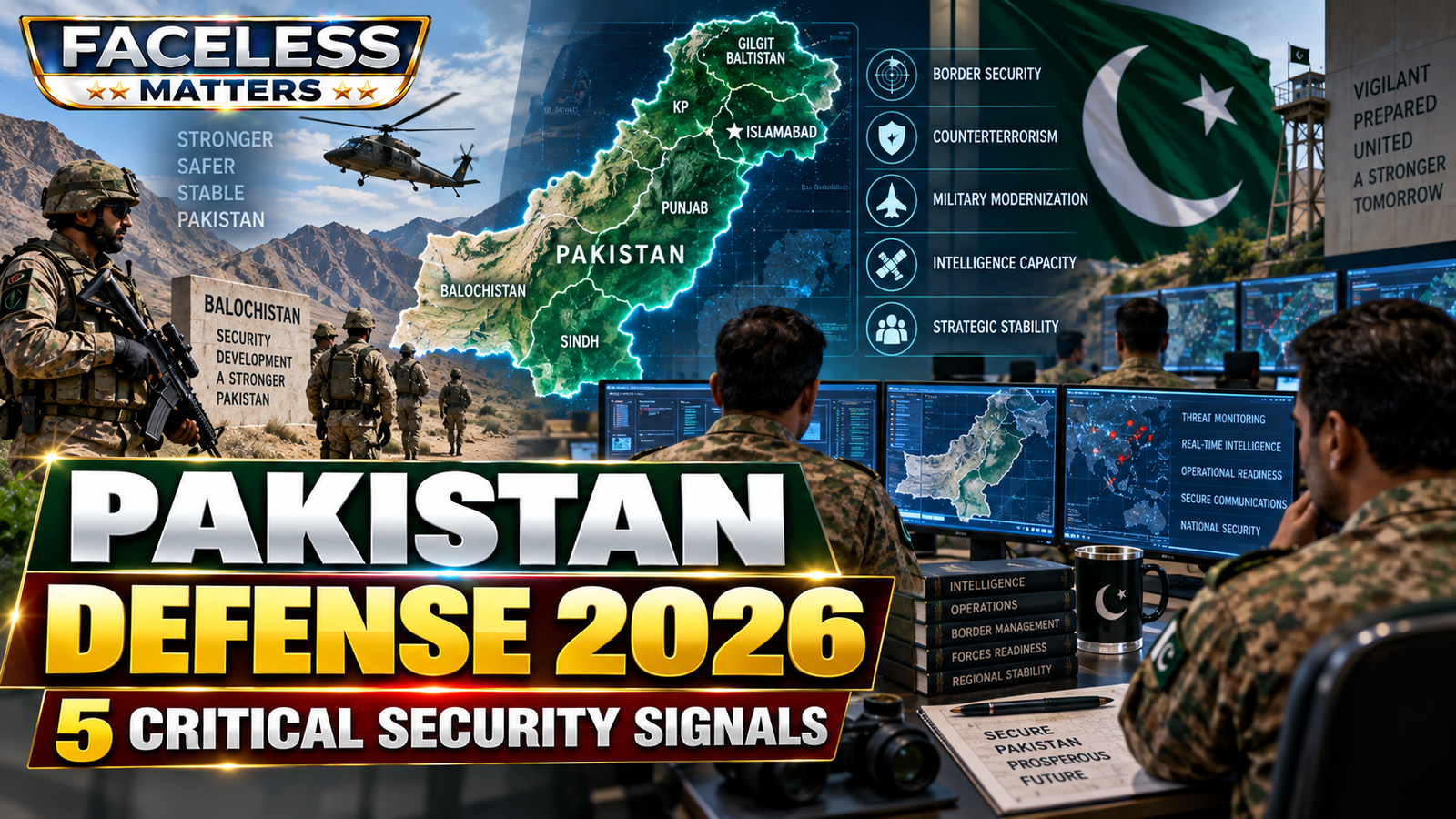
Pakistan Defense 2026 increasingly connects counterterrorism, border security, defense technology and regional strategic partnerships.
The Economic Side of National Defense
Defense policy also has a significant economic dimension.
A modern defense strategy requires investment in:
- Cybersecurity
- Intelligence systems
- Aerospace
- Secure communications
- Surveillance technology
- Military logistics
- Defense manufacturing
- Research and development
- Border-security infrastructure
That creates opportunities for Pakistan’s defense industry and technology sector.
But it also creates fiscal challenges.
Pakistan has limited financial space, and defense modernization must compete with debt servicing, infrastructure requirements, social spending and economic development.
This creates an important policy question:
How can Pakistan strengthen national security while maintaining sustainable public finances?
The answer cannot simply be more spending.
The more strategic approach is improving the efficiency of defense procurement, domestic production, technology partnerships, maintenance capacity and industrial localization.
That is where defense policy and economic policy increasingly intersect.
FACELESS MATTERS Analysis: The Five Signals That Matter Most
The latest developments reveal five broader signals.
Signal 1: The threat environment remains persistent
Pakistan Defense 2026 is being shaped by a security environment in which counterterrorism, intelligence and rapid operational response remain central priorities.
The repeated operations in Balochistan and the attempted infiltration from Afghanistan show that Pakistan continues to face serious internal-security pressure.
Signal 2: Intelligence is becoming central
The emphasis on intelligence-based operations demonstrates the growing importance of information, surveillance and rapid response.
Signal 3: Command structures are evolving
The new CDF-centered architecture represents a major institutional change that deserves continued scrutiny.
Signal 4: Regional partnerships are expanding
Pakistan is not addressing security challenges alone. Its relationships with Türkiye and Saudi Arabia show a broader regional defense strategy.
Signal 5: Defense and technology are converging
Cybersecurity, intelligence platforms, communications and advanced defense technology are becoming increasingly important to national security.
That convergence could eventually become as important as conventional military modernization.
What Pakistan Should Watch Next
The next phase should be judged through measurable indicators rather than headlines.
1. Balochistan security trends
Does the frequency and geographic spread of militant attacks decline?
2. Afghanistan border developments
Can Islamabad and Kabul establish mechanisms that reduce cross-border militant movement?
3. Intelligence capability
Does Pakistan continue investing in modern intelligence, surveillance and cybersecurity infrastructure?
4. Military command implementation
How effectively does the new CDF-centered command structure integrate the army, navy and air force?
5. Regional defense cooperation
Does the Makkah Defence Alliance move from institutional announcements toward practical cooperation?
6. Defense industry
Can Pakistan increase domestic production and develop commercially sustainable defense technology partnerships?
These indicators will provide a much clearer picture of Pakistan’s security trajectory.
Defense Modernization Is No Longer Only About Weapons
One of the biggest mistakes in analyzing modern national security is to focus exclusively on weapons systems.
A modern defense ecosystem includes:
Data.
Cybersecurity.
Satellite intelligence.
Secure communications.
Artificial intelligence.
Logistics.
Training.
Industrial capacity.
Financial sustainability.
Diplomatic partnerships.
Pakistan’s future security competitiveness will depend on how effectively these elements work together.
This is especially important because the country faces threats that are difficult to address through conventional military power alone.
Terrorist networks can be decentralized.
Cyber threats can cross borders instantly.
Misinformation can spread globally within minutes.
Economic instability can weaken national resilience.
Therefore, national defense increasingly overlaps with economic security, digital security and institutional resilience.
Why the Latest Balochistan Operations Matter Beyond Balochistan
The immediate operational geography may be Balochistan, but the strategic implications extend across Pakistan.
Security conditions affect:
- Investor confidence
- Infrastructure development
- Mining investment
- Energy projects
- Trade corridors
- Transport networks
- Tourism
- Provincial development
Balochistan is particularly important because of its geographic position, natural resources and access to the Arabian Sea.
A sustained improvement in security could therefore have an economic effect beyond the security sector.
Conversely, persistent instability can increase the cost of doing business and complicate infrastructure development.
This is why Pakistan Defense 2026 is also an economic-security story.
The China and Regional Dimension
Pakistan’s strategic environment also involves China.
The country’s economic and infrastructure relationship with China means regional security has direct implications for investment and connectivity.
Any instability affecting major infrastructure corridors, transport routes or energy projects can have consequences beyond traditional defense calculations.
At the same time, Pakistan’s relationships with Türkiye, Saudi Arabia and Central Asian states are adding additional layers to its regional diplomacy.
The challenge for Islamabad is therefore strategic balancing.
Pakistan must strengthen security cooperation without allowing its relationships to become unnecessarily confrontational toward other major powers.
The most sustainable defense strategy is one that increases Pakistan’s security options while preserving diplomatic flexibility.
Defense Industry Could Become a Strategic Economic Sector
Pakistan has an established defense-production ecosystem, but the next phase of competition will increasingly involve technology.
The most valuable areas may include:
- Aerospace systems
- Unmanned platforms
- Electronic systems
- Cybersecurity
- Secure communications
- Artificial intelligence
- Radar and surveillance
- Military software
- Maintenance and logistics
- Dual-use technology
A successful defense-industrial strategy could create both security and economic benefits.
It could reduce selected import dependencies, generate technical expertise and potentially create export opportunities.
However, defense exports require international compliance, reliable manufacturing, quality standards and sustainable research investment.
The objective should therefore be capability development rather than headline-driven procurement.
FACELESS MATTERS Strategic Assessment
The latest security developments should be viewed as part of a larger transformation in Pakistan’s national-security environment.
The immediate operational success reported by the military is important.
But operational success must eventually translate into a measurable reduction in violence.
That requires more than military action.
It requires:
Intelligence + policing + border management + diplomacy + economic development + technology + institutional coordination.
This is the central strategic lesson.
A country cannot permanently solve a complex security challenge through operations alone.
Military capability can suppress threats.
Strong institutions can prevent them from regenerating.
Economic development can reduce vulnerabilities.
Diplomacy can reduce external pressure.
Technology can improve early warning and response.
The strongest national-security strategy therefore combines all of these elements. This is ultimately the central challenge for Pakistan Defense 2026: converting military capability, technology, diplomacy and institutional coordination into sustainable national security.
Final FACELESS MATTERS Assessment
Pakistan Defense 2026 is significant because the latest security developments reveal several trends at the same time.
The military has reported intensive counterterrorism operations in Balochistan, including 48 militant deaths over the previous 48–72 hours, while another operation reportedly stopped 15 militants attempting to cross from Afghanistan. These figures and operational details come from Pakistani military statements reported by national and international media and should be understood as reported claims rather than independently verified battlefield counts.
At the institutional level, Pakistan is also operating under a substantially revised senior military command structure.
At the regional level, it is developing new defense partnerships.
And at the technological level, intelligence, cybersecurity, surveillance and defense-industry capabilities are becoming increasingly important.
The result is a much broader national-security equation.
Pakistan Defense 2026 is no longer simply about battlefield readiness.
It is about building a resilient security ecosystem capable of protecting citizens, infrastructure, investment, borders and national strategic interests.
The next test will not be the number of operations announced.
It will be whether Pakistan can convert operational pressure into sustainable security, stronger institutions, better border management and a more resilient defense economy.
That is the real strategic question now facing Islamabad.
INTERNAL LINKS
- Makkah Defence Alliance: 5 Essential Facts for Pakistan — Relevant to Pakistan’s expanding regional defense partnerships, collective security architecture and defense-industry cooperation.
- Pakistan Terrorism in 2026: President & PM Renew Resolve — Provides broader context on Pakistan’s continuing counterterrorism challenge, institutional coordination and national-security priorities.
- Pakistan SCO Chairmanship 2026–27: 5 Critical Tests After Bishkek — Connects Pakistan’s security strategy with regional diplomacy, Central Asian connectivity and wider strategic cooperation.
TRUSTED EXTERNAL SOURCES
- Daily Jang — Latest Pakistan national-security reporting — Current Pakistani reporting includes the latest Balochistan security developments.
- Geo News — 48 militants reported killed across Balochistan — Reports the ISPR account of the latest operations.
- Associated Press — Pakistan military reports 48 militants killed — Provides independent international reporting and important attribution/context.
- Dawn — Forces ramp up actions in Balochistan — Independent Pakistani coverage of the latest security operation.
SOURCE VERIFICATION & FACELESS MATTERS ANALYSIS
The latest operational figures in this report are attributed to Pakistan’s military and independently contextualized through AP, Geo News and Dawn reporting. AP specifically notes that claims of Indian sponsorship accompanying the military’s account were not supported by evidence in the statement it reviewed.
The Afghanistan-border incident is based on the Pakistani military’s account as reported by AP, which also notes that relevant allegations have been denied by India and Afghanistan.
The military command restructuring is based on international reporting by Al Jazeera, which examined the legal creation of the Chief of Defence Forces role and the broader questions around command and civilian oversight.
The Makkah Defence Alliance discussion is based on previously verified reporting and FACELESS MATTERS analysis concerning Pakistan, Türkiye and Saudi Arabia’s emerging collective-defense framework.
The sections labeled FACELESS MATTERS Analysis and FACELESS MATTERS Strategic Assessment are editorial interpretation. They should not be read as official government policy, military intelligence or guaranteed forecasts.
This article is for informational and educational purposes and does not constitute legal, financial, investment or security advice.
For editorial questions, corrections or source concerns: info@facelessmatters.com
[…] 1. [Pakistan Defense 2026: 5 Critical Security Signals After Balochistan Operations] — پاکستان کے موجودہ national-security environment اور broader strategic developments کے لیے مفید context۔ Pakistan Defense 2026: 5 Critical Security Signals After Balochistan Operations […]