

Date: September 13, 2026
Key Takeaway
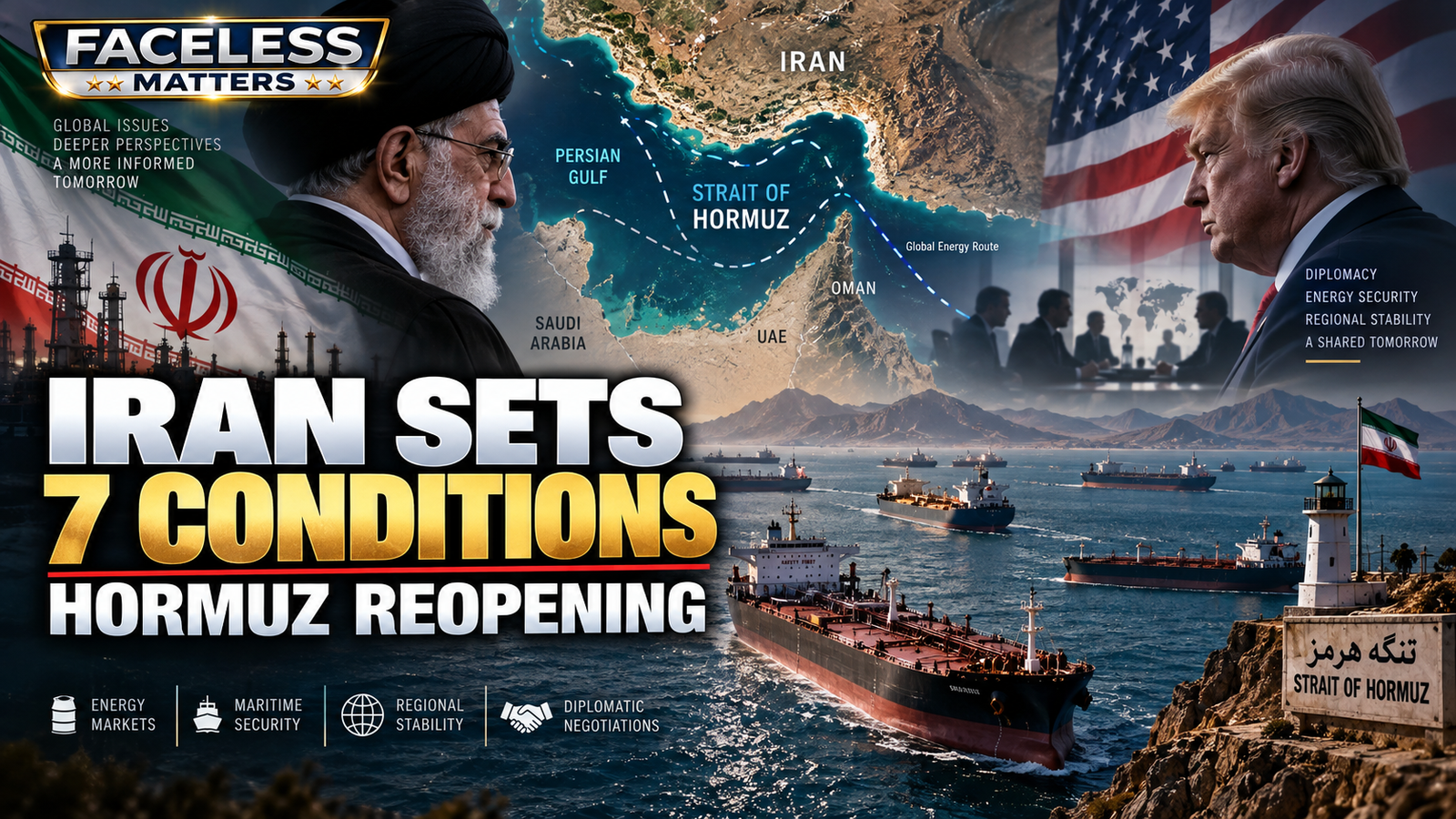
Iran has reportedly conveyed seven conditions to the United States through intermediaries for reopening the Strait of Hormuz, but the details of those seven conditions have not been publicly disclosed. The development means that an Iran-Oman understanding on maritime routes does not automatically reopen the strategic waterway.
The latest reporting indicates that Tehran is linking the reopening of the waterway directly to steps by Washington.
Reuters reported that an Iranian source told the semi-official Tasnim news agency that the strait would remain closed until the seven conditions approved by Iran’s highest authorities are fulfilled.
For global markets, the issue is larger than a diplomatic disagreement.
The waterway remains a critical energy corridor, and uncertainty over shipping can affect crude oil prices, tanker insurance, freight costs, energy security and inflation expectations.
TABLE OF CONTENTS
Article Content / What Happened?
Iran has reportedly presented the United States with seven conditions for reopening the Strait of Hormuz, according to reporting based on information from Iranian sources.
The conditions were reportedly transmitted through intermediaries and have been approved by Iran’s highest authorities.
However, there is an important distinction between what has been reported and what has actually been disclosed.
The seven conditions themselves have not been made public.
Iranian sources have indicated that the strait will remain closed until Washington meets those conditions.
That means the latest development should not be interpreted as an announcement that the waterway is about to reopen.
Instead, it suggests that Tehran is establishing a political and diplomatic framework that it considers necessary before normal maritime traffic can resume.
Reuters reported that an Iranian source described the upcoming Iran-Oman arrangement as a basis for future navigation rather than an immediate reopening of the strait.
What Are Iran’s Seven Conditions?
At this stage, the precise seven conditions are not publicly available.
This is one of the most important facts about the story.
Some earlier Iranian statements in August included demands concerning U.S. military activity, sanctions, attacks involving Iran and its regional partners, compensation and frozen Iranian assets. But those earlier demands should not automatically be presented as the seven conditions now reported in September.
Earlier reporting from August described several Iranian requirements for reopening Hormuz, including an end to U.S. threats, an end to attacks involving Iran and its allies, withdrawal of U.S. naval and air forces from around Iran, compensation for wartime damage, lifting sanctions and release of frozen Iranian assets.
Those earlier demands provide context.
They do not, however, establish the contents of the current seven-condition list.
That distinction is essential for accurate reporting.
Why This Matters
A headline saying that Iran has seven conditions can easily lead readers to assume that the seven demands have already been published.
They have not.
At present, the strongest verified formulation is:
Iran says it has conveyed seven conditions to the United States, and reopening the Strait of Hormuz depends on Washington meeting them. The details remain undisclosed.
That is the position FACELESS MATTERS should maintain until the conditions are officially or reliably disclosed.
What Does the Iran-Oman Understanding Actually Mean?
The latest Iran-Oman development has created confusion because reports of an agreement concerning shipping routes could initially sound like an announcement that Hormuz is reopening.
That is not what the available reporting establishes.
An Iranian source told Tasnim that the Iran-Oman understanding does not itself mean that the waterway has reopened. Reuters separately reported the same basic distinction: the arrangement creates a possible framework for future reopening, but Tehran’s reported conditions for Washington remain a separate requirement.
The proposed arrangement concerns routes for vessels entering and leaving the Persian Gulf.
According to reporting based on the Iranian side, the inbound route would lie entirely within Iranian territorial waters, while part of the outbound route would also pass through Iranian waters.
That makes the maritime arrangement strategically significant.
It is not simply about drawing a new shipping route.
It is also connected to the question of who has authority over maritime traffic and how future navigation through the waterway will be administered.
Why the Strait of Hormuz Matters to the World
The Strait of Hormuz is one of the world’s most important maritime energy chokepoints.
Its geographical position connects the Persian Gulf with the Gulf of Oman and the wider Indian Ocean.
Large volumes of energy shipments have historically passed through the waterway, making its security important to oil-importing economies across Asia and beyond.
This is why uncertainty around Hormuz immediately becomes an international economic issue.
A prolonged disruption can affect:
- crude oil prices;
- LNG transportation;
- tanker availability;
- marine insurance;
- freight costs;
- refinery economics;
- inflation expectations;
- and global investor sentiment.
The impact can therefore extend far beyond Iran and the United States.
A shipping problem in the Gulf can eventually become a cost problem for manufacturers, transport companies and consumers thousands of kilometres away.
The New Risk: Hormuz Is Becoming a Negotiating Instrument
The most significant strategic development may be the connection between maritime access and diplomacy.
Iran appears to be treating the reopening of the waterway as something that cannot be separated from its wider dispute with Washington.
That changes the nature of the issue.
The waterway is no longer being discussed only as a shipping-security problem.
It is becoming part of a broader diplomatic negotiation involving military activity, sanctions, regional security and Iran’s relationship with the United States.
FACELESS MATTERS Analysis
This gives Tehran significant negotiating leverage.
But leverage is not unlimited.
Keeping a strategic waterway restricted also imposes economic costs on Iran and countries that depend on predictable Gulf shipping.
The longer disruption continues, the more pressure can accumulate through energy prices, shipping costs and regional economic activity.
Iran therefore faces its own strategic calculation:
How much maritime pressure can produce diplomatic leverage without creating wider economic consequences that become difficult to control?
Why the United States Faces a Difficult Choice
Washington now faces a complicated diplomatic equation.
If the United States accepts Tehran’s conditions, it could create a pathway toward reopening the waterway and reducing pressure on global energy markets.
But accepting conditions related to military deployments, sanctions, compensation or regional security could have much broader political consequences.
On the other hand, rejecting the conditions could prolong uncertainty around maritime traffic.
That could maintain upward pressure on energy prices and increase the cost of shipping through the region.
This creates a classic geopolitical trade-off:
Diplomatic compromise may reduce economic risk, while diplomatic resistance may preserve political leverage but prolong market uncertainty.
The eventual American response will therefore matter well beyond the bilateral Iran-U.S. relationship.
What It Means for Oil and Global Markets
The timing of the announcement is particularly important for energy markets.
Reuters reported on September 13 that a new report of a projectile hitting a vessel in the strait had heightened concerns over global oil supplies.
Brent crude had moved back above $100 a barrel amid the widening regional conflict and concerns over supply disruptions.
This demonstrates how quickly maritime security can become a financial-market issue.
Markets do not need to wait for a complete supply collapse.
Investors can react to the possibility of:
- fewer vessels;
- higher insurance costs;
- longer routes;
- higher freight rates;
- reduced energy availability;
- or further military escalation.
That expectation itself can increase the risk premium attached to crude oil.
What Happens If Oil Remains Above $100?
A temporary oil-price spike is one thing.
A prolonged period above $100 is very different.
If elevated crude prices persist, countries that depend heavily on imported energy could face increased pressure on their trade balances and inflation.
Central banks could also face a more difficult policy environment.
If inflation rises because of energy costs while economic activity weakens, policymakers may find it harder to support growth without worsening inflation.
That is why the waterway is now being watched not only by diplomats and naval authorities, but also by central banks, energy companies and investors.
What It Means for Pakistan
Pakistan has a direct economic interest in the stability of Gulf energy markets.
The country is exposed to imported energy costs, meaning sustained increases in international crude prices can eventually affect the domestic economy.
Higher oil prices can increase:
- the import bill;
- transportation costs;
- inflationary pressure;
- industrial costs;
- foreign-exchange requirements;
- and pressure on consumers.
This connection has already been visible in Pakistan’s financial markets.
FACELESS MATTERS previously reported that the Pakistan Stock Exchange came under pressure as oil prices and Strait of Hormuz risks increased investor concerns.
The wider energy implications have also been covered in FACELESS MATTERS’ Pakistan Energy 2026 analysis.
For Pakistan, therefore, the Hormuz story is not distant foreign policy.
It is also an energy, inflation, currency and financial-market story.
The Market Connection
The current situation creates a chain that investors should understand:
Hormuz disruption → higher shipping risk → higher oil risk premium → higher energy costs → inflation pressure → monetary-policy uncertainty → financial-market volatility.
This chain does not mean every step will necessarily occur.
But it explains why geopolitical developments around the waterway can produce immediate reactions in international markets.
The same logic applies to Pakistan.
If oil remains elevated for a prolonged period, Pakistan’s external financing requirements and imported-energy costs could become more important considerations for investors.
What Happens Next?
The next phase will depend on several developments.
1. Will Iran publish the seven conditions?
This is perhaps the most important immediate question.
Until the conditions are disclosed, governments and markets can only assess the broader direction of Tehran’s demands.
2. How will Washington respond?
The U.S. response will determine whether the issue moves toward negotiation or further confrontation.
3. What happens at the Oman meeting?
Iran has said that Gulf and regional representatives will participate in discussions in Muscat concerning the future of navigation through Hormuz.
The meeting could clarify the proposed shipping arrangement and regional positions.
4. Will commercial shipping resume?
A diplomatic announcement alone may not immediately restore normal maritime traffic.
Shipping companies, insurers and vessel operators will also need confidence that routes are sufficiently safe and predictable.
5. Where does oil go next?
This remains critical for the global economy.
A credible reopening mechanism could reduce part of the geopolitical risk premium.
Further escalation could push it higher.
Three Possible Scenarios
Scenario One: Diplomatic Progress
If Washington and Tehran find a workable formula, maritime traffic could gradually normalize.
Oil prices could respond positively.
Shipping insurance costs could eventually decline.
Global markets could receive relief.
For Pakistan, lower energy-market pressure would be particularly beneficial.
Scenario Two: Prolonged Negotiations
The parties could remain engaged without reaching a final settlement.
In this scenario, Hormuz could remain restricted while markets experience continued volatility.
Oil prices could remain elevated, but not necessarily move continuously higher.
This may become the most difficult environment for businesses because uncertainty itself becomes a cost.
Scenario Three: Further Escalation
A major deterioration in regional security could create additional shipping disruption.
That would increase the possibility of a larger oil-price shock.
Global inflation expectations could rise.
Emerging markets could face additional pressure.
For Pakistan, this would be the most challenging scenario because energy costs and external financing pressures could reinforce one another.
These scenarios are FACELESS MATTERS analysis, not predictions.
FACELESS MATTERS Analysis
The most important lesson from the current development is that the Strait of Hormuz is no longer simply a question of navigation.
It has become a strategic bargaining point.
Iran is signaling that reopening the waterway requires political and diplomatic concessions from Washington.
The United States, meanwhile, must balance freedom of navigation, regional security and its broader objectives toward Tehran.
Regional states are trying to protect their own economic and security interests.
And international markets are watching every development through the price of oil.
The biggest uncertainty is therefore not simply whether the waterway will reopen.
It is under what political and security conditions it would reopen, who would control the operating arrangements, and whether commercial shipping would regard the new system as sufficiently safe and predictable.
That is the deeper significance of the reported seven conditions.
Their contents remain unknown.
But their existence indicates that Tehran wants the future of Hormuz to be part of a much broader strategic settlement.
Conclusion
Iran has reportedly conveyed seven conditions to the United States for reopening the Strait of Hormuz, but the details of those conditions have not yet been publicly disclosed.
That distinction matters.
The Iran-Oman understanding over future shipping routes does not, by itself, mean that the strategic waterway has reopened.
Instead, the latest developments suggest that Tehran is linking maritime access to a wider set of political and security demands.
For the international economy, the stakes are significant.
Any prolonged uncertainty around Hormuz can influence oil prices, shipping insurance, freight costs, inflation and financial markets.
For Pakistan, the consequences could be even more direct because imported energy costs can feed into the country’s trade position, inflation and financial-market sentiment.
The next decisive step will be whether the seven conditions become public and how Washington responds.
Until then, the most accurate assessment is simple:
Hormuz is not yet a reopening story. It is a negotiation story — and the next move from Washington may determine how that story develops.
INTERNAL READING — FACELESS MATTERS
Strait of Hormuz Crisis: Oil Above $90 in 2026
A broader analysis of Hormuz disruption, oil prices, shipping costs and global energy security.
Iran Strait of Hormuz: 5 Strategic Signals Behind Tehran’s Latest Warning
Previous FACELESS MATTERS analysis of Tehran’s position on the waterway and its wider strategic implications.
Pakistan Energy 2026: 5 Critical Signals
Useful context on Pakistan’s exposure to global oil, LNG, shipping and energy-security risks.
Pakistan Stock Market: 5 Critical Risks From Oil Shock
Explains how oil and Hormuz risks can move from geopolitics into Pakistan’s financial markets.
SOURCES & EDITORIAL NOTE
Reuters — New report of attack on Strait of Hormuz shipping fans fears of threats to oil supplies — Current reporting on the latest shipping-security developments, Iran’s seven conditions, the Oman meeting and the wider impact on global energy supplies. Reuters reports that the seven conditions were conveyed to the United States through Iran’s intermediaries, while their full contents have not been disclosed.
Reuters — Iran-Oman understanding does not provide for immediate reopening of the waterway
— Reporting on the Iran-Oman understanding and Tehran’s position that reopening depends on the United States meeting its conditions.
Jang — Iran presents seven conditions for reopening the waterway — The original Pakistani report supplied for this article, reporting that Iran conveyed seven conditions to the United States through intermediaries.
Reuters — No signed Hormuz deal expected yet from Oman meeting on Monday — Additional context on the planned Oman meeting, Iran’s position on control and fees, and the importance of the Strait of Hormuz to global oil flows.
Editorial Note
The existence of seven Iranian conditions is reported, but their complete contents have not been publicly disclosed in the sources reviewed. FACELESS MATTERS therefore does not present an invented or unverified list of seven conditions as fact. Earlier Iranian demands are treated only as historical context and are not presented as the current seven conditions.