

TABLE OF CONTENTS
Strategic Space Analysis
A remarkable chapter in space science has entered an unexpected final phase. NASA’s Neil Gehrels Swift Observatory, a spacecraft that has spent more than two decades studying some of the universe’s most powerful explosions, will no longer receive the orbital rescue that was intended to extend its scientific life.
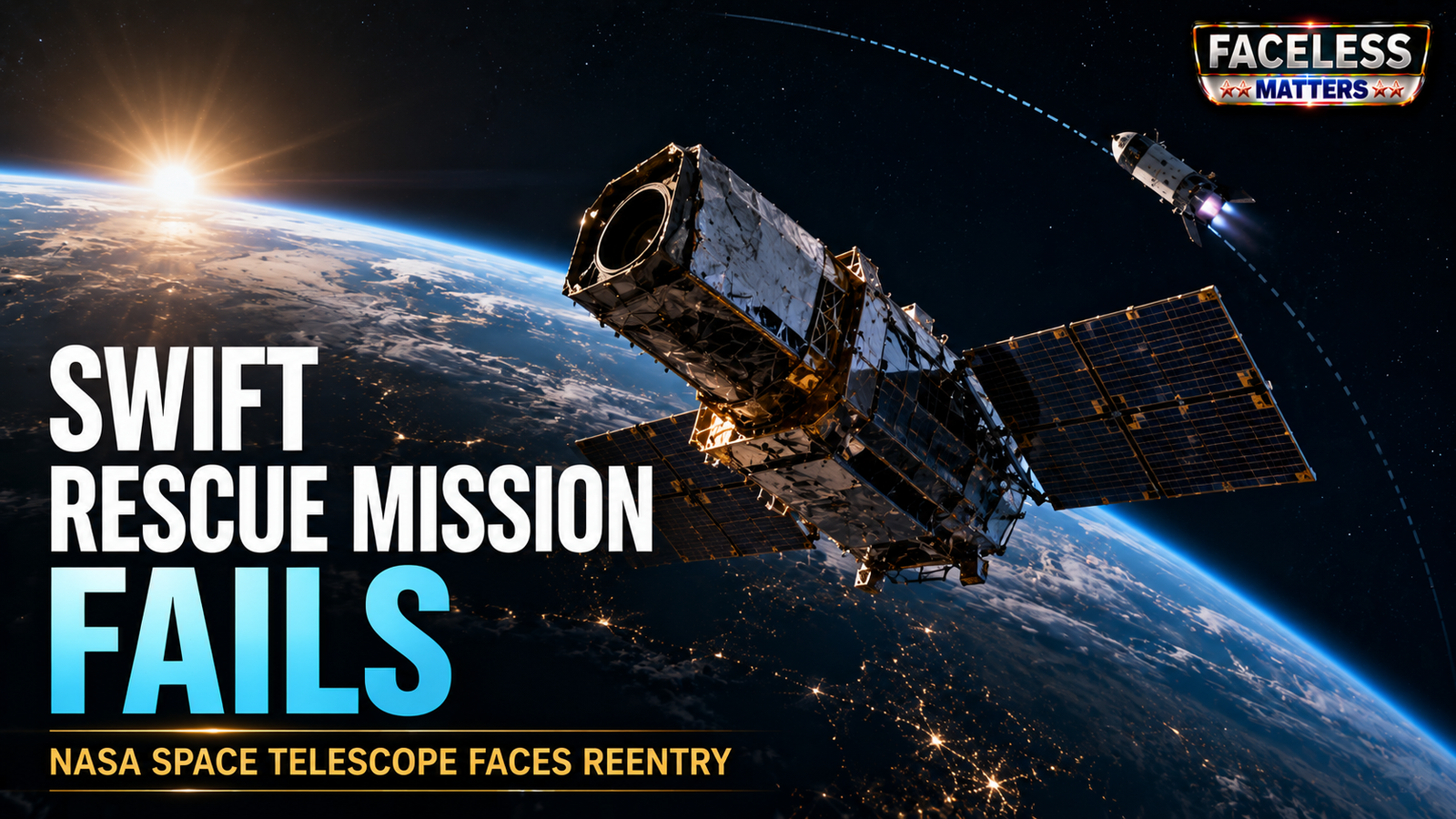
Swift rescue mission has failed after LINK suffered control problems, leaving NASA’s aging space telescope headed toward reentry later in 2026.
The Swift rescue mission was designed to extend the operational life of the aging observatory by raising its orbit.
NASA and Katalyst Space Technologies announced on August 19, 2026, that the LINK spacecraft would not attempt to capture and raise Swift’s orbit because of continuing attitude-control problems. The decision ends a highly ambitious effort to move the aging observatory into a higher orbit.
The development is significant well beyond the fate of one satellite. It demonstrates both the possibilities and risks of a new era of commercial spacecraft servicing, while also highlighting how solar activity, orbital decay and spacecraft-control challenges can affect long-running scientific missions.
Why the Swift Observatory Matters
The Neil Gehrels Swift Observatory was launched in 2004 with a primary mission to study gamma-ray bursts, among the most energetic explosions known in the universe.
Over time, Swift became much more than a specialized gamma-ray mission. Its observations across multiple wavelengths allowed scientists to investigate transient cosmic events and rapidly changing astronomical objects.
Its longevity is particularly notable because the original mission was designed around a much shorter operational period. More than 20 years after launch, the observatory had continued providing scientific value.
That long operational history made the rescue attempt especially important. Instead of simply accepting the spacecraft’s eventual atmospheric reentry, NASA and Katalyst Space Technologies attempted to develop a way to extend its orbital lifetime.
What the Swift Rescue Mission Was Supposed to Do
The rescue concept depended on a spacecraft called LINK.
The plan was relatively straightforward in principle but extremely difficult in practice: LINK would approach Swift, establish control of the observatory, and raise its orbital altitude.
Swift had been operating at roughly 216 miles, or 347 kilometers, above Earth. The proposed maneuver would have moved it toward a significantly higher orbit, extending the spacecraft’s useful life. NASA had previously reported that an orbit-raising maneuver would become increasingly difficult as the observatory descended toward approximately 185 miles, or 300 kilometers.
The challenge was that both spacecraft had to operate precisely in orbit.
A servicing vehicle must maintain accurate attitude control, determine its position, match the target spacecraft’s orbit and execute carefully timed maneuvers. A small control problem can become a major obstacle when a spacecraft is moving thousands of meters per second relative to Earth.
The Problem With the LINK Spacecraft
The rescue effort encountered a critical problem with LINK itself.
The Swift rescue mission ultimately depended on LINK maintaining precise attitude control during the rendezvous.
Earlier in August, NASA had reported that an updated flight-software package was designed to help LINK maintain stability using its remaining actuators. At that stage, the spacecraft was still expected to continue approaching Swift.
But the problem ultimately could not be overcome sufficiently to make the capture attempt safe and reliable.
On August 19, NASA and Katalyst concluded that LINK would not capture and boost Swift. Instead, the spacecraft will continue work that can provide useful information for future rendezvous and proximity operations.
That means the rescue mission failed in its primary objective, but the technology demonstration may still contribute to the development of future spacecraft-servicing systems.
Why Solar Activity Made the Situation More Difficult
The Swift rescue mission was also taking place against a changing low-Earth-orbit environment affected by solar activity.
Earth’s upper atmosphere expands when solar activity increases. For the Swift rescue mission, a satellite operating in low Earth orbit can consequently experience increased atmospheric drag even though the atmosphere at those altitudes is extremely thin.
Solar-driven changes in the upper atmosphere can increase atmospheric drag on satellites operating in low Earth orbit, making orbital decay more difficult to manage.
More drag means a spacecraft loses orbital energy and altitude more rapidly.
This became an important factor in the Swift situation. NASA has previously described the observatory’s declining altitude and the effort to slow its orbital decay through operational changes.
The relationship between solar activity and spacecraft operations is becoming increasingly important as more satellites operate in low Earth orbit.
A spacecraft’s lifetime is therefore influenced not only by its onboard systems and fuel but also by the changing space environment around Earth.
What Happens to Swift Now?
With the rescue attempt canceled, NASA expects the observatory to eventually reenter Earth’s atmosphere. The end of the Swift rescue mission marks an important transition for the aging observatory and the scientific archive it has created.
Current reporting indicates that the reentry is expected later in 2026, although an exact date is not established in the available information. The spacecraft is expected to burn up during atmospheric reentry rather than remain in orbit indefinitely.
For scientists, the end of Swift’s mission represents the loss of an unusually productive observatory.
For engineers, however, the mission also creates a valuable opportunity to study what went wrong and what can be improved.
Future servicing spacecraft will need more robust control systems, greater redundancy and stronger contingency planning when approaching aging satellites.
The Bigger Lesson for Space Operations
The Swift rescue attempt illustrates a major transition in space exploration.
For decades, spacecraft were generally designed, launched and operated without realistic expectations that they could later be repaired or relocated.
That model is beginning to change.
Commercial spacecraft-servicing technology could eventually allow operators to refuel satellites, repair spacecraft, move assets between orbits and potentially extend the operational lives of expensive scientific observatories.
But Swift demonstrates that these operations remain technically demanding.
A servicing spacecraft must essentially perform a highly precise robotic rendezvous in an environment where there is no conventional runway, no repair shop and no simple way to stop if something goes wrong.
The failure therefore should not be interpreted simply as a setback. It is also a real-world test of how difficult orbital servicing can be.
Could This Matter for Hubble?
The Swift rescue attempt also attracted attention because of a broader question surrounding aging space telescopes.
The concept of extending a satellite’s orbital lifetime is relevant to other spacecraft operating in low Earth orbit, including major observatories.
However, Swift and Hubble are different spacecraft with different designs, masses, missions and operational requirements. A failure to rescue Swift does not automatically mean that another telescope could not be serviced.
Instead, the experience provides engineers with another case study.
The more spacecraft-servicing missions are attempted, the more engineers can learn about navigation, rendezvous, docking, attitude control and orbital maneuvering.
A New Era of Commercial Space Servicing
The most important long-term story may therefore be what happens after the failed rescue.
Katalyst Space Technologies developed LINK under a NASA contract to attempt an unusually ambitious operation. The mission demonstrated how commercial companies are increasingly being asked to perform tasks that were historically associated with government spacecraft.
NASA has described the effort as high-risk and high-reward, emphasizing that the mission generated valuable lessons despite not achieving the intended orbital boost.
That model is likely to become increasingly important.
As the number of satellites grows, space agencies and commercial operators will need practical methods for maintaining valuable assets, reducing orbital debris and managing spacecraft at the end of their operational lives.
What Scientists Can Still Learn
Swift’s scientific contribution does not disappear simply because the spacecraft eventually reenters.
More than two decades of observations represent a substantial scientific archive.
Its observations of gamma-ray bursts and other transient phenomena have contributed to a broader understanding of energetic events across the universe.
The mission’s final chapter may also provide engineers with data about orbital decay, spacecraft operations and the interaction between long-lived satellites and the changing near-Earth environment.
That combination of scientific and engineering knowledge can influence the design of future observatories.
Strategic Conclusion
The failure of the Swift rescue mission is disappointing because a successful orbital boost could have extended the life of a scientifically valuable observatory.
But the attempt itself represents an important milestone.
NASA and its commercial partners demonstrated that sophisticated spacecraft-servicing missions are moving from theoretical concepts toward real operational experiments. The difficulty of controlling LINK shows how much precision is required when one spacecraft attempts to approach and manipulate another in orbit.
Swift’s eventual reentry will mark the end of an extraordinary scientific journey that began in 2004.
Yet its legacy will continue through its scientific data and through the engineering lessons generated by the attempt to save it.
The larger question is no longer simply how long a satellite can survive.
It is whether future generations of spacecraft can be designed so that they can be serviced, upgraded, moved and rescued when their original mission begins to approach its natural end.
That could become one of the defining challenges of the next era of space exploration.
Verification note: The report’s current mission-status information was cross-checked against NASA’s August 2026 updates and recent reporting on the cancellation of the Swift orbital rescue attempt. NASA’s August 19 update confirms that the planned capture and orbital boost will not proceed because of the ongoing spacecraft attitude-control issue.
Educational Note
This article is provided for educational and informational purposes. Spacecraft operations, orbital decay, atmospheric drag and commercial servicing missions involve complex technical factors that continue to be studied by scientists and engineers.
FACELESS MATTERS distinguishes scientific reporting from interpretation and presents developing space research with appropriate context.
Suggested Future Internal Article
1. Global Bond Market Selloff: Why Borrowing Costs Are Rising in 2026
Use this as a macroeconomic connection because higher energy prices can influence inflation, interest rates and borrowing costs.
2. The AI Infrastructure Boom: Nvidia, OpenAI and the Global Race for Data Centers, Chips and Power
Use this for the connection between rising electricity demand, data centers, AI infrastructure and global power investment.
3. Pakistan Digital Economy Initiative 2026: Powerful Digital Growth
Use this as a Pakistan-focused technology and infrastructure connection because digital expansion also increases demand for reliable energy and electricity infrastructure.
Social / SEO Footer
Follow FACELESS MATTERS for independent space news, astronomy, NASA missions, scientific discoveries and important technology developments.
Website: facelessmatters.com