

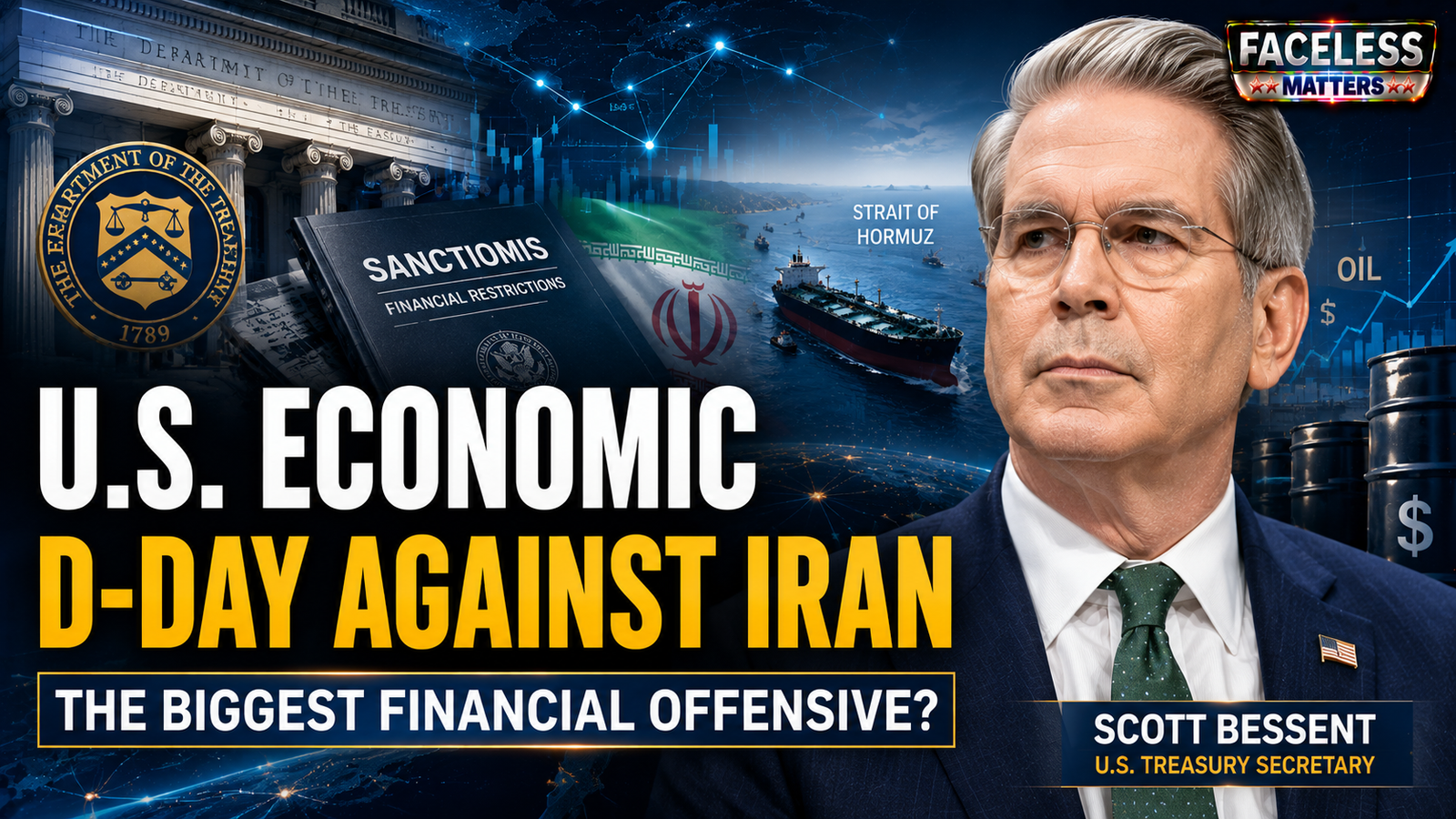
The United States is preparing a major new phase of financial pressure on Iran, with Treasury Secretary Scott Bessent describing the campaign as an “economic D-Day.” Washington says it is preparing sweeping measures aimed at Iran’s economy and at countries and entities that continue to support trade with Tehran.
The timing is critical. Reuters reported on August 24 that Bessent is expected to outline additional sanctions on Monday, while Iran has threatened to halt oil exports from the Gulf if what Tehran calls economic warfare continues. The exact package remains the key unanswered question.
The this financial campaign against Iran marks a major escalation in financial and economic pressure, with consequences extending far beyond the Middle East.
FACELESS MATTERS Analysis: The strategic importance of this moment is not simply another sanctions announcement. The real issue is whether Washington can convert financial pressure into political leverage without triggering a larger energy, shipping or diplomatic crisis.
FACELESS MATTERS Analysis: The U.S. economic D-Day against Iran could become a broader test of sanctions policy, energy security and global financial resilience.
Why the Financial Offensive Matters
For decades, U.S. sanctions on Iran have targeted banking, energy, shipping and procurement networks. The new strategy appears designed to widen the pressure beyond Iranian entities by increasing the risks for foreign governments, companies and financial institutions that continue economic relations with Tehran.
the U.S. financial offensive is therefore best understood as an attempt to use the international financial system as a strategic instrument. A company may have limited exposure to Iran but substantial exposure to the U.S. dollar, American banks or U.S. markets. That imbalance can make compliance with Washington’s restrictions commercially attractive.
The effectiveness of this strategy will depend on enforcement. U.S. economic D-Day against Iran will ultimately be judged by whether enforcement changes real commercial behavior.
Sanctions matter most when companies believe the penalties will actually be applied and when alternative trading routes become more expensive or difficult.
FACELESS MATTERS Analysis: The central test is not the number of entities placed on a sanctions list. It is whether Iran’s remaining economic lifelines become materially harder to use.
FACELESS MATTERS Analysis: The U.S. economic D-Day against Iran could therefore become a broader test of sanctions policy, energy security and global financial resilience.
Oil Is the Immediate Pressure Point
Iranian oil exports remain central to Tehran’s ability to generate foreign currency. Washington has repeatedly targeted networks accused of moving Iranian petroleum through intermediaries, front companies and complex shipping arrangements.
The current escalation is especially sensitive because the Strait of Hormuz remains under severe pressure. Reuters reported that shipping through the waterway has been disrupted, while Iran has warned that continued economic pressure could lead to a halt in Gulf oil exports.
That creates a difficult calculation for Washington. Stronger sanctions may reduce Iran’s revenue, but a major disruption to Gulf energy flows could increase global crude prices, shipping insurance costs and transportation expenses.
U.S. economic D-Day against Iran could therefore have consequences well outside the Middle East.
Oil markets are already responding to uncertainty. Reuters reporting cited Brent crude near $93 per barrel and WTI near $86 before the expected announcement, after a sharp weekly rise. The market is therefore watching both the sanctions package and the physical security of energy routes.
FACELESS MATTERS Analysis: The most important distinction is between a sanctions shock and a supply shock. A sanctions shock primarily affects Iran’s ability to earn and move money. A supply shock can affect every major importing economy.
The Hormuz Risk
The Strait of Hormuz connects the Persian Gulf with the Gulf of Oman and the wider Arabian Sea. Its strategic importance means that even partial disruption can influence oil prices, freight rates and insurance premiums.
A prolonged shipping disruption could affect refiners, airlines, manufacturers, transport companies and consumers. Energy-intensive industries would face higher operating costs, while governments could face additional inflationary pressure.
For Pakistan, the risk is particularly important because imported fuel costs can feed into transportation, electricity generation, manufacturing and food prices. A prolonged increase in crude prices can also pressure foreign-exchange reserves and the current account.
The wider economic chain is straightforward. U.S. economic D-Day against Iran could accelerate that chain if energy and financial risks rise together: geopolitical tension raises shipping risk; shipping risk raises freight and insurance costs; higher logistics costs feed into energy and goods prices; and persistent inflation can complicate monetary policy.
FACELESS MATTERS Analysis: This is why the Iran confrontation should not be treated only as a military or diplomatic story. It is also an energy-security, inflation, trade-finance and global economic story.
The UAE Factor
The United Arab Emirates has become another important part of the pressure campaign. Recent reporting indicates that the UAE suspended commercial and financial dealings with Iran amid renewed regional tensions.
This matters because Dubai has historically been an important commercial gateway for Iranian trade. Restrictions on financial channels, cargo movements and business relationships can make it harder for Iranian companies to access foreign currency and international markets.
U.S. economic D-Day against Iran becomes more consequential if regional financial centers participate in the isolation campaign.
But the UAE also has its own economic interests. A complete rupture with Iran could create commercial costs, affect regional trade flows and increase pressure on businesses that previously operated across the Gulf.
FACELESS MATTERS Analysis: The regional question is therefore whether economic isolation can be coordinated without creating a second economic shock for the countries enforcing it.
China and the Enforcement Challenge
China is likely to remain one of the most important variables in the campaign because Chinese companies have historically been major buyers of Iranian oil.
If Washington targets foreign companies that continue purchasing Iranian energy, Chinese businesses could face a difficult choice between Iranian commercial opportunities and access to the U.S. financial system.
That creates the possibility of a broader dispute over secondary sanctions, international trade and financial sovereignty.
The United States has enormous leverage because the dollar remains deeply embedded in international trade and banking. But financial pressure is not unlimited. The more Washington relies on secondary sanctions, the greater the diplomatic friction with countries that reject the extraterritorial reach of U.S. policy.
FACELESS MATTERS Analysis: The outcome may ultimately depend less on Iran alone and more on the behavior of the countries surrounding its economy.
Could Financial Pressure Force Negotiations?
The strategic objective appears to be straightforward: increase the economic cost of resistance until Tehran considers a negotiated settlement preferable to continued confrontation.
But economic pressure does not automatically produce political concessions.
Iran has lived under sanctions for decades and has developed alternative trade networks, domestic production strategies and methods for circumventing restrictions. At the same time, prolonged economic pressure can weaken investment, reduce purchasing power and intensify inflation.
The political response is therefore difficult to predict.
If Iranian leaders believe sanctions threaten the long-term stability of the state, they may become more willing to negotiate. If they believe the campaign is designed to force capitulation, they may instead increase resistance and portray negotiations as surrender.
U.S. economic D-Day against Iran will therefore be measured by political outcomes, not simply by the size of the sanctions package.
FACELESS MATTERS Analysis: The U.S. economic D-Day against Iran could intensify pressure on energy markets and international trade.
What Markets Should Watch
Investors and businesses should focus on several indicators.
First, the exact scope of the new sanctions. Markets need to know whether the measures target oil buyers, banks, shipping companies, insurers, aviation networks or broader commercial activity.
Second, the response of China and other major trading partners.
Third, the level of shipping activity through the Strait of Hormuz.
Fourth, crude oil prices and the spread between different regional benchmarks.
Fifth, inflation expectations and bond yields in major economies.
Sixth, the reaction of Gulf states and the direction of diplomatic negotiations.
Each indicator can change the economic impact of the confrontation.
FACELESS MATTERS Analysis: The most important market risk is not necessarily the headline announcement. It is the possibility that several pressures appear simultaneously: higher energy prices, rising freight costs, tighter financial conditions and weaker consumer confidence.
The Pakistan and Emerging-Market Channel
Pakistan deserves special attention because its economic exposure is indirect but potentially meaningful. A sustained increase in crude prices can raise the import bill, transport costs and pressure on inflation. Higher freight and insurance costs can also affect food, industrial inputs and consumer goods.
For emerging markets, the financial channel can be just as important as the energy channel. If investors move toward safer assets during a geopolitical shock, emerging-market currencies and bond markets can experience additional volatility. Governments may then face higher borrowing costs precisely when energy subsidies or external financing needs are increasing.
U.S. economic D-Day against Iran therefore has a second-order effect: even countries outside the conflict can face tighter financial conditions through oil, trade, currencies and investor risk appetite.
The U.S. economic D-Day against Iran also raises broader questions about sanctions, financial stability and global economic resilience.
The Global Economic Consequences
A prolonged confrontation could create a complicated policy environment for central banks.
If energy prices rise while economic growth slows, policymakers face a difficult combination. Higher inflation normally argues for tighter monetary policy, while weaker growth argues for support.
Businesses could also delay investment decisions if energy and financing costs become unpredictable. Manufacturers may face higher input costs. Airlines and logistics companies may face higher fuel expenses. Consumers may have less disposable income if transportation and household energy costs rise.
This is why the consequences of the Iran confrontation can travel through the global economy even when a company has no direct relationship with Iran.
U.S. economic D-Day against Iran could also affect sovereign debt markets if prolonged inflation reduces expectations for rapid interest-rate cuts.
The energy story and the financial story are therefore increasingly connected.
Diplomacy Remains the Exit Route
Despite the escalating rhetoric, diplomacy remains the most important mechanism for preventing economic pressure from becoming a permanent crisis.
Reuters reported that meaningful talks have remained limited while Pakistan has been involved in mediation efforts. Any credible diplomatic opening could reduce the risk premium embedded in oil and shipping markets.
The opposite is also true. If negotiations collapse and economic measures are followed by new threats around Hormuz, markets could rapidly price in a larger supply risk.
FACELESS MATTERS Analysis: The strongest economic pressure is often the pressure that creates a credible path toward negotiation. Without an exit route, sanctions can become an engine of escalation rather than a tool of settlement.
What Happens Next
The immediate next step is the U.S. Treasury announcement. U.S. economic D-Day against Iran now enters its most important evidence phase.
Until the detailed measures are officially released, claims about specific companies, countries or sectors should be treated carefully. Reuters reported that Bessent was expected to provide further details on Monday, while Iranian officials have warned that support for new sanctions could be treated as an act of war.
The evidence already shows that Washington is preparing a significantly broader financial campaign and that Tehran is warning of consequences for Gulf energy exports.
This is therefore not simply a new chapter in the sanctions story. It is a test of whether financial power can produce strategic change without generating a larger global energy crisis.
For Iran, the challenge is preserving access to revenue and international trade.
For Washington, the challenge is maintaining pressure while limiting collateral economic damage.
For Gulf states, the challenge is balancing security, trade and energy stability.
For China and other major trading powers, the challenge is managing the growing conflict between commercial interests and U.S. financial restrictions.
For Pakistan and other energy-importing economies, the central concern is the cost of oil, freight, inflation and currency pressure.
The coming days should reveal whether the new campaign becomes a genuine turning point or another escalation that leaves both sides further from a settlement.
Source Verification & Analysis
Reuters — August 24, 2026 reporting on the planned U.S. sanctions campaign and Iran’s warning concerning Gulf oil exports.
Associated Press — August 24, 2026 reporting on Iran’s response, the Strait of Hormuz and diplomatic developments.
U.S. Department of the Treasury — Recent official sanctions actions targeting Iranian financial and sanctions-evasion networks.
Wall Street Journal — Recent reporting on the role of the UAE and Dubai in Iran’s financial and commercial networks.
FACELESS MATTERS — Internal analysis on the Strait of Hormuz crisis, global energy security and the broader Iran-U.S. confrontation.
Suggested Future Internal Article
1. Global Energy Supply Crisis 2026: What Happens Next?
This future article will examine the Strait of Hormuz, oil, natural gas, shipping and the wider implications for global energy security.
Global Energy Supply Crisis 2026: What Happens Next?
2. Global Bond Market Selloff: Why Borrowing Costs Are Rising in 2026
This future article will explain the relationship between geopolitical tension, inflation, interest rates, bond markets and global financial conditions.
Global Bond Market Selloff: Why Borrowing Costs Are Rising in 2026
3. The AI Infrastructure Boom: Nvidia, OpenAI and the Global Race for Data Centers, Chips and Power
This future article will explain the connection between artificial intelligence, data centers, electricity demand and global energy infrastructure.
The AI Infrastructure Boom: Nvidia, OpenAI and the Global Race for Data Centers, Chips and Power
Fresh News Link
Reuters — U.S. vows “economic D-Day” as Iran threatens to halt all oil exports
Read the latest Reuters report
Previous FACELESS MATTERS Coverage
Strait of Hormuz Crisis: Oil Above $90 in 2026
This is the strongest existing internal article for contextualizing the energy, shipping, inflation and Pakistan-related consequences discussed in this report.