

TABLE OF CONTENTS
Pakistan Defense Strategy 2026 is increasingly being shaped by two developments that might initially appear contradictory: a stronger commitment to collective security partnerships and a more active role in diplomatic efforts aimed at preventing wider regional conflict.
The most important recent development is not simply the signing of the Saudi Arabia–Türkiye–Pakistan defense agreement in Makkah. The larger story is how Islamabad is attempting to combine strategic deterrence, defense cooperation and diplomatic engagement at the same time.
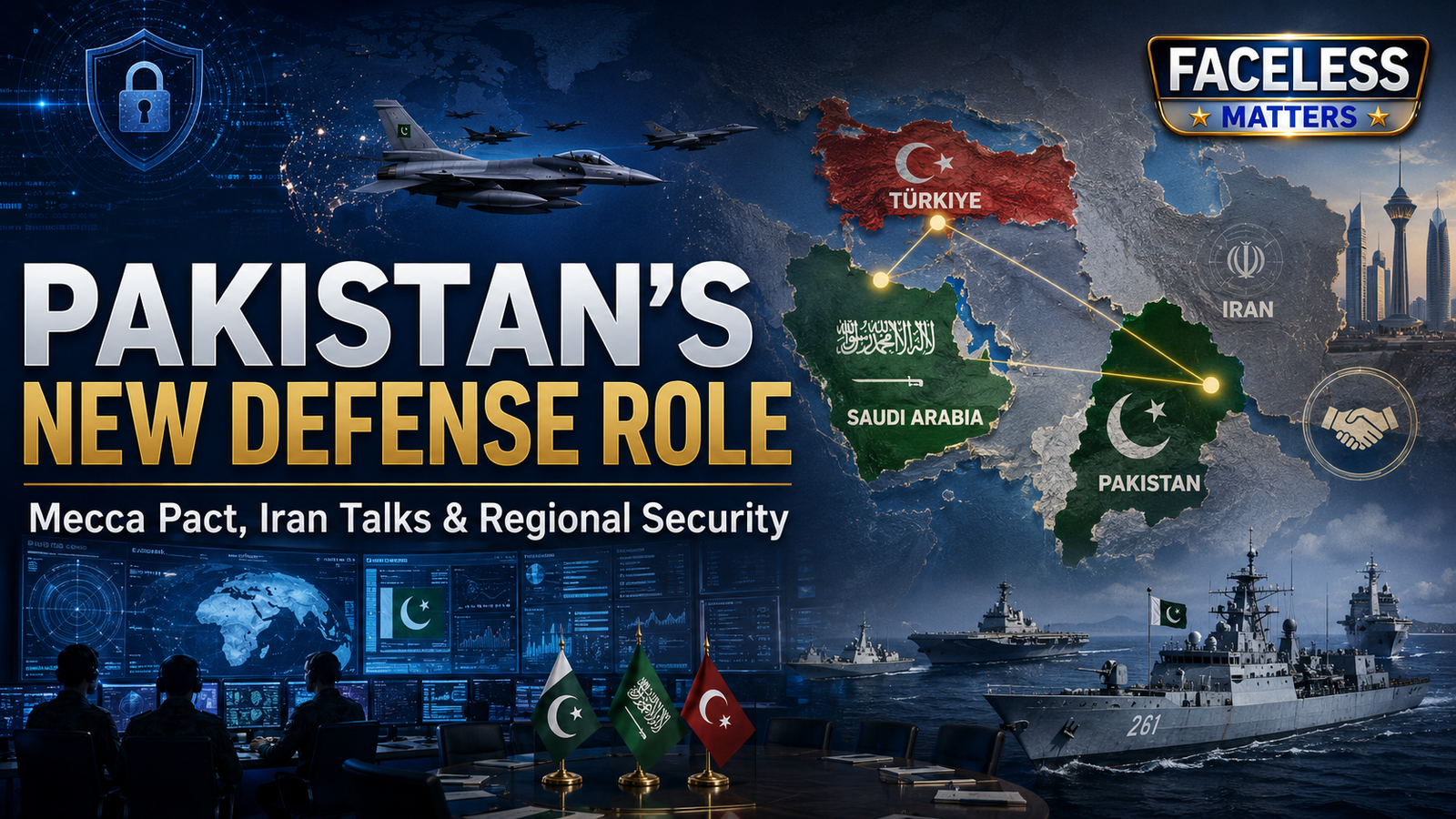
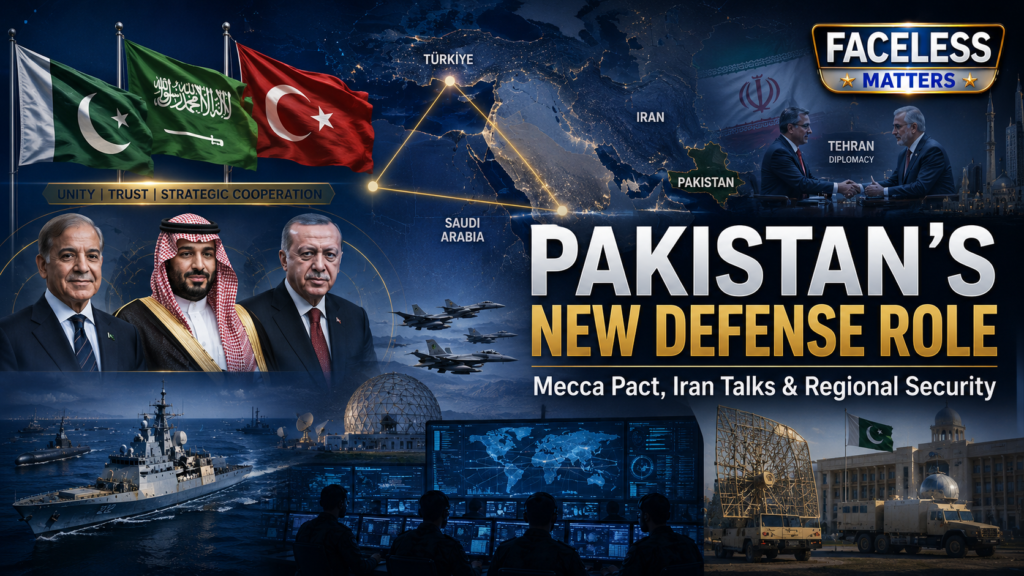
On August 7, Saudi Arabia, Türkiye and Pakistan signed the Makkah Joint Defense Agreement, establishing that an armed attack against one of the three states would be regarded as an attack against all three. International reporting has compared the principle to NATO’s Article 5, although the agreement should not automatically be treated as equivalent to NATO’s institutional structure.
At the same time, Pakistan has continued communicating with Tehran and Washington as tensions surrounding Iran remain high.
That combination makes Pakistan Defense Strategy 2026 particularly significant for Pakistan’s regional security outlook. The Pakistan Defense Strategy 2026 also reflects a broader effort to balance defense preparedness with regional diplomacy.
Pakistan Defense Strategy 2026: A More Uncertain Regional Security Environment
The Middle East security environment has become substantially more complicated during 2026.
The conflict involving Iran, the United States and Israel has affected military calculations far beyond the immediate battlefield. Energy infrastructure, maritime shipping, Gulf security and regional alliances are now interconnected.
The Strait of Hormuz has become especially important because disruption there can affect international energy markets and the security calculations of Gulf states.
Against this background, Saudi Arabia has sought stronger regional security arrangements, while Türkiye has continued expanding its strategic role and Pakistan has emphasized both defense readiness and diplomacy.
Pakistan Defense Strategy 2026 therefore deserves close attention as a developing regional security framework.
It is an attempt to create an additional layer of regional deterrence.
2. What the Makkah Defense Agreement Actually Changes
The central provision is straightforward: an armed attack against one member is treated as an attack against all three.
That creates a political and strategic deterrent because a potential aggressor must consider the possibility that a confrontation with one state could trigger a coordinated response involving the other two.
However, it is important not to exaggerate what the agreement means.
Reuters reported that Turkish Foreign Minister Hakan Fidan described the pact as technically similar to NATO’s Article 5, while also stressing that it was not directed against Iran or another particular country. Reuters also reported plans for a ministerial committee and a secretariat in Saudi Arabia, with additional operational details to be discussed later.
This distinction matters.
A defense agreement can establish a strategic commitment without automatically creating a single integrated military command.
Therefore, the real test will be implementation.
3. Why Pakistan Is Strategically Important
Pakistan brings a unique combination of military experience, geographic position and strategic deterrence to the arrangement.
It connects South Asia with the Middle East and maintains longstanding relationships with Saudi Arabia and Türkiye.
Pakistan also has established military cooperation with both countries, meaning the new agreement is building on existing relationships rather than starting from zero.
The Associated Press noted that Pakistan contributes extensive military experience and nuclear deterrence, Saudi Arabia brings major economic and regional influence, while Türkiye contributes a large military and an increasingly sophisticated defense industry.
This creates a partnership in which each country contributes different strategic strengths.
For Pakistan, however, the greatest opportunity may not be purely military.
It may be diplomatic.
4. Pakistan’s Tehran Mission Changes the Defense Narrative
The recent visit of Chief of Defence Forces and Chief of Army Staff Field Marshal Asim Munir to Tehran demonstrates this broader strategy.
Geo News reported that Munir and Interior Minister Mohsin Naqvi held high-level meetings in Iran focused on preventing further escalation, reopening the Strait of Hormuz and seeking an expedited end to the conflict. Iranian leaders also welcomed Pakistan’s efforts to facilitate dialogue and de-escalation.
Reuters similarly reported that Pakistan and Iran discussed preventing further escalation, reopening the Strait of Hormuz and pursuing a negotiated settlement.
This is strategically important because Pakistan is simultaneously strengthening defense cooperation with Saudi Arabia and Türkiye while maintaining communication with Iran.
That is a difficult balancing act.
5. The Trump–Munir Conversation Adds Another Layer
Reuters reported that U.S. President Donald Trump spoke with Field Marshal Asim Munir before Munir’s Tehran visit and encouraged Pakistan to use its influence to help persuade Iran to return to negotiations.
The report also said the conversation came amid U.S. pressure on countries maintaining economic relationships with Iran.
This suggests that Pakistan’s geographic and diplomatic position is becoming more valuable.
Islamabad is not merely observing the regional crisis.
It is being asked to help manage it.
That gives Pakistan additional diplomatic leverage, but it also creates risks.
If mediation fails, Pakistan could face pressure from multiple sides.
6. FACELESS MATTERS Strategic Assessment
The key development in Pakistan Defense Strategy 2026 is the emergence of a dual-track Pakistani security strategy.
Track One — Deterrence
Pakistan is strengthening collective defense relationships with Saudi Arabia and Türkiye.
Track Two — Diplomacy
Pakistan is simultaneously maintaining channels with Iran and encouraging negotiated solutions.
These two tracks do not necessarily contradict each other.
In fact, deterrence can strengthen diplomacy.
A country that has credible defense partnerships may have greater freedom to negotiate because it is not approaching the diplomatic table from a position of strategic vulnerability.
The reverse is also true.
Diplomatic engagement can reduce the probability that defense agreements are forced into immediate military use.
That may ultimately be the most valuable feature of Pakistan’s current approach.
7. Internal Reading: Related FACELESS MATTERS Analysis
1. Diplomatic Mediation & Strategic Defense 2026
DIPLOMATIC MEDIATION & STRATEGIC DEFENSE 2026
This earlier FACELESS MATTERS analysis examined Pakistan and Türkiye’s mediation efforts and the broader relationship between diplomacy and regional defense strategy.
2. The Islamabad Accord: High-Level Iranian Delegation Lands in Pakistan
THE ISLAMABAD ACCORD: HIGH-LEVEL IRANIAN DELEGATION LANDS IN PAKISTAN
This report provides additional background on Pakistan’s role in diplomatic efforts involving Iran and the United States.
3. The Liquidation of Multilateral Defense Shields
THE LIQUIDATION OF MULTILATERAL DEFENSE SHIELDS
This FACELESS MATTERS strategic analysis examined the changing architecture of international defense alliances and the growing pressure on countries to strengthen their own security frameworks.
8. Why Saudi Arabia and Türkiye Matter to Pakistan
The relationship has three major dimensions.
Defense cooperation
Pakistan gains deeper access to defense coordination with two influential regional powers.
Technology and industrial cooperation
Türkiye’s growing defense industry creates opportunities for military technology, aerospace and defense-production cooperation.
Strategic diplomacy
Saudi Arabia provides Pakistan with an important Gulf relationship, while Türkiye offers a major bridge toward Europe and the wider Middle East.
The combination gives Pakistan a broader strategic network.
But alliances also create obligations.
The more interconnected the security architecture becomes, the more carefully Pakistan must manage its relations with countries outside the pact.
9. Is the Alliance Really About Iran?
This is one of the most important questions.
Officially, the answer is no.
Turkish officials have repeatedly said the pact is not directed against Iran. Pakistan has also described the arrangement as defensive. The Washington Post reported that Pakistan’s foreign minister characterized the agreement as purely defensive and open to other countries that accept its principles.
However, strategic analysts have pointed to Iran’s regional military capabilities and the wider instability surrounding the Gulf as part of the context in which the agreement emerged.
The distinction between official intent and strategic perception is therefore critical.
Even if Iran is not formally designated as an adversary, Tehran will naturally examine how the new defense structure affects its security environment.
That perception could influence future diplomacy.
10. The Strait of Hormuz Is the Critical Security Variable
For Pakistan, the Strait of Hormuz is more than a distant geopolitical issue.
Pakistan is heavily connected to international energy markets.
Any sustained disruption in Gulf shipping could affect energy prices, transportation costs, inflation and industrial activity.
That is why Pakistan’s diplomatic effort to encourage stability around the Strait has a direct economic-security dimension.
Geo News reported that reopening the Strait was explicitly discussed during Munir’s Tehran meetings.
This creates an important link between defense policy and economic security.
Modern national defense is no longer limited to troops and weapons.
It also includes energy security, maritime security, supply-chain resilience and diplomatic access.
11. The Emerging Regional Security Architecture
The current regional security environment is becoming increasingly important to Pakistan Defense Strategy 2026.
The Financial Times has highlighted the broader regional realignment and the emergence of stronger Saudi-Türkiye-Pakistan cooperation amid doubts about the reliability of traditional security guarantees.
The Guardian has similarly described the Makkah agreement as a major new mutual-defense arrangement involving three influential Muslim-majority states.
This does not necessarily mean a new military bloc has fully emerged.
It means regional states are experimenting with additional security mechanisms.
That distinction is important.
12. What Happens Next?
FACELESS MATTERS identifies three possible directions.
Scenario A — Controlled Strategic Cooperation
The most stable outcome would involve the three members expanding military coordination while maintaining diplomatic channels with Iran and other regional states.
This would strengthen deterrence without automatically increasing confrontation.
Scenario B — Alliance Expansion
Reuters reported that Egypt could be considered as a potential future member of the arrangement.
If additional states join, the pact could gradually evolve into a much broader regional security mechanism.
That would significantly change the strategic balance.
Scenario C — Regional Polarization
The most dangerous possibility would be a situation in which the defense agreement becomes associated with competing regional blocs.
That could turn a deterrence mechanism into an escalation mechanism.
For Pakistan, avoiding this outcome should remain a major strategic priority.
13. The Defense Industry Opportunity
There is another dimension that deserves attention: defense-industrial cooperation.
Pakistan and Türkiye already have substantial defense cooperation, while Saudi Arabia has strong financial capacity and a growing interest in domestic defense production.
A deeper three-way framework could potentially encourage:
- Defense technology cooperation
- Aerospace collaboration
- Naval security systems
- Intelligence coordination
- Counterterrorism capabilities
- Cybersecurity
- Drone and counter-drone systems
- Joint training
- Defense manufacturing
The long-term strategic value may therefore extend well beyond military diplomacy.
14. Pakistan’s Biggest Strategic Challenge
Pakistan Defense Strategy 2026 must avoid being forced into a binary choice.
The country has relationships with:
- Saudi Arabia
- Türkiye
- Iran
- China
- The United States
- Gulf states
- Central Asian countries
Maintaining these relationships simultaneously requires careful diplomacy.
The current Tehran engagement demonstrates that Islamabad understands this challenge.
Pakistan’s defense partnerships can strengthen its deterrence, but its diplomatic channels must remain open.
15. FACELESS MATTERS Final Assessment
The Makkah Joint Defense Agreement is an important part of Pakistan Defense Strategy 2026 and strengthens Pakistan’s strategic relationships with Saudi Arabia and Türkiye.
It is the attempt to combine deterrence with diplomacy.
The Makkah Joint Defense Agreement strengthens Pakistan’s strategic relationships with Saudi Arabia and Türkiye. International reporting confirms that its collective-defense provision is significant, while officials continue to characterize the agreement as defensive rather than directed against a particular country.
At the same time, Pakistan’s engagement with Iran shows that Islamabad is trying to prevent its defense partnerships from becoming a barrier to diplomacy.
That may be the most consequential part of the strategy.
If Pakistan Defense Strategy 2026 can strengthen its defense relationships while preserving its ability to communicate with competing regional powers, Islamabad could emerge as a more influential security and diplomatic actor.
If regional polarization intensifies, however, maintaining that balance will become much harder.
The coming months will therefore test whether Pakistan Defense Strategy 2026 can function as a shield for diplomacy rather than a trigger for confrontation.
Internal Reading — Related FACELESS MATTERS Analysis
1. Pakistan Terrorism in 2026: The Role of Institutions and Citizens
Pakistan Terrorism in 2026: The Role of Institutions and Citizens
Published in the Pakistan category, this recent FACELESS MATTERS report examines the continuing national-security challenge of terrorism and the importance of institutional coordination, public resilience and sustained efforts to strengthen stability. It provides useful domestic-security context for understanding Pakistan’s wider defense priorities.
2. World News 2026: 4 Major Global Risks to Watch
World News 2026: 4 Major Global Risks to Watch
Published in the World News category, this analysis looks at how security conflicts, energy disruptions, trade tensions and other global risks are becoming interconnected. Its discussion of Iran, the Strait of Hormuz and wider geopolitical uncertainty adds important international context to Pakistan’s evolving regional-security role.
3. The 2026 AI Governance Crisis: The Silicon Revolt
The 2026 AI Governance Crisis: The Silicon Revolt
Published in the Science and Technology category on April 26, 2026, this earlier FACELESS MATTERS analysis examines the growing tension between autonomous artificial intelligence, human oversight and regulatory systems. The report is particularly relevant to defense because advanced AI is increasingly connected with cybersecurity, military technology, strategic decision-making and national security.
Source Verification & Analysis
Reuters
Associated Press
Geo News
Daily Jang
Dawn
Al Jazeera English
The Guardian
The Washington Post
Financial Times
DW
FACELESS MATTERS Strategic Analysis
The report separates confirmed developments from strategic interpretation. Claims concerning the Makkah defense agreement, Field Marshal Asim Munir’s Tehran visit, Pakistan-Iran discussions and the regional security environment were cross-checked against the cited Pakistani and international reporting.
FACELESS MATTERS — Educational & Editorial Note
This report is intended for educational, informational and editorial analysis. Defense and geopolitical developments can change rapidly, and strategic assessments represent analysis rather than certainty. Readers should distinguish verified statements from analytical interpretation and should consult official statements and multiple reputable sources when making decisions based on developing events.