

TABLE OF CONTENTS
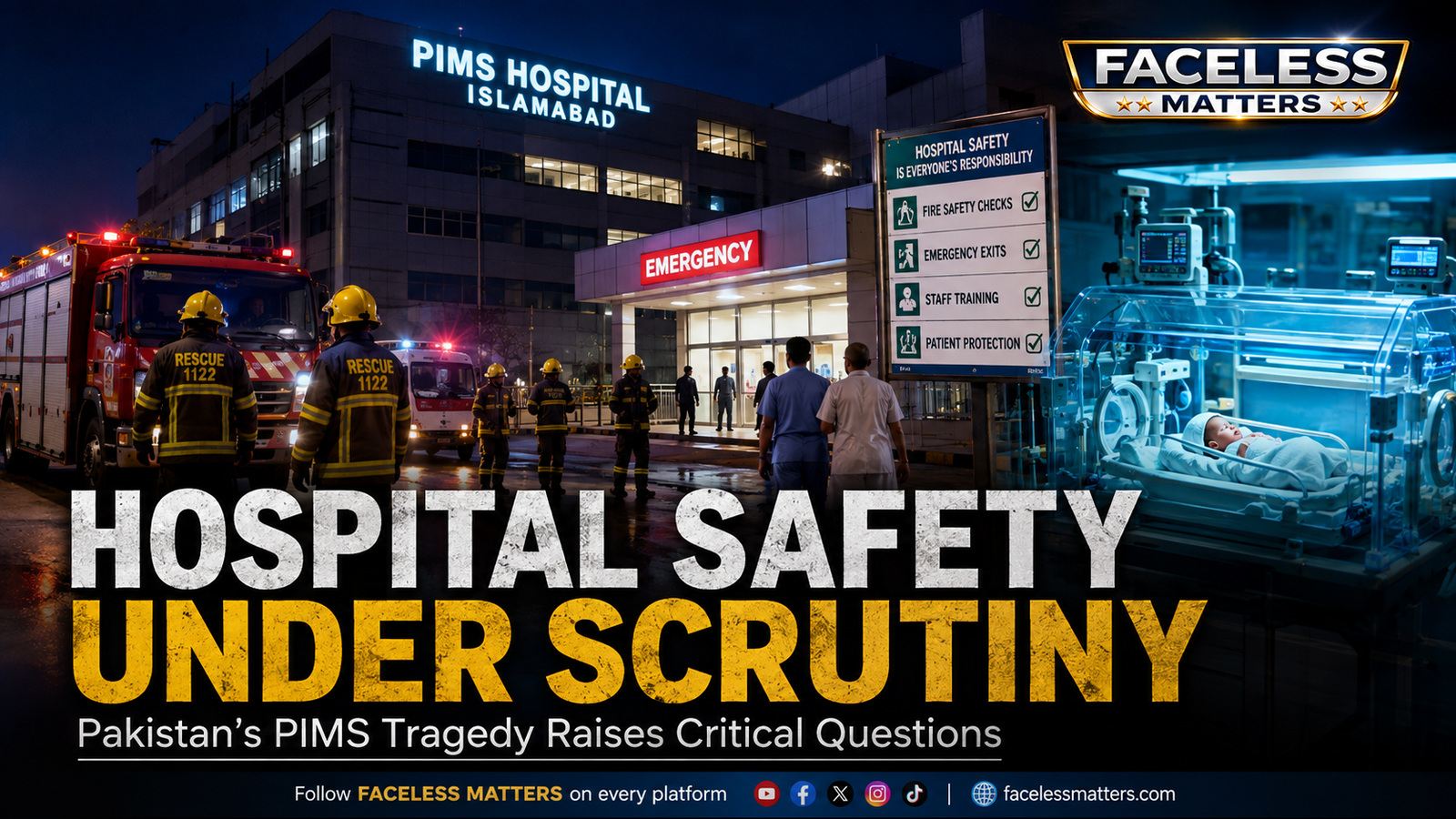
A devastating fire at the Pakistan Institute of Medical Sciences (PIMS) in Islamabad has placed Pakistan hospital fire safety under intense public scrutiny after 14 newborn babies died in a nursery blaze on August 26.
The incident has generated grief across Pakistan, but it has also raised a broader public-health question: how prepared are hospitals to protect patients who cannot evacuate themselves during a fire or other emergency?
Reuters reported that at least 14 infants died in the state-run hospital fire, while authorities launched an investigation into the circumstances surrounding the blaze. Associated Press reported that the fire was confined to the nursery on the hospital’s third floor and that only one baby among those present was rescued.
The tragedy should therefore not be viewed only as an isolated fire incident.
It is also a warning about healthcare infrastructure, emergency preparedness, fire prevention, neonatal patient protection and institutional safety standards.
What Happened at PIMS?
The fire broke out on August 26 at the Pakistan Institute of Medical Sciences in Islamabad, one of the country’s major public healthcare institutions.
Reuters reported that the blaze began around 7 a.m. in the mother-and-child health ward and that at least 14 infants were killed. The report said the health minister attributed the incident to a blast involving an air-conditioning system and noted that oxygen availability in the ward contributed to the rapid spread of the fire.
Associated Press separately reported that the fire occurred in a third-floor nursery and that authorities opened an investigation. The government also moved to remove the health secretary and establish a fact-finding process.
These early reports are important, but the final cause should remain a matter for the official investigation.
That distinction is critical.
A developing investigation should not be turned into a definitive claim about negligence, equipment failure or individual responsibility before technical investigators establish what happened.
The larger question, however, does not depend on the final cause.
Even if an electrical component, air-conditioning system or another technical failure triggered the fire, hospitals must be designed around the possibility that equipment can fail.
That is the foundation of modern Pakistan hospital fire safety.
Why Neonatal Units Face Unique Risks
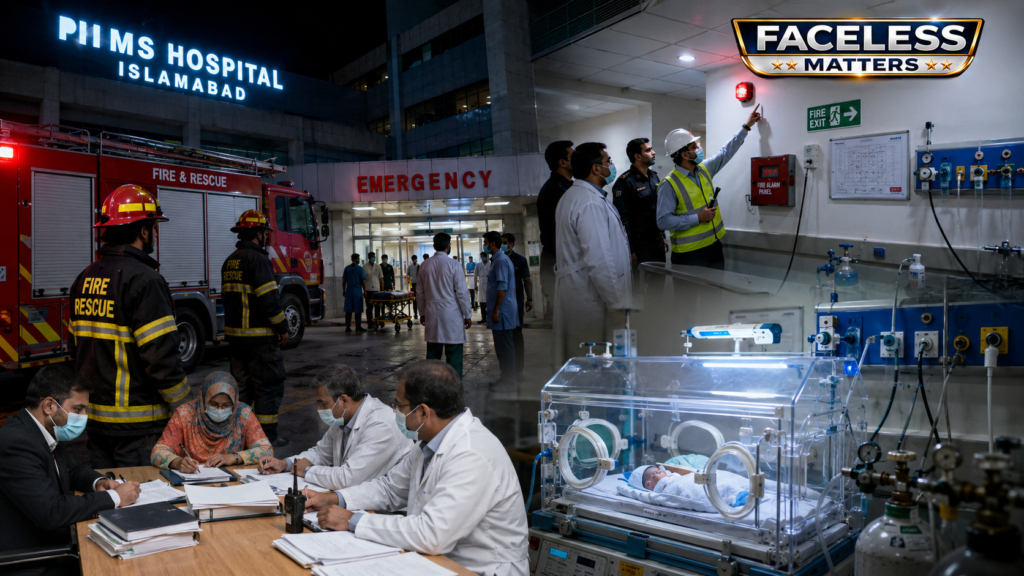
A neonatal intensive-care or newborn nursery is fundamentally different from an ordinary hospital ward.
Most adult patients can potentially walk, crawl or respond to emergency instructions.
Newborns cannot.
A premature baby may require continuous monitoring, oxygen support, intravenous medication or mechanical assistance. Moving such a patient quickly during a fire can be extremely difficult.
This creates a special category of healthcare risk.
A hospital can have trained doctors and nurses and still face an enormous evacuation challenge if the building itself is not designed for rapid compartmentalisation and safe patient movement.
The tragedy therefore highlights the importance of designing neonatal facilities around the needs of the most vulnerable patients.
That includes:
- clearly accessible emergency exits;
- functioning fire alarms;
- automatic detection systems;
- fire-resistant doors;
- smoke-control systems;
- emergency lighting;
- evacuation routes;
- backup power;
- accessible fire extinguishing equipment;
- staff emergency drills;
- and clearly defined evacuation responsibilities.
These are not luxury features.
They are part of patient protection.
Why Pakistan Hospital Fire Safety Matters
Pakistan hospital fire safety should be considered part of healthcare quality rather than a separate building-management issue.
Patients enter hospitals because they trust the institution to protect them while they are receiving treatment.
That responsibility becomes even greater when patients are unconscious, sedated, critically ill or unable to move independently, making Pakistan hospital fire safety a fundamental part of patient protection.
A hospital therefore has two simultaneous responsibilities.
The first is medical care.
The second is physical protection.
A world-class medical department cannot compensate for an unsafe building.
Similarly, advanced medical equipment cannot protect patients if alarms do not function, evacuation routes are blocked or emergency procedures are not regularly practiced.
This is why hospital safety deserves the same strategic attention as clinical quality, infection prevention and emergency medicine.
The Oxygen Factor in Hospital Fires
Hospitals contain an additional fire-safety challenge that ordinary buildings may not face at the same scale: medical gases.
Oxygen itself does not burn, but it can greatly accelerate combustion when a fire starts.
That means oxygen-rich environments require carefully controlled fire-prevention systems.
Reuters reported that the health minister linked the rapid spread of the PIMS fire to the presence of ample oxygen in the ward.
The final investigation should establish exactly how oxygen systems, equipment and ventilation interacted with the fire.
But the broader lesson is already clear.
Hospitals require specialised fire-risk assessments because the materials and equipment used for patient care can create circumstances very different from those in ordinary commercial buildings.
This is particularly important in:
- intensive-care units;
- neonatal wards;
- operating theatres;
- emergency departments;
- laboratories;
- oxygen-storage areas;
- and high-dependency units.
Emergency Evacuation Is Different in a Nursery
One of the most difficult problems in neonatal emergency management is patient mobility.
A nurse cannot simply tell a newborn patient to leave the building.
The evacuation process may involve:
- identifying which babies are most vulnerable;
- disconnecting or switching essential equipment safely;
- moving multiple infants simultaneously;
- maintaining temperature control;
- protecting babies from smoke;
- coordinating medical staff;
- using alternative routes if one corridor is blocked;
- communicating with emergency responders;
- accounting for every patient.
This requires careful planning before the emergency occurs, which is a central requirement of Pakistan hospital fire safety.
Hospitals should therefore conduct realistic drills that specifically simulate the evacuation of patients who cannot walk.
A generic fire drill may not be enough.
A neonatal evacuation drill should test whether staff can actually move patients under realistic conditions.
Fire Prevention Must Come Before Rescue
Public discussion after a major disaster often focuses on the response.
How quickly did firefighters arrive?
How many ambulances were available?
How did staff react?
Those questions matter.
But the most effective fire-safety strategy begins much earlier.
It begins with prevention.
Hospitals should regularly inspect electrical systems, air-conditioning equipment, wiring, oxygen infrastructure, emergency generators, fire doors, alarms and extinguishing equipment as part of a comprehensive Pakistan hospital fire safety program.
Preventive maintenance is especially important in large public hospitals because these facilities may operate continuously under heavy patient loads, making Pakistan hospital fire safety an ongoing operational responsibility.
An overloaded electrical system or poorly maintained mechanical equipment may create risks that are invisible to patients and visitors.
A serious Pakistan hospital fire safety program should therefore combine:
Prevention + Detection + Containment + Evacuation + Rescue + Recovery
Failure at any stage can increase the consequences of an emergency.
The Importance of Hospital Infrastructure
The PIMS tragedy also raises a wider question about public-sector healthcare infrastructure in Pakistan.
Public hospitals serve enormous numbers of people.
They often operate under pressure from overcrowding, limited resources and high demand.
That makes infrastructure investment particularly important.
Fire safety should not be treated as a one-time procurement exercise.
A hospital may install fire extinguishers today, but the system can become ineffective if equipment is not maintained, alarms are disconnected, exits become obstructed or staff stop receiving training.
Healthcare infrastructure therefore requires continuous investment.
That includes:
- fire detection;
- emergency power;
- building maintenance;
- ventilation systems;
- medical-gas safety;
- evacuation infrastructure;
- staff training;
- emergency communication;
- and regular independent inspections.
The economic argument is also straightforward.
Preventive investment is generally less costly than responding to catastrophic infrastructure failure.
What Pakistan Can Learn From the Incident
Pakistan should not wait for the final investigation report before strengthening hospital safety systems.
Authorities can immediately begin a nationwide safety review.
The first priority should be high-risk wards.
These include neonatal units, intensive-care units, emergency rooms and operating theatres.
Second, hospitals should identify buildings where evacuation would be particularly difficult.
Third, independent technical inspections should verify whether emergency systems actually work.
A fire alarm that exists on paper but fails during an emergency provides no meaningful protection, showing why Pakistan hospital fire safety systems must be independently tested.
The same applies to emergency exits, fire doors and extinguishers.
Fourth, staff should receive regular practical training.
Healthcare workers are not firefighters.
They should not be expected to improvise during a crisis.
Their role should be clearly defined before an emergency occurs.
Hospital Safety as a Public-Health Issue
The PIMS tragedy demonstrates why hospital safety belongs inside the public-health conversation.
Public health is not only about preventing infectious diseases.
It also involves creating environments where people can safely receive treatment.
The same principle applies to environmental conditions.
Dawn highlighted the continuing health consequences of air pollution in Pakistan, noting that the country still lacks a major sustained effort to reduce the problem.
Air pollution and Pakistan hospital fire safety may appear unrelated.
They are not.
Both demonstrate the relationship between infrastructure, government policy and health outcomes.
A population’s health depends not only on doctors and medicines but also on the physical systems surrounding healthcare.
That includes clean air, safe buildings, reliable electricity, clean water, emergency preparedness and accessible medical services.
The Broader Environmental Health Connection
Climate and environmental pressures are also increasingly becoming healthcare concerns.
Extreme heat, wildfire smoke, air pollution and other environmental stresses can increase pressure on health systems.
Recent FACELESS MATTERS analysis of permafrost thaw and extreme heat has highlighted how environmental risks can interact across infrastructure, ecosystems and public health.
This creates an important strategic lesson.
Health policy cannot operate entirely separately from infrastructure policy.
A hospital needs reliable electricity.
Reliable electricity requires resilient infrastructure.
Resilient infrastructure requires investment and planning.
And effective planning requires authorities to understand how different risks interact.
This is why healthcare infrastructure investment is becoming an increasingly important component of national resilience.
What Authorities Should Examine
The official investigation into the PIMS fire should establish facts rather than assumptions.
Several areas deserve particular attention.
1. Origin of the Fire
Investigators should establish precisely where and how the fire began.
2. Fire Detection
Authorities should determine whether alarms and detection systems functioned correctly.
3. Emergency Exits
Investigators should examine whether safe evacuation routes existed and were accessible.
4. Fire Containment
The investigation should establish how quickly smoke and flames moved and whether fire-resistant barriers worked as intended.
5. Medical-Gas Systems
Oxygen and other medical gases should be examined as part of the technical investigation.
6. Staff Response
Investigators should examine whether staff followed established emergency procedures and whether those procedures were adequate.
7. Building Design
The physical design of the nursery should be reviewed from an evacuation perspective.
8. Equipment Maintenance
Air-conditioning, electrical and other mechanical systems should be examined through maintenance records.
9. Emergency Training
Authorities should establish how frequently staff conducted fire and neonatal evacuation drills.
10. Accountability
If the investigation identifies failures, responsibility should be determined through evidence rather than speculation.
What Happens Next?
The immediate priority is the investigation and support for the affected families.
But the longer-term question is whether the tragedy results in meaningful institutional change.
Pakistan has an opportunity to use this painful incident as a catalyst for a nationwide Pakistan hospital fire safety review.
Every major public hospital could be assessed against a common safety framework.
Hospitals could then be classified according to emergency preparedness, with high-risk facilities receiving immediate attention.
The process should be transparent enough to establish public confidence without compromising legitimate security or medical information.
Most importantly, improvements should continue after public attention moves elsewhere.
The greatest danger after a tragedy is not only forgetting what happened.
It is returning to normal without fixing the conditions that allowed the risk to exist.
Why This Story Matters Beyond Islamabad
The PIMS fire happened in Islamabad, but the underlying issue is national.
Pakistan has a large and diverse healthcare system ranging from major tertiary hospitals to small district facilities.
The resources and infrastructure vary considerably.
That means hospital safety standards cannot depend entirely on individual institutions.
National and provincial health authorities have an important role in setting minimum requirements, monitoring compliance and supporting facilities that lack resources.
The goal should not be to punish hospitals for every technical problem.
The goal should be to create a system in which dangerous conditions are identified before patients are harmed.
That requires a culture of prevention.
The Human Dimension
Statistics can describe the scale of a tragedy, but they cannot describe the experience of families who expected their newborn children to receive care and instead lost them in a hospital disaster.
For those families, accountability is not an abstract policy question.
It is about understanding what happened.
It is about knowing whether the disaster could have been prevented.
And it is about ensuring that other families do not face the same experience.
That is why responsible reporting should focus on verified facts rather than unconfirmed accusations.
The deaths of newborns deserve seriousness, accuracy and dignity.
FACELESS MATTERS Strategic Assessment
The PIMS nursery fire should be understood as a health-system resilience warning, not simply as a tragic news event.
The immediate facts remain subject to investigation, but the broader policy lesson is already clear: hospitals must be designed and operated around the safety needs of their most vulnerable patients.
For Pakistan, the strategic priority should be to move from reactive disaster management toward continuous hospital safety management.
That means regular technical inspections, modern fire-detection systems, safe evacuation routes, medical-gas controls, emergency power, trained staff and independent verification.
The most important measure of healthcare quality is not simply how effectively a hospital treats illness.
It is also how effectively it protects patients when something goes wrong.
The PIMS tragedy should therefore become a turning point for Pakistan hospital fire safety.
If the lessons are properly implemented, the country can strengthen healthcare infrastructure, improve emergency preparedness and protect vulnerable patients across the public health system.
The ultimate objective should be simple:
No family should have to enter a hospital for care while unknowingly facing preventable infrastructure risks.
SOURCE VERIFICATION & ANALYSIS
Reuters — Reported that at least 14 infants died in the PIMS Islamabad hospital fire and described the investigation and concerns surrounding the blaze.
Associated Press — Reported that the fire occurred in the third-floor nursery, killing 14 newborns, and covered the government investigation and response.
Dawn — Published current analysis concerning hospital safety and separately highlighted Pakistan’s continuing air-pollution health burden.
WHO — Current health information confirms that Pakistan continues to face important public-health challenges, including communicable-disease surveillance and polio transmission concerns.
Government of Khyber Pakhtunkhwa — Current dengue-control planning demonstrates the importance of surveillance, prevention, timely diagnosis and public awareness in Pakistan’s health system.
Government of Pakistan — Ministry of National Health Services — Maintains current dengue prevention and control guidance for Pakistan.
This article independently interprets the verified information and does not reproduce any source article.
9. RELATED FACELESS MATTERS ANALYSIS
1. Imran Khan Hospital Transfer: What the Supreme Court Order Means — Politics | August 19, 2026
This very recent Politics article examines medical treatment, hospital access, specialist supervision and healthcare arrangements surrounding a high-profile Pakistani patient.
2. Permafrost Thaw 2026: Heat and Wildfires Raise Climate Tipping Point Risks — Environment | August 20, 2026
This medium-recent Environment analysis connects extreme environmental conditions with wider infrastructure and human-health risks, providing useful context for the relationship between environment and healthcare resilience.
10. FINAL FACELESS MATTERS STRATEGIC ASSESSMENT
Hospital safety is healthcare.
The PIMS tragedy demonstrates that protecting patients requires more than medical expertise. Safe buildings, reliable emergency systems, trained personnel, preventive maintenance and effective evacuation planning are fundamental components of a functioning health system.
Pakistan’s next step should be a systematic, evidence-based review of high-risk hospital facilities, particularly neonatal and intensive-care units.
The purpose should not be simply to identify blame.
It should be to identify vulnerabilities before another tragedy occurs.