

TABLE OF CONTENTS
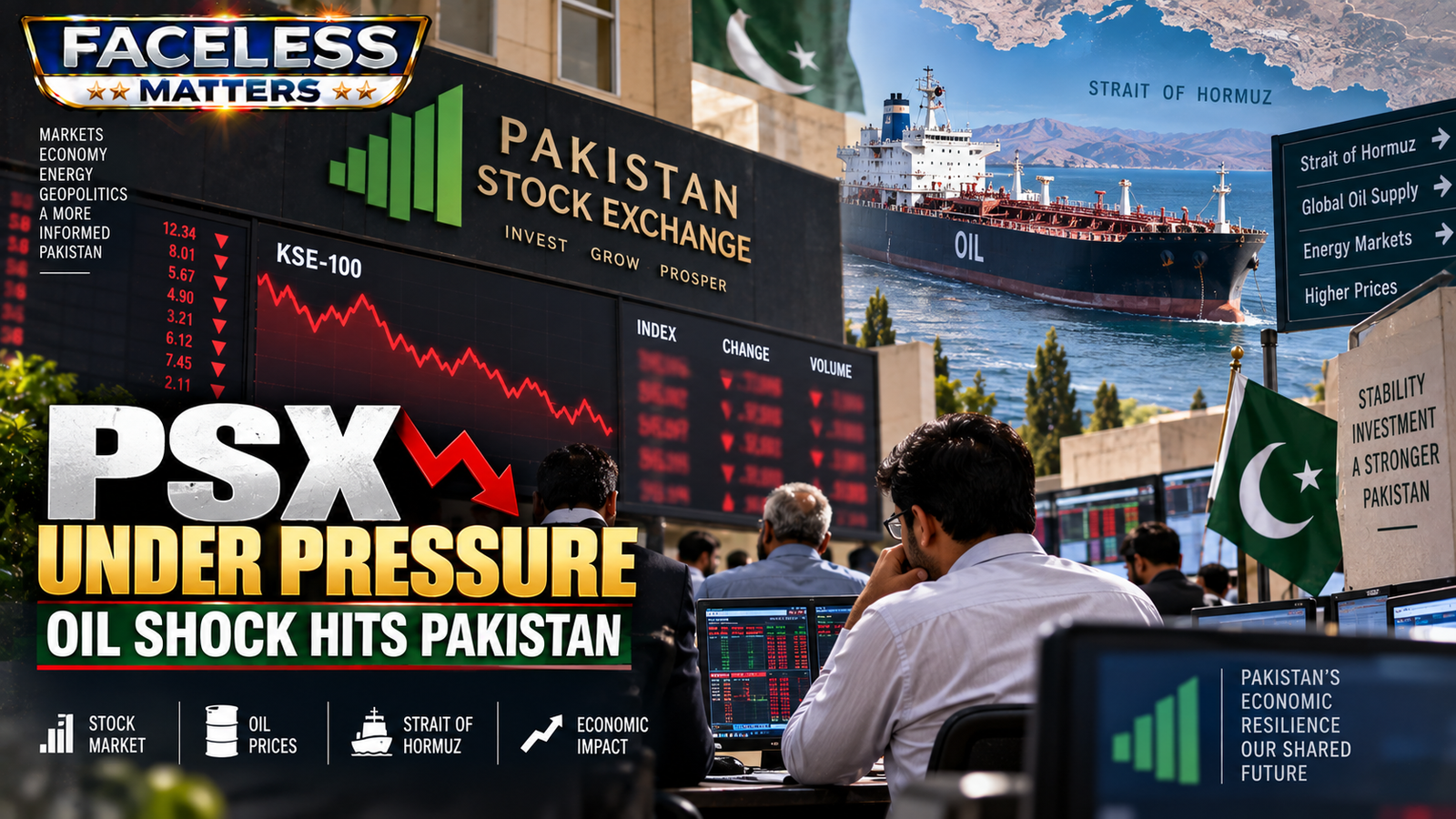
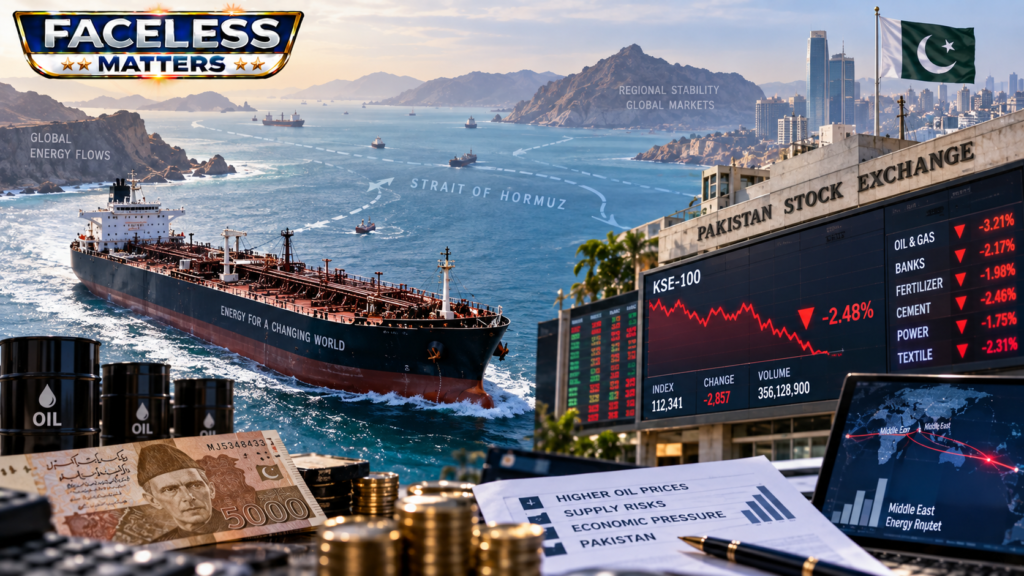
Pakistan’s financial markets face pressure as rising oil prices and Strait of Hormuz risks weigh on investor sentiment. The Pakistan Stock Exchange began September 8 under pressure after the KSE-100 Index fell 1,692.74 points, or 0.97%, on September 7. At 9:45am, the benchmark was reported at 173,411.59, down 224.48 points.
The immediate trigger is geopolitical risk.
For Pakistan, higher oil prices matter because the country is highly exposed to imported energy. An extended rise in crude prices can increase the import bill, place pressure on inflation, affect transportation and production costs, complicate monetary policy and influence corporate profitability.
The pressure is arriving at an important time. Pakistan’s trade deficit widened 18.11% year on year to $7.116 billion during July-August 2026, with imports rising 13.03% to $12.575 billion while exports increased 7.04% to $5.46 billion.
At the same time, petrol prices were raised by Rs12.90 per litre to Rs358.77, while high-speed diesel increased by Rs3.72 to Rs381.77, effective September 8.
The result is a financial pressure chain that deserves closer attention.
What Happened to the Pakistan Stock Market Today?
The KSE-100 Index closed September 7 at 173,636.07, down 1,692.75 points, or 0.97%, according to official Pakistan Stock Exchange data. The session had a high of 175,353.67 and a low of 173,603.75.
Selling was broad rather than confined to one industry.
Business Recorder reported pressure across automobile assemblers, cement companies, commercial banks and oil marketing companies, with several major index-heavy stocks trading lower during early September 8 trading.
That breadth matters.
When investors sell across multiple sectors at the same time, the Pakistan stock market is usually responding to a broader risk assessment rather than an isolated company-specific problem.
The current concern is that geopolitical uncertainty could translate into higher energy costs and wider economic pressure.
FACELESS MATTERS Analysis
The KSE-100 decline should not automatically be interpreted as evidence that Pakistan’s economy is entering a financial crisis.
Stock markets react to expectations.
If investors in the Pakistan stock market believe that a geopolitical event could increase oil prices, weaken external balances or reduce corporate margins, they can reduce risk exposure before those effects appear fully in economic data.
That makes the stock market an important early-warning mechanism—but not a perfect forecast.
Why Oil Prices Are Suddenly So Important
The international oil market has become the central financial variable in the current story.
Business Recorder reported on September 8 that Brent crude had moved to around $97.04 per barrel, after reaching a six-week high as tensions involving Iran and the Persian Gulf increased concerns about possible disruption to energy infrastructure.
For the Pakistan stock market, that matters immediately because higher oil costs can influence investor expectations about the wider economy.
Pakistan does not control international crude prices.
When global oil becomes more expensive, the country can face higher costs for imported petroleum products. Those costs can then move through transportation, electricity generation, logistics, manufacturing and consumer prices.
This is why an oil shock can affect the Pakistan stock market far beyond the oil sector.
It can become a macroeconomic shock.
Pakistan’s Fuel Prices Show How Quickly the Shock Can Reach Consumers
The government increased petrol prices by Rs12.90 per litre and HSD prices by Rs3.72 per litre for September 8. Petrol rose from Rs345.87 to Rs358.77, while HSD increased from Rs378.05 to Rs381.77.
The government has also moved toward a more frequent petroleum-pricing mechanism because international oil-market conditions have become unusually volatile.
According to the Petroleum Division, reforms are being considered to make fuel pricing more transparent and predictable while protecting consumers from excessive volatility.
This is economically significant.
A daily or more responsive pricing system can transmit global price changes to domestic consumers faster.
That has one advantage: it can reduce the gap between international costs and domestic prices.
But it also has a disadvantage for households and businesses.
Price volatility becomes more visible.
For transport operators, manufacturers and logistics companies, the ability to plan costs becomes more difficult when fuel prices change frequently.
The Trade Deficit Makes the Oil Shock More Important
Pakistan’s external trade position provides another reason for caution.
According to data released by the Pakistan Bureau of Statistics, the merchandise trade deficit reached $7.116 billion in July-August 2026, compared with about $6.025 billion during the same period a year earlier.
Imports increased by 13.03%, reaching $12.575 billion.
Exports increased by 7.04%, reaching $5.46 billion.
The difference between those growth rates is important.
Pakistan is exporting more, but the Pakistan stock market remains sensitive to how quickly imports are growing.
FACELESS MATTERS Analysis
This creates a vulnerability to another oil shock.
If international energy prices remain elevated for an extended period, Pakistan may need to spend more dollars on energy imports.
That does not automatically mean the Pakistan stock market will collapse or the external account will deteriorate sharply.
But it means the margin for error becomes smaller.
The stronger Pakistan’s exports, remittances, reserves and other external inflows are, the easier it becomes to absorb an energy shock.
The weaker those buffers are, the more uncomfortable the adjustment can become.
Inflation Is Another Transmission Channel
Pakistan’s Consumer Price Index inflation reached 11.1% year on year in August 2026, according to the Pakistan Bureau of Statistics.
That is a crucial background factor.
Oil prices can affect inflation directly through petrol and diesel.
They can also affect it indirectly.
Higher fuel costs can raise:
- transportation expenses;
- freight charges;
- food distribution costs;
- manufacturing costs;
- agricultural input costs;
- electricity-related expenses;
- and operating costs for businesses.
The effect does not always appear immediately.
Companies may initially absorb higher costs through lower margins.
Later, some of those costs may be passed to consumers.
That is why an oil shock can become more important for the Pakistan stock market over several weeks or months than it appears on the first day.
Why Banks, Cement and Autos Can Also Be Affected
The current selling pressure is notable because it extends beyond oil-related companies.
Banks, cement companies and automobile assemblers were among the sectors under pressure during the recent PSX weakness.
The reason is not that these industries directly depend on the same factor in exactly the same way.
Rather, investors are reassessing the wider economic environment.
Banks
Banks can be affected if higher inflation and economic uncertainty influence interest-rate expectations, credit demand, asset quality or investment sentiment.
Cement
Cement demand is closely connected to construction, infrastructure and broader economic activity. Higher energy and transportation costs can also affect production and distribution expenses.
Automobiles
Automobile sales can be sensitive to interest rates, household purchasing power, financing costs and consumer confidence.
Oil Marketing Companies
Oil marketing companies are directly exposed to fuel volumes, pricing mechanisms, inventory effects and broader petroleum-market conditions.
For the Pakistan stock market, the important point is that one external shock can affect very different sectors through different channels.
The Strait of Hormuz Is the Bigger International Risk
The financial market is not reacting to the price of oil alone.
Investors are also assessing the possibility of prolonged disruption around the Strait of Hormuz.
The waterway is strategically important to global energy trade. Renewed tensions involving Iran and the United States have increased concern about shipping and energy infrastructure in the Gulf.
The market does not require a complete physical shutdown of the waterway to react.
Insurance costs can rise.
Shipping can become more expensive.
Freight routes can change.
Risk premiums can increase.
Pakistan stock market investors can begin pricing the possibility of future shortages before a shortage actually occurs.
That expectation alone can move crude prices.
What Happens If Oil Stays Near $100?
A short-term move toward $100 per barrel would be uncomfortable but manageable for many economies.
The bigger concern is duration.
If oil stays close to that level for a prolonged period, the financial consequences become more significant.
For Pakistan, the potential chain could look like this:
Higher crude prices → higher import costs → greater external financing pressure → inflation risk → tighter monetary conditions → weaker consumer demand → pressure on corporate earnings.
That is not a prediction that every step will necessarily occur.
It is a risk pathway.
FACELESS MATTERS Analysis
For the Pakistan stock market, the duration of the shock may ultimately matter more than the headline price.
A temporary spike can be absorbed.
A prolonged period of elevated oil prices can become embedded in business planning, consumer behaviour and inflation expectations.
That distinction should remain central to any serious financial analysis.
Pakistan’s Rupee Becomes Another Important Indicator
The Pakistani rupee is another variable investors will watch closely.
Business Recorder listed the September 7 interbank USD/PKR rate at approximately 277.60 selling and 277.40 buying.
A stable currency can reduce the domestic impact of imported commodities.
A weaker currency can amplify the cost.
For example, if international oil prices rise while the rupee remains stable, the domestic impact may be manageable relative to a scenario where oil rises and the currency simultaneously weakens.
For the Pakistan stock market, exchange-rate stability is one of the most important buffers for an import-dependent economy.
Pakistan’s External Account Has Some Positive Signals Too
The current picture is not entirely negative.
Pakistan’s current-account deficit narrowed to approximately $328 million in July 2026, compared with $529 million in July 2025, according to reporting based on the Finance Division’s economic update. Stronger remittances and improvements in other balances helped offset some pressure from the wider trade position.
This distinction is important.
A widening merchandise trade deficit does not automatically mean the current account will deteriorate by the same amount.
Remittances, services, primary income and other external flows also matter.
FACELESS MATTERS Analysis
Pakistan’s financial resilience therefore depends on the interaction of several variables rather than one headline number.
The country needs:
stronger exports + stable remittances + adequate reserves + disciplined fiscal policy + manageable energy costs + currency stability.
The more of these buffers remain intact, the better Pakistan can absorb external shocks.
Why the PSX Decline Should Not Be Read as a Complete Economic Verdict
A stock-market decline is important.
But it is not the same thing as an economic recession.
The PSX can fall because investors temporarily reduce risk.
It can also recover before economic data improve.
Likewise, a rising stock market does not automatically mean households are becoming wealthier or structural economic problems have disappeared.
The KSE-100 remains sensitive to:
- interest rates;
- oil prices;
- currency movements;
- IMF developments;
- corporate earnings;
- foreign flows;
- domestic liquidity;
- and geopolitical risk.
That means today’s decline should be understood as a Pakistan stock market signal within a larger economic system.
The Bigger Problem: Pakistan Is Facing Several Financial Pressures at Once
The most important issue is not one bad trading session.
It is the possibility of several pressures appearing simultaneously.
Pakistan is dealing with:
- higher global energy risk;
- elevated domestic inflation;
- a widening merchandise trade deficit;
- changing fuel prices;
- geopolitical uncertainty;
- sensitivity to external financing;
- and investor concerns about future economic conditions.
Each issue can be manageable individually.
The challenge is when they reinforce one another.
For example, higher oil prices can raise inflation.
Higher inflation can complicate monetary policy.
Tighter financial conditions can affect business activity.
Slower business activity can affect corporate earnings.
Lower earnings expectations can affect equity valuations.
This is how a geopolitical event can eventually become a Pakistan stock market story.
What Pakistan Can Control
Pakistan cannot determine what happens in the Strait of Hormuz.
It cannot set global crude prices.
It cannot control U.S.-Iran tensions.
But it can strengthen its domestic economic buffers.
Those include:
- maintaining credible fiscal discipline;
- improving export competitiveness;
- expanding high-value services exports;
- protecting foreign-exchange liquidity;
- reducing energy-sector inefficiencies;
- improving tax collection;
- encouraging productive investment;
- and creating greater certainty for businesses.
This is where structural reform becomes more important than short-term intervention for the Pakistan stock market and wider economy.
Why Export Growth Matters More Than Ever
The recent trade data show that exports increased 7.04% during July-August 2026, but imports grew 13.03%.
That gap is the key issue.
Pakistan does not necessarily need to eliminate imports.
Imports of machinery, technology, industrial inputs and productive equipment can support future growth.
The more important question is whether imports generate sufficient future earning capacity.
An economy that imports machinery to produce exportable goods is fundamentally different from an economy that relies heavily on imports for consumption without creating corresponding foreign-exchange earnings.
FACELESS MATTERS Analysis
Pakistan’s long-term financial objective should therefore not simply be “lower imports.”
It should be:
more productive imports + stronger exports + higher-value services + stable foreign-exchange earnings.
That is a more sustainable model.
What Businesses Should Watch Now
Pakistani businesses should pay particular attention to five indicators.
1. Oil prices
A sustained move higher would increase cost pressure.
2. The rupee
Currency stability can determine how much of the global oil shock reaches domestic prices.
3. Inflation
Persistent inflation can influence interest-rate expectations and consumer demand.
4. Interest rates
Higher financing costs can reduce investment and consumer borrowing.
5. External financing
Pakistan’s ability to maintain adequate external liquidity remains critical.
These variables are interconnected.
What Investors Should Watch in the PSX
For investors following the Pakistan Stock Exchange, the next sessions should be evaluated through fundamentals rather than emotion.
Important indicators include:
- KSE-100 market breadth;
- commercial-bank performance;
- oil and gas stocks;
- oil marketing companies;
- cement stocks;
- automobile companies;
- foreign investor flows;
- rupee stability;
- crude prices;
- and official economic data.
A recovery in the KSE-100 would be encouraging.
But a single positive session would not necessarily remove the underlying risks.
Likewise, another weak session would not automatically prove that a larger market collapse is coming.
The quality of the market response matters more than one day’s headline.
FACELESS MATTERS Analysis: The Real Market Test Is Resilience
The current PSX pressure provides a useful test of Pakistan’s economic resilience.
A resilient economy is not one in which external shocks never occur.
External shocks are unavoidable.
A resilient economy is one that can absorb them without losing financial stability.
That requires buffers.
It requires foreign-exchange liquidity.
It requires credible institutions.
It requires businesses capable of passing through temporary shocks without collapsing.
And it requires policymakers who can respond without creating a second problem while solving the first.
Pakistan’s progress should therefore not be judged solely by whether the KSE-100 rises or falls on a particular day.
The deeper question is whether the country’s economic structure is becoming more capable of absorbing volatility.
What the Latest Oil Shock Could Mean for Consumers
For ordinary households, the financial story is ultimately about purchasing power.
Higher petrol prices affect commuting.
Higher diesel prices affect transport and logistics.
Higher logistics costs can affect food and manufactured products.
Higher inflation can reduce the amount households can spend on discretionary goods.
That creates a secondary effect on businesses.
If households spend more on fuel and essential goods, they may spend less on restaurants, retail, entertainment and other discretionary categories.
This is how an energy shock can move beyond the petrol station and into the broader economy.
What Happens If the Geopolitical Situation Improves?
The risk is not one-directional.
If tensions around the Strait of Hormuz ease, oil prices could fall quickly.
Shipping risk premiums could decline.
Asian markets could stabilize.
Emerging-market sentiment could improve.
Pakistan could benefit through lower imported energy costs and reduced pressure on inflation and the external account.
That is why investors should avoid assuming that the current market weakness must continue.
Markets are forward-looking.
If geopolitical risk improves, financial prices can respond before the underlying economic data change.
What Happens If the Crisis Gets Worse?
The opposite scenario would be more challenging.
A prolonged disruption to Gulf energy flows could push oil prices materially higher.
For Pakistan, that could increase:
- the petroleum import bill;
- transport costs;
- inflation;
- pressure on the current account;
- corporate operating expenses;
- and investor risk premiums.
It could also make monetary policy more complicated.
The central bank could face a difficult balance between supporting economic activity and preventing second-round inflation effects.
This is why geopolitical developments are now directly relevant to Pakistan’s financial outlook.
Pakistan’s Finance Story Is Becoming an Energy Story
One of the clearest lessons from the current market pressure is that finance cannot be separated from energy security.
Oil affects imports.
Imports affect foreign-exchange demand.
Foreign-exchange conditions affect the currency.
The currency affects inflation.
Inflation affects interest rates.
Interest rates affect investment.
Investment affects growth.
And growth ultimately affects corporate earnings and the stock market.
This interconnected chain explains why the current PSX decline deserves attention beyond traders.
A Useful Comparison With Global Markets
Internationally, markets are also responding to the same geopolitical energy shock.
Reuters reported on September 8 that Asian markets were mixed as Iran warned of retaliation and Brent crude moved to around $97.04 per barrel. The Japanese yen strengthened while investors assessed the potential impact of higher energy prices and geopolitical uncertainty.
That means Pakistan is not experiencing an isolated market phenomenon.
However, Pakistan’s exposure can be different from that of larger economies because imported energy, external financing and foreign-exchange liquidity play a particularly important role in its macroeconomic stability.
This is why the same global oil shock can produce different effects in different countries.
Three Scenarios for Pakistan’s Financial Markets
Scenario 1: Tensions Ease
If geopolitical tensions decline and oil prices retreat, pressure on Pakistan’s external account could moderate.
That would be the most favourable scenario for equities.
Scenario 2: Volatility Continues
If oil remains elevated but supply continues flowing, Pakistan could face higher costs without a complete external shock.
Markets would likely remain selective.
Scenario 3: Major Supply Disruption
If energy flows are materially disrupted for an extended period, the consequences could be significantly larger.
Oil could remain elevated.
Inflation could increase.
External financing needs could rise.
Corporate margins could come under greater pressure.
This would be the most challenging scenario.
These are scenarios, not predictions.
What Happens Next for the Pakistan Stock Market in 2026?
The immediate direction of the Pakistan stock market will depend heavily on oil prices, geopolitical developments and investor risk appetite.
But the next several weeks will also reveal whether the recent market weakness is temporary profit-taking or the beginning of a more persistent reassessment of economic risk.
Investors should watch whether:
- KSE-100 stabilizes above recent lows;
- selling remains broad;
- oil prices continue rising;
- the rupee remains stable;
- inflation expectations change;
- and foreign flows strengthen or weaken.
The market does not need perfect conditions to recover.
It needs confidence that the economic shock is manageable.
FACELESS MATTERS Strategic Assessment
The current financial situation should be viewed neither with unnecessary panic nor with excessive optimism.
Pakistan has genuine vulnerabilities.
The widening trade deficit, elevated inflation and renewed energy-price pressure deserve attention.
But the country also has important buffers.
Remittances remain significant.
Exports are growing, even if more slowly than imports.
The current-account position has shown improvement in some recent data.
And the financial system is operating within an established macroeconomic policy framework.
The central challenge is therefore resilience.
Pakistan’s financial strategy should focus on reducing the economy’s sensitivity to external shocks rather than attempting to eliminate volatility altogether.
That means improving export competitiveness, strengthening energy efficiency, maintaining credible fiscal management, improving foreign-exchange buffers and encouraging productive investment.
The stock market is only one part of that story.
The more important measure is whether Pakistan can turn periods of external pressure into incentives for structural improvement.
What Investors Should Remember
The latest PSX decline does not provide enough evidence to declare a market crash.
It does, however, provide a clear warning.
Oil prices matter.
Geopolitical risk matters.
Pakistan’s trade balance matters.
Inflation matters.
The rupee matters.
And all of these variables interact.
Investors should therefore avoid making decisions based solely on a single red trading session.
A disciplined approach requires examining company fundamentals, earnings, balance sheets, sector exposure and the broader macroeconomic environment.
For readers who want broader context, FACELESS MATTERS has also examined Pakistan’s energy exposure, debt management and wider global financial risks.
Pakistan Energy 2026: 5 Critical Signals From Power Costs, LNG and Global Oil Markets
Pakistan Debt Repayment 2026: A Major Test of Fiscal Management
Bond Market 2026: Rising Yields Trigger a Market Crisis
Conclusion
The Pakistan Stock Exchange is facing renewed pressure at a time when global energy markets are becoming more uncertain.
The KSE-100’s 1,692.74-point decline on September 7 and further weakness in early September 8 trading show that investors are taking the geopolitical and oil risks seriously.
But the real financial story goes deeper than the stock index.
Pakistan has entered the new fiscal year with a wider trade deficit, inflation at 11.1% in August and another increase in domestic fuel prices.
That combination makes oil-market stability particularly important.
If tensions ease, some of the current pressure could reverse.
If the energy shock persists, Pakistan will need stronger economic buffers to protect inflation, foreign-exchange stability, corporate profitability and investor confidence.
The key lesson is simple:
Pakistan cannot control the global oil market or geopolitical events, but it can strengthen the economic resilience needed to absorb them.
For the Pakistan stock market, the next phase will be less about predicting one day’s direction and more about determining whether investors believe the country’s financial fundamentals can withstand another external shock.
That is the question that matters most now.
5. INTERNAL LINKS
- Pakistan Energy 2026: 5 Critical Signals From Power Costs, LNG and Global Oil Markets — Directly relevant to oil prices, energy exposure and Pakistan’s economic vulnerability.
- Pakistan Debt Repayment 2026: A Major Test of Fiscal Management — Provides context on Pakistan’s debt management and fiscal resilience.
- Bond Market 2026: Rising Yields Trigger a Market Crisis — Connects global yields, inflation, government debt and financial-market risk.
6. SOURCE VERIFICATION / TRUSTED SOURCES
- Pakistan Stock Exchange: Official KSE-100 market data and September 7 closing figures.
- Pakistan Bureau of Statistics: August 2026 inflation and July-August 2026 trade data.
- Petroleum Division / Government of Pakistan: Petroleum pricing and energy-market policy information.
- Business Recorder: September 8 PSX intraday market update and oil-market context.
- Reuters: Global market reaction, oil prices and geopolitical risk.
- Express Tribune: Pakistan Stock Exchange and trade-deficit reporting.
Editorial distinction: Reported market figures and official statistics above are presented as factual information. The sections marked FACELESS MATTERS Analysis and Strategic Assessment are editorial interpretation and forward-looking analysis, not guaranteed predictions.
[…] Pakistan Stock Market Under Pressure: Oil Shock, Hormuz Risk and What It Means for Investors8 ستمبر کی Markets/Finance رپورٹ، جو PSX، oil shock، Hormuz risk اور پاکستانی investors پر موجودہ دباؤ کا تفصیلی پس منظر فراہم کرتی ہے۔ […]
[…] 1.Pakistan Stock Market Under Pressure: Oil Shock, Hormuz Risk and What It Means for Investorsپاکستان کے financial markets پر oil prices، Hormuz risk، inflation اور investor sentiment کے اثرات کا تازہ تجزیہ۔ […]
[…] Pakistan Stock Market: 5 Critical Risks From Oil Shock […]
[…] Pakistan Stock Market Under Pressure: Oil Shock, Hormuz Risk and What It Means for Investors […]
[…] Pakistan Stock Market: 5 Critical Risks From Oil Shock […]
[…] Pakistan Stock Market Under Pressure: Oil Shock, Hormuz Risk and What It Means for Investors […]