

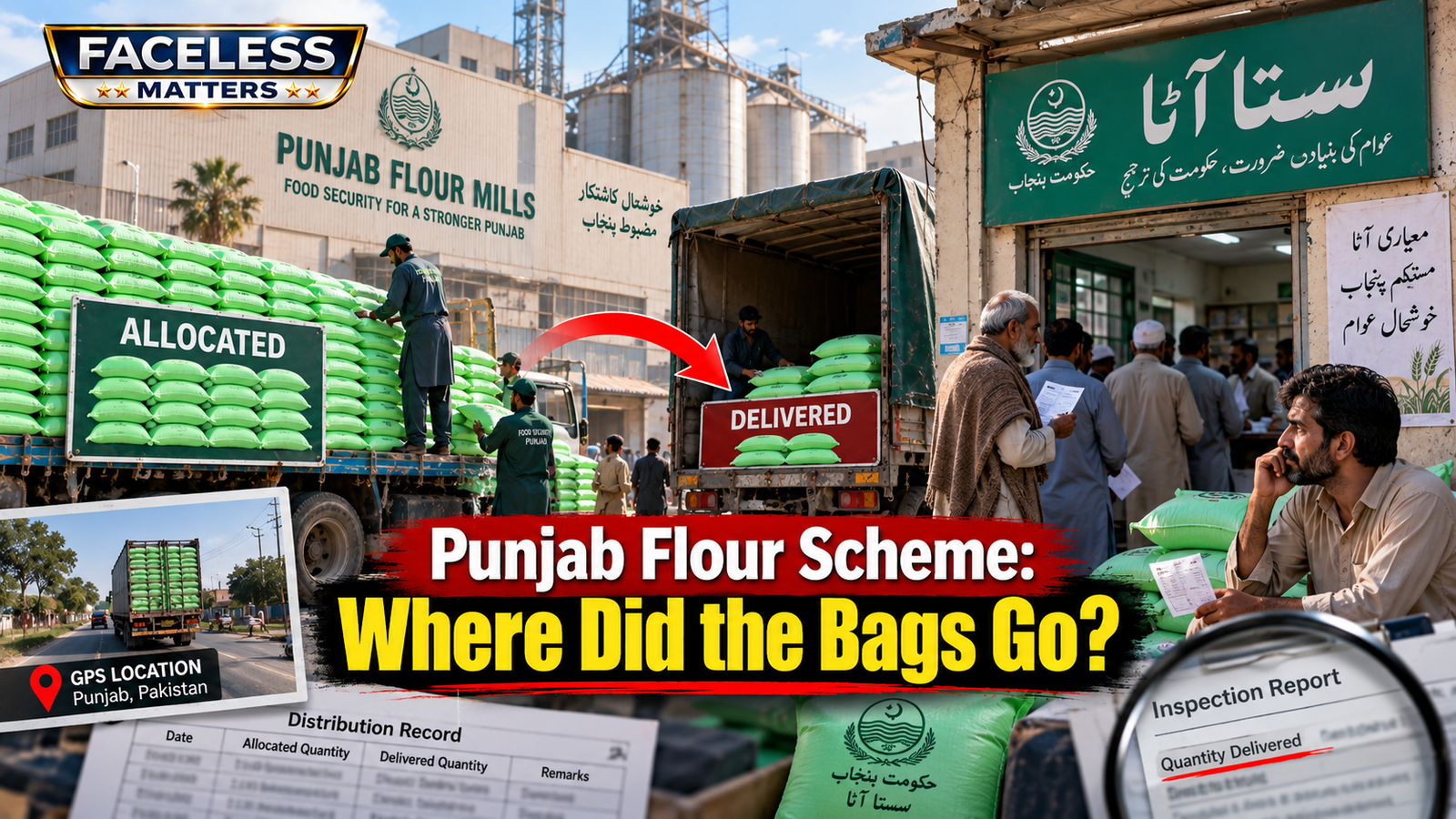
پنجاب کی سستے آٹے کی سکیم میں مبینہ بے ضابطگیاں، کم سپلائی اور رشوت کے الزامات، فیس لیس میٹرز کی تحقیقات میں اہم سوالات سامنے آگئے
Date: September 14, 2026
Key Takeaway
FACELESS MATTERS has received allegations concerning the distribution of subsidized flour in Punjab, including claims that some flour mills and retailers are allegedly being supplied substantially less flour than their stated allocation, while unofficial payments are allegedly demanded to avoid temporary closure or disruption of mill operations and wheat quotas.
One allegation described to FACELESS MATTERS is that a retailer expecting 100 bags may receive only 20 or 30, with the remaining quantity allegedly not reaching the intended market channel. Other allegations concern flour being delivered during the day and allegedly removed again at night.
The most serious allegation concerns claimed daily payments ranging from Rs5 Lac to Rs15 Lac per mill, allegedly demanded by officials to prevent enforcement action. These allegations have not been independently established by a government investigation, and FACELESS MATTERS does not present them as proven facts.
The available material raises a straightforward public-interest question: If subsidized flour is allocated for consumers, can the complete movement of that flour from wheat quota to mill, retailer and final buyer be independently verified?
TABLE OF CONTENTS
Article Content — What Happened?
Punjab subsidized flour scheme is a public-interest programme designed to ensure that government-supported wheat and flour ultimately translate into affordable flour for consumers.
That objective makes the distribution chain particularly important to the Punjab subsidized flour scheme.
Official material confirms that Punjab has used government intervention and subsidies to keep flour affordable. In July 2026, an official statement reported that the Punjab government was providing more than Rs20 billion in subsidies to support affordable flour and stable bread prices. The same report said subsidized wheat was being supplied to operational flour mills and that a significant share of flour in Punjab was being sold at subsidized rates.
Against that background, FACELESS MATTERS has received serious allegations about what allegedly happens within the Punjab subsidized flour scheme between the allocation of wheat/flour and its final sale through the market.
The allegations require investigation rather than assumptions, particularly where the Punjab subsidized flour scheme is concerned.
Punjab Subsidized Flour Scheme: The Alleged Supply Gap
According to information provided to FACELESS MATTERS, some retailers allegedly do not receive the quantity of subsidized flour they are expected to receive under the Punjab subsidized flour scheme.
One example described is straightforward:
If a shopkeeper is supposed to receive 100 bags, the alleged actual delivery may be only 20 or 30 bags.
The central question is what happens to the remaining quantity.
The allegation is not simply that flour is unavailable. It is that the distribution mechanism may allegedly be manipulated so that the full allocation does not reach the intended retail market.
There are also allegations that some mills provide a limited quantity during the day and allegedly take part of the stock back at night.
These are serious claims. They require documentary reconciliation between:
wheat allocation → mill production → subsidized flour bags → dispatch → retailer receipt → retail sale.
Without that chain, it becomes difficult to determine where a shortage actually occurs.
The Alleged Payment Mechanism
The most serious allegation received by FACELESS MATTERS concerns alleged unofficial payments involving flour mills in the Punjab subsidized flour scheme.
According to the allegations, some Food Department/PASSCO-related officials allegedly demand substantial daily payments from mills in connection with the distribution of subsidized flour and wheat quotas.
The allegation described to us puts the claimed amount at approximately Rs5 Lac to Rs15 Lac per mill per day in some cases.
FACELESS MATTERS has not independently verified these monetary allegations through an official inquiry, and they should therefore be treated as allegations requiring investigation.
If such payments were established through documentary evidence, bank records, communications, witnesses or an official investigation, the implications would extend far beyond individual mills.
They would raise questions about:
- public subsidy leakage;
- administrative corruption;
- wheat quota management;
- flour availability;
- consumer prices;
- competition between compliant and non-compliant mills;
- government revenue and subsidy efficiency; and
- the credibility of Punjab’s food-distribution monitoring system.
Why Mill Owners May Feel Trapped
The allegations also describe a pressure mechanism.
A mill owner who allegedly refuses an unofficial payment may face the risk of the mill or wheat quota being sealed or suspended for several days.
That creates a difficult situation for a business operator.
If a mill depends on regular wheat allocation to maintain production, even a temporary disruption can create significant commercial losses.
The alleged choice therefore becomes:
Pay the demanded amount — or risk operational disruption.
Again, this is an allegation, not an established finding.
But it is precisely the kind of allegation that requires an independent audit because a legitimate regulatory system should not depend on informal payments.
PASSCO itself states that its Inspection & Vigilance Wing is responsible for monitoring field operations, identifying irregularities, examining records, conducting investigations and carrying out surprise or spot checks.
That makes independent verification particularly important.
The 100-Bag Versus 20-Bag Question
The simplest way to investigate the alleged mechanism is also one of the most powerful.
Take one documented allocation.
For example:
Official allocation: 100 bags
Actual delivery allegedly received: 20–30 bags
Then independently verify:
- What quantity was authorized?
- What quantity was lifted from the mill?
- What quantity was transported?
- What quantity reached the retailer?
- Was a computerized invoice generated?
- Who signed or digitally confirmed delivery?
- Where did the remaining quantity go?
- Was the same quantity recorded elsewhere?
- Was any stock returned?
- Did the retailer actually sell the quantity recorded in the system?
A digital audit trail could potentially answer most of these questions.
That is why the issue should not be investigated solely through verbal statements.
GPS Evidence and Digital Monitoring
One particularly important allegation concerns GPS-enabled photographs and videos.
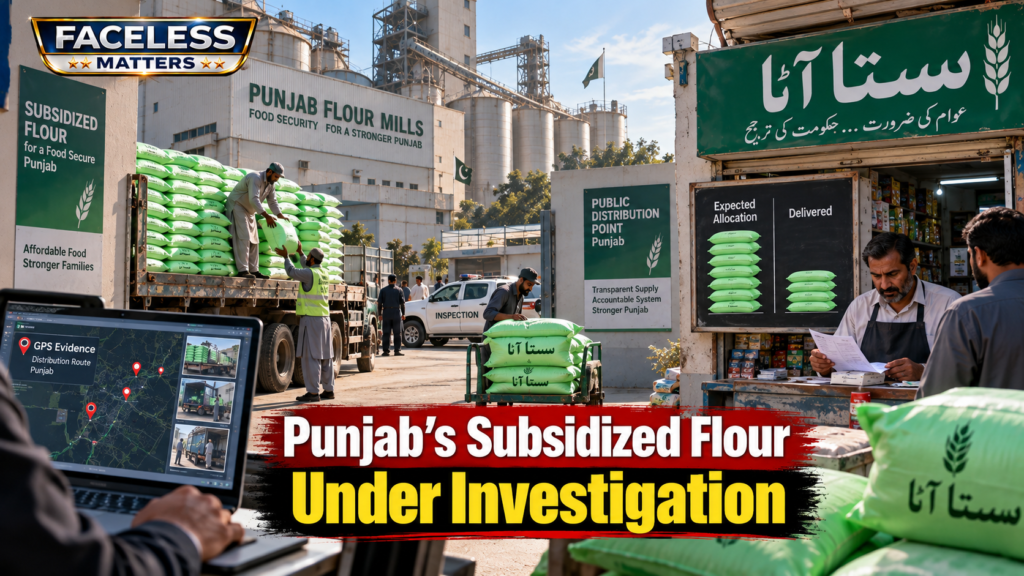
According to the information provided to FACELESS MATTERS, photographs and videos containing location-related evidence are allegedly being recorded and sent to Punjab government offices as part of concerns surrounding the Punjab subsidized flour scheme.
If that material exists, it could become highly useful for an independent investigation.
GPS-linked photographs can potentially establish:
- where a delivery occurred;
- when it occurred;
- what vehicle or location was involved;
- what quantity was visibly present;
- whether the same stock appeared at another location;
- whether a claimed delivery location corresponds with the actual location; and
- whether physical evidence matches administrative records.
However, metadata should be independently authenticated before being treated as conclusive evidence.
A photograph alone does not prove the entire transaction.
A properly preserved chain of evidence can be much stronger.
The Computerized Bill Question
Another allegation concerns retail documentation.
FACELESS MATTERS has been told that, in some reported instances, shopkeepers allegedly do not receive a computerized bill corresponding to the actual quantity supplied under the Punjab subsidized flour scheme.
More seriously, the allegation is that shopkeepers may allegedly be instructed to report a higher quantity if they receive a verification call from Punjab government or Lahore offices.
The example provided is stark:
Actual supply allegedly received: 50 bags
Quantity allegedly instructed to be reported: 150 bags
If independently established, this would be a major documentation and accountability issue.
A computerized transaction system should make such discrepancies easier to detect, not easier to conceal.
The relevant test is therefore simple:
Does the digital record match the physical stock?
If not, why not?
What the Government’s Own System Is Supposed to Achieve
Punjab’s broader food and wheat policy has historically relied on government wheat releases and regulated channels to stabilize flour availability and prices.
Official Punjab statistical material explains that government wheat releases to roller flour mills can be used to support flour supplies and stabilize open-market prices.
More recently, Punjab government reporting has emphasized support for farmers and food affordability, while the government has also described interventions intended to keep flour affordable.
That makes accountability at the distribution level essential.
A subsidy has value only when the intended consumer receives the benefit.
Why PASSCO and Food Department Oversight Matters
PASSCO describes its mission as contributing to national food security through strategic wheat reserves, price stabilization and supply functions.
Its Inspection & Vigilance Wing says it can physically verify stocks, examine records, question employees, investigate premises and conduct surprise checks.
Therefore, the allegations described by FACELESS MATTERS can be tested through mechanisms that already exist.
The question is not whether monitoring is theoretically possible.
The question is whether the monitoring data is being independently compared against the physical movement of flour.
What Should Be Verified Immediately?
A credible investigation should begin with records rather than accusations.
1. Mill-by-mill quota records
Obtain the authorized wheat and flour quota for each relevant mill.
2. Actual lifting records
Compare the authorized quantity with the quantity physically lifted.
3. Production records
Check whether the wheat input corresponds with the claimed flour output.
4. Dispatch records
Verify every dispatch against vehicle, date, destination and quantity.
5. Retailer receipts
Compare the retailer’s claimed receipt with the mill’s dispatch record.
6. Computerized invoices
Check whether computerized bills correspond with physical deliveries.
7. GPS photographs
Authenticate timestamps, locations and original metadata.
8. Night-time stock movement
Where allegations concern stock being removed at night, compare CCTV, vehicle movement, gate logs and GPS data.
9. Complaint records
Check whether mills or retailers previously reported pressure, quota suspension or payment demands.
10. Financial investigation
Where specific bribery allegations exist, investigators should examine financial records and communications rather than relying solely on testimony.
What Happens Next?
The allegations described in this report are serious enough to warrant an independent, documented verification process.
The most important point is that the investigation should not begin by assuming that every Food Department or PASSCO official is involved.
Nor should it begin by dismissing the allegations.
It should begin with data.
If the records show that 100 bags were allocated but only 20 or 30 reached the intended retailer, investigators should determine where the remaining stock went.
If a computerized system says 150 bags were delivered but physical evidence shows 50, the discrepancy should be explained.
If an official is accused of demanding Rs5 Lac to Rs15 Lac per day, the allegation should be tested through evidence capable of establishing whether such payments occurred.
And if the allegations are false, a transparent audit should help clear the officials and institutions involved.
That is what a functioning accountability system should achieve.
FACELESS MATTERS Editorial Position
FACELESS MATTERS is presenting these matters as allegations requiring verification, not as final judicial findings.
The purpose of this report is to put specific, testable questions into the public record.
The alleged mechanism can be investigated through official allocation records, computerized bills, GPS metadata, transport records, mill production figures, retailer receipts, CCTV footage and financial evidence.
If these records contradict the allegations, that evidence should be made public.
If they support them, responsible action should follow.
The public interest is straightforward:
A subsidy intended for ordinary consumers should reach ordinary consumers.
The system should protect honest mill owners, legitimate retailers, government revenue and — most importantly — the people who depend on affordable food.
A Message for the Punjab Government
The allegations described here deserve attention precisely because the Punjab government’s food-relief policies are intended to provide tangible relief to consumers through the Punjab subsidized flour scheme.
Official reporting has repeatedly described government efforts to keep flour affordable, including a reported more than Rs20 billion subsidy in 2026 and subsidized wheat supplies to flour mills.
That public investment makes transparency even more important. For the Punjab subsidized flour scheme, accountability depends on whether officials can trace subsidized wheat from allocation and milling through transport, retail delivery and final sale. A reliable system should allow authorized quantities, physical stock, computerized records and delivery evidence to be compared without relying only on verbal assurances.
This kind of verification can also distinguish an administrative error from a genuine supply discrepancy. It can protect public funds while giving legitimate flour mills and retailers a clear way to demonstrate compliance. Most importantly, transparent records can help determine whether the subsidy is reaching the consumers for whom it was intended.
If monitoring mechanisms are working, they should be able to identify discrepancies quickly.
If they are not working, the system needs stronger independent controls.
For the administration led by Chief Minister Maryam Nawaz Sharif, the most useful response to allegations of this nature would be a transparent fact-finding process based on records, physical verification and independent accountability.
The same principle applies to every public office involved in the wheat and flour supply chain.
INTERNAL READING — FACELESS MATTERS
Pakistan Energy 2026: 5 Critical Signals From Power Costs, LNG and Global Oil Markets
Pakistan Petrol Price: 5 Business Risks After Fresh Hike
Pakistan Stock Market: 5 Critical Risks From Oil Shock
Pakistan Eurobond 2026: A Step Toward Global Capital Markets
Global Markets 2026: Proven AI Gains Face a Major Test
Sources & Editorial Note
Official Punjab Government / Agriculture Department — Punjab’s current official programme pages provide information on government initiatives and agricultural support. Punjab Agriculture Department — Chief Minister’s Initiatives
Punjab Government Portal — Official information on Punjab’s wheat-support policies and flour-mill requirements. Punjab Government — Wheat Farmer Support Programme
Associated Press of Pakistan — Reporting on Punjab’s subsidized flour policy, including the reported subsidy and supply arrangements in July 2026. APP — Punjab providing Rs20 billion subsidy to keep flour affordable
PASSCO — Official information on PASSCO’s food-security role and wheat supply functions. PASSCO Official Website
PASSCO Inspection & Vigilance Wing — Official description of inspection, stock verification, investigations and surprise checks. PASSCO Inspection & Vigilance Wing
Editorial Note
The corruption, bribery, reduced-supply, stock-return and false-reporting allegations in this article are claims requiring independent verification. FACELESS MATTERS has not presented them as proven findings of a court or government inquiry.
FACELESS MATTERS invites the Punjab Food Department, PASSCO, relevant district administrations, flour-mill owners, distributors and retailers to provide documentary responses or evidence that can clarify the allegations. Any substantive response received can be incorporated into an updated version of this report.