

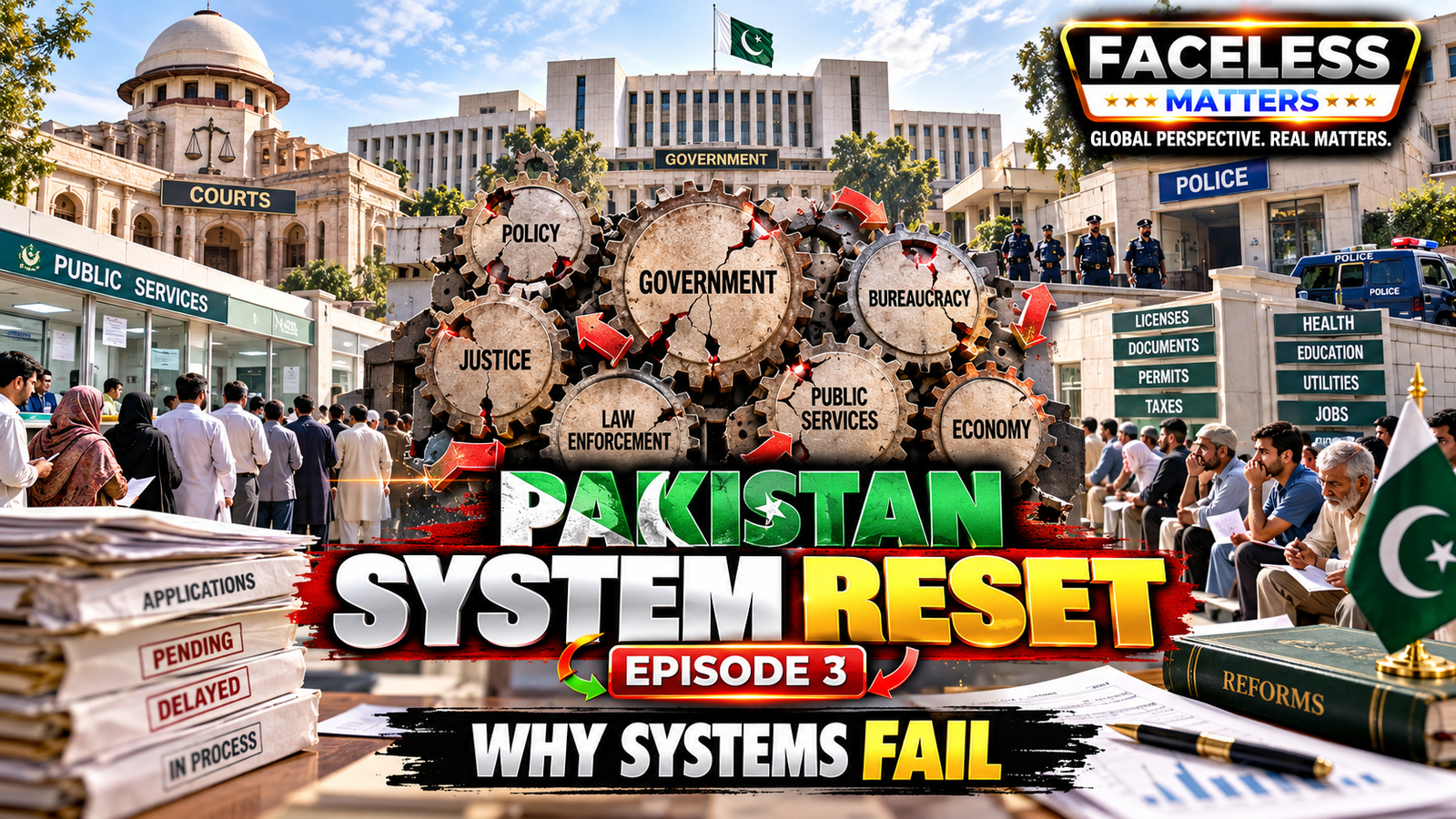

Key Takeaway
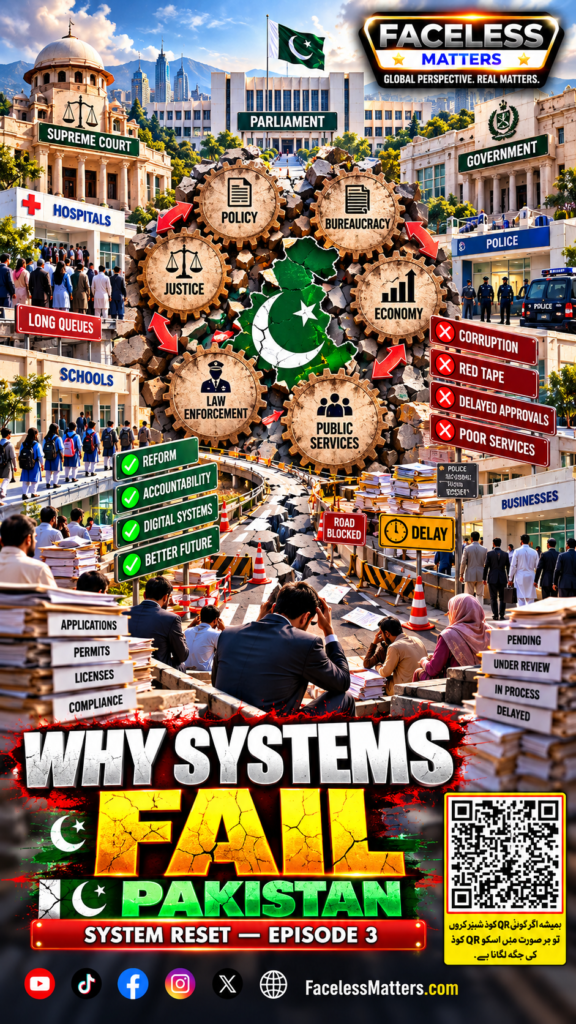
A system does not necessarily fail because there are no laws, policies or institutions. It can fail when the different parts of the system do not work together, when responsibilities are unclear, when implementation is weak, when information does not reach decision-makers, when accountability is inconsistent, or when reforms are announced without sufficient capacity to execute them.
Why Systems Fail Pakistan is therefore not a question that should be reduced to blaming one institution, one government or one group of citizens.
Pakistan has laws, courts, regulators, ministries, local administrations, businesses, professional bodies and thousands of public servants. The more useful question is why these components sometimes produce results that are weaker, slower or less predictable than the policy itself intended.
Pakistan’s 2025 IMF Governance and Corruption Diagnostic identified weak institutional capacity, fragmented oversight, inconsistent accountability, complex regulatory environments and constrained rule of law among governance vulnerabilities affecting economic performance and reform efforts.
The central lesson is simple:
A good system is not defined only by what is written on paper. It is defined by what happens when the rules meet reality.
TABLE OF CONTENTS
Why Systems Fail Pakistan: The Central Question
Why Systems Fail Pakistan is a broader question than asking why a particular government department performed poorly.
A system is made up of connected parts.
For example, a public-service process may involve:
- legislation;
- policy;
- budget;
- ministry;
- implementing department;
- field officers;
- technology;
- procurement;
- audit;
- complaints;
- courts;
- and citizens.
If one component is weak, the final result can suffer.
But an even more important problem can occur when all components exist but do not connect effectively.
A ministry may create a policy.
A department may receive instructions.
A budget may be approved.
A project may be announced.
Yet the citizen may still not receive the expected service.
That is the difference between institutional existence and institutional performance.
A Law Is Not the Same as a Working System
Pakistan does not lack laws.
The more important question is whether laws are understandable, accessible, consistently implemented and supported by institutions capable of enforcing them.
The same principle applies to government policies.
A policy document can contain ambitious objectives, measurable targets and detailed timelines.
But implementation requires:
- people;
- money;
- authority;
- information;
- coordination;
- technology;
- procedures;
- monitoring;
- and accountability.
If these components are missing, the distance between policy and outcome grows.
This is one of the central explanations for Why Systems Fail Pakistan.
The IMF’s 2025 Governance and Corruption Diagnostic did not describe the problem simply as an absence of institutions. It identified weaknesses involving institutional capacity, fragmented oversight, inconsistent accountability and complex regulatory environments.
That distinction matters.
The question is not merely:
“Does Pakistan have the institution?”
It is:
“Does the institution have the capacity and coordination required to perform its function?”
The Implementation Gap
The implementation gap appears when an officially approved decision does not translate into the expected real-world outcome.
Consider a simple example.
Suppose a government introduces a digital complaint system.
The policy objective is clear:
Citizen → complaint → tracking number → responsible department → resolution → feedback.
But if:
- complaints are not assigned quickly;
- departments do not update the system;
- citizens cannot see progress;
- officers are not measured on resolution;
- or there is no escalation mechanism,
then the technology exists but the system does not work as intended.
The problem is therefore not necessarily the software.
It is the institutional process surrounding the software.
This is why Why Systems Fail Pakistan cannot be answered by purchasing more technology alone.
When Institutions Work in Silos
One of the most difficult governance problems is institutional fragmentation.
A citizen may interact with several departments for a single issue.
A business may need:
- registration;
- taxation;
- licensing;
- environmental approval;
- utilities;
- labour compliance;
- customs;
- and local permissions.
If every department maintains a separate process, the burden increases.
The IMF’s governance diagnostic specifically identified fragmented oversight and the need for stronger coordination across agencies.
This does not mean every institution should be merged.
Different institutions often need different responsibilities.
The objective should instead be clear division of responsibility combined with effective coordination.
A good system should answer:
Who is responsible?
Who has authority?
Who provides the data?
Who monitors performance?
Who handles complaints?
Who corrects failure?
Without clear answers, responsibility can become distributed so widely that accountability becomes difficult.
Weak Institutional Capacity
Institutional capacity includes much more than the number of employees.
It includes:
- professional skills;
- leadership;
- procedures;
- technology;
- financial resources;
- data;
- training;
- institutional memory;
- management systems;
- and the ability to implement decisions.
A department may have thousands of employees and still struggle with capacity if its processes are outdated or responsibilities are unclear.
Conversely, a smaller institution can perform effectively if it has clear authority, professional expertise, reliable data and strong management.
The IMF’s 2026 Pakistan review says the authorities are implementing governance reforms intended to strengthen institutional capacity and anti-corruption efforts, while the Prime Minister’s Economic Governance Reform Plan contains 15 reform actions with KPIs, timelines and monitoring arrangements.
This provides an important lesson:
Institutional capacity itself has to be built, measured and maintained.
Too Many Rules, Too Much Complexity
Another reason systems can fail is excessive complexity.
Rules are necessary.
But when citizens and businesses face overlapping regulations, unclear procedures and multiple approvals, compliance can become unnecessarily expensive and slow.
The result may be:
More rules → more procedures → more administrative burden → more opportunities for delay and discretion.
Pakistan’s reform agenda includes efforts to reduce excessive regulatory burdens and improve the business environment. The IMF’s 2026 review also refers to regulatory streamlining and a planned national regulatory registry to improve transparency and reduce uncertainty.
The goal should therefore not be:
Maximum regulation.
It should be:
Clear, necessary, predictable and enforceable regulation.
Accountability Without Consistency
Accountability is necessary for functioning institutions.
But accountability must also be predictable and evidence-based.
If similar violations receive completely different treatment without a lawful explanation, confidence can decline.
A functioning accountability framework should answer:
- What rule was violated?
- What evidence exists?
- Who investigates?
- Who decides?
- What appeal or review process exists?
- What corrective action is required?
- How is recurrence prevented?
The IMF’s governance diagnostic identified ineffective and inconsistent accountability among Pakistan’s governance vulnerabilities and recommended stronger institutional integrity, transparency and more reliable enforcement.
The purpose of accountability is therefore not simply punishment.
It should also improve the system that allowed the problem to occur.
Information and Data Failures
Modern government depends increasingly on reliable information.
If one department does not know:
- how many applications are pending;
- how long cases take;
- where delays occur;
- which offices receive the most complaints;
- or which projects are behind schedule,
then management becomes reactive.
Good systems create feedback loops.
Decision → implementation → data → review → correction → new decision.
Without that loop, mistakes can continue for years.
This is why measurable KPIs matter.
Pakistan’s Economic Governance Reform framework includes measurable KPIs, timelines and monitoring mechanisms, with semi-annual reporting arrangements described in official reform documents.
The challenge is then to ensure that data is not simply collected.
It must be used.
Human Incentives and Institutional Culture
Systems are operated by people.
Therefore, incentives matter.
If an employee is rewarded for solving problems quickly, professional performance can improve.
If an employee faces no consequence for avoidable delays, the incentive structure may be weaker.
Likewise, if honest reporting creates problems while hiding problems creates short-term comfort, institutional culture can become distorted.
A healthy system should reward:
- competence;
- integrity;
- timely delivery;
- accurate reporting;
- problem-solving;
- professional conduct;
- and responsible leadership.
It should also establish fair consequences for proven misconduct.
This is not about creating fear.
It is about making the relationship between performance, responsibility and accountability clear.
Political and Administrative Continuity
Long-term reforms often take longer than one political cycle.
A reform may require:
- legislation;
- budget changes;
- staff training;
- technology;
- procurement;
- institutional restructuring;
- pilot projects;
- evaluation;
- and several years of implementation.
If every change in leadership results in a completely different administrative direction, institutional learning can be lost.
This does not mean governments should never change policies.
It means major institutional reforms benefit from:
documented objectives + measurable indicators + transparent evaluation + institutional ownership.
Pakistan’s current reform architecture includes monitoring committees, KPIs and periodic reporting precisely because implementation needs to continue beyond an announcement.
Why Reform Plans Can Still Fail
A reform plan can be technically excellent and still fail.
Why?
Because a plan is not implementation.
A successful reform needs:
- clear ownership;
- realistic timelines;
- adequate resources;
- trained personnel;
- political and administrative support;
- data;
- monitoring;
- correction mechanisms;
- public transparency;
- institutional continuity.
Pakistan’s Prime Minister’s Economic Governance Reform Plan sets out 15 priority reform recommendations and a larger action framework with measurable indicators and monitoring structures.
The IMF’s 2026 review likewise notes that Pakistan established an institutional framework to implement the plan and committed to progress reporting and outcome-based indicators.
The important test is therefore not simply whether reform documents exist.
It is whether measurable improvements appear in actual institutional performance.
Technology Is a Tool, Not a Cure
Technology can reduce unnecessary human discretion.
It can also improve:
- tracking;
- transparency;
- payments;
- records;
- notifications;
- licensing;
- procurement;
- complaint management;
- and performance monitoring.
But technology can reproduce a bad process just as efficiently as a good one.
If a ten-step paper process is converted into a ten-step digital process without removing unnecessary steps, the system may simply become a digital version of the same problem.
Therefore:
Digital transformation should simplify the process before automating it.
FACELESS MATTERS ANALYSIS
The Five Layers Behind System Failure
Our analysis of Why Systems Fail Pakistan points toward five connected layers.
1. Design Failure
The policy or process may be poorly designed.
2. Capacity Failure
The responsible institution may lack people, skills, money or technology.
3. Coordination Failure
Multiple institutions may have overlapping or disconnected responsibilities.
4. Accountability Failure
Performance may not be measured consistently, or corrective action may be weak.
5. Learning Failure
The system may repeatedly experience the same problem without converting experience into reform.
This fifth layer is particularly important.
A mature system does not expect perfection.
It expects learning.
A mistake occurs.
The institution investigates it.
The cause is identified.
The procedure changes.
The performance indicator changes.
The staff is trained.
The new system is tested.
That is how institutional improvement becomes cumulative.
A Practical System-Repair Framework
Pakistan can evaluate major public systems through a simple framework.
Step 1 — Define the Outcome
What should the citizen actually receive?
Step 2 — Identify the Owner
Which institution is responsible?
Step 3 — Map the Process
How many steps are involved?
Step 4 — Remove Unnecessary Steps
Every unnecessary approval creates potential delay.
Step 5 — Measure Time
How long should a normal case take?
Step 6 — Measure Quality
Was the result accurate and lawful?
Step 7 — Track Complaints
Can the citizen see where the case stands?
Step 8 — Publish Appropriate Performance Data
Where legally and operationally appropriate, citizens should be able to see aggregate performance.
Step 9 — Correct Failure
Repeated failure should trigger institutional review.
Step 10 — Protect Due Process
Efficiency must never replace lawful procedure and fundamental rights.
National Security and System Capacity
System capacity is also a national-security issue.
A state needs institutions capable of:
- emergency response;
- intelligence coordination;
- border management;
- policing;
- disaster response;
- infrastructure protection;
- public communication;
- and economic continuity.
Weak coordination can create vulnerabilities even when individual institutions are capable.
Pakistan’s broader reform agenda therefore cannot be separated entirely from national resilience.
Security institutions, civilian administration, law enforcement, technology systems and public services all operate within the wider state capacity framework.
The objective is not to treat every problem as a security problem.
It is to recognize that institutional reliability contributes to national resilience.
What Pakistan Should Watch Next
The next stage of Pakistan’s reform journey can be assessed through measurable indicators.
1. Reform implementation
Are the published reform actions progressing according to their timelines?
2. Institutional capacity
Are agencies gaining the skills, systems and resources needed to perform?
3. Regulatory simplification
Are unnecessary procedures actually being removed?
4. Accountability
Are enforcement and oversight becoming more transparent and consistent?
5. Public services
Do citizens experience shorter delays and clearer procedures?
6. Digital government
Are digital systems reducing unnecessary discretion rather than simply digitizing bureaucracy?
7. Public trust
Do measurable improvements translate into greater confidence in institutions?
In September 2026, Pakistan’s Ministry of Law and Justice announced work on a comprehensive roadmap for improving governance indicators, including immediate, medium- and long-term measures.
The Planning Commission also reported in September 2026 that consultations were underway on civil-service reforms focused on a specialized, merit-based, accountable and technology-enabled public administration.
These developments make implementation capacity an especially relevant question for the next phase of the Pakistan System Reset series.
Quick Answers
Why do systems fail?
Usually not because of one reason. Design weaknesses, limited capacity, poor coordination, complex rules, weak accountability, poor information and inadequate institutional learning can interact.
Does Pakistan need more laws?
Not necessarily. In many areas, the more important issue is implementation, enforcement, institutional capacity and coordination.
Can technology fix weak institutions?
Technology can improve processes, but it cannot independently solve poor institutional design, weak accountability or unclear responsibility.
Does accountability solve system failure?
Accountability is important, but sustainable improvement also requires prevention, institutional learning and correction.
Can one government fix every institutional problem?
Major institutional reforms usually require continuity, coordination and time. They often extend beyond a single administrative period.
What is the biggest test of reform?
Whether citizens and businesses experience measurable improvements in the services and processes that affect their daily lives.
Conclusion
Why Systems Fail Pakistan is ultimately a question about the distance between intention and implementation.
Pakistan has institutions.
Pakistan has laws.
Pakistan has policies.
Pakistan has professionals.
Pakistan also has ongoing reform efforts.
The challenge is converting these separate components into systems that work consistently.
A government announcement is not the same as implementation.
A law is not the same as enforcement.
A department is not the same as capacity.
A digital portal is not the same as digital government.
An accountability institution is not the same as effective accountability.
And a reform plan is not the same as a reform outcome.
Pakistan’s current governance reform framework provides measurable actions, KPIs, timelines and monitoring mechanisms. The 2025 IMF diagnostic also provides a documented assessment of governance vulnerabilities and emphasizes institutional integrity, transparency, reliable enforcement and coordination.
The next challenge is therefore implementation.
A stronger Pakistan will not emerge simply from writing better documents.
It will emerge when institutions learn to:
design clearly,
implement consistently,
coordinate effectively,
measure honestly,
correct failures,
reward professional performance,
protect lawful rights,
and learn from experience.
That is the deeper meaning of Pakistan System Reset — Episode 3.
The goal is not to declare that every Pakistani institution is failing.
The goal is to understand where systems break, why they break, and how they can be repaired without weakening the institutions themselves.
Because a country becomes stronger not when it claims that its systems are perfect, but when it builds the capacity to identify failure, correct it and continuously improve.
Episode 4 will examine the next question: The Culture of Impunity — why rules lose their deterrent effect when consequences become uncertain.
INTERNAL READING — FACELESS MATTERS
1. Ahsan Iqbal: 5 Critical Questions Behind Pakistan’s 15-Province Debate
Ahsan Iqbal: 5 Critical Questions Behind Pakistan’s 15-Province Debate
2. Pakistan Digital Economy Initiative 2026: Powerful Digital Growth
Pakistan Digital Economy Initiative 2026: Powerful Digital Growth
3. The Role of Institutions and Citizens in Ending Pakistan Terrorism
The Role of Institutions and Citizens in Ending Pakistan Terrorism
4. Pakistan Defense 2026: 5 Critical Security Signals After Balochistan Operations
Pakistan Defense 2026: 5 Critical Security Signals After Balochistan Operations
5. Pakistan at a Critical Hour: What Regional War, Oil Shock and Political Protests Mean for the Nation
https://facelessmatters.com/pakistan-regional-crisis-2026/
SOURCES & EDITORIAL NOTE
International Monetary Fund — Pakistan Governance and Corruption Diagnostic
The IMF’s 2025 diagnostic examined federal governance vulnerabilities including fiscal governance, market regulation, financial-sector oversight, AML/CFT and rule of law, and identified institutional-capacity, oversight, accountability and regulatory challenges.
IMF — Pakistan Governance and Corruption Diagnostic Report
International Monetary Fund — Pakistan 2026 Review
The 2026 IMF review describes the Economic Governance Reform Plan, its 15 reform actions, KPIs, timelines, monitoring framework and related institutional measures.
Government of Pakistan — Prime Minister’s Economic Governance Reforms
The Ministry of Finance document sets out the reform framework, priority actions, KPIs, timelines and monitoring arrangements.
Prime Minister’s Economic Governance Reforms — Ministry of Finance
World Justice Project — Rule of Law Index 2025
The 2025 WJP data report Pakistan’s overall rule-of-law score at 0.37, with a 2.3% annual decline in the index’s measurement.
World Justice Project — Rule of Law Index 2025
Government of Pakistan — Governance Indicators Roadmap
In September 2026, the Ministry of Law and Justice announced work on a comprehensive roadmap aimed at improving Pakistan’s governance indicators through immediate, medium- and long-term measures.
Government of Pakistan — Governance Indicators Roadmap
Editorial Note
This episode is an evidence-based examination of institutional performance, governance and reform implementation in Pakistan. It does not endorse or oppose any political party, candidate, government, institution or political choice.
Documented findings and official claims are distinguished from FACELESS MATTERS analysis. Where government or institutional reform efforts are discussed, their existence is not treated as proof of completed outcomes. Likewise, identified weaknesses should not be interpreted as a blanket assessment of every institution or public official.