


TABLE OF CONTENTS
Strategic Execution Mode
The bond market 2026 story has rapidly become one of the most important financial developments for investors, businesses and governments. Rising long-term Treasury yields are colliding with higher oil prices, inflation concerns, heavy government borrowing and uncertainty about future Federal Reserve policy.
The pressure is no longer limited to government bonds.
Higher yields influence mortgage rates, corporate borrowing costs, technology investment, equity valuations and government debt servicing. When long-term yields rise quickly, investors begin reassessing the price they are willing to pay for stocks, particularly companies whose valuations depend heavily on future growth.
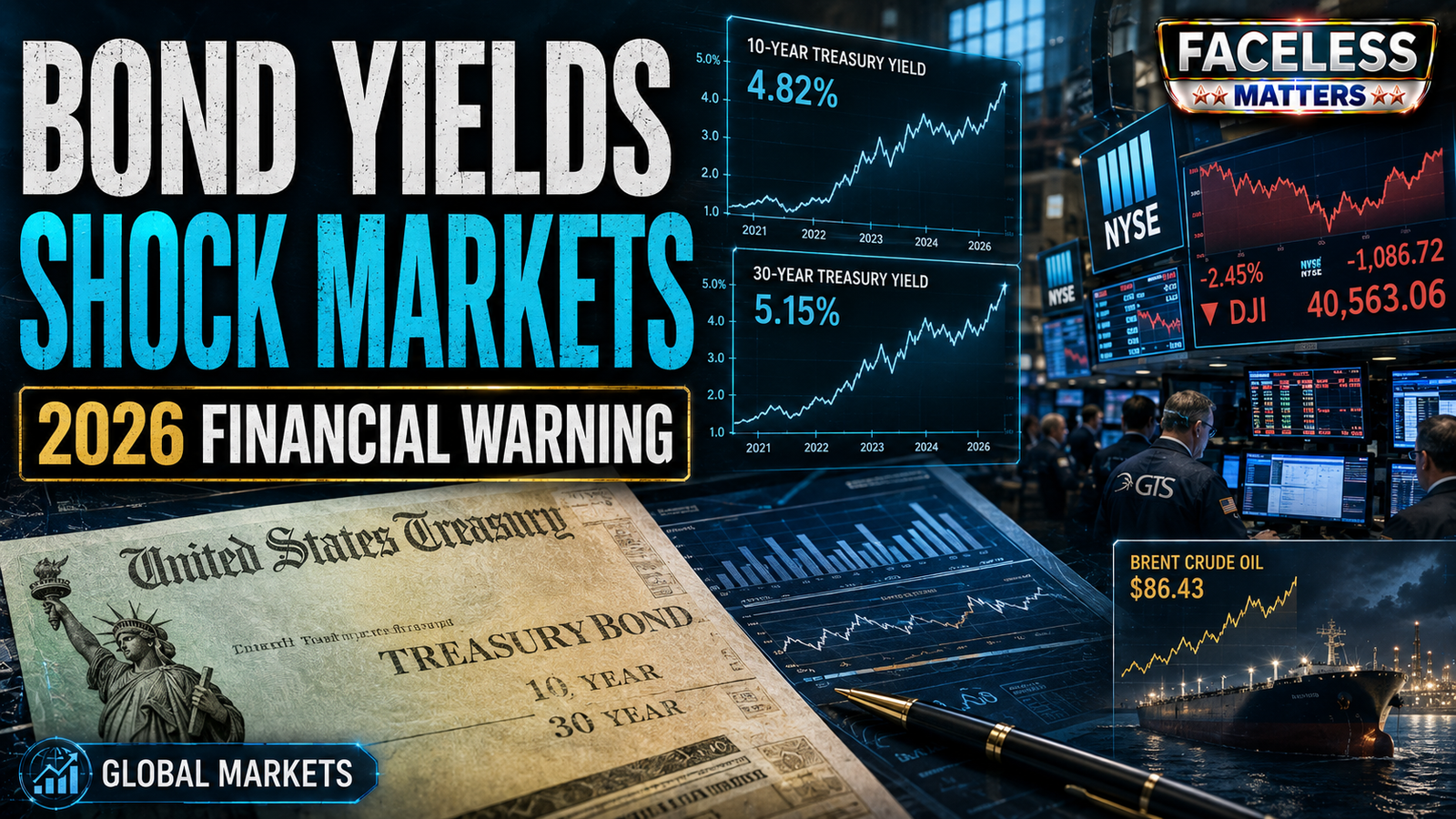
On August 20, U.S. stocks suffered their sharpest decline in roughly three weeks. The S&P 500 fell 0.9%, the Dow Jones Industrial Average dropped about 703 points, and the Nasdaq declined 1%. AP News
The bond market 2026 environment therefore deserves attention not because every market decline signals a financial crisis, but because several pressures are appearing simultaneously.
The 30-year Treasury yield has remained around the 5.25% area, while the 10-year Treasury yield has moved near 4.7%. At the same time, oil prices have remained elevated because of geopolitical tensions, adding another potential source of inflation pressure. Reuters
The key question is simple:
Is this temporary market volatility, or is the bond market sending a deeper warning about inflation, debt and economic policy?
1. Why Bond Market 2026 Matters
The bond market 2026 environment matters because government bonds sit at the center of modern financial pricing.
Treasury yields influence the cost of money throughout the economy.
When Treasury yields rise, banks, companies and consumers can face higher financing costs. Investors also reassess equity valuations because the return available from relatively safer government securities becomes more competitive.
This relationship is particularly important for technology and growth companies.
Many high-growth businesses are valued partly on earnings expected years into the future. Higher interest rates reduce the present value of those future earnings, which can create pressure on share prices even when the underlying companies remain profitable.
That is why the bond market 2026 story is not simply about bond investors.
It is also a story about stocks, corporate finance, housing, government budgets and consumer spending.
Recent market movements illustrate the connection.
The U.S. Treasury has expanded its purchases of longer-duration government debt in an attempt to provide additional liquidity to the long end of the Treasury market. The program was increased to at least $4 billion per operation from $2 billion. Wealth Insights
However, the intervention did not permanently eliminate yield pressures.
That distinction is extremely important.
2. Rising Treasury Yields Are Pressuring Stocks
The central feature of the current bond market 2026 story is the renewed increase in long-term yields.
The 10-year Treasury yield has approached 4.7%, while the 30-year yield has remained above 5%. Reuters reported that global markets were facing pressure as elevated bond yields and oil prices combined to weaken investor sentiment. Reuters
Why does this matter for stocks?
Because investors constantly compare expected returns.
Suppose a company is expected to generate significant earnings several years from now. If interest rates rise, those future earnings become less valuable when discounted back to today’s dollars.
That can put pressure on high-growth companies.
The impact can be particularly visible in technology stocks, where valuations have sometimes depended on aggressive expectations for future growth.
The market therefore does not necessarily need a recession for stocks to fall.
A significant change in the cost of capital can be enough.
The August 20 decline demonstrated this mechanism.
The Dow lost more than 700 points, while the S&P 500 and Nasdaq also declined. Rising Treasury yields, higher oil prices and disappointing Walmart results combined to weaken risk appetite. AP News
This does not automatically mean a prolonged bear market.
It does mean investors are becoming more sensitive to financial conditions.
3. Why Government Debt Is Becoming a Bigger Market Issue
Another major component of the bond market 2026 story is government borrowing.
The U.S. national debt has moved beyond $40 trillion, while concerns about fiscal deficits have increased pressure on long-term Treasury yields. AP News
Large government borrowing requirements can create a persistent supply of bonds that investors must absorb.
If investors demand higher compensation for holding long-term debt, yields can rise.
Higher yields then increase government interest costs.
This creates a difficult feedback mechanism:
Higher debt → more borrowing → higher interest costs → greater fiscal pressure → higher required yields.
Markets do not necessarily move through this sequence in a straight line, but the possibility is important.
The current bond market 2026 environment is therefore also a fiscal-policy story.
Investors are asking whether government borrowing can remain elevated without creating additional pressure on long-term interest rates.
That question extends well beyond the United States.
Japan, Europe and other major economies are also dealing with changing inflation expectations, fiscal requirements and shifting monetary-policy expectations.
4. Treasury Buybacks: Relief or Temporary Solution?
The Treasury’s decision to increase long-duration bond buybacks initially produced a positive market reaction.
Long-term yields fell and financial markets received temporary relief.
But the following session demonstrated the limitations of such interventions.
Reuters reported that Treasury yields resumed climbing as investors continued to focus on fiscal deficits, high oil prices and broader concerns about government borrowing. Reuters
This creates an important distinction.
A buyback can improve liquidity.
It can also reduce the supply of specific securities available to the market.
But it cannot automatically eliminate inflation.
It cannot eliminate geopolitical risk.
And it cannot permanently solve a structural fiscal deficit.
That is why the bond market 2026 response remains cautious.
Investors appear willing to recognize government intervention as a stabilizing tool while continuing to watch the deeper economic fundamentals.
5. Oil Prices Are Reintroducing Inflation Risk
The second major force behind the bond market 2026 story is oil.
Higher crude prices can affect inflation through transportation, manufacturing, logistics, aviation and consumer goods.
When oil prices rise sharply, central banks may become more cautious about cutting interest rates.
That is especially important when inflation is already above desired levels.
Recent reports have placed crude oil above the mid-$80s per barrel, with geopolitical tensions contributing to the increase. Hide.me
The economic chain is straightforward:
Higher oil → higher transportation costs → higher operating costs → potential consumer price pressure.
For consumers, higher fuel prices can also reduce disposable income.
That can create another problem.
If households spend more on fuel, they may spend less on retail goods, travel and discretionary services.
The Walmart sell-off highlighted exactly this concern. Walmart shares fell sharply after the company reported weaker comparable-sales expectations, while analysts linked consumer pressure partly to higher gasoline costs. Hide.me
This means the bond market 2026 story is connected directly to the real economy.
6. Why Technology Stocks Are Especially Sensitive
Technology companies have become an important part of the current financial debate.
The AI investment boom requires enormous amounts of capital for data centers, semiconductors, electricity infrastructure and networking equipment.
If borrowing costs remain high, the cost of financing this expansion also increases.
That does not necessarily stop AI investment.
However, it can change the economics.
Investors may begin asking:
- How much debt is being used to finance AI infrastructure?
- How quickly will the investment generate cash flow?
- Are technology valuations already pricing in extremely strong growth?
- What happens if long-term interest rates remain elevated?
These questions make the bond market 2026 especially relevant to the technology sector.
Reuters has highlighted the relationship between high long-term yields and heavy AI-related corporate debt issuance. Investing.com South Africa
The market will also be watching major technology earnings closely.
Nvidia’s upcoming results are particularly important because the company sits near the center of the global AI investment cycle. Reuters
7. The Federal Reserve Policy Question
The Federal Reserve remains at the center of the bond market 2026 debate.
Investors are attempting to determine whether inflation risks will justify tighter monetary policy or whether weaker economic activity will eventually create room for lower rates.
Recent U.S. economic data have produced mixed signals.
Retail sales weakened, while other indicators have remained relatively resilient.
That makes the policy outlook complicated.
If inflation remains elevated, the Federal Reserve may need to keep policy restrictive.
If economic growth and employment weaken significantly, policymakers could face pressure to provide monetary relief.
The bond market is effectively trying to price both possibilities.
The Federal Reserve’s July meeting minutes showed disagreement among policymakers about the inflation outlook and the appropriate policy direction. Central Banking
This uncertainty can create volatility in both bonds and stocks.
8. What the Dollar and Gold Are Signaling
The bond market 2026 story is also visible in currency and precious-metal markets.
The U.S. dollar recently moved toward multi-month lows as investors responded to Treasury intervention and changing expectations around U.S. monetary policy. Reuters reported the dollar index near a three-month low on August 20. MarketScreener UAE Emirates
Gold has also attracted attention.
Gold moved sharply higher during the recent decline in long-term yields and weaker-dollar environment, with prices reaching above $4,500 per ounce during the week. The Wall Street Journal
Gold does not move in response to one factor.
It can react to:
- real interest rates,
- dollar movements,
- inflation expectations,
- geopolitical risk,
- central-bank demand,
- recession concerns.
The current combination makes precious metals an important market indicator.
9. What Investors and Businesses Should Watch
The bond market 2026 situation should not be reduced to a single daily stock-market move.
Investors should watch several indicators together.
Treasury yields
The 10-year and 30-year Treasury yields remain among the most important indicators.
A sustained rise would increase pressure on equity valuations and borrowing costs.
Oil prices
If crude prices remain elevated, inflation expectations could become more difficult for policymakers to manage.
Federal Reserve communication
Any major shift in expectations around interest rates could quickly affect stocks, bonds and currencies.
Corporate earnings
Strong earnings can offset some pressure from higher yields.
Weak earnings can amplify the impact.
Government borrowing
The fiscal trajectory remains a long-term issue for bond investors.
Consumer spending
A weakening consumer could signal that higher energy and borrowing costs are beginning to affect economic activity.
10. Global Impact Beyond Wall Street
The bond market 2026 story is global.
Higher U.S. Treasury yields can influence international borrowing costs because U.S. government bonds remain a central reference point for global finance.
Emerging markets can be particularly sensitive.
Higher U.S. yields can make dollar-denominated assets more attractive and can increase financing pressure on countries or companies that borrow in dollars.
Europe and Asia are also dealing with their own inflation and monetary-policy challenges.
Japan is particularly important because rising inflation expectations have strengthened speculation about future monetary tightening. Reuters reported that Japanese inflation and energy costs could influence expectations for further Bank of Japan policy moves. Reuters
This means the global financial system is not dealing with one isolated problem.
It is dealing with several interconnected variables.
11. What Happens Next?
The next phase of the bond market 2026 story will depend on whether long-term yields stabilize.
There are three broad possibilities.
Scenario One: Yields Stabilize
If Treasury yields stop rising and oil prices moderate, pressure on stocks could ease.
Investors could return to growth assets if economic data remain supportive.
Scenario Two: Yields Remain High
If yields stay elevated, markets could experience a prolonged period of valuation adjustment.
Companies with heavy borrowing requirements could face greater pressure.
Scenario Three: Yields Rise Further
A renewed acceleration in long-term yields could become a larger threat to equity valuations and economic activity.
That would increase pressure on policymakers and governments to demonstrate credible fiscal and monetary strategies.
At present, the evidence does not prove that the global economy is entering a systemic crisis.
But it does show that financial conditions have become more sensitive.
CONCLUSION
The bond market 2026 story is becoming one of the defining financial themes of August.
Rising Treasury yields, elevated oil prices, inflation uncertainty, government debt and changing Federal Reserve expectations are interacting across global markets.
The recent decline in U.S. stocks demonstrates how quickly bond-market pressure can move into equities.
The Treasury’s expanded buyback program has provided temporary relief, but investors continue to focus on the underlying fiscal and inflation environment. Reuters
For businesses, the message is equally important.
Higher financing costs can influence investment decisions, expansion plans and corporate valuations.
For consumers, elevated energy and borrowing costs can affect purchasing power.
For investors, the key lesson is that stocks cannot be evaluated independently from interest rates and bond markets.
The bond market 2026 environment therefore deserves continued monitoring.
The most important signals will be Treasury yields, oil prices, inflation data, Federal Reserve communication, government borrowing and corporate earnings.
The market does not need a financial crisis to become volatile.
Sometimes, a change in the cost of money is enough.
INTERNAL READING
1. Global Energy Supply Crisis 2026: Oil and Hormuz Risks
This report provides additional context on how oil supply disruptions and geopolitical risk can influence inflation, transportation costs and global markets.
2. The Digital Gold Rush: AI and Human Intelligence Redefining Wealth
This analysis provides broader context on AI investment, digital infrastructure and the changing economics of wealth creation.
3. The Price of Policy: A Strategic Financial Audit
This financial investigation examines the relationship between policy decisions, capital flows and political influence.
SOURCE VERIFICATION & ANALYSIS
Reuters — Global Markets report, August 21, 2026.
Reuters — U.S. stocks, Treasury yields and Walmart market reaction, August 21, 2026.
Reuters — Global bonds and Treasury buyback developments, August 20, 2026.
Associated Press — U.S. stock-market performance and Treasury yield pressure, August 20, 2026.
U.S. Department of the Treasury — Treasury securities and buyback policy information.
Federal Reserve — July 2026 FOMC meeting minutes.
World Gold Council — July and August 2026 gold-market analysis.
Investopedia — U.S. Treasury yields, Federal Reserve expectations and market developments.
MarketWatch — Treasury buybacks, bond yields and U.S. equity-market reaction.
Business Recorder — Pakistan and international market indicators.
FACELESS MATTERS ANALYSIS
The bond market 2026 development should be viewed as a financial-system signal rather than a simple stock-market event.
The most important issue is the interaction between debt, inflation, energy prices and the cost of capital.
Treasury intervention can provide liquidity and reduce disorderly market conditions, but long-term stability depends on broader economic fundamentals.
The current market environment also demonstrates why financial news should be interpreted across asset classes.
Stocks tell one part of the story.
Bonds tell another.
Oil, gold and currencies provide additional signals.
When all of these markets begin reacting to the same macroeconomic pressures, investors should pay attention to the underlying connection.
The central question for the remainder of 2026 is therefore not simply whether stocks rise or fall.
It is whether governments and central banks can maintain financial stability while managing inflation, energy risks, high borrowing requirements and an increasingly capital-intensive global economy.
Educational Note: This article is for informational and educational purposes only. It does not constitute financial, investment, trading, tax or legal advice. Market conditions can change rapidly, and readers should conduct independent research before making financial decisions.
[…] Bond Market 2026: Rising Yields Trigger a Market Crisis — Finance | August 21, […]
[…] Bond Market 2026: Rising Yields Trigger a Market Crisis — Finance | August 21, […]
[…] Bond Market 2026: Rising Yields Cause a Severe Financial Crisisبانڈ مارکیٹ، yields اور عالمی مالیاتی خطرات کے وسیع تناظر کو سمجھنے کے لیے متعلقہ Finance/Economy analysis۔ […]
[…] Bond Market 2026: Rising Yields Trigger a Market Crisis […]