


TABLE OF CONTENTS
Good Afternoon from FACELESS MATTERS — August 21, 2026
The AI Investment 2026 story has reached an important turning point.
For several years, the central question was simple:
How big can AI become?
That question is becoming less useful.
The more important question now is:
How much economic value must AI generate to justify the extraordinary amount of capital being committed to it?
That distinction matters because AI investment is no longer limited to software experiments, research laboratories or a small group of technology companies.
It now involves enormous data centers, semiconductor production, electricity generation, cooling systems, transmission infrastructure, cloud computing capacity, debt financing and long-term corporate capital expenditure.
At the same time, investors are confronting a much less forgiving financial environment.
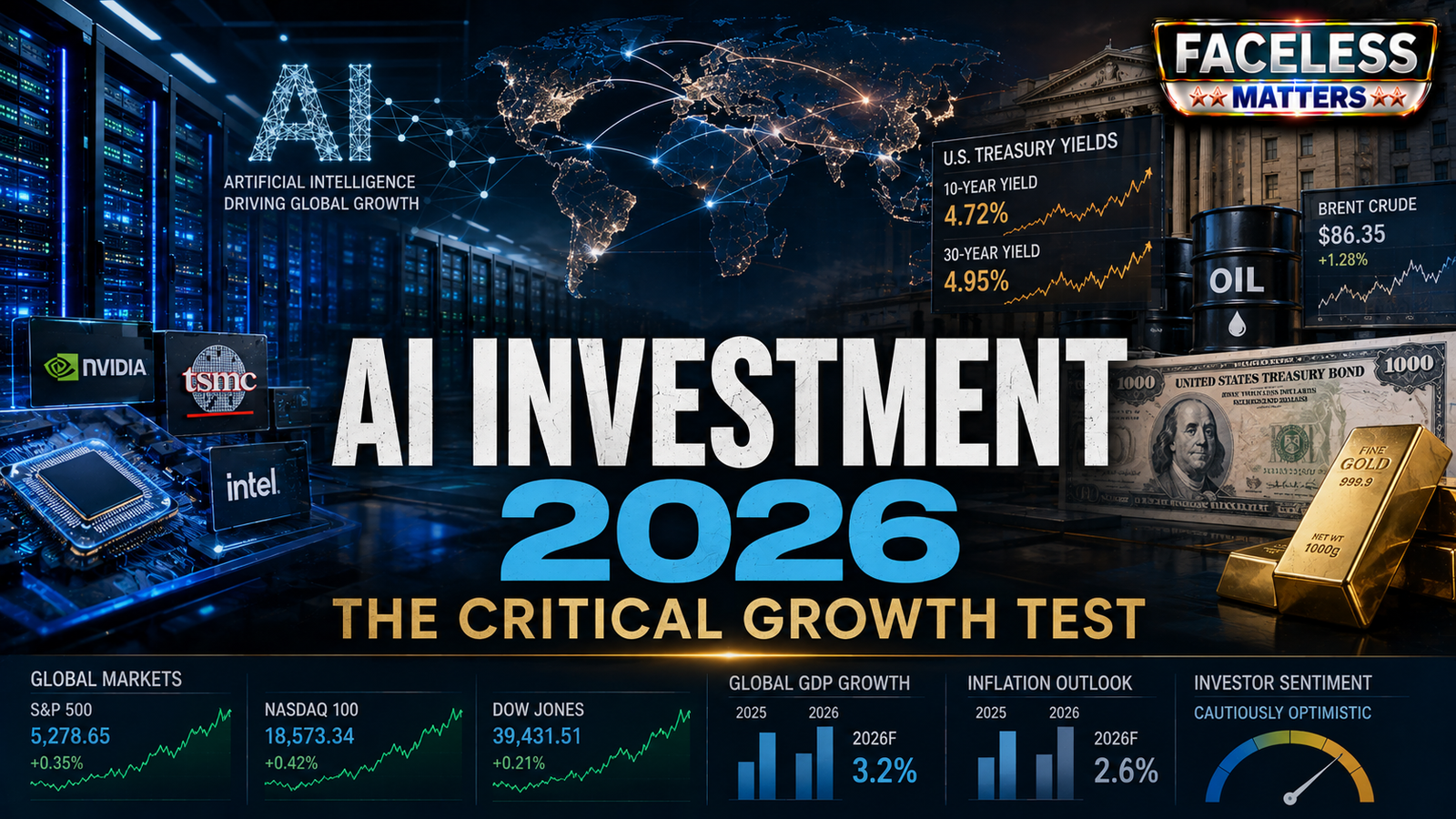
U.S. long-term Treasury yields have remained elevated, with the 30-year yield around 5.25% and the 10-year yield around 4.71% on August 21. Brent crude also reached a one-month high near $94.71 before easing. Higher borrowing costs and expensive energy create a more demanding environment for companies building capital-intensive AI infrastructure. Reuters
My view is straightforward:
AI is not necessarily a bubble simply because investment is enormous. But enormous investment creates an enormous requirement for future economic returns.
That is the real test.
Strategic Execution Mode
AI Investment 2026 should therefore be viewed through three separate lenses:
Technology opportunity.
Corporate earnings.
Capital efficiency.
The first remains extremely powerful.
The second is already showing meaningful evidence of strength.
The third is where the biggest questions are emerging.
This is important because investors can be simultaneously correct about the long-term importance of AI and wrong about the valuation of individual companies.
A technology can transform the economy while many investors still overpay for exposure to it.
That happened repeatedly throughout financial history.
The technology can be real.
The demand can be real.
The investment can be real.
And yet the financial returns can disappoint.
1. AI Investment 2026 Has Entered a Different Phase
AI Investment 2026 has moved from experimentation toward infrastructure.
Companies are building computing capacity because demand for AI services is growing.
Cloud providers need additional capacity.
Model developers need computing power.
Enterprises want AI tools.
Governments increasingly view advanced computing infrastructure as strategically important.
Semiconductor companies are benefiting from the demand.
Electricity providers and data-center developers are becoming part of the AI ecosystem.
This means AI Investment 2026 is increasingly becoming a physical infrastructure story rather than simply a software story.
That creates enormous opportunities.
But it also creates enormous fixed costs.
Once a company spends billions building a data center, buying equipment and securing electricity, those costs do not disappear simply because AI demand temporarily slows.
The investment therefore needs to generate returns over many years.
That makes the quality of demand more important than the headline growth rate.
2. The Real Question Is No Longer Whether AI Is Growing
There is already substantial evidence that AI-related demand is real.
Recent S&P 500 results showed aggregate second-quarter earnings rising 52% year over year, with technology-sector profits up 74%. Even after excluding certain mark-to-market investment gains, earnings growth remained strong at about 33%. Reuters
That is important.
It means the AI story cannot simply be dismissed as speculation.
Real companies are generating real revenue.
Real businesses are increasing spending.
Real customers are buying computing capacity.
But this is precisely where the next question begins.
Revenue growth is not the same as investment return.
A company can increase revenue while simultaneously spending so aggressively on infrastructure that free cash flow becomes pressured.
That distinction will become increasingly important for investors.
The market eventually has to determine which companies are creating economic value and which companies are simply moving enormous amounts of capital through the AI ecosystem.
3. Capital Spending Is Becoming the Market’s Main Test
The scale of AI Investment 2026 infrastructure spending is extraordinary.
Reuters reported in July that the largest U.S. hyperscalers were increasingly seeing the cost of AI infrastructure affect free cash flow, with combined capital expenditure expected to exceed their combined free cash flow by 2027 under then-current consensus estimates. Investing.com
That should not automatically be interpreted as bearish.
Companies sometimes need to invest heavily before future revenues arrive.
The early stages of major infrastructure revolutions often require enormous upfront spending.
Railways required tracks.
Telecommunications required networks.
The internet required servers and fiber.
Modern AI requires chips, data centers and electricity.
The problem begins when investment grows faster than the economic value generated by the infrastructure.
That is the dividing line investors should watch.
If AI infrastructure produces durable revenue growth, strong margins and increasing free cash flow, today’s spending could eventually look rational.
If utilization disappoints, competition intensifies or AI pricing falls rapidly, the same spending could become a financial burden.
4. Higher Bond Yields Change the AI Investment Equation
This may be the most underappreciated part of the AI Investment 2026 story.
AI investment is happening at the same time that the cost of capital is becoming more important.
Higher bond yields increase the cost of borrowing.
They also increase the discount rate investors apply to future corporate earnings.
That matters especially for technology companies whose valuations depend heavily on profits expected many years into the future.
On August 21, U.S. long-term Treasury yields remained around elevated levels despite recent Treasury intervention, while investors continued to question whether government measures could permanently suppress long-term borrowing costs. Reuters
This creates an interesting contradiction.
AI companies want to invest more.
Investors want stronger AI growth.
But higher yields make future growth more expensive to finance and less valuable in today’s valuation models.
That does not destroy the AI investment case.
It simply raises the standard.
5. Strong Earnings Make the Bull Case Hard to Ignore
The strongest argument against an overly pessimistic view of AI is earnings.
Recent corporate results have demonstrated that AI infrastructure demand is translating into meaningful business activity.
Reuters reported that investors were increasingly shifting their focus from whether Big Tech’s AI spending would pay off at all toward identifying which companies could generate sustainable returns from the next phase of the AI ecosystem. Investing.com
That is a major change in investor psychology.
The market is moving from:
“Is AI real?”
to:
“Who will capture the profits?”
That is a healthier question.
It forces investors to distinguish between semiconductor suppliers, cloud platforms, infrastructure companies, model developers, data-center operators and businesses using AI to increase productivity.
The winners may not necessarily be the companies spending the most.
They may be the companies with the strongest combination of:
- pricing power
- recurring revenue
- high utilization
- strong balance sheets
- proprietary technology
- efficient capital allocation
- durable customer demand
6. Alibaba Shows the Cost of Building AI Infrastructure
A recent example demonstrates why investors need to separate growth from profitability.
Alibaba Group reported a 75% decline in quarterly net profit despite 9% revenue growth as AI infrastructure spending accelerated. Its cloud and AI services revenue grew 45%, while capital expenditure increased sharply. The company has committed to a much larger AI investment program through 2029. Reuters
This is not necessarily evidence that the investment is wrong.
Management is effectively arguing that today’s capital spending is necessary to capture future AI demand.
That may prove correct.
But it demonstrates the central economic reality of AI infrastructure:
Growth can arrive before profitability.
Investors therefore need patience.
But patience cannot mean ignoring capital efficiency.
Eventually the investment has to produce sufficient cash flow.
7. The Financing Question Deserves More Attention
Another important development is the increasing connection between AI companies, semiconductor suppliers and financing markets.
Nvidia has agreed to provide guarantees of up to $105 billion connected to an OpenAI data-center project in Ohio, while also investing in the project developer. Reuters reported that the arrangement is part of a broader strategy to support AI infrastructure demand, but it has also raised questions about financing structures and the relationships between AI hardware suppliers and their customers. Reuters
This is where the AI story becomes more complicated.
If the companies building AI infrastructure need increasingly creative financing structures to continue expanding, investors should ask why.
There may be a perfectly reasonable explanation.
AI infrastructure is capital intensive.
Long-term contracts can support financing.
Future demand can justify today’s investment.
But financial markets have historically become vulnerable when companies begin depending on increasingly complex financing structures to maintain growth.
The question is therefore not whether financing exists.
The question is whether the underlying cash flows can ultimately support it.
8. AI Investment Is Also an Energy Story
AI is frequently discussed as a technology revolution.
It is equally an energy story.
Data centers require electricity.
More computing requires more power.
More power requires generation capacity, transmission infrastructure and grid investment.
That means AI Investment 2026 is increasingly connected to energy markets.
This creates another challenge.
Oil prices have recently remained elevated because of geopolitical tensions, while higher energy costs can feed into broader inflation pressures. Brent crude briefly reached $94.71 on August 21 before easing. Reuters
AI itself also increases demand for electricity and physical infrastructure.
The result is an unusual economic situation:
Technology investment can simultaneously stimulate growth and increase demand for scarce resources.
That is why Global Markets 2026 cannot be analyzed separately from AI, energy, bonds and industrial infrastructure.
9. What Investors Should Watch Next
Several indicators will become increasingly important.
AI Revenue Growth
The first question in Global Markets 2026 is whether AI-related revenue continues growing fast enough to justify current infrastructure spending.
Growth alone is not enough.
Global Markets 2026 needs durable growth supported by real earnings and sustainable investment.
Free Cash Flow
Investors should increasingly focus on whether AI leaders can convert revenue growth into sustainable free cash flow.
This could become more important than headline revenue.
Data Center Utilization
Unused infrastructure can become a major financial problem.
High utilization supports returns.
Low utilization creates pressure on margins and debt servicing.
Bond Yields
If long-term yields remain elevated, highly valued growth stocks could face continued valuation pressure.
Energy Costs
Higher electricity and fuel prices can increase the cost of building and operating AI infrastructure.
AI Pricing
If AI services become commoditized too quickly, revenue growth could remain high while margins decline.
Nvidia’s Earnings and Outlook
The next major market test is the earnings outlook from Nvidia, which investors are watching as an important indicator of AI infrastructure demand. Reuters described the upcoming results as a major test for the AI trade. Reuters
10. The Opinion: AI Will Likely Survive, But Not Every AI Investment Will
This is where my view differs from both extreme bulls and extreme bears.
I do not believe the most useful conclusion is:
“AI is a bubble.”
Nor is it:
“AI can only go higher.”
Both statements are too simple.
The more realistic conclusion is that AI is probably one of the most important technological transformations of this generation, but that does not guarantee every AI-related asset will produce exceptional returns.
The economic winners will be determined by capital efficiency.
Companies that can turn enormous infrastructure investments into durable cash flows will have an advantage.
Companies that spend aggressively without achieving sufficient utilization may struggle.
Companies with strong balance sheets can survive periods of slower growth.
Companies dependent on continuous external financing may face greater pressure.
This is why the next phase of AI Investment 2026 may be less about discovering whether AI works and more about discovering who can make money from it consistently.
The next phase of AI Investment 2026 may be less about discovering whether AI works and more about discovering who can make money from it consistently.
That is a much harder test.
CONCLUSION
AI Investment 2026 is entering a more mature stage.
The technology behind AI Investment 2026 is real.
The demand is real.
The investment is real.
The earnings impact is increasingly visible.
But the cost of capital is also real.
Higher bond yields, elevated energy prices, geopolitical uncertainty and enormous infrastructure requirements are forcing investors to become more selective.
In my view, that is healthy.
A mature investment cycle should eventually move away from pure excitement and toward measurable economic returns.
The winners of the next stage may not simply be the companies with the biggest AI announcements.
They may be the companies that demonstrate:
strong demand + high utilization + sustainable margins + disciplined capital spending + durable free cash flow.
That is the critical growth test.
And it is a test that the entire AI ecosystem will increasingly have to pass.
INTERNAL READING
1. Global Markets 2026: Yields and Oil Reshape Investor Risk
Use this internal article to connect AI investment with higher Treasury yields, oil prices, inflation and broader market risk.
Internal URL:
https://facelessmatters.com/global-markets-2026-yields-oil/2. Suggested Future Internal Article
1. Global Bond Market Selloff: Why Borrowing Costs Are Rising in 2026
Use this as a macroeconomic connection because higher energy prices can influence inflation, interest rates and borrowing costs.
2. The AI Infrastructure Boom: Nvidia, OpenAI and the Global Race for Data Centers, Chips and Power
Use this for the connection between rising electricity demand, data centers, AI infrastructure and global power investment.
3. Pakistan Digital Economy Initiative 2026: Powerful Digital Growth
Use this as a Pakistan-focused technology and infrastructure connection because digital expansion also increases demand for reliable energy and electricity infrastructure.
EDUCATIONAL NOTE
This article represents opinion, news analysis and general market education only. It is not financial, investment or trading advice. Markets can change rapidly, and readers should conduct independent research and consider their own financial circumstances before making investment decisions.
Source Verification & Analysis
The analysis was prepared using recent reporting and market information from established financial and economic sources, including:
Reuters
Associated Press
Financial Times
The Wall Street Journal
MarketWatch
Cambridge Judge Business School
Major global financial-market reporting and earnings disclosures
Key current-market facts were cross-checked against recent reporting on AI capital expenditure, corporate earnings, Treasury yields, oil prices, data-center financing and investor sentiment. Reuters
[…] Scenario 1 — AI Investment Boom Continues […]