

September 13, 2026
Key Takeaway
Iranian President Masoud Pezeshkian says Tehran is not at war with Saudi Arabia and that Yemen’s Houthis have their own issues. His statement comes as attacks involving Saudi infrastructure and Houthi activity are increasing regional pressure. The statement separates Iran’s official position from the actions of the Houthis, but it does not remove the wider security risks facing the Gulf.
TABLE OF CONTENTS
Article Content / What Happened?
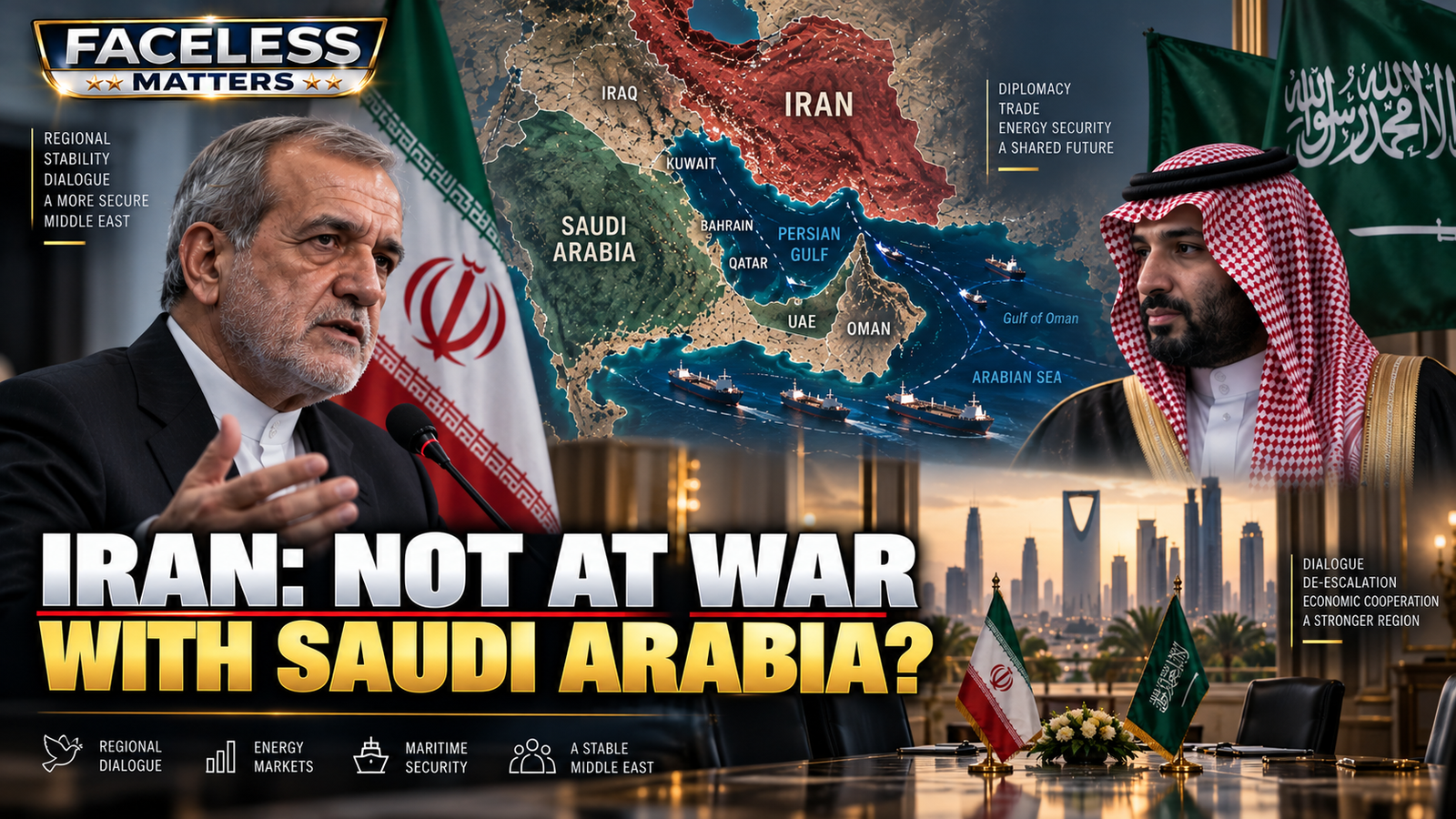
Iranian President Masoud Pezeshkian has said that Iran is not at war with Saudi Arabia, while also stating that the Houthis have their own issues.
The statement comes at a particularly sensitive moment for the Gulf. Saudi Arabia has faced attacks on critical energy infrastructure, while Houthi activity in the region has added another layer of security risk.
The Iranian president’s comments therefore carry significance beyond a simple diplomatic statement.
They suggest that Tehran is seeking to distinguish its official position from military actions attributed to the Houthis, even as the broader regional confrontation continues.
Jang reported on September 13 that Pezeshkian said Iran was not in a state of war with Saudi Arabia and that the Houthis had their own issues.
Other current reporting confirms the same basic position. Al Jazeera reported that Pezeshkian said Tehran was not at war with Saudi Arabia and called for regional countries to work together on peace and security.
For readers following the crisis, the distinction matters because diplomatic language can shape expectations even when security conditions remain uncertain across the Gulf and surrounding maritime routes, for governments, businesses, and investors alike.
Instead, it raises a more important question:
Is Iran attempting to prevent the regional conflict from being interpreted as a direct Iran-Saudi war?
What Did Iran’s President Say?
Pezeshkian’s position on Iran Saudi Arabia relations is straightforward: Tehran does not regard itself as being at war with Saudi Arabia.
He also said the Houthis have their own issues.
That distinction is important because Houthi forces in Yemen have been involved in attacks and military activity affecting Saudi Arabia and regional shipping.
The Iranian position therefore appears designed to draw a line between the Iran Saudi Arabia relationship and the independent actions attributed to the Houthis.
According to current reporting, Pezeshkian has also called for regional countries to cooperate on peace and security rather than allowing tensions to continue escalating.
For policymakers, that creates a potentially important diplomatic signal.
It does not settle the wider conflict, but it indicates that Tehran does not want its relationship with Riyadh to be formally characterized as an open war.
Why the Saudi Arabia Question Matters
Saudi Arabia occupies a central position in Gulf security and global energy markets.
The kingdom is also directly exposed to the consequences of instability involving Yemen, the Red Sea, the Persian Gulf and regional oil infrastructure.
Recent attacks have demonstrated how quickly a security incident can become an energy-market problem.
Reuters reported that attacks on Saudi Arabia’s East-West oil pipeline forced a precautionary shutdown, while Saudi shares declined as investors assessed the regional security risks.
The pipeline is strategically important because it provides an alternative route for moving Saudi crude when maritime routes face disruption.
Any prolonged threat to such infrastructure can therefore affect:
- oil supply expectations;
- shipping risk;
- insurance costs;
- energy prices;
- investor confidence;
- and regional economic stability.
That is why a statement from Iran’s president about the absence of a direct war with Saudi Arabia has significance beyond diplomacy.
The Houthi Factor
The Houthi issue is central to understanding the statement.
The Houthis operate in Yemen and have their own military and political agenda. Their attacks have affected Saudi Arabia and regional shipping, while Iran has long been described by international reporting as supporting the group.
But Tehran’s current political messaging emphasizes that the Houthis have their own issues.
That wording matters.
It creates a distinction between Iran’s official state position and actions undertaken by a regional armed group.
The distinction does not automatically resolve questions about Iranian influence or support.
It does, however, provide Tehran with a diplomatic argument against describing the current confrontation as a direct Iran Saudi Arabia war.
The United States has also accused Iran of involvement in regional attacks, while Tehran has rejected such characterizations in different contexts. Current reporting shows that attribution remains a major part of the wider diplomatic confrontation.
Iran Saudi Arabia: What the Statement Does and Does Not Mean
The statement should be interpreted carefully.
What it means
Iran’s president is publicly saying that Tehran does not consider itself to be at war with Saudi Arabia.
He is also separating the Houthi issue from the direct state-to-state relationship.
And he is calling for regional cooperation on peace and security.
What it does not mean
It does not mean the Gulf is secure.
It does not mean Saudi Arabia faces no further threat.
It does not mean Iran and Saudi Arabia have resolved their strategic differences.
And it does not establish that future attacks in the region will stop.
The distinction is important because Iran Saudi Arabia diplomacy and military activity can move in different directions at the same time.
Why the Timing Matters
The timing of Pezeshkian’s statement is significant.
Regional tensions are already affecting energy infrastructure and shipping security.
A vessel was struck by a projectile in the Strait of Hormuz on September 13, according to the UK Maritime Trade Operations, while a separate incident involving an Iranian commercial vessel near Qeshm Island was also reported.
At the same time, Saudi infrastructure has come under attack.
This means the region is dealing with several overlapping security problems rather than one isolated confrontation.
In such an environment, statements that distinguish between state policy and actions by allied or aligned groups can become part of a broader effort to prevent further escalation.
Impact on Gulf Security and Oil Markets
The Gulf’s security environment gives the Iran Saudi Arabia relationship direct consequences for global energy markets.
The Strait of Hormuz remains a critical maritime energy route, while Saudi Arabia’s East-West pipeline provides an alternative pathway for crude exports.
When both maritime and land-based energy infrastructure face heightened security concerns, markets can react quickly.
Reuters reported that oil prices moved above $100 per barrel amid rising concerns over regional supply disruptions.
The economic chain is straightforward:
Regional tension → infrastructure risk → shipping uncertainty → higher insurance costs → oil-price risk → inflation pressure → market volatility.
That chain does not mean every disruption will automatically produce a sustained oil-price shock.
But investors price risk before the full economic impact becomes visible.
This is why diplomatic signals from Tehran, Riyadh, Washington and other regional capitals are being watched closely.
What It Means for Pakistan
Pakistan has a direct interest in stability across Iran Saudi Arabia relations.
Both countries are geographically important to Pakistan’s regional environment, while Gulf energy prices have a direct effect on Pakistan’s economy.
A prolonged increase in oil prices can raise:
- the country’s import bill;
- transport costs;
- inflationary pressure;
- industrial expenses;
- foreign-exchange requirements;
- and pressure on household budgets.
The Saudi-Iranian relationship therefore matters to Pakistan not only as a foreign-policy issue but also as an energy and economic-security issue.
Any reduction in direct confrontation could help lower one layer of geopolitical risk.
But that benefit would depend on whether the wider regional security situation also stabilizes.
What Happens Next?
Several developments will be important.
1. Will Saudi Arabia respond to the statement?
Riyadh’s response could indicate whether Tehran’s message creates diplomatic space or is viewed as insufficient.
2. Will Houthi activity continue?
The future level of Houthi attacks will remain important to Saudi security calculations.
3. Will regional states pursue direct dialogue?
Pezeshkian’s call for regional cooperation could become more significant if neighboring governments pursue a broader security framework.
4. What happens to energy infrastructure?
Further attacks on Saudi oil infrastructure could quickly increase market pressure.
5. Will the Gulf security environment stabilize?
This is ultimately the bigger question.
A single diplomatic statement cannot determine the security situation by itself.
FACELESS MATTERS Analysis
The most important point in Pezeshkian’s statement is not simply the sentence that Iran Saudi Arabia relations are not defined by direct war.
The more significant issue is the separation between Tehran’s official position and the actions of regional armed groups.
That distinction could provide Iran with diplomatic room to argue that the conflict should not expand into a direct Iran-Saudi confrontation.
For Saudi Arabia, however, the practical security question remains different.
If attacks continue against Saudi infrastructure, Riyadh will remain focused on the source, capability and consequences of those attacks regardless of how Tehran characterizes its relationship with the groups involved.
This creates a difficult regional equation.
Iran may seek to avoid a direct confrontation with Saudi Arabia.
Saudi Arabia may simultaneously seek stronger guarantees for its infrastructure and territory.
The United States may continue to assess Iranian involvement in regional attacks.
And the Houthis may continue pursuing their own military calculations.
The result is a regional environment where political messaging and security developments can move in different directions.
That is why Pezeshkian’s statement should be viewed as a diplomatic signal, not as evidence that the broader regional crisis has ended.
Conclusion
Iranian President Masoud Pezeshkian says Iran is not at war with Saudi Arabia and that the Houthis have their own issues.
The statement is important because it separates Tehran’s declared state-to-state position from the activities of the Houthis.
But the broader security environment remains unsettled.
Saudi energy infrastructure has been targeted, shipping security remains under pressure, and oil markets are responding to the possibility of further disruption.
For Pakistan and other energy-importing economies, the outcome matters because regional instability can quickly become an energy-price and inflation issue.
The key question now is not simply whether Iran and Saudi Arabia are formally at war.
It is whether the latest diplomatic messaging can help prevent Iran Saudi Arabia tensions from developing into a wider direct confrontation.
INTERNAL READING — FACELESS MATTERS
Strait of Hormuz Crisis: Oil Above $90 in 2026
A broader analysis of Hormuz disruption, oil prices, shipping costs and global energy security.
Iran Strait of Hormuz: 5 Strategic Signals Behind Tehran’s Latest Warning
An earlier FACELESS MATTERS analysis examining Tehran’s position on the waterway and its wider strategic implications.
Pakistan Energy 2026: 5 Critical Signals
Useful context on Pakistan’s exposure to global oil, shipping and energy-security risks.
Pakistan Stock Market: 5 Critical Risks From Oil Shock
Explains how geopolitical and oil-market risks can move into Pakistan’s financial markets.
SOURCES & EDITORIAL NOTE
Jang — Iran says it is not at war with Saudi Arabia — The original Pakistani report for this article, published September 13, 2026.
Reuters — New report of attack on Strait of Hormuz shipping fans fears of threats to oil supplies — Current context on shipping security, Saudi energy infrastructure and the wider oil-market impact.
Associated Press — Iranian media say 1 killed in ship strike on the Strait of Hormuz — Current reporting on the vessel incident near Qeshm Island and the wider regional security environment.
Al Jazeera — Iran’s Pezeshkian: We are not at war with Saudi Arabia — Reporting on Pezeshkian’s statement and his call for regional cooperation on peace and security.
Editorial Note
FACELESS MATTERS distinguishes between verified statements, reported allegations and analysis. Pezeshkian’s statement that Iran is not at war with Saudi Arabia is presented as his position. It does not establish that all regional hostilities have ended or that responsibility for individual attacks has been independently established.
[…] Iran Says It Is Not at War With Saudi Arabia […]
[…] Iran Saudi Arabia: 5 Critical Signals Behind War Claims […]