

FACELESS MATTERS — Fact Check | August 28, 2026
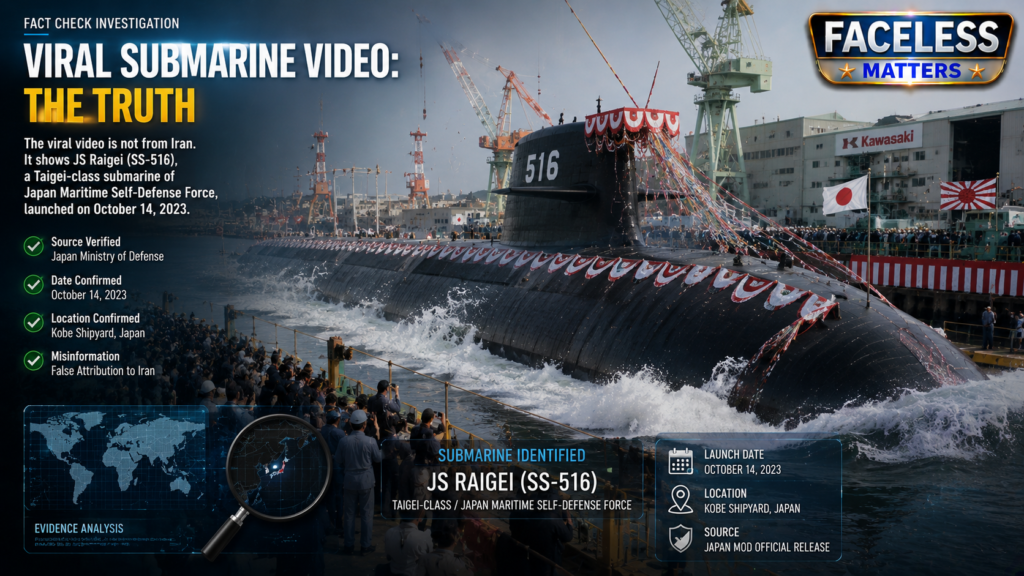
TABLE OF CONTENTS
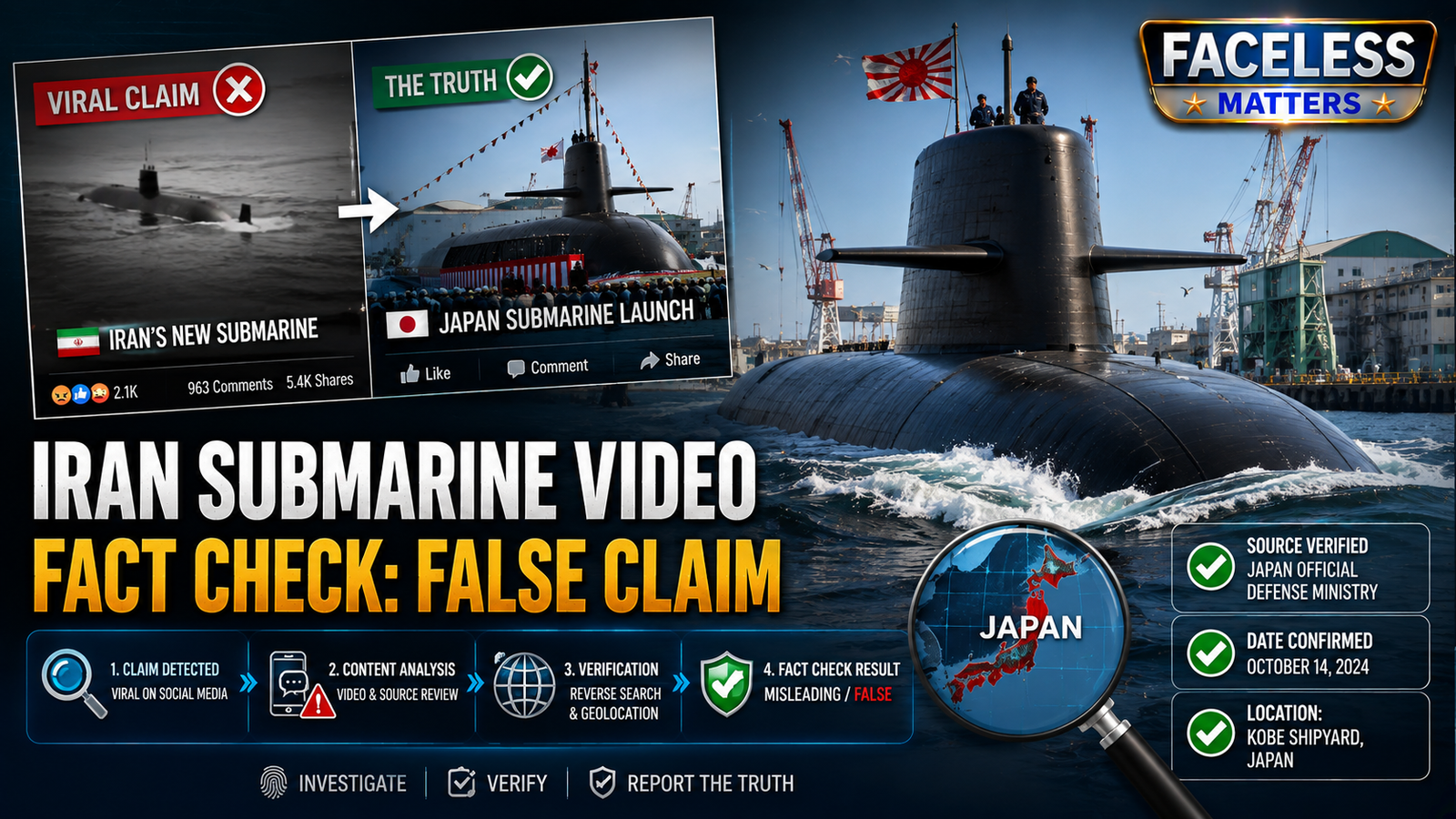
A dramatic submarine-launch video has been circulating across social media with a major claim: that Iran has unveiled its first domestically manufactured submarine despite sanctions, military pressure and technological restrictions.
The claim is false or misleading.
The latest fact-check shows that the footage does not depict a newly launched Iranian submarine. Instead, the video comes from Japan and shows the launch of the Raigei, the fourth Taigei-class submarine, SS-516, in October 2023. Independent fact-checking organizations have reached the same conclusion after tracing the footage and comparing identifiable visual details.
The story is important because the video appeared during a period of heightened military and geopolitical tensions involving Iran, the United States and the wider Middle East. That environment can make dramatic military claims particularly easy to spread online.
What Is the Iran Submarine Video Fact Check 2026?
The viral post presents submarine footage as evidence that Iran has achieved a major new naval capability.
The accompanying narrative claims that Iran has launched its first domestically manufactured submarine despite sanctions and years of technological and military pressure.
The video attracted attention because submarine technology is closely associated with national defense, maritime security and strategic deterrence.
But the Iran Submarine Video Fact Check finds that the central identification of the footage is wrong.
The submarine in the video is not a newly launched Iranian vessel.
It is a Japanese submarine.
The footage dates to October 2023, when Japan launched the fourth Taigei-class submarine, Raigei SS-516, at Kawasaki Heavy Industries’ Kobe shipyard.
2. How Was the Video Verified?
Professional fact-checking does not depend simply on whether a video “looks real.”
The critical question is whether the video shows what the caption claims it shows.
In this case, fact-checkers used reverse-image searches, frame comparisons and older versions of the footage.
The investigation found an earlier version of the same material connected to Japan’s submarine launch.
The vessel’s identifying details were particularly important.
The number 516 can be seen in the footage, providing a strong visual clue that the submarine is Raigei SS-516.
Fact-checkers then compared the vessel with Japanese reporting and other available footage from the launch event.
The visual similarities matched.
This is one of the most important lessons from the Iran Submarine Video Fact Check: a genuine video can still be used to support a false claim.
The footage itself may be authentic while the description attached to it is false.
That distinction is essential when checking military videos, disaster footage, political speeches and breaking-news material.
3. The Real Story: Japan’s Raigei SS-516
The submarine shown in the viral video is Japan’s Raigei, the fourth vessel in the Taigei-class submarine program.
The submarine was launched in Kobe in October 2023.
Later reporting documented its entry into service with the Japan Maritime Self-Defense Force.
The same vessel has therefore appeared in legitimate Japanese reporting long before the current viral claim about Iran.
India Today independently traced the footage to Japan and identified the submarine as JS Raigei. The publication also reported that the vessel was later commissioned into the Japanese Maritime Self-Defense Force.
The Quint reached a similar conclusion, identifying the vessel as Japan’s Taigei-class diesel-electric submarine and noting that the footage was being falsely presented as an Iranian nuclear-submarine launch.
This evidence makes the Iran Submarine Video Fact Check considerably stronger than a simple visual guess.
4. Why the Claim Became Viral
False or misleading military content often spreads quickly because it combines three powerful elements:
dramatic imagery, geopolitical tension and technological competition.
A submarine emerging from water is visually impressive.
Iran’s military relationship with the United States and other regional powers is already the subject of intense public attention.
And claims about new weapons or military technology naturally attract high engagement.
When those three elements are combined, an old video can suddenly appear to represent a breaking development.
This is why the Iran Submarine Video Fact Check matters beyond this single video.
A misleading caption can transform historical footage into apparently current news.
The same technique has been used with aircraft, missiles, military exercises, protests, natural disasters and political events.
5. Does Iran Have Submarines?
The existence of the viral misinformation should not be confused with the separate question of Iran’s actual submarine capabilities.
Iran does operate submarines, including domestically developed diesel-electric submarine classes.
The problem with the viral claim is the identification of this particular video as evidence of a newly launched Iranian submarine.
The available evidence reviewed by multiple fact-checkers does not support that identification.
The Quint noted that public information does not show Iran possessing a domestically built nuclear-powered submarine and identified the viral footage as the Japanese Raigei launch instead.
Therefore, readers should separate two questions:
- Does Iran possess submarine capabilities?
- Does this viral video show Iran launching the submarine described in the post?
The evidence answers the second question clearly: No.
6. What Does the Evidence Show?
The evidence can be summarized in four stages.
Evidence One: The Footage Is Old
The video is not new.
It can be traced back to the Japanese submarine launch in 2023.
Evidence Two: The Submarine Matches Raigei SS-516
The identifying number and visual characteristics match Japan’s Raigei submarine.
Evidence Three: Japanese Reporting Confirms the Launch
Independent reporting about the 2023 launch provides a historical record of the same event.
Evidence Four: Multiple Fact-Checkers Agree
Soch Fact Check, India Today, The Quint and other fact-checking organizations have independently reached the same basic conclusion.
That makes the Iran Submarine Video Fact Check a useful example of evidence-based digital verification.
7. Why Old Military Videos Are Dangerous
Military misinformation can have consequences beyond ordinary online rumors.
A falsely identified military video can influence public perceptions of a country’s capabilities.
It can also create exaggerated impressions about military escalation, technological breakthroughs or regional security.
For advertisers, publishers and digital platforms, this also creates an important online misinformation risk.
Responsible journalism should therefore distinguish between:
- verified military developments;
- historical footage;
- user-generated content;
- unverified claims;
- manipulated media;
- and commentary.
A professional fact checking service should never treat virality as proof.
The number of views does not determine whether a claim is true.
8. How Readers Can Fact-Check a Viral Military Video
Readers can perform several simple checks before sharing a dramatic video.
Check the Date
Search for older versions of the footage.
A video presented as “today’s breaking news” may actually be several years old.
Check Identifying Numbers
Aircraft, ships and submarines often have visible identification numbers.
These can provide powerful clues.
Reverse-Search a Key Frame
A screenshot from the video can sometimes reveal older versions of the same footage.
Look for Independent Sources
A major military development should normally generate reporting from multiple credible sources.
Compare the Location
Architecture, shipyards, coastlines, flags, uniforms and infrastructure can reveal where footage was actually recorded.
Separate Video From Caption
This is perhaps the most important rule.
A real video can carry a false caption.
The Iran Submarine Video Fact Check demonstrates exactly why this distinction matters.
9. Geo News, Jang News and the Wider Verification Environment
Pakistan’s digital information environment has seen a growing need for verification.
Geo Fact Check’s recent work includes investigations into a fake Punjab districts notification, a misleading Islamabad airport video and other viral claims. Its latest listed fact-check before this article concerns a false claim about Punjab’s Metro T-Cash card being usable for international transactions.
Jang’s recent reporting has also highlighted the wider challenge of fake and misleading material circulating on digital platforms. A recent report quoted Punjab Information Minister Azma Bukhari describing the rapid removal of fake and misleading digital content as a major challenge.
Internationally, India Today and The Quint have independently examined the same submarine claim and traced the footage to Japan.
This cross-source comparison is important because media verification becomes stronger when the evidence is not dependent on a single publication.
10. The Bigger Lesson for Social Media Users
The most important lesson is simple:
A viral video is not automatically a current video.
A real event can be presented in a completely different context.
That means users should ask three questions before sharing:
When was this recorded?
Where was it recorded?
Does the original source support the caption?
These three questions can prevent a large amount of misinformation from spreading.
The Iran Submarine Video Fact Check provides a clear example of how an authentic historical video can become misleading when it is stripped from its original context.
11. Why Context Matters More Than Virality
Social platforms reward content that attracts attention.
That can unintentionally give misleading posts an advantage.
A dramatic military video with a powerful caption may generate thousands of views before journalists or fact-checkers have enough time to investigate it.
By the time the correction appears, the original claim may already have travelled across multiple platforms.
This creates what researchers often describe as an information verification gap.
The solution is not to reject every viral claim.
The solution is to verify before accepting.
The Iran Submarine Video Fact Check shows that even a short piece of footage can contain enough visual evidence to establish its real origin when investigators examine it carefully.
12. What Should Readers Believe?
Based on the available evidence, readers should not treat the viral video as proof that Iran has just launched the submarine shown in the footage.
The footage is from Japan’s 2023 launch of Raigei SS-516.
The claim that the same footage shows Iran’s first domestically manufactured submarine is therefore false or misleading.
That conclusion does not require speculation about Iran’s wider military capabilities.
It is based specifically on the identity and origin of the video.
That distinction is essential for responsible fact-checking.
Internal Reading — Related FACELESS MATTERS Analysis
For readers who want additional context, FACELESS MATTERS recommends these three tested internal resources from different categories:
1. [World News 2026: 4 Major Global Risks to Watch] — A recent World News analysis examining how Iran, energy security, trade and global geopolitical risks are becoming increasingly interconnected.
2. [OpenAI Slows AI Development: Safety Risks Put the AI Race at a Turning Point] — A medium-period Technology / Artificial Intelligence analysis examining how verification, safety and information risks are changing the digital environment.
3. [Iran’s Mysterious Shockwaves: Seismic Event or Strategic Signal?] — An older Global News / Geopolitics analysis showing why extraordinary claims involving Iran require careful separation between evidence, speculation and analysis.
FACELESS MATTERS Final Assessment
The viral submarine video is not evidence of Iran launching the submarine shown in the footage.
The strongest available evidence identifies the vessel as Japan’s Raigei SS-516, launched in Kobe in October 2023. Multiple independent fact-checking organizations have reached the same conclusion.
The broader lesson is equally important: verify the original footage before accepting the caption.
In an era of rapid social-media distribution, the difference between real footage and real context can determine whether a story is informative or misleading.
Educational Note: This article is intended for news literacy, public-interest information and educational fact-checking. It does not endorse any political, military or geopolitical position. Readers should verify rapidly developing claims through multiple credible sources.
HIGH-VALUE / HIGH-CPC KEYWORDS
Fact Checking, Online Fact Check, Misinformation Detection, Fake News Detection, Digital Media Literacy, Social Media Verification, News Verification, Online Safety, Cybersecurity Awareness, Digital Forensics, AI Fact Checking, Media Monitoring, Information Security, Geopolitical Risk Analysis, Global Security News, Military Technology Analysis, International News Verification.