

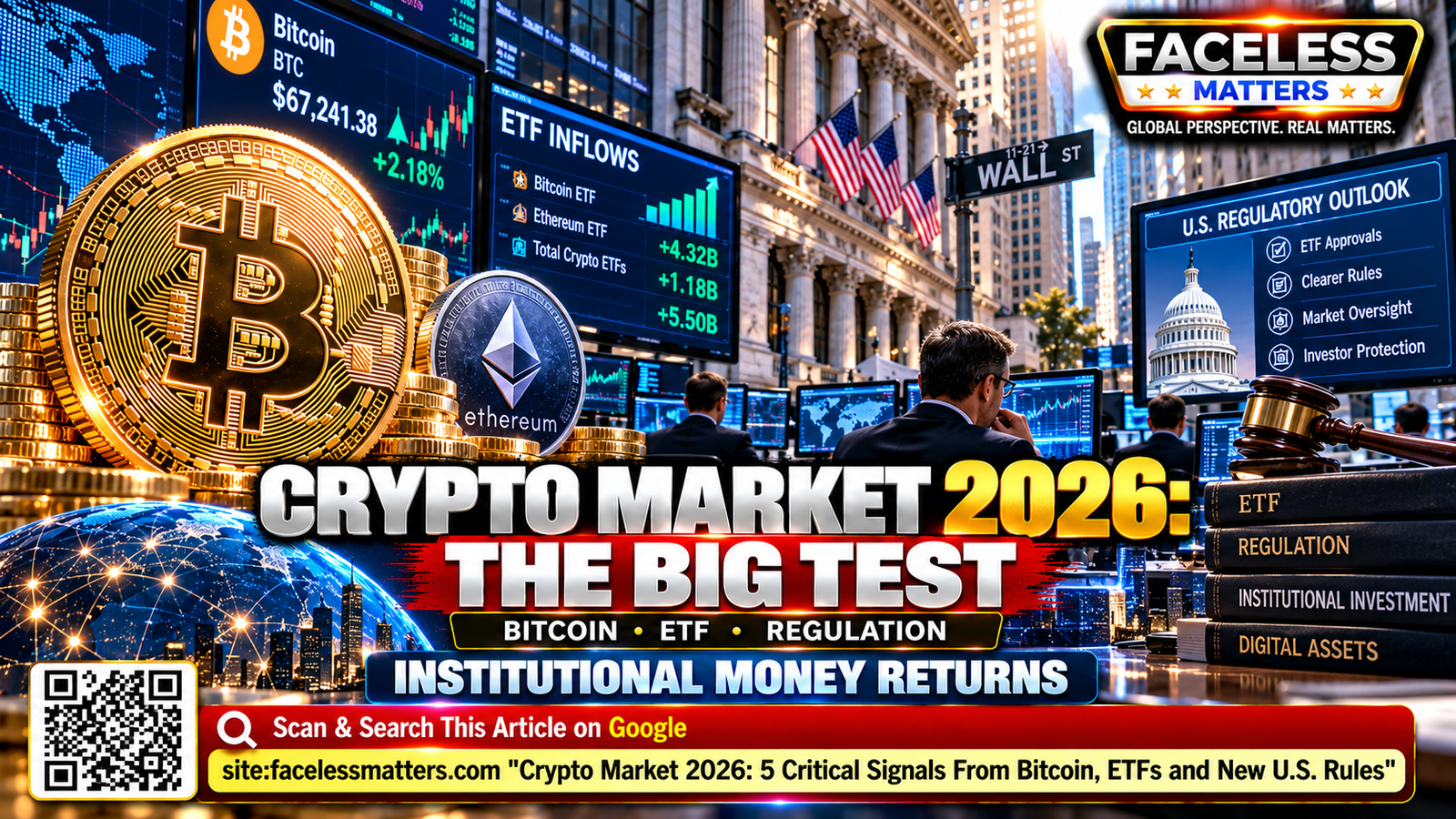
کرپٹو مارکیٹ 2026: بٹ کوائن، ETFs اور نئے امریکی قوانین سے سامنے آنے والے 5 اہم اشارے
Date : 4 October 2026

Key Takeaway
The crypto market 2026 is entering October with a very different tone from the weakness seen earlier in the year. Bitcoin has recovered strongly from its summer lows, while institutional participation, exchange-traded fund activity and regulatory developments are giving the digital-asset industry a new foundation.
CoinDesk’s latest market data places Bitcoin around the mid-$80,000 range, with Ethereum near $2,700 and Bitcoin dominance approaching 60%. It also reports renewed demand for bullish Bitcoin exposure through higher open interest and funding rates. CoinDesk
At the policy level, the U.S. Securities and Exchange Commission has proposed new rules covering the custody of crypto assets by registered investment advisers and regulated funds. The SEC says the proposal is intended to provide a tailored framework for crypto custody and expand investor choice. SEC
Citigroup has also raised its 12-month Bitcoin forecast to $113,000 and its Ether forecast to $3,028, citing stronger crypto activity and renewed ETF inflows. These are an analyst forecast, not a guaranteed future price. Reuters
The bigger story is therefore not simply Bitcoin’s price.
It is the combination of liquidity, institutional adoption, ETFs, regulation, macroeconomic conditions and market structure.
What Is Changing in the Crypto Market?
The crypto market 2026 story is increasingly becoming an institutional finance story rather than a purely retail speculation story.
Bitcoin remains the dominant digital asset, but the market around it is becoming more connected to traditional financial infrastructure.
Exchange-traded funds allow investors to gain Bitcoin exposure through regulated investment products.
Custody rules determine how professional money managers can hold digital assets.
Stablecoins connect blockchain networks with payments and settlement.
Tokenization brings traditional financial instruments onto blockchain infrastructure.
And regulatory frameworks determine which businesses can operate within the mainstream financial system.
This combination is changing the way investors evaluate cryptocurrency.
Instead of asking only whether Bitcoin will rise or fall, professional investors increasingly need to consider:
- liquidity;
- ETF flows;
- interest rates;
- Treasury yields;
- institutional allocations;
- custody infrastructure;
- regulation;
- stablecoins;
- tokenization;
- market structure;
- and risk management.
That makes the crypto market 2026 more complex — but potentially more mature.
Signal 1: Bitcoin’s Recovery Is Meeting a New Macro Test
The first major signal is Bitcoin’s recovery.
CoinDesk reported that Bitcoin had gained roughly 3% during the opening days of October and was trading above $86,000 ahead of the U.S. jobs report, while bond yields and the U.S. dollar remained important pressures on broader risk assets. CoinDesk
The subsequent U.S. employment report showed that nonfarm payroll employment increased by only 29,000 in September, while the unemployment rate remained at 4.2%. The Bureau of Labor Statistics said employment across major industries changed little. Bureau of Labor Statistics
That matters for crypto because monetary policy and liquidity conditions can influence investor appetite for risky assets.
A weaker labor market can strengthen expectations for easier monetary policy, although the Federal Reserve considers a much broader set of economic information.
For the crypto market 2026, the important question is therefore not simply whether Bitcoin’s price is rising.
It is whether the macroeconomic environment can continue supporting risk appetite.
A strong dollar, rising Treasury yields or renewed inflation concerns could challenge speculative assets.
Conversely, easier financial conditions could provide another tailwind.
This makes macroeconomic data one of the most important drivers to monitor.
Signal 2: ETF Flows Are Becoming More Important
The second major signal is the growing importance of crypto ETFs.
Citigroup said it expects crypto inflows to resume at a slower but steadier pace as advisers and brokerages gradually increase allocations to Bitcoin. Reuters reported that Citi expects around $5 billion of crypto inflows over the next 12 months. Investing.com South Africa
The significance of ETFs goes beyond one day’s trading volume.
They create a bridge between traditional investment accounts and digital assets.
An investor who does not want to manage private keys directly can gain market exposure through a regulated financial product.
That can make cryptocurrency more accessible to:
- wealth managers;
- investment advisers;
- institutional investors;
- retirement-oriented investors;
- family offices;
- and traditional portfolio managers.
The Block’s ETF tracker currently shows large assets under management across major Bitcoin spot ETFs, including BlackRock’s IBIT and Fidelity’s FBTC. The Block
This does not mean ETF inflows guarantee higher Bitcoin prices.
Flows can reverse.
Investors can reduce exposure.
And broader financial conditions can overwhelm ETF demand.
But the infrastructure itself represents an important structural development.
Signal 3: Institutional Crypto Adoption Is Moving Forward
The third signal shows how the crypto market 2026 is becoming more closely integrated with institutional finance.
The most important evidence is not necessarily a single bank announcement.
It is the expansion of infrastructure around digital assets.
Institutional investors require:
- professional custody;
- compliance;
- reporting;
- liquidity;
- risk controls;
- legal clarity;
- market surveillance;
- and reliable settlement.
That is why the SEC’s latest custody proposal is potentially significant.
The agency says its proposed framework would allow registered investment advisers and regulated funds to use a tailored framework for crypto custody while modernizing existing custody requirements. SEC
This is not the same thing as regulatory approval of every cryptocurrency.
It is a framework for how professional investment organizations could custody crypto assets under federal securities laws.
That distinction is critical.
Institutional adoption does not eliminate risk.
It can, however, reduce some of the infrastructure barriers that previously made digital assets difficult for traditional financial organizations to handle.
Signal 4: U.S. Crypto Regulation Is Becoming More Specific
The fourth signal is the transformation of U.S. crypto regulation.
The SEC’s October 1 proposal is particularly important because it addresses an area that has been difficult for investment advisers and regulated funds: how crypto assets can be held safely and compliantly.
The SEC says its proposal would modernize custody rules and remove some regulatory barriers that can limit advisers’ ability to provide crypto-related investment advice. SEC
The agency also says crypto markets have grown into a multi-trillion-dollar asset class, making a more tailored regulatory framework increasingly relevant. SEC
This is a major change in tone.
The crypto industry is no longer being treated solely as a peripheral technology experiment.
It is increasingly being considered part of the broader financial system.
But regulation remains unfinished.
The U.S. Senate’s failure to advance the CLARITY Act in September was a setback for comprehensive market-structure legislation. Citi said the legislative setback narrowed the path to a broader market-structure bill, even as SEC actions helped reduce some negative sentiment. Investing.com South Africa
This creates a complicated environment.
There is regulatory progress.
But there is not yet complete regulatory certainty.
Signal 5: Stablecoins and Tokenization Could Reshape Finance
The fifth signal may ultimately become even more important to the crypto market 2026 than Bitcoin itself.
That signal is the growth of stablecoins and tokenization.
Stablecoins are digital assets designed to maintain a relatively stable value against a reference asset, often the U.S. dollar.
Their importance comes from utility.
They can potentially be used for:
- digital payments;
- settlement;
- cross-border transfers;
- exchange liquidity;
- tokenized financial assets;
- decentralized finance;
- and blockchain-based financial infrastructure.
The regulatory treatment of stablecoins is therefore becoming increasingly important.
The SEC has already been developing a broader crypto framework that distinguishes payment stablecoins and other types of digital assets. SEC
At the same time, tokenization is bringing traditional financial instruments into blockchain-based systems.
This could eventually affect:
- money-market funds;
- securities;
- payment networks;
- collateral;
- private markets;
- and settlement infrastructure.
The potential opportunity is enormous.
But so are the regulatory questions.
Who holds the assets?
Who verifies ownership?
What happens during a failure?
How are reserves monitored?
Which jurisdiction applies?
These questions will determine whether tokenization becomes mainstream financial infrastructure or remains a niche technology.
What the Latest Jobs Data Means for Crypto
The September U.S. employment report deserves special attention because it can influence the crypto market 2026 through expectations for interest rates and liquidity.
The Bureau of Labor Statistics reported only 29,000 additional nonfarm jobs in September, while unemployment remained at 4.2%. Bureau of Labor Statistics
A weak jobs number can influence expectations for interest rates, but investors should not automatically assume that weak employment equals higher Bitcoin prices.
The Federal Reserve also considers inflation, economic activity, financial conditions and other indicators.
For crypto investors, the key transmission mechanism is liquidity.
When financial conditions become easier, risk assets can benefit.
When yields rise and investors demand safer returns, speculative assets can face pressure.
This is why Treasury yields remain an important variable for Bitcoin.
The latest market environment shows that cryptocurrency is increasingly integrated into the same macroeconomic system that influences stocks, bonds and currencies.
What Investors Should Watch
The next phase of the crypto market 2026 will likely depend on several measurable indicators.
1. Bitcoin ETF Flows
Continued net inflows would indicate sustained institutional demand.
Outflows could signal a change in risk appetite.
2. Treasury Yields
Higher yields can make risk-free or lower-risk assets more attractive relative to speculative investments.
3. Federal Reserve Policy
Interest-rate expectations can influence liquidity across financial markets.
4. Bitcoin Dominance
CoinDesk recently reported Bitcoin dominance approaching 60%, an important signal for understanding whether capital is concentrated in Bitcoin or moving toward alternative digital assets. CoinDesk
5. Ethereum Positioning
Ethereum remains important because it is closely connected with smart contracts, tokenization and decentralized applications.
6. Stablecoin Growth
Stablecoin adoption could become one of the most important indicators of real-world blockchain utility.
7. Regulatory Developments
The SEC’s custody proposal, market-structure legislation and stablecoin implementation should remain on every serious crypto researcher’s watchlist.
Risks Behind the Current Optimism
The current crypto market 2026 narrative is positive, but several risks remain.
Macro Risk
Higher Treasury yields or renewed inflation could pressure risk assets.
Regulatory Risk
Rules can change, and legislative uncertainty remains.
Liquidity Risk
Crypto markets can move sharply when large positions are unwound.
Leverage Risk
Higher open interest can amplify both gains and losses.
Technology Risk
Blockchain networks, exchanges and crypto infrastructure remain exposed to technical and cybersecurity risks.
Valuation Risk
A rising asset price does not automatically mean that its valuation is sustainable.
Stablecoin Risk
The growth of stablecoins creates questions about reserves, governance, liquidity and financial stability.
This is why the current rally should be viewed as a developing market phase rather than a guaranteed new bull market.
FACELESS MATTERS Analysis
The most important change in the crypto market 2026 is not simply Bitcoin’s recovery.
It is the gradual transformation of cryptocurrency from a largely speculative asset class into a more structured component of financial infrastructure.
The SEC’s latest custody proposal is a strong example.
Instead of asking whether institutions should interact with crypto at all, policymakers are increasingly asking how those institutions should interact with it.
That is a fundamentally different question.
The same transformation can be seen in ETFs.
A Bitcoin ETF does not change Bitcoin’s underlying technology.
It changes the way traditional investors access the asset.
Stablecoins and tokenization represent an even deeper development.
They potentially allow blockchain infrastructure to become part of payments, settlement and capital markets.
This could eventually be more economically significant than cryptocurrency trading itself.
But there is an important warning.
Regulatory clarity does not automatically create value.
ETF approval does not guarantee profits.
Institutional adoption does not eliminate volatility.
And a strong Bitcoin quarter does not guarantee that the next quarter will be stronger.
The quality of this market transition will ultimately depend on whether technology, regulation, liquidity and investor protection develop together.
What Happens Next?
The coming months could provide several important tests.
First:
The SEC’s crypto custody proposal will move through the public-comment process. The SEC states that comments are due 60 days after publication in the Federal Register. SEC
Second:
U.S. lawmakers will continue debating broader digital-asset market structure.
Third:
Institutional investors will watch whether ETF inflows remain consistent.
Fourth:
Stablecoin implementation and tokenization projects could provide evidence of real-world blockchain adoption.
Fifth:
Bitcoin will continue responding to the broader macroeconomic environment.
The next phase of the crypto market 2026 will therefore be determined by a combination of policy, liquidity, institutional demand and technology adoption.
Conclusion
The crypto market 2026 is entering a potentially important new phase.
Bitcoin has recovered strongly from its earlier weakness, ETF activity is drawing renewed attention, institutional infrastructure is expanding and U.S. regulators are moving toward more specialized crypto rules. Reuters
But the market is not risk-free.
Investors still face volatility, leverage, regulatory uncertainty, macroeconomic pressure and technology risks.
The most important development may ultimately be the shift from asking whether cryptocurrency belongs in mainstream finance to determining how cryptocurrency should be integrated into mainstream finance.
Bitcoin remains the market’s most important digital asset.
Ethereum remains central to smart contracts and tokenization.
Stablecoins could become a major payment and settlement layer.
ETFs can connect traditional capital with digital assets.
And regulatory clarity could determine which businesses survive and scale.
For readers, the right approach is therefore not to chase a single price prediction.
Readers should watch the underlying infrastructure.
The crypto market 2026 will be shaped by Bitcoin’s next move, ETF flows, institutional adoption, custody rules, stablecoins, tokenization, interest rates and the evolving architecture of digital finance.
Educational Note: Cryptocurrency and financial-market content on FACELESS MATTERS is for general informational and educational purposes. It is not personalized investment, trading, tax or legal advice. Market conditions can change rapidly. FACELESS MATTERS

INTERNAL READING — FACELESS MATTERS
Crypto Regulation 2026: SEC Rules Bring Clarity for Bitcoin
Global Markets 2026: Proven AI Gains Face a Major Test
Pakistan IMF Review 2026: $22.6B Reserves and the Next Test
Pakistan Stock Market Under Pressure: Oil Shock, Hormuz Risk and What It Means for Investors
AI Investment 2026: The Critical Growth Test for Investors
AI Infrastructure Investment 2026: Why the $7 Trillion Boom Could Reshape Global Business
SOURCES & EDITORIAL NOTE
U.S. Securities and Exchange Commission — Crypto Custody Rules SEC
U.S. Securities and Exchange Commission — Proposal on Crypto Asset Custody SEC
Reuters — Citi Raises Bitcoin and Ether Forecasts Reuters
CoinDesk — Bitcoin Tops $86,000 Ahead of U.S. Jobs Report CoinDesk
CoinDesk — Latest Crypto Market Data and News CoinDesk
U.S. Bureau of Labor Statistics — September 2026 Employment Situation Bureau of Labor Statistics
Editorial Note
This article separates current market data, official regulatory developments, analyst forecasts and FACELESS MATTERS analysis. Citi’s Bitcoin and Ether price targets are presented as forecasts rather than guaranteed outcomes. The article does not provide personalized investment advice. Reuters